
External Possession in Enindhilyakwa towards an appositional analysis
- Slides: 21
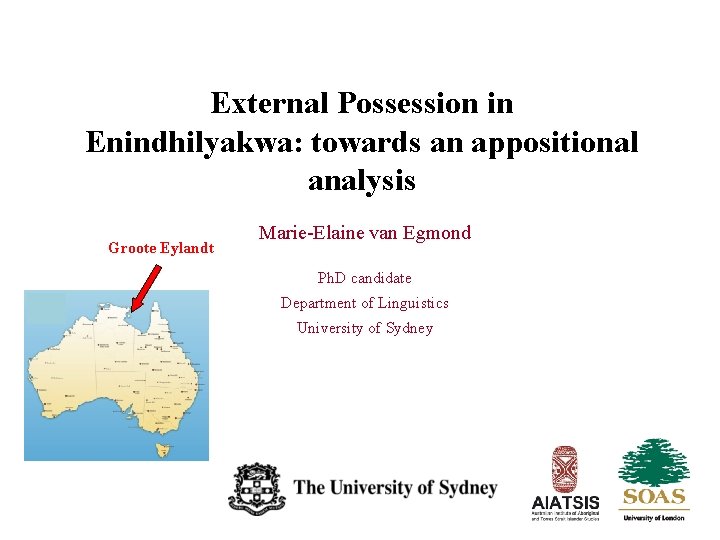
External Possession in Enindhilyakwa: towards an appositional analysis Groote Eylandt Marie-Elaine van Egmond Ph. D candidate Department of Linguistics University of Sydney
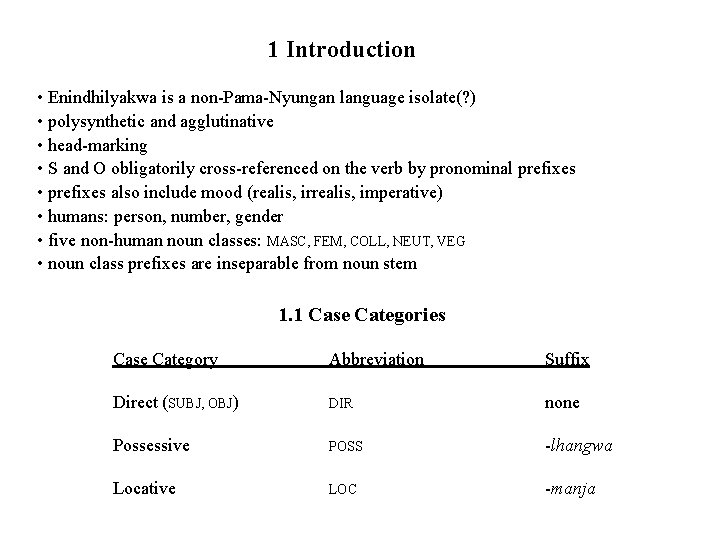
1 Introduction • Enindhilyakwa is a non-Pama-Nyungan language isolate(? ) • polysynthetic and agglutinative • head-marking • S and O obligatorily cross-referenced on the verb by pronominal prefixes • prefixes also include mood (realis, irrealis, imperative) • humans: person, number, gender • five non-human noun classes: MASC, FEM, COLL, NEUT, VEG • noun class prefixes are inseparable from noun stem 1. 1 Case Categories Case Category Abbreviation Suffix Direct (SUBJ, OBJ) DIR none Possessive POSS -lhangwa Locative LOC -manja
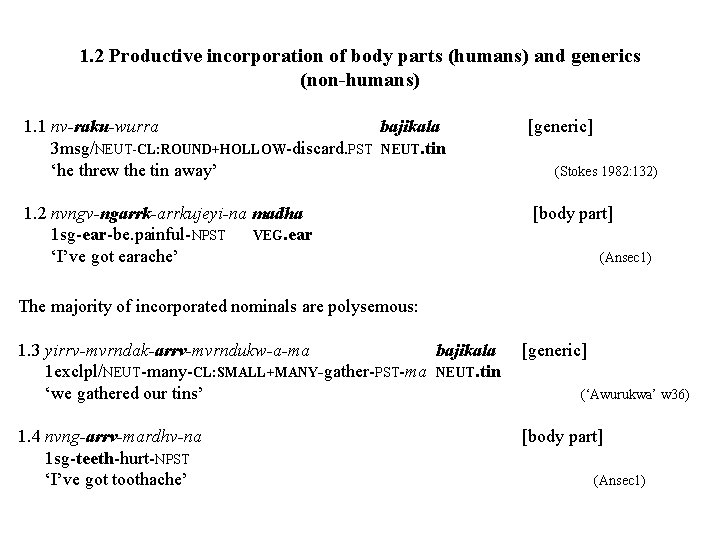
1. 2 Productive incorporation of body parts (humans) and generics (non-humans) 1. 1 nv-raku-wurra bajikala 3 msg/NEUT-CL: ROUND+HOLLOW-discard. PST NEUT. tin ‘he threw the tin away’ [generic] 1. 2 nvngv-ngarrk-arrkujeyi-na madha 1 sg-ear-be. painful-NPST VEG. ear ‘I’ve got earache’ [body part] (Stokes 1982: 132) (Ansec 1) The majority of incorporated nominals are polysemous: 1. 3 yirrv-mvrndak-arrv-mvrndukw-a-ma bajikala 1 exclpl/NEUT-many-CL: SMALL+MANY-gather-PST-ma NEUT. tin ‘we gathered our tins’ [generic] 1. 4 nvng-arrv-mardhv-na 1 sg-teeth-hurt-NPST ‘I’ve got toothache’ [body part] (‘Awurukwa’ w 36) (Ansec 1)
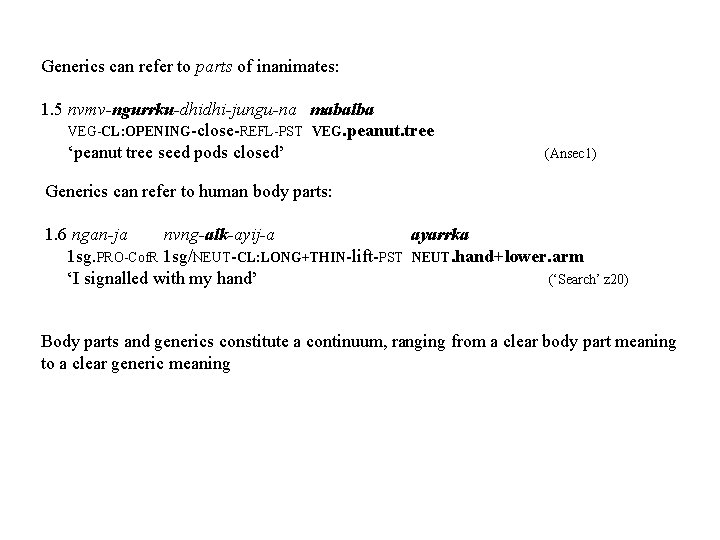
Generics can refer to parts of inanimates: 1. 5 nvmv-ngurrku-dhidhi-jungu-na mabalba VEG-CL: OPENING-close-REFL-PST VEG. peanut. tree ‘peanut tree seed pods closed’ (Ansec 1) Generics can refer to human body parts: 1. 6 ngan-ja nvng-alk-ayij-a ayarrka 1 sg. PRO-Cof. R 1 sg/NEUT-CL: LONG+THIN-lift-PST NEUT. hand+lower. arm ‘I signalled with my hand’ (‘Search’ z 20) Body parts and generics constitute a continuum, ranging from a clear body part meaning to a clear generic meaning
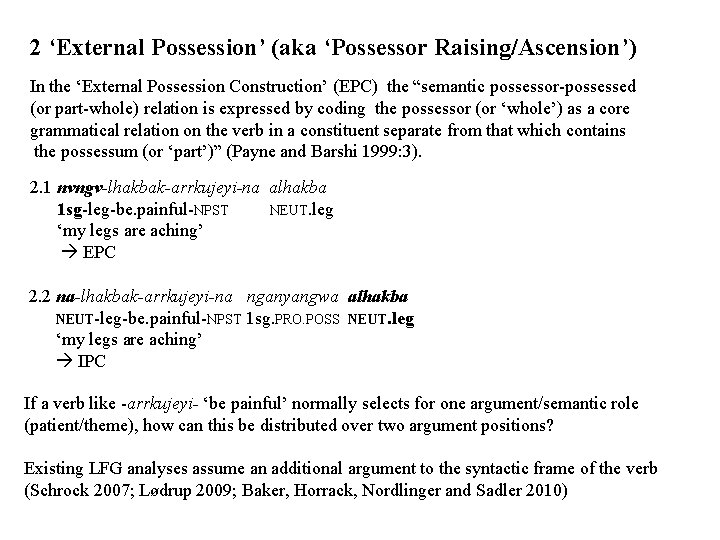
2 ‘External Possession’ (aka ‘Possessor Raising/Ascension’) In the ‘External Possession Construction’ (EPC) the “semantic possessor-possessed (or part-whole) relation is expressed by coding the possessor (or ‘whole’) as a core grammatical relation on the verb in a constituent separate from that which contains the possessum (or ‘part’)” (Payne and Barshi 1999: 3). 2. 1 nvngv-lhakbak-arrkujeyi-na alhakba 1 sg-leg-be. painful-NPST NEUT. leg ‘my legs are aching’ EPC 2. 2 na-lhakbak-arrkujeyi-na nganyangwa alhakba NEUT-leg-be. painful-NPST 1 sg. PRO. POSS NEUT. leg ‘my legs are aching’ IPC If a verb like -arrkujeyi- ‘be painful’ normally selects for one argument/semantic role (patient/theme), how can this be distributed over two argument positions? Existing LFG analyses assume an additional argument to the syntactic frame of the verb (Schrock 2007; Lødrup 2009; Baker, Horrack, Nordlinger and Sadler 2010)
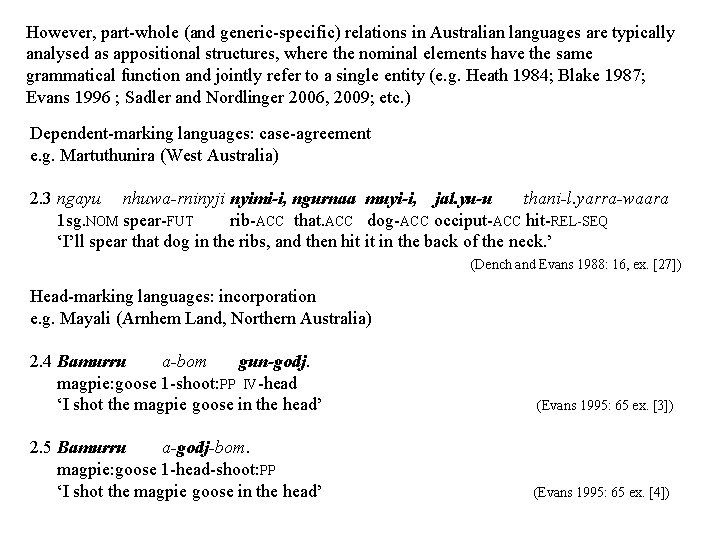
However, part-whole (and generic-specific) relations in Australian languages are typically analysed as appositional structures, where the nominal elements have the same grammatical function and jointly refer to a single entity (e. g. Heath 1984; Blake 1987; Evans 1996 ; Sadler and Nordlinger 2006, 2009; etc. ) Dependent-marking languages: case-agreement e. g. Martuthunira (West Australia) 2. 3 ngayu nhuwa-rninyji nyimi-i, ngurnaa muyi-i, jal. yu-u thani-l. yarra-waara 1 sg. NOM spear-FUT rib-ACC that. ACC dog-ACC occiput-ACC hit-REL-SEQ ‘I’ll spear that dog in the ribs, and then hit it in the back of the neck. ’ (Dench and Evans 1988: 16, ex. [27]) Head-marking languages: incorporation e. g. Mayali (Arnhem Land, Northern Australia) 2. 4 Bamurru a-bom gun-godj. magpie: goose 1 -shoot: PP IV-head ‘I shot the magpie goose in the head’ (Evans 1995: 65 ex. [3]) 2. 5 Bamurru a-godj-bom. magpie: goose 1 -head-shoot: PP ‘I shot the magpie goose in the head’ (Evans 1995: 65 ex. [4])
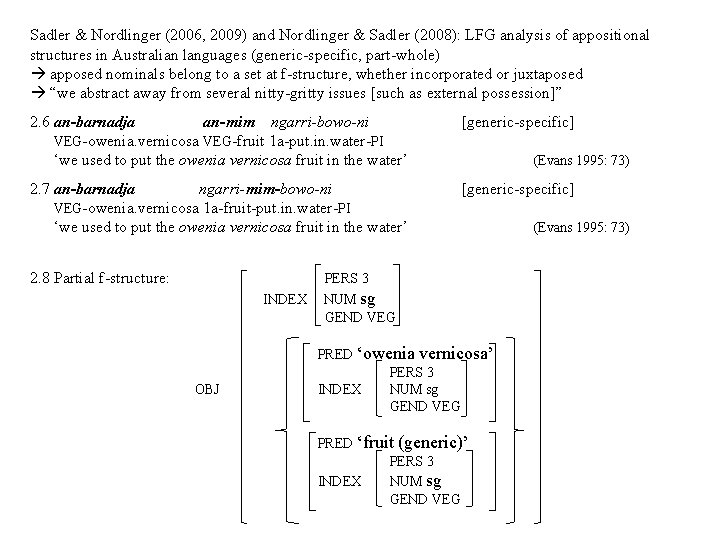
Sadler & Nordlinger (2006, 2009) and Nordlinger & Sadler (2008): LFG analysis of appositional structures in Australian languages (generic-specific, part-whole) apposed nominals belong to a set at f-structure, whether incorporated or juxtaposed “we abstract away from several nitty-gritty issues [such as external possession]” 2. 6 an-barnadja an-mim ngarri-bowo-ni VEG-owenia. vernicosa VEG-fruit 1 a-put. in. water-PI ‘we used to put the owenia vernicosa fruit in the water’ [generic-specific] 2. 7 an-barnadja ngarri-mim-bowo-ni VEG-owenia. vernicosa 1 a-fruit-put. in. water-PI ‘we used to put the owenia vernicosa fruit in the water’ [generic-specific] 2. 8 Partial f-structure: (Evans 1995: 73) PERS 3 INDEX OBJ NUM sg GEND VEG PRED ‘owenia vernicosa’ PERS 3 INDEX NUM sg GEND VEG PRED ‘fruit (generic)’ PERS 3 INDEX NUM sg GEND VEG (Evans 1995: 73)
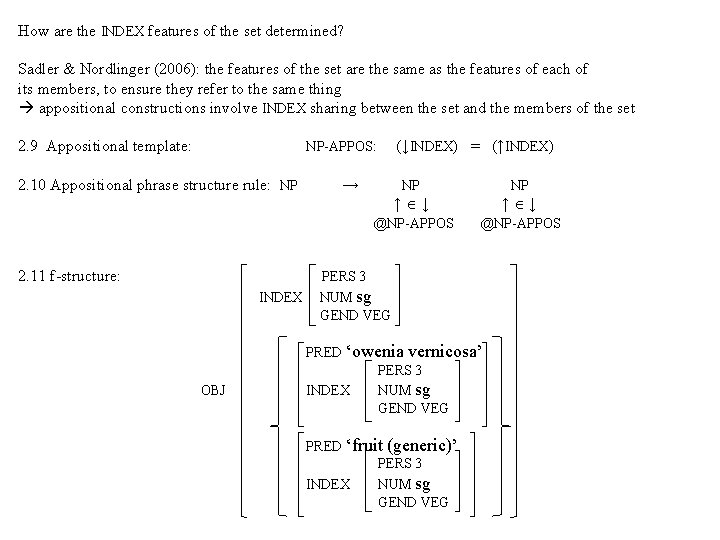
How are the INDEX features of the set determined? Sadler & Nordlinger (2006): the features of the set are the same as the features of each of its members, to ensure they refer to the same thing appositional constructions involve INDEX sharing between the set and the members of the set 2. 9 Appositional template: NP-APPOS: 2. 10 Appositional phrase structure rule: NP 2. 11 f-structure: → (↓INDEX) = (↑INDEX) NP NP ↑ ↓ @NP-APPOS PERS 3 INDEX OBJ NUM sg GEND VEG PRED ‘owenia vernicosa’ PERS 3 INDEX NUM sg GEND VEG PRED ‘fruit (generic)’ PERS 3 INDEX NUM sg GEND VEG
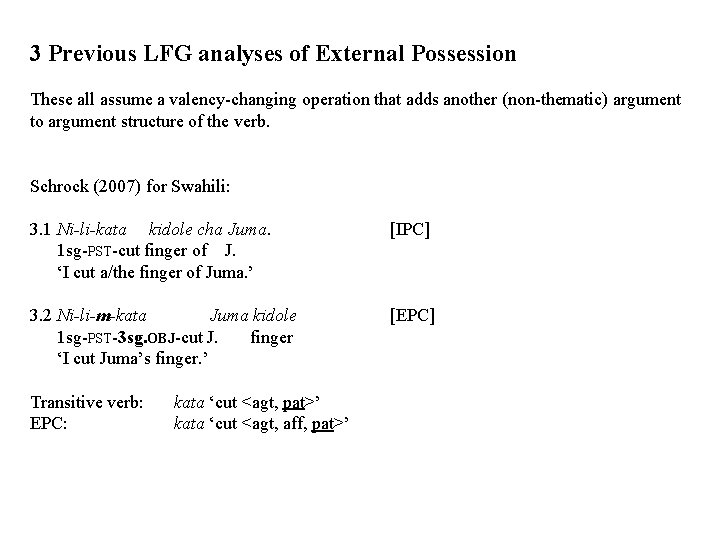
3 Previous LFG analyses of External Possession These all assume a valency-changing operation that adds another (non-thematic) argument to argument structure of the verb. Schrock (2007) for Swahili: 3. 1 Ni-li-kata kidole cha Juma. 1 sg-PST-cut finger of J. ‘I cut a/the finger of Juma. ’ [IPC] 3. 2 Ni-li-m-kata Juma kidole 1 sg-PST-3 sg. OBJ-cut J. finger ‘I cut Juma’s finger. ’ [EPC] Transitive verb: EPC: kata ‘cut <agt, pat>’ kata ‘cut <agt, aff, pat>’
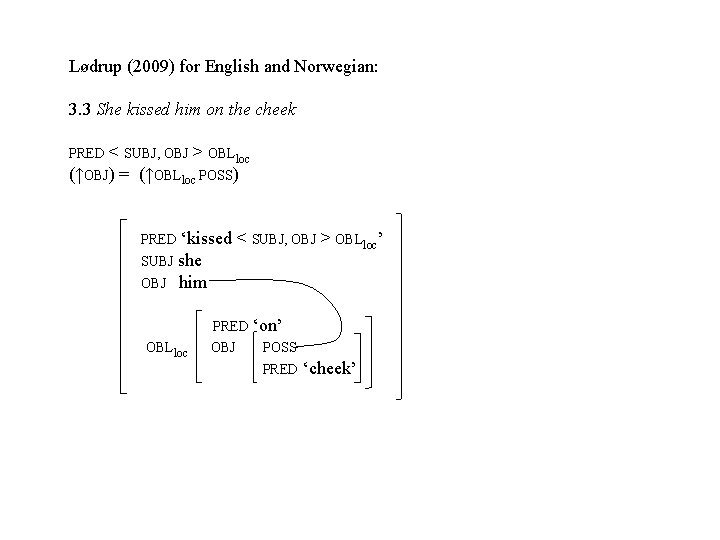
Lødrup (2009) for English and Norwegian: 3. 3 She kissed him on the cheek < SUBJ, OBJ > OBLloc (↑OBJ) = (↑OBLloc POSS) PRED ‘kissed < SUBJ, OBJ > OBLloc’ SUBJ she OBJ him PRED OBLloc OBJ ‘on’ POSS PRED ‘cheek’
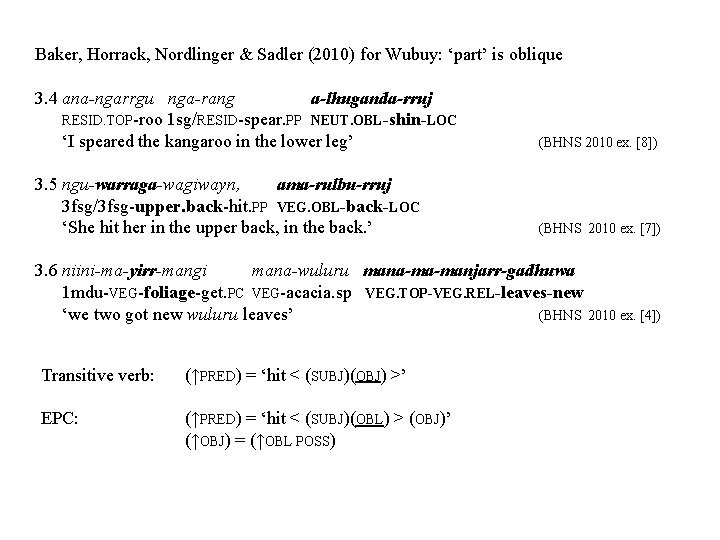
Baker, Horrack, Nordlinger & Sadler (2010) for Wubuy: ‘part’ is oblique 3. 4 ana-ngarrgu nga-rang a-lhuganda-rruj RESID. TOP-roo 1 sg/RESID-spear. PP NEUT. OBL-shin-LOC ‘I speared the kangaroo in the lower leg’ (BHNS 2010 ex. [8]) 3. 5 ngu-warraga-wagiwayn, ama-rulbu-rruj 3 fsg/3 fsg-upper. back-hit. PP VEG. OBL-back-LOC ‘She hit her in the upper back, in the back. ’ (BHNS 2010 ex. [7]) 3. 6 niini-ma-yirr-mangi mana-wuluru mana-ma-manjarr-gadhuwa 1 mdu-VEG-foliage-get. PC VEG-acacia. sp VEG. TOP-VEG. REL-leaves-new ‘we two got new wuluru leaves’ (BHNS 2010 ex. [4]) Transitive verb: (↑PRED) = ‘hit < (SUBJ)(OBJ) >’ EPC: (↑PRED) = ‘hit < (SUBJ)(OBL) > (OBJ)’ (↑OBJ) = (↑OBL POSS)
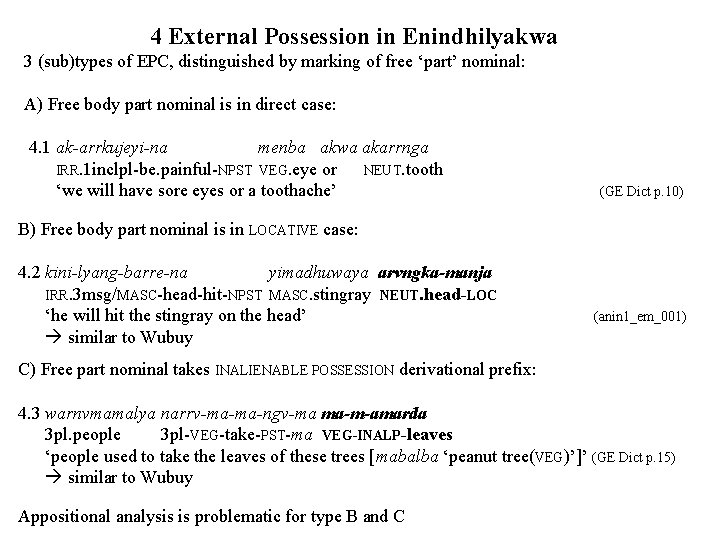
4 External Possession in Enindhilyakwa 3 (sub)types of EPC, distinguished by marking of free ‘part’ nominal: A) Free body part nominal is in direct case: 4. 1 ak-arrkujeyi-na menba akwa akarrnga IRR. 1 inclpl-be. painful-NPST VEG. eye or NEUT. tooth ‘we will have sore eyes or a toothache’ (GE Dict p. 10) B) Free body part nominal is in LOCATIVE case: 4. 2 kini-lyang-barre-na yimadhuwaya arvngka-manja IRR. 3 msg/MASC-head-hit-NPST MASC. stingray NEUT. head-LOC ‘he will hit the stingray on the head’ similar to Wubuy (anin 1_em_001) C) Free part nominal takes INALIENABLE POSSESSION derivational prefix: 4. 3 warnvmamalya narrv-ma-ma-ngv-ma ma-m-amarda 3 pl. people 3 pl-VEG-take-PST-ma VEG-INALP-leaves ‘people used to take the leaves of these trees [mabalba ‘peanut tree(VEG)’]’ (GE Dict p. 15) similar to Wubuy Appositional analysis is problematic for type B and C
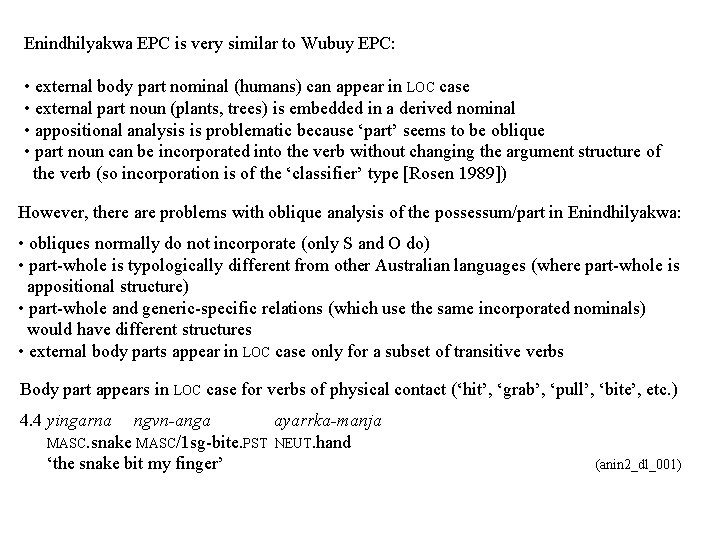
Enindhilyakwa EPC is very similar to Wubuy EPC: • external body part nominal (humans) can appear in LOC case • external part noun (plants, trees) is embedded in a derived nominal • appositional analysis is problematic because ‘part’ seems to be oblique • part noun can be incorporated into the verb without changing the argument structure of the verb (so incorporation is of the ‘classifier’ type [Rosen 1989]) However, there are problems with oblique analysis of the possessum/part in Enindhilyakwa: • obliques normally do not incorporate (only S and O do) • part-whole is typologically different from other Australian languages (where part-whole is appositional structure) • part-whole and generic-specific relations (which use the same incorporated nominals) would have different structures • external body parts appear in LOC case only for a subset of transitive verbs Body part appears in LOC case for verbs of physical contact (‘hit’, ‘grab’, ‘pull’, ‘bite’, etc. ) 4. 4 yingarna ngvn-anga ayarrka-manja MASC. snake MASC/1 sg-bite. PST NEUT. hand ‘the snake bit my finger’ (anin 2_dl_001)
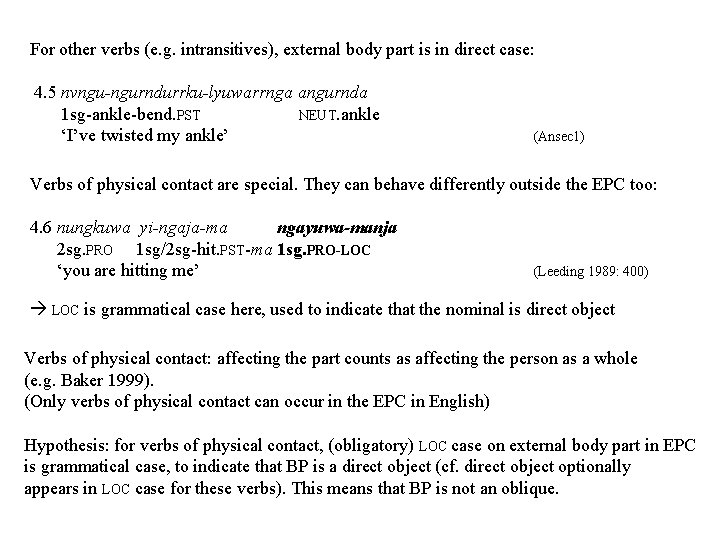
For other verbs (e. g. intransitives), external body part is in direct case: 4. 5 nvngu-ngurndurrku-lyuwarrnga angurnda 1 sg-ankle-bend. PST NEUT. ankle ‘I’ve twisted my ankle’ (Ansec 1) Verbs of physical contact are special. They can behave differently outside the EPC too: 4. 6 nungkuwa yi-ngaja-ma ngayuwa-manja 2 sg. PRO 1 sg/2 sg-hit. PST-ma 1 sg. PRO-LOC ‘you are hitting me’ (Leeding 1989: 400) LOC is grammatical case here, used to indicate that the nominal is direct object Verbs of physical contact: affecting the part counts as affecting the person as a whole (e. g. Baker 1999). (Only verbs of physical contact can occur in the EPC in English) Hypothesis: for verbs of physical contact, (obligatory) LOC case on external body part in EPC is grammatical case, to indicate that BP is a direct object (cf. direct object optionally appears in LOC case for these verbs). This means that BP is not an oblique.
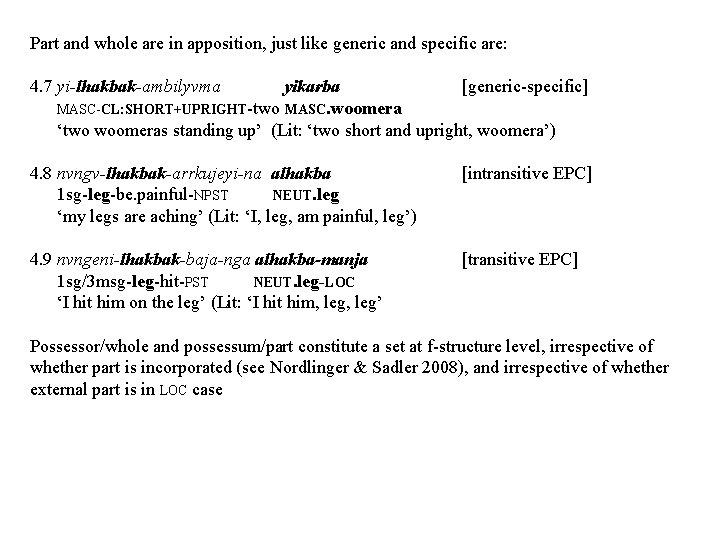
Part and whole are in apposition, just like generic and specific are: 4. 7 yi-lhakbak-ambilyvma yikarba [generic-specific] MASC-CL: SHORT+UPRIGHT-two MASC. woomera ‘two woomeras standing up’ (Lit: ‘two short and upright, woomera’) 4. 8 nvngv-lhakbak-arrkujeyi-na alhakba 1 sg-leg-be. painful-NPST NEUT. leg ‘my legs are aching’ (Lit: ‘I, leg, am painful, leg’) [intransitive EPC] 4. 9 nvngeni-lhakbak-baja-nga alhakba-manja 1 sg/3 msg-leg-hit-PST NEUT. leg-LOC ‘I hit him on the leg’ (Lit: ‘I hit him, leg’ [transitive EPC] Possessor/whole and possessum/part constitute a set at f-structure level, irrespective of whether part is incorporated (see Nordlinger & Sadler 2008), and irrespective of whether external part is in LOC case
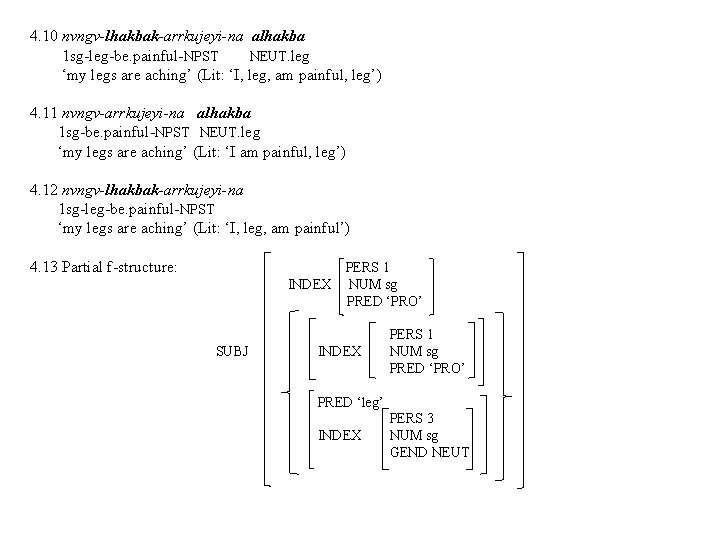
4. 10 nvngv-lhakbak-arrkujeyi-na alhakba 1 sg-leg-be. painful-NPST NEUT. leg ‘my legs are aching’ (Lit: ‘I, leg, am painful, leg’) 4. 11 nvngv-arrkujeyi-na alhakba 1 sg-be. painful-NPST NEUT. leg ‘my legs are aching’ (Lit: ‘I am painful, leg’) 4. 12 nvngv-lhakbak-arrkujeyi-na 1 sg-leg-be. painful-NPST ‘my legs are aching’ (Lit: ‘I, leg, am painful’) 4. 13 Partial f-structure: INDEX SUBJ PERS 1 NUM sg PRED ‘PRO’ INDEX PERS 1 NUM sg PRED ‘PRO’ PRED ‘leg’ INDEX PERS 3 NUM sg GEND NEUT
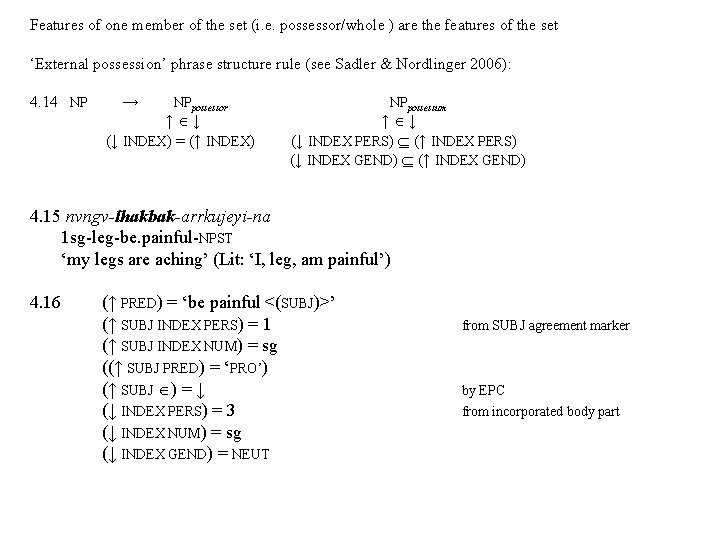
Features of one member of the set (i. e. possessor/whole ) are the features of the set ‘External possession’ phrase structure rule (see Sadler & Nordlinger 2006): 4. 14 NP → NPpossessor ↑ ↓ (↓ INDEX) = (↑ INDEX) NPpossessum ↑ ↓ (↓ INDEX PERS) (↑ INDEX PERS) (↓ INDEX GEND) (↑ INDEX GEND) 4. 15 nvngv-lhakbak-arrkujeyi-na 1 sg-leg-be. painful-NPST ‘my legs are aching’ (Lit: ‘I, leg, am painful’) 4. 16 (↑ PRED) = ‘be painful <(SUBJ)>’ (↑ SUBJ INDEX PERS) = 1 (↑ SUBJ INDEX NUM) = sg ((↑ SUBJ PRED) = ‘PRO’) (↑ SUBJ ) = ↓ (↓ INDEX PERS) = 3 (↓ INDEX NUM) = sg (↓ INDEX GEND) = NEUT from SUBJ agreement marker by EPC from incorporated body part
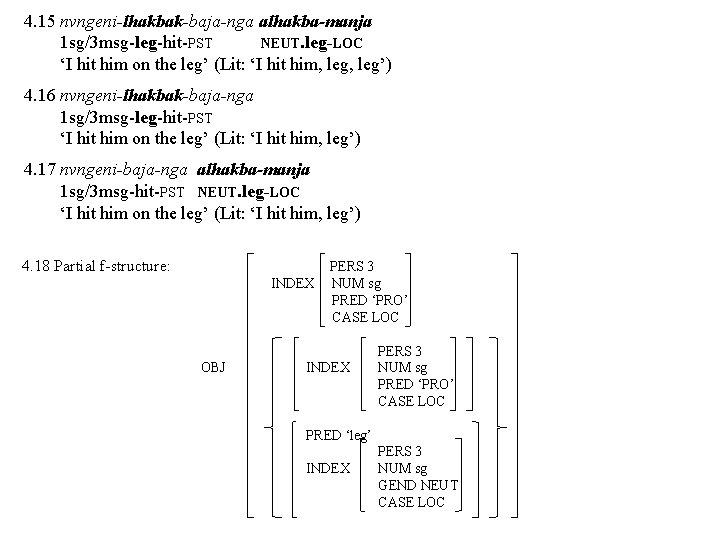
4. 15 nvngeni-lhakbak-baja-nga alhakba-manja 1 sg/3 msg-leg-hit-PST NEUT. leg-LOC ‘I hit him on the leg’ (Lit: ‘I hit him, leg’) 4. 16 nvngeni-lhakbak-baja-nga 1 sg/3 msg-leg-hit-PST ‘I hit him on the leg’ (Lit: ‘I hit him, leg’) 4. 17 nvngeni-baja-nga alhakba-manja 1 sg/3 msg-hit-PST NEUT. leg-LOC ‘I hit him on the leg’ (Lit: ‘I hit him, leg’) 4. 18 Partial f-structure: INDEX OBJ PERS 3 NUM sg PRED ‘PRO’ CASE LOC INDEX PERS 3 NUM sg PRED ‘PRO’ CASE LOC PRED ‘leg’ INDEX PERS 3 NUM sg GEND NEUT CASE LOC
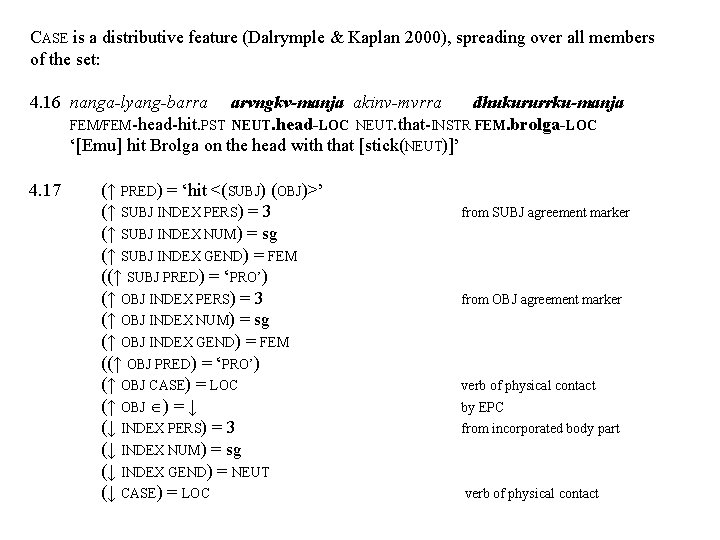
CASE is a distributive feature (Dalrymple & Kaplan 2000), spreading over all members of the set: 4. 16 nanga-lyang-barra arvngkv-manja akinv-mvrra dhukururrku-manja FEM/FEM-head-hit. PST NEUT. head-LOC NEUT. that-INSTR FEM. brolga-LOC ‘[Emu] hit Brolga on the head with that [stick(NEUT)]’ 4. 17 (↑ PRED) = ‘hit <(SUBJ) (OBJ)>’ (↑ SUBJ INDEX PERS) = 3 (↑ SUBJ INDEX NUM) = sg (↑ SUBJ INDEX GEND) = FEM ((↑ SUBJ PRED) = ‘PRO’) (↑ OBJ INDEX PERS) = 3 (↑ OBJ INDEX NUM) = sg (↑ OBJ INDEX GEND) = FEM ((↑ OBJ PRED) = ‘PRO’) (↑ OBJ CASE) = LOC (↑ OBJ ) = ↓ (↓ INDEX PERS) = 3 (↓ INDEX NUM) = sg (↓ INDEX GEND) = NEUT (↓ CASE) = LOC from SUBJ agreement marker from OBJ agreement marker verb of physical contact by EPC from incorporated body part verb of physical contact
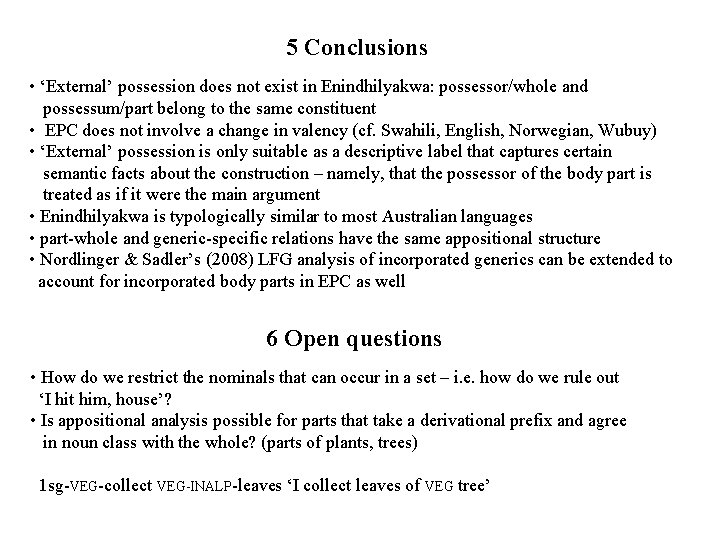
5 Conclusions • ‘External’ possession does not exist in Enindhilyakwa: possessor/whole and possessum/part belong to the same constituent • EPC does not involve a change in valency (cf. Swahili, English, Norwegian, Wubuy) • ‘External’ possession is only suitable as a descriptive label that captures certain semantic facts about the construction – namely, that the possessor of the body part is treated as if it were the main argument • Enindhilyakwa is typologically similar to most Australian languages • part-whole and generic-specific relations have the same appositional structure • Nordlinger & Sadler’s (2008) LFG analysis of incorporated generics can be extended to account for incorporated body parts in EPC as well 6 Open questions • How do we restrict the nominals that can occur in a set – i. e. how do we rule out ‘I hit him, house’? • Is appositional analysis possible for parts that take a derivational prefix and agree in noun class with the whole? (parts of plants, trees) 1 sg-VEG-collect VEG-INALP-leaves ‘I collect leaves of VEG tree’
Selected references Baker, Brett, Kate Horrack, Rachel Nordlinger, Louisa Sadler (2010). Putting it all together: agreement, incorporation, coordination and external possession in Wubuy (Australia), In: M. Butt and T. H. King (eds. ), Proceedings of LFG 10 Conference. Stanford, CA: CSLI Publications. Baker, Mark C. (1999). External Possession in Mohawk, In: Doris Payne and Immanuel Barshi (eds. ), External Possession. Amsterdam: John Benjamins. Dalrymple, Mary and Ronald M. Kaplan (2000). Feature indeterminacy and feature resolution. Language 76(4), 759798. Lødrup, Helge (2009). Looking possessor raising in the mouth: Norwegian possessor raising with unergatives. In: M. Butt and T. H. King (eds. ), Proceedings of the LFG 09 Conference. Stanford, CA: CSLI Publications. Nordlinger, Rachel and Louisa Sadler (2008). Incorporated Appositions: Incorporation in Part-Whole and Generic-Specific Constructions, In: M. Butt and T. H. King (eds. ), Proceedings of the LFG 08 Conference. Stanford, CA: CSLI Publications. Sadler, Louisa and Rachel Nordlinger (2006). Apposition as Coordination: evidence from Australian Languages, In: M. Butt and T. H. King (eds. ), Proceedings of the LFG 06 Conference. Stanford, CA: CSLI Publications. Sadler, Louisa and Rachel Nordlinger (2009). Nominal juxtaposition in Australian languages: An LFG analysis. Journal of Linguistics 46(2), 415 -452. Schrock, Terrill (2007). Toward an LFG Analysis of Swahili ‘External Possession’ (ms).