
External Internal Respiration Both carbon dioxide and oxygen
External & Internal Respiration

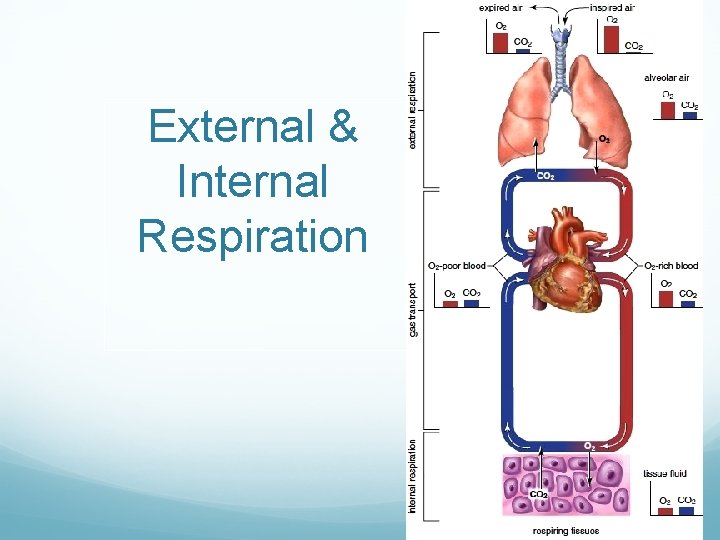
Both carbon dioxide and oxygen are exchanged during both internal and external respiration, but in different locations. Internal Respiration - gas exchange occurs between blood & tissue fluid (interstitial fluid) External Respiration - gas exchange occurs between air (in lungs) & blood
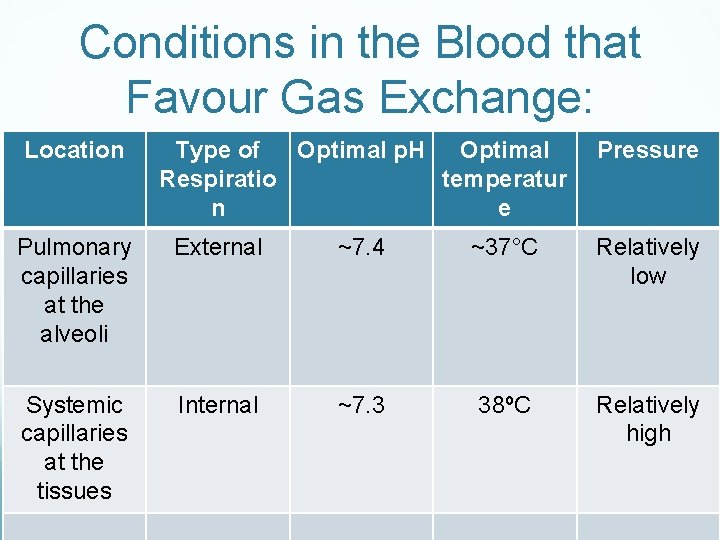
Conditions in the Blood that Favour Gas Exchange: Location Type of Optimal p. H Optimal Respiratio temperatur n e Pressure Pulmonary capillaries at the alveoli External ~7. 4 ~37°C Relatively low Systemic capillaries at the tissues Internal ~7. 3 38ºC Relatively high
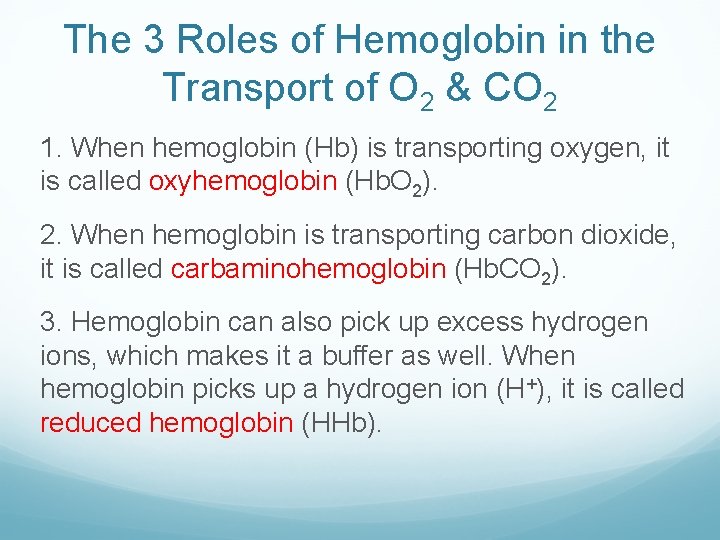
The 3 Roles of Hemoglobin in the Transport of O 2 & CO 2 1. When hemoglobin (Hb) is transporting oxygen, it is called oxyhemoglobin (Hb. O 2). 2. When hemoglobin is transporting carbon dioxide, it is called carbaminohemoglobin (Hb. CO 2). 3. Hemoglobin can also pick up excess hydrogen ions, which makes it a buffer as well. When hemoglobin picks up a hydrogen ion (H+), it is called reduced hemoglobin (HHb).
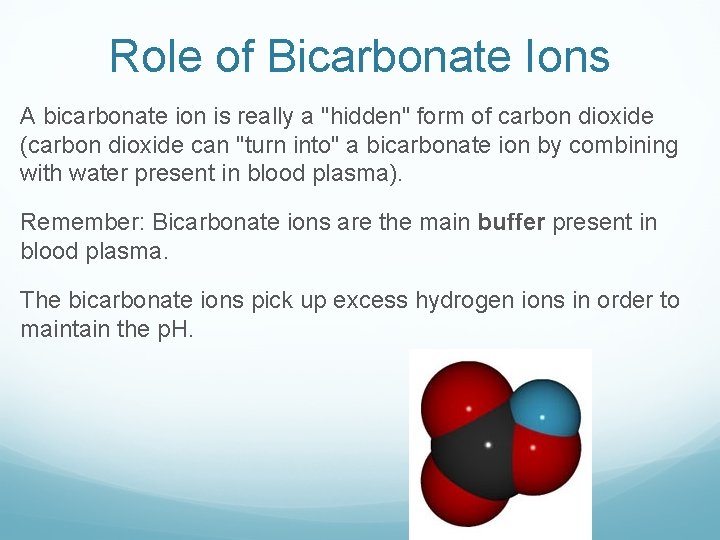
Role of Bicarbonate Ions A bicarbonate ion is really a "hidden" form of carbon dioxide (carbon dioxide can "turn into" a bicarbonate ion by combining with water present in blood plasma). Remember: Bicarbonate ions are the main buffer present in blood plasma. The bicarbonate ions pick up excess hydrogen ions in order to maintain the p. H.

Chemical Equations At the pulmonary capillaries, reactions #2, 3, & 4 occur leaving Hb free to pick up O 2 (reaction #1)
If conditions are optimal in the pulmonary capillaries: Carbaminohemoglobin (Hb. CO 2) will drop off CO 2 & it will simply diffuses out of the blood & into the alveoli The reduced hemoglobin (HHb) drops off the H+ ions which then joins with the bicarbonate ion (HCO 3 -) to form H 2 CO 3 (carbonic acid) In order to maintain blood p. H, the enzyme carbonic anhydrase helps convert the carbonic acid into CO 2 and H 2 O. These molecules then diffuse out of the blood and into the alveoli This leaves room for the hemoglobin to carry oxygen as Hb. O 2 (oxyhemoglobin)
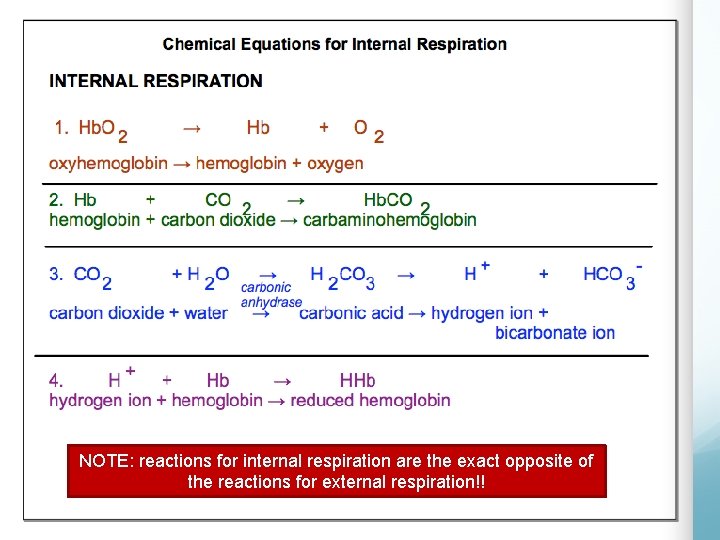
NOTE: reactions for internal respiration are the exact opposite of the reactions for external respiration!!
If conditions are optimal in the systemic capillaries: Hb. O 2 releases O 2 which diffuses into the tissues O 2 is used in cellular respiration producing the waste products, CO 2 & H 2 O which diffuse into the capillaries H 2 O & CO 2 combine to form carbonic acid (H 2 CO 3) which is then converted to H+ & HCO 3 - H+ is picked up by hemoglobin forming HHb (maintaining p. H!) HCO 3 - stays in the blood in this form acting as a buffer Small amounts of CO 2 will join with Hb to form Hb. CO 2
- Slides: 9