
External Ear Diseases DR MONA AHMED ARAHIM ENT
- Slides: 37
External Ear Diseases DR. MONA AHMED A/RAHIM ENT Surgeon Khartoum Center for Ear, Nose and Throat Diseases and Head and Neck Surgery Assistant Professor Faculty of Medicine Alneelain University
External Ear Diseases u Perichondritis u Inflammation of the external auditory canal (EAC)
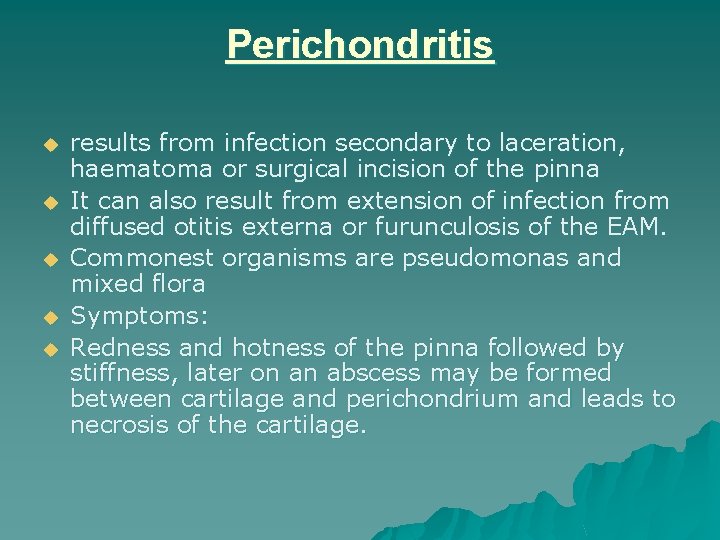
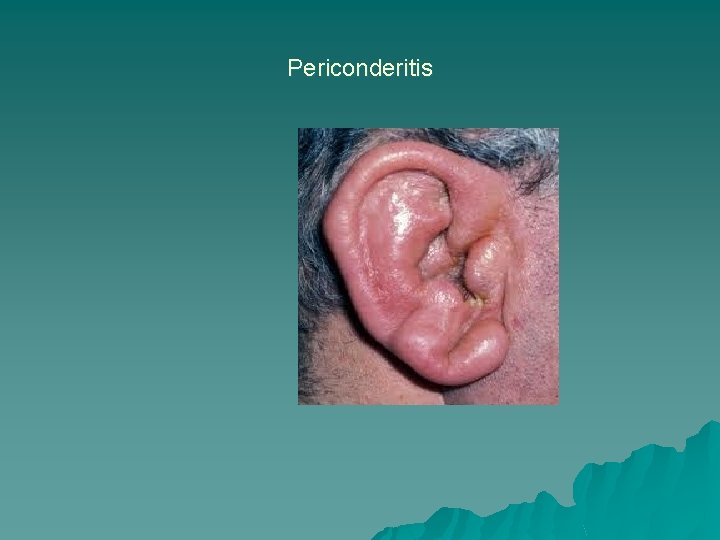
Perichondritis u u u results from infection secondary to laceration, haematoma or surgical incision of the pinna It can also result from extension of infection from diffused otitis externa or furunculosis of the EAM. Commonest organisms are pseudomonas and mixed flora Symptoms: Redness and hotness of the pinna followed by stiffness, later on an abscess may be formed between cartilage and perichondrium and leads to necrosis of the cartilage.
Periconderitis
Treatment u Early intravenous antibiotic (broad spectrum) + analgesia. u If an abscess has been formed it must be drained and pus taken for culture and sensitivity + tied dressing
Inflammation of the EAC u Bacterial: – – – u u localized O. E (furunculosis) diffused O. E malignant O. E Fungal: (otomycosis) Viral: - Herpes Zoster oticus
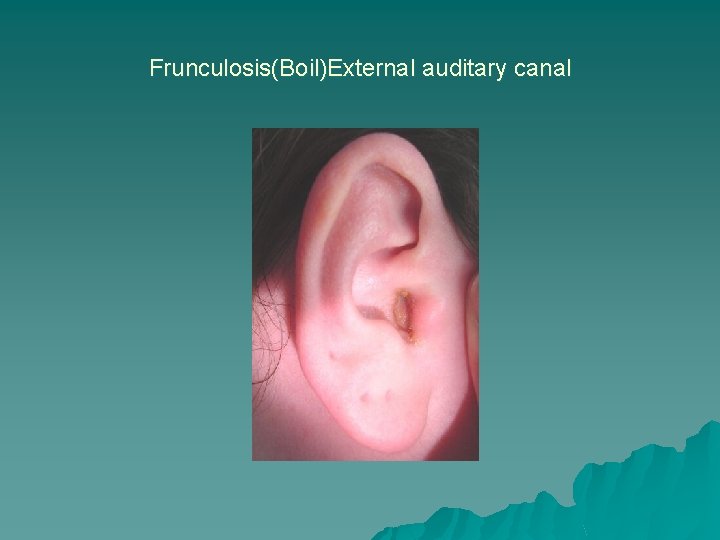
Furuncle A furuncle is a staphylococcal infection of the hair follicle. u Patient presented with severe pain and tenderness aggravated by movement of the pinna and jaw movement. u Treatment: u In early stage before abscess formation treatment is consisted of: u - antibiotic u - analgesia u - 10% Ecthammol glycerin pack u If abscess is formed then incision and draining is mandatory u
Frunculosis(Boil)External auditary canal
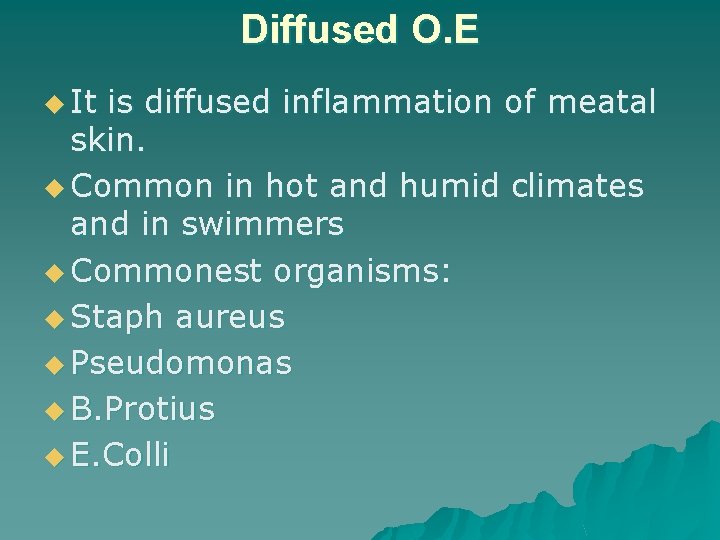
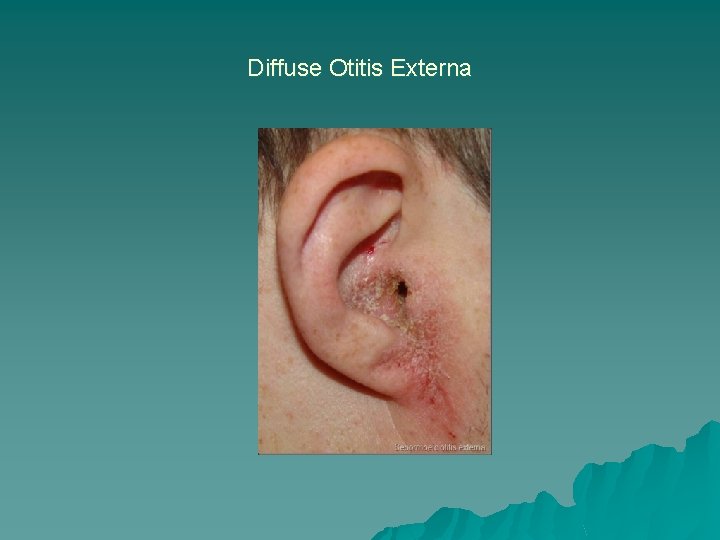
Diffused O. E u It is diffused inflammation of meatal skin. u Common in hot and humid climates and in swimmers u Commonest organisms: u Staph aureus u Pseudomonas u B. Protius u E. Colli
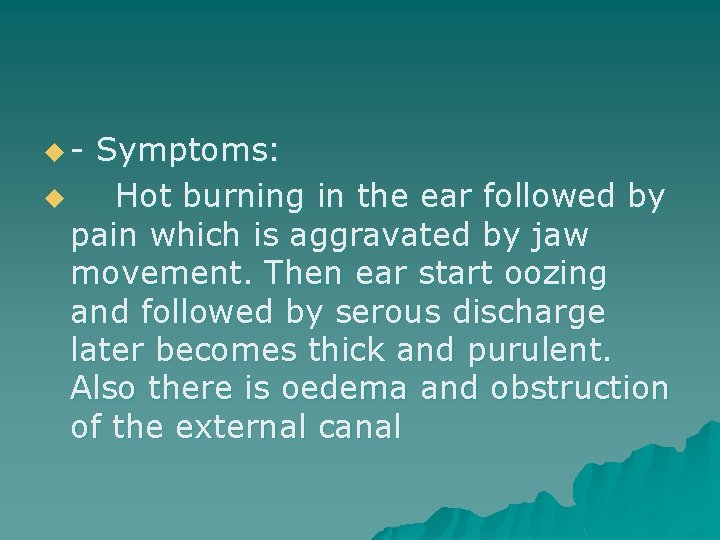
u- Symptoms: u Hot burning in the ear followed by pain which is aggravated by jaw movement. Then ear start oozing and followed by serous discharge later becomes thick and purulent. Also there is oedema and obstruction of the external canal
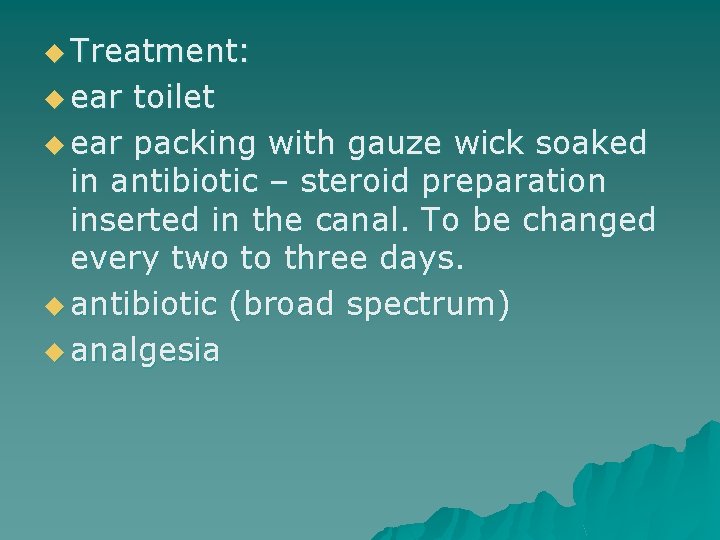
u Treatment: u ear toilet u ear packing with gauze wick soaked in antibiotic – steroid preparation inserted in the canal. To be changed every two to three days. u antibiotic (broad spectrum) u analgesia
Diffuse Otitis Externa
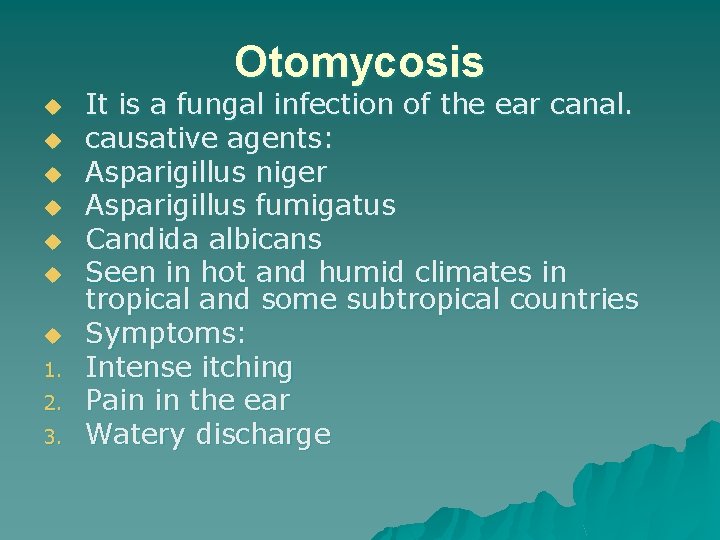
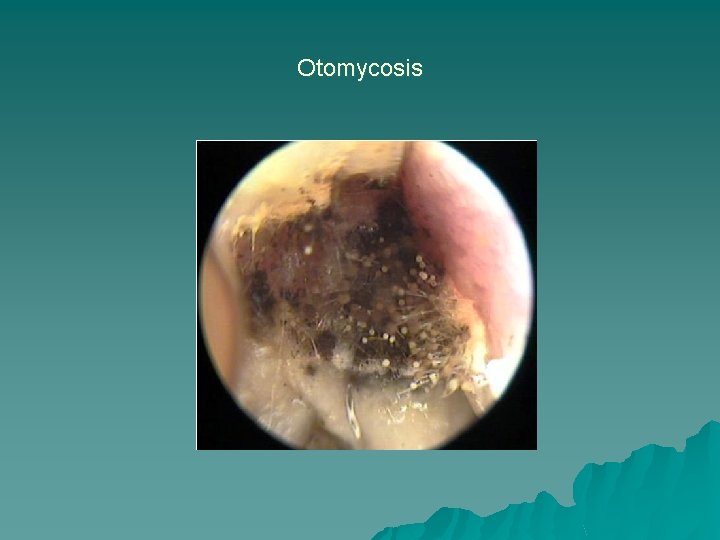
Otomycosis u u u u 1. 2. 3. It is a fungal infection of the ear canal. causative agents: Asparigillus niger Asparigillus fumigatus Candida albicans Seen in hot and humid climates in tropical and some subtropical countries Symptoms: Intense itching Pain in the ear Watery discharge
Otomycosis
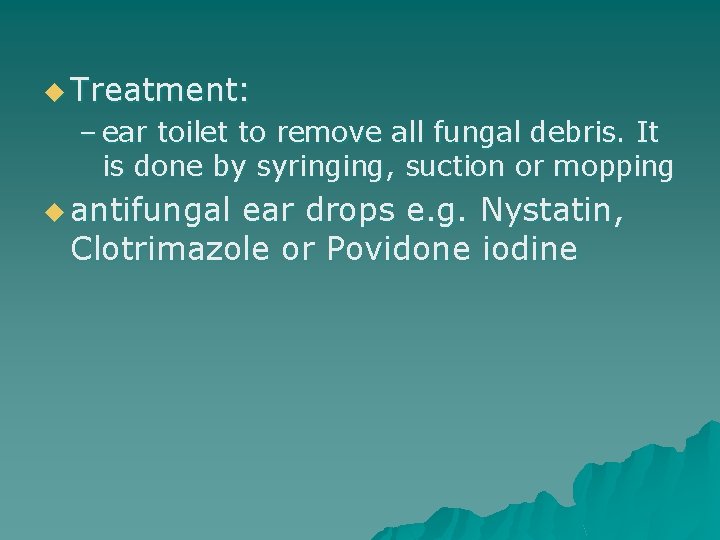
u Treatment: – ear toilet to remove all fungal debris. It is done by syringing, suction or mopping u antifungal ear drops e. g. Nystatin, Clotrimazole or Povidone iodine
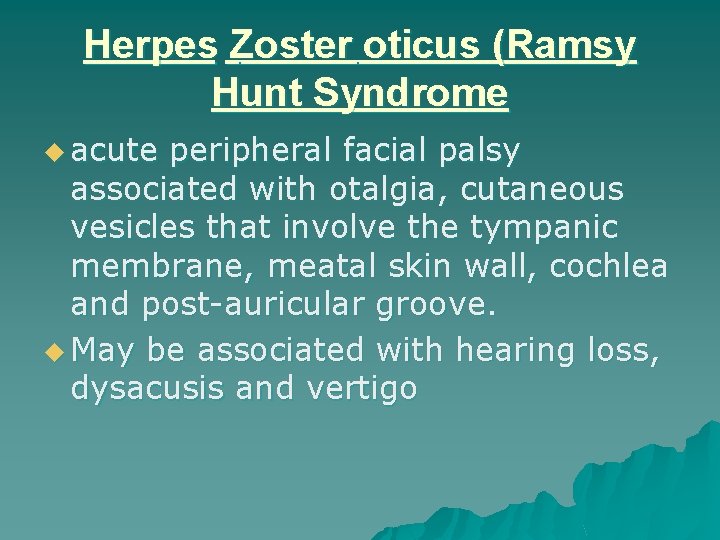
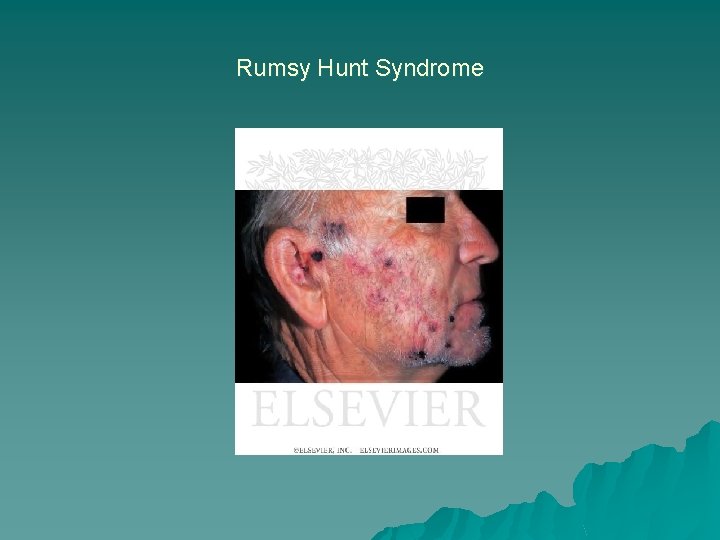
Herpes Zoster oticus (Ramsy Hunt Syndrome u acute peripheral facial palsy associated with otalgia, cutaneous vesicles that involve the tympanic membrane, meatal skin wall, cochlea and post-auricular groove. u May be associated with hearing loss, dysacusis and vertigo
Rumsy Hunt Syndrome
–Treatment: u Steroids u Antiviral therapy
Malignant Otitis Externa (Necrotizing O. E) u An inflammatory condition caused by pseudomonous infection u occurs in: u the elderly u diabetics u patients on immunotherapy
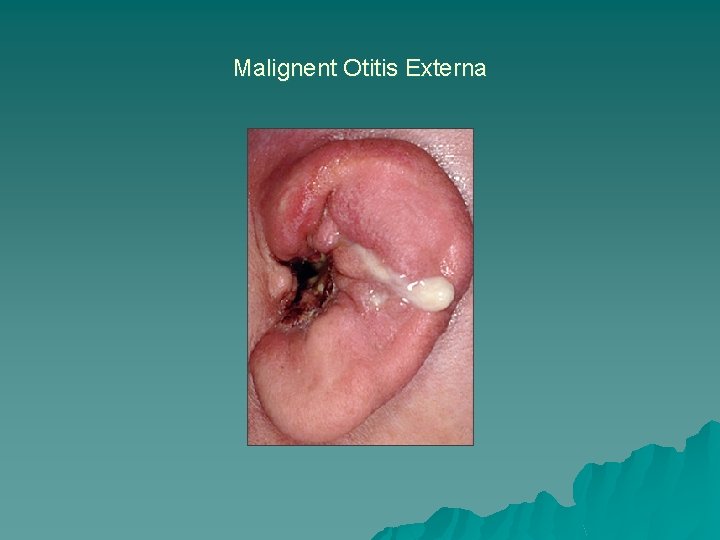
It looks like diffused otitis externa but there is excruciating pain and granulation tissue in the EAC. Facial palsy is common. Infection may spread to the skull base and Jugular foramen leads to multiple cranial nerve palsies.
Malignent Otitis Externa
u 1. 2. Investigations: CT scan to know the extent of the disease bone scan
u 1. 2. 3. 4. Treatment: Hospital admission If patient is diabetic control diabetes high doses of IV antibiotics against pseudomonas (Ciprofloxacin, Tobramycin or third generation Cephalosporins. ) given for 6 to 8 weeks. Surgical debridements
Inner Ear Problems
Inner Ear Problems 1. Menier’s Disease 2. Labrynthitis 3. Ototoxic Drugs
Menier’s Disease u u Is a disorder of the inner ear. Triade of: 1. vertigo 2. SNHL 3. Tinitus
u u Aetiology: The exact cause is unknown, but there are many theories: 1. defective absorption of endolymph by endolymphatic sac 2. vasomotor disturbance 3. allergy 4. sodium and water retention 5. hypoadrenalism and hypopituitarism 6. hypothyroidism 7. autoimmune and viral aetiologies
u 1. 2. 3. 4. Clinical Features: fluctuating hearing loss episodic vertigo tinnitus sense of fullness in the affected ear
u 1. 2. 3. 4. 5. 6. 7. Treatment: reassurance is important in the acute attack stop smoking low salt diet avoid excessive intake of water management of acute attack by vestibular sedatives e. g cinnarizine diuretics neurotonics
Labrynthitis u u u u Definition: Is an inflammation of the inner ear Types: It may be viral, bacterial or syphilitic labrynthitis: – viral labrynthitis: usually virus reaches the inner ear by blood stream Measles, mumps and cytomegalovirus are well known to cause viral labrynthitis – bacterial labrynthitis: - bacterial infection usually reaches the labrynth either through the middle ear or CSF - common example is SNHL, which follows bacterial meningitis – syphilitic labrynthitis: u - labrynthitis can be caused both by congenital and aquired syphilis
u 1. 2. 3. 4. Symptoms: vertigo which lasts for hours to days nausia and vomiting hearing loss in the affected ear tinnitus
u 1. 2. Diagnosis: by history + symptoms The patient usually has history of recent upper respiratory tract infection
u 1. 2. 3. Treatment: intravenous broad spectrum antibiotic labrynthin sedatives bed rest
Ototoxic Drugs u some drugs can cause hearing loss either temporary or permanent u people with hearing loss have to avoid using ototoxic drugs as it can make the hearing loss worse
common ototoxic drugs are: u Aminoglycoside antibiotics: - Streptomycin - Gentamycin - Tobramycin - Neomycin - Kanamycin - Amikacin u Diuretics: u – - loop diuretics Antimalarials: - Quinine - Chloroquine u
Cytotoxic drugs: - Cisplatin - Carboplatin u Analgesics: - Salicylates - Indomethacin - Iboprofen u Chemicals: - Alcohol - Tobacco - Marijuana u Miscellaneous: - Erythromycin - Ampicillin - Propranolol u
Symptoms of ototoxicity: Tinnitus and/or giddiness either during treatment or after completion of treatment u u 1. 2. Treatment: to stop the drug immediately neurotonics