
External Competitiveness Determining the Pay Level Chapter 7
![Competitive Pay Policy Options: Pay With the Competition (Match) [1 of 2] • attempts](https://slidetodoc.com/presentation_image/3c55310c13c9722f3740a3102abfa2d0/image-14.jpg "Competitive Pay Policy Options: Pay With the Competition (Match) [1 of 2] • attempts")
![Competitive Pay Policy Options: Pay With the Competition (Match) [2 of 2] • avoids](https://slidetodoc.com/presentation_image/3c55310c13c9722f3740a3102abfa2d0/image-15.jpg "Competitive Pay Policy Options: Pay With the Competition (Match) [2 of 2] • avoids")


- Slides: 23
External Competitiveness: Determining the Pay Level Chapter 7 Defining Competitiveness Chapter 8 Designing Pay Levels and Pay Structures Irwin/Mc. Graw-Hill © The Mc. Graw-Hill Companies, Inc. , 1999 1
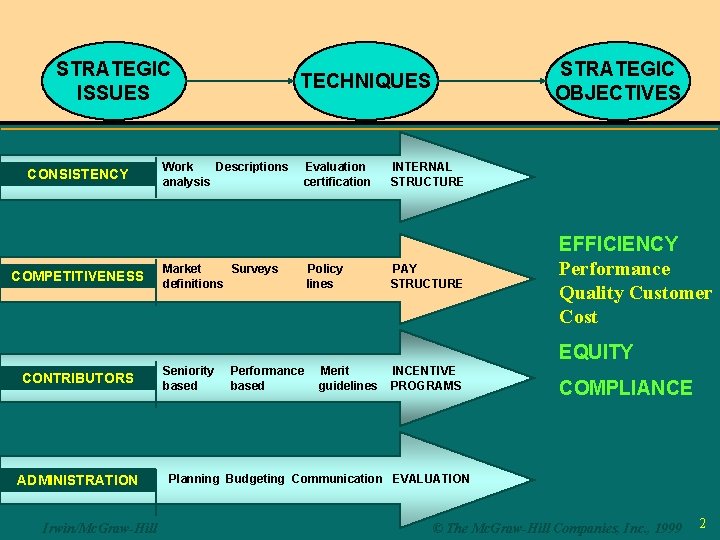
STRATEGIC ISSUES CONSISTENCY COMPETITIVENESS STRATEGIC OBJECTIVES TECHNIQUES Work Descriptions analysis Evaluation certification Market Surveys definitions Policy lines INTERNAL STRUCTURE PAY STRUCTURE EFFICIENCY Performance Quality Customer Cost EQUITY CONTRIBUTORS ADMINISTRATION Irwin/Mc. Graw-Hill Seniority based Performance based Merit guidelines INCENTIVE PROGRAMS COMPLIANCE Planning Budgeting Communication EVALUATION © The Mc. Graw-Hill Companies, Inc. , 1999 2
Chapter 7 Defining Competitiveness Irwin/Mc. Graw-Hill © The Mc. Graw-Hill Companies, Inc. , 1999 3
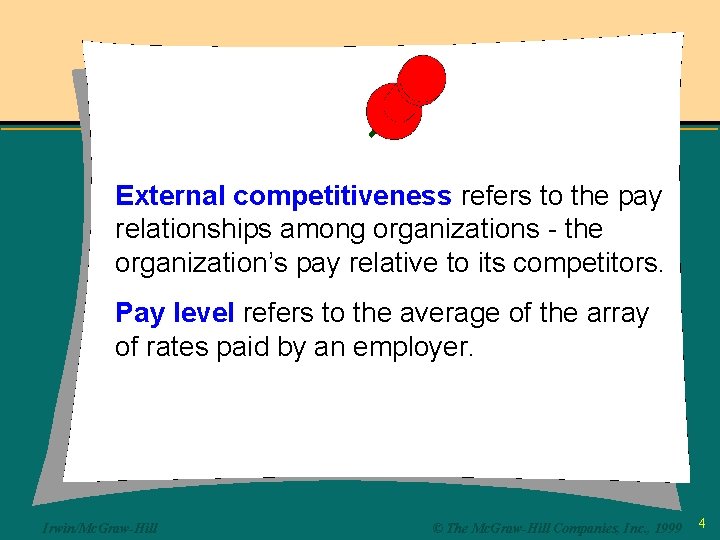
External competitiveness refers to the pay relationships among organizations - the organization’s pay relative to its competitors. Pay level refers to the average of the array of rates paid by an employer. Irwin/Mc. Graw-Hill © The Mc. Graw-Hill Companies, Inc. , 1999 4
External Competitiveness: Determining the Pay Level • Varies in importance by country. In the USA and UK, it’s a primary factor as employees/managers are hired at all levels. • In Japan and other Asian countries, most hiring is done at entry level, so external market is less important. Irwin/Mc. Graw-Hill © The Mc. Graw-Hill Companies, Inc. , 1999 5
External Competitiveness The two key decisions regarding external competitiveness are: • Determining what competitors are paying • Setting pay levels relative to competitors Irwin/Mc. Graw-Hill © The Mc. Graw-Hill Companies, Inc. , 1999 6
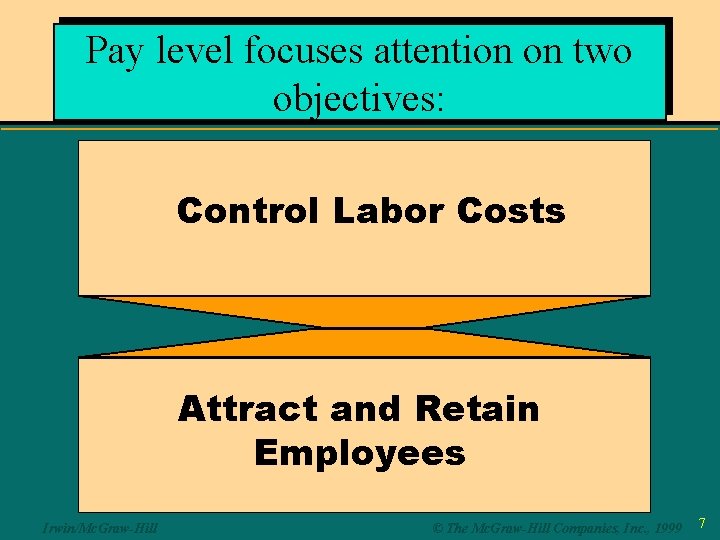
Pay level focuses attention on two objectives: Control Labor Costs Attract and Retain Employees Irwin/Mc. Graw-Hill © The Mc. Graw-Hill Companies, Inc. , 1999 7
Relevant Markets • Each organization operates in many labor markets with unique demand supply; Three factors: – Occupations – qualifications may limit mobility (e. g. licensing, ) – Geography – local or national scope? – Product Market Competitors – industry in which employer competes Irwin/Mc. Graw-Hill © The Mc. Graw-Hill Companies, Inc. , 1999 8
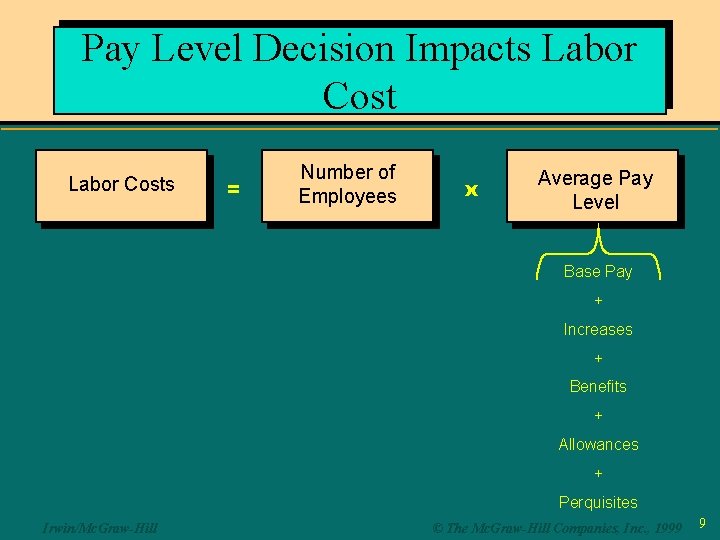
Pay Level Decision Impacts Labor Costs = Number of Employees x Average Pay Level Base Pay + Increases + Benefits + Allowances + Perquisites Irwin/Mc. Graw-Hill © The Mc. Graw-Hill Companies, Inc. , 1999 9
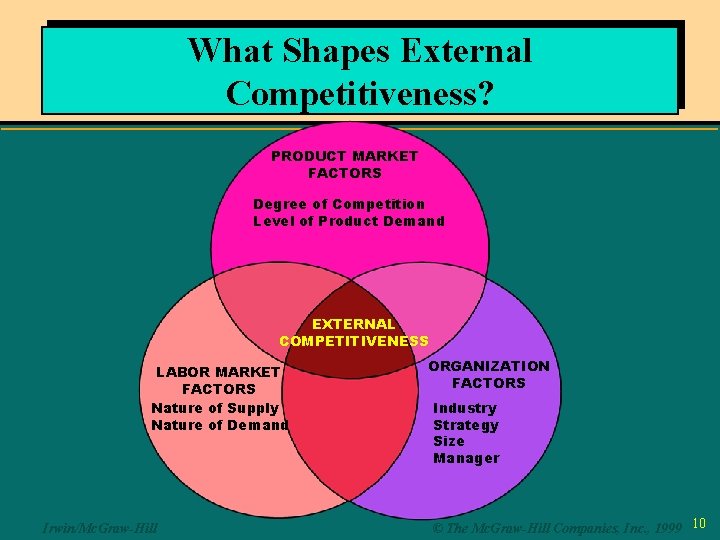
What Shapes External Competitiveness? PRODUCT MARKET FACTORS Degree of Competition Level of Product Demand EXTERNAL COMPETITIVENESS LABOR MARKET FACTORS Nature of Supply Nature of Demand Irwin/Mc. Graw-Hill ORGANIZATION FACTORS Industry Strategy Size Manager © The Mc. Graw-Hill Companies, Inc. , 1999 10
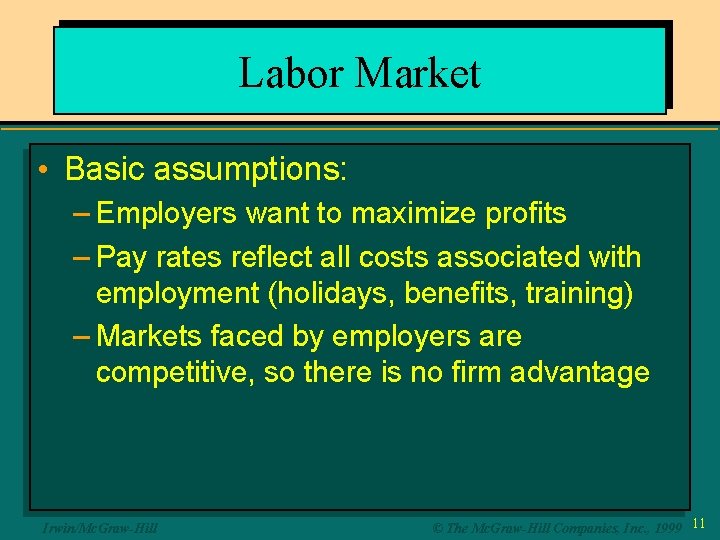
Labor Market • Basic assumptions: – Employers want to maximize profits – Pay rates reflect all costs associated with employment (holidays, benefits, training) – Markets faced by employers are competitive, so there is no firm advantage Irwin/Mc. Graw-Hill © The Mc. Graw-Hill Companies, Inc. , 1999 11
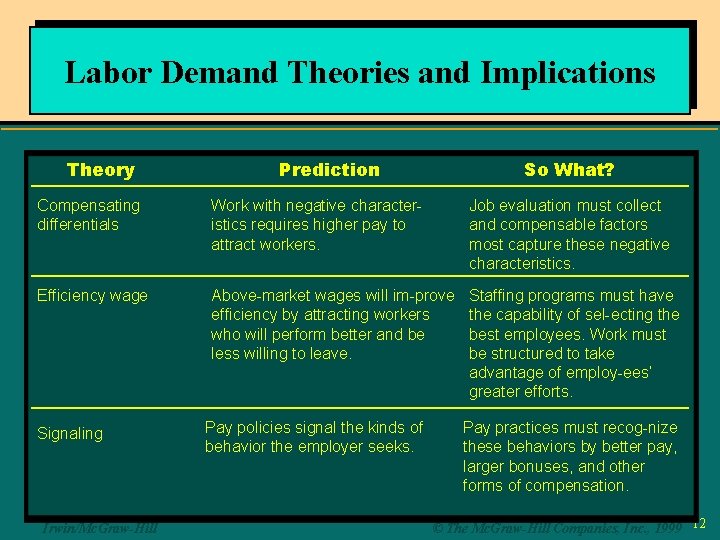
Labor Demand Theories and Implications Theory Prediction So What? Compensating differentials Work with negative characteristics requires higher pay to attract workers. Job evaluation must collect and compensable factors most capture these negative characteristics. Efficiency wage Above-market wages will im-prove efficiency by attracting workers who will perform better and be less willing to leave. Staffing programs must have the capability of sel-ecting the best employees. Work must be structured to take advantage of employ-ees’ greater efforts. Signaling Irwin/Mc. Graw-Hill Pay policies signal the kinds of behavior the employer seeks. Pay practices must recog-nize these behaviors by better pay, larger bonuses, and other forms of compensation. © The Mc. Graw-Hill Companies, Inc. , 1999 12
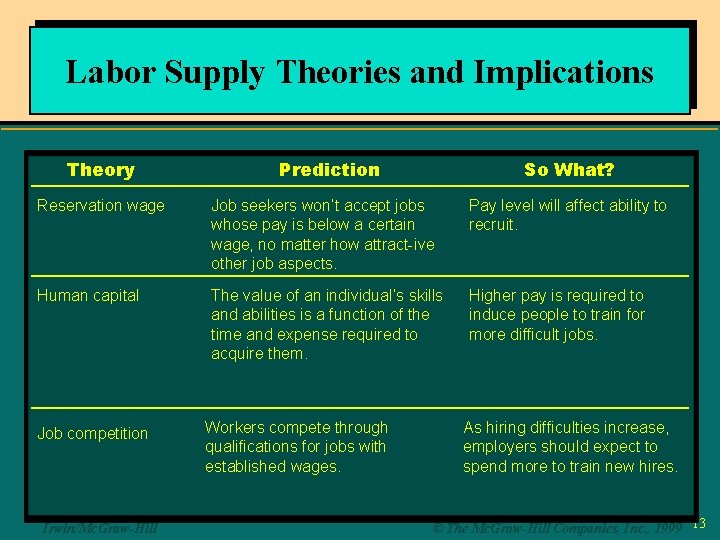
Labor Supply Theories and Implications Theory Prediction So What? Reservation wage Job seekers won’t accept jobs whose pay is below a certain wage, no matter how attract-ive other job aspects. Pay level will affect ability to recruit. Human capital The value of an individual’s skills and abilities is a function of the time and expense required to acquire them. Higher pay is required to induce people to train for more difficult jobs. Job competition Irwin/Mc. Graw-Hill Workers compete through qualifications for jobs with established wages. As hiring difficulties increase, employers should expect to spend more to train new hires. © The Mc. Graw-Hill Companies, Inc. , 1999 13
Competitive Pay Policy Options: Pay With the Competition (Match) [1 of 2] • attempts to ensure that an organization’s wage costs are approximately equal to those of its product competitors; and • that its ability to attract people for employment will be approximately equal to its labor market competitors; Irwin/Mc. Graw-Hill © The Mc. Graw-Hill Companies, Inc. , 1999 14
Competitive Pay Policy Options: Pay With the Competition (Match) [2 of 2] • avoids placing an employer at a disadvantage in pricing products or in maintaining a qualified work force; • may not provide an employer with a competitive advantage in its labor markets. Irwin/Mc. Graw-Hill © The Mc. Graw-Hill Companies, Inc. , 1999 15
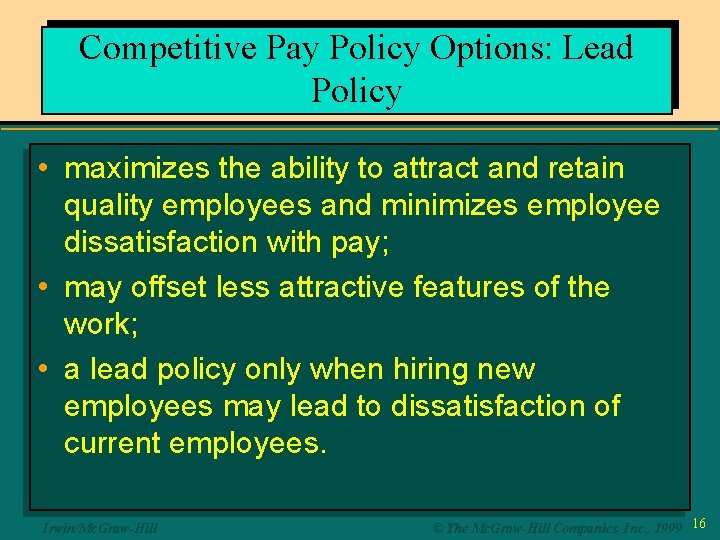
Competitive Pay Policy Options: Lead Policy • maximizes the ability to attract and retain quality employees and minimizes employee dissatisfaction with pay; • may offset less attractive features of the work; • a lead policy only when hiring new employees may lead to dissatisfaction of current employees. Irwin/Mc. Graw-Hill © The Mc. Graw-Hill Companies, Inc. , 1999 16
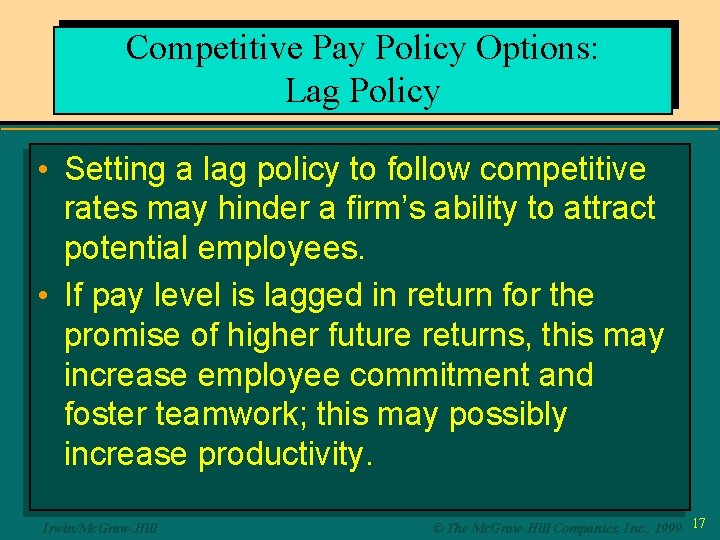
Competitive Pay Policy Options: Lag Policy • Setting a lag policy to follow competitive rates may hinder a firm’s ability to attract potential employees. • If pay level is lagged in return for the promise of higher future returns, this may increase employee commitment and foster teamwork; this may possibly increase productivity. Irwin/Mc. Graw-Hill © The Mc. Graw-Hill Companies, Inc. , 1999 17
Hybrid Pay Policies (1 of 2) • Employers have more than one pay policy. • Policy may vary for different occupational families above market for critical skill groups below or at market for others Irwin/Mc. Graw-Hill © The Mc. Graw-Hill Companies, Inc. , 1999 18
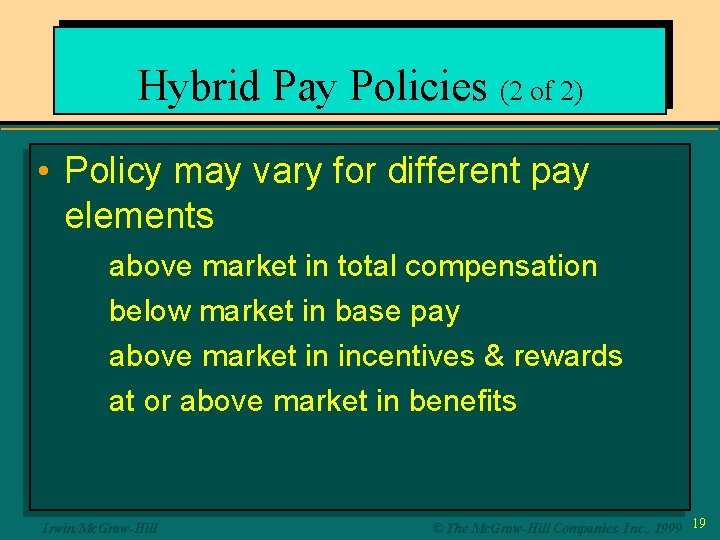
Hybrid Pay Policies (2 of 2) • Policy may vary for different pay elements above market in total compensation below market in base pay above market in incentives & rewards at or above market in benefits Irwin/Mc. Graw-Hill © The Mc. Graw-Hill Companies, Inc. , 1999 19
Product Market Factors and Ability to Pay • Product Demand – the labor market creates the minimum level but the product market puts a maximum on the pay level. Prices otherwise must be increased or profits decreased. • Degree of Competition – employers in highly competitive industries are less able to raise prices than monopolists. Irwin/Mc. Graw-Hill © The Mc. Graw-Hill Companies, Inc. , 1999 20
Organization Factors influencing Pay • Industry – labor intensive industries and services tend to pay lower overall • Employer size – large firms tend to pay more (about 5 -10% more for same jobs) • Organization strategy – may be low cost/low wage or mutual commitment of higher wages/greater quality and service. Irwin/Mc. Graw-Hill © The Mc. Graw-Hill Companies, Inc. , 1999 21
Employer of Choice • An employer of choice policy is more complex than the other options. • It defines compensation more broadly to include all forms of returns. • Thus, an organization’s position is based on total returns of working for it. Irwin/Mc. Graw-Hill © The Mc. Graw-Hill Companies, Inc. , 1999 22
Consequences of Pay Level Decisions • • • Contain labor costs Increase pool of qualified applicants Increase quality and experience Reduce voluntary turnover Increase probability of union-free status Reduce pay-related work stoppages Irwin/Mc. Graw-Hill © The Mc. Graw-Hill Companies, Inc. , 1999 23