
EXTERNAL APPLICATIONS PHILOSOPHY OF THE NATURE OF LOCAL


- Slides: 60
EXTERNAL APPLICATIONS
PHILOSOPHY OF THE NATURE OF LOCAL DISEASES �The individual is sick and not his isolated parts. �The treatment for 'local diseases' must be directed at the 'whole' and not towards the local part. �It is only the Homoeopathic similimum that cures.
• Simultaneous administration of homoeopathic similimum and homoeopathic specific external application is not permitted because the local affection will be removed sooner than the restoration of the internal derangement, leading to a deceptive impression that a complete cure has been effected (Apho 196&197)
�Exclusive topical application of a homoeopathic medicine is also not permissible, because with disappearance of the chief symptom, the residual portion of the disease remains in a mutilated and vague form, making it then difficult to select the right remedy. (Apho 198)
• Use of unhomoeopathic external applications is totally inadmissible as they lead to suppression, obscuring the 'outwardly reflected picture of the internal essence of the disease' and driving the disease manifestations to other parts of the body. (Apho 199&200)
• Apho 201 – 203 • Local symptom, enlarged by vital force lessens internal disease • HERING’S LAW: The cure must take place from above downwards , with in outwards and from more important organs to less important organs
INDICATIONS FOR EXTERNAL APPLICATIONS • Figwarts, if they have existed for some time without treatment have need for their perfect cure, external application of their specific medicines as well as their internal use at the same time SAME MEDICINE INTERNALLY & EXTERNALLY) (Footnote 163, Aphorism 282)
INDICATIONS FOR EXTERNAL APPLICATIONS • 6 th edition of OM • Apho 284 : Besides the tongue, mouth and stomach, the nose and respiratory organs are receptive of the action of medicine in fluid form by means of olfaction and inhalation through the mouth.
INDICATIONS FOR EXTERNAL APPLICATIONS • Apho 285: The cure of old disease is done by the external application on back, arms by rubbing after administration of the same medicine internally
Diseases deserving topical application maybe of recent origin and produced by an external lesion - adynamic diseases, eg. injuries, burns, that require local dressing and cleaning.
Local applications, to suppress the expression of the disease, is prohibited. But if the use of local applications is based upon physical principles, it may be considered.
MOTHER TINCTURE FOR EXTERNAL USE When a mother tincture is to be used for the purpose of preparing external applications, it needs to undergo a modification. Normally, except otherwise specified, 10% mixture of mother tincture for external application and suitable base is used.
• If the mother tincture is prepared according to New method, equal weight of mother tincture and ethyl alcohol are to be taken and this mother tincture will be used for external application.
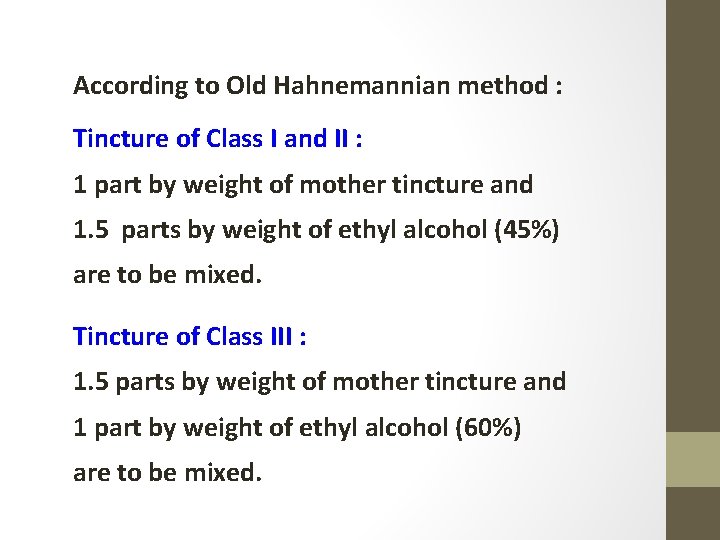
According to Old Hahnemannian method : Tincture of Class I and II : 1 part by weight of mother tincture and 1. 5 parts by weight of ethyl alcohol (45%) are to be mixed. Tincture of Class III : 1. 5 parts by weight of mother tincture and 1 part by weight of ethyl alcohol (60%) are to be mixed.
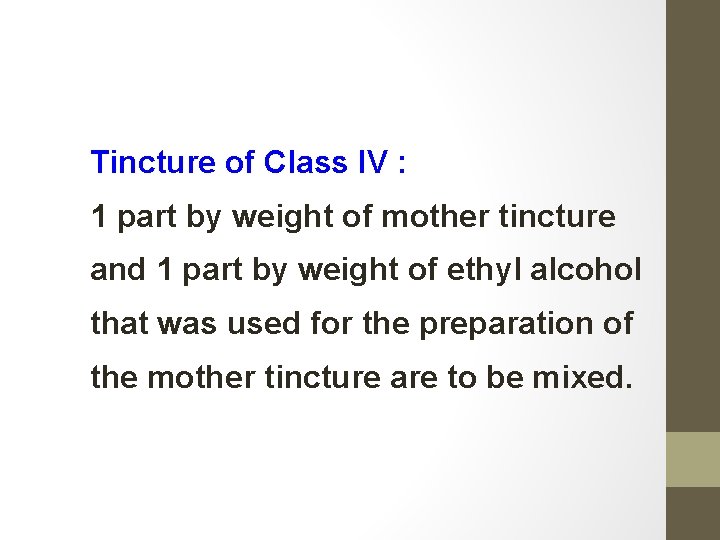
Tincture of Class IV : 1 part by weight of mother tincture and 1 part by weight of ethyl alcohol that was used for the preparation of the mother tincture are to be mixed.
BASES FOR EXTERNAL APPLICATION The following are the vehicles that are used as bases for preparing external applications. The choice of the vehicle depends upon the purpose of use and the nature of application.
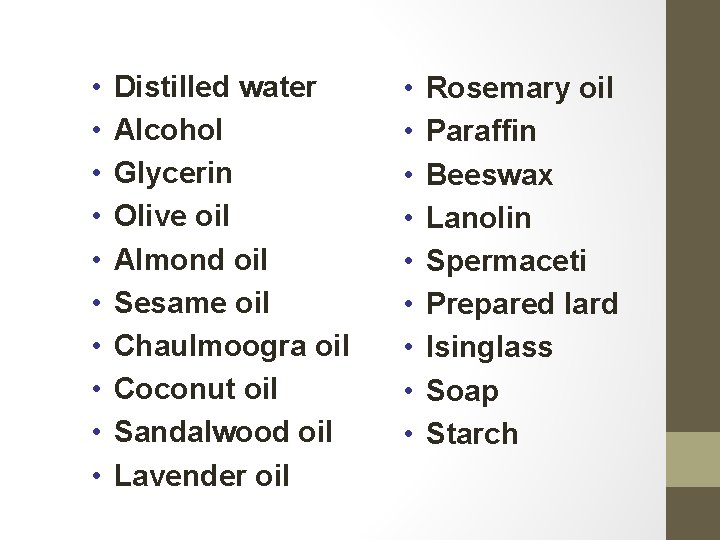
• • • Distilled water Alcohol Glycerin Olive oil Almond oil Sesame oil Chaulmoogra oil Coconut oil Sandalwood oil Lavender oil • • • Rosemary oil Paraffin Beeswax Lanolin Spermaceti Prepared lard Isinglass Soap Starch
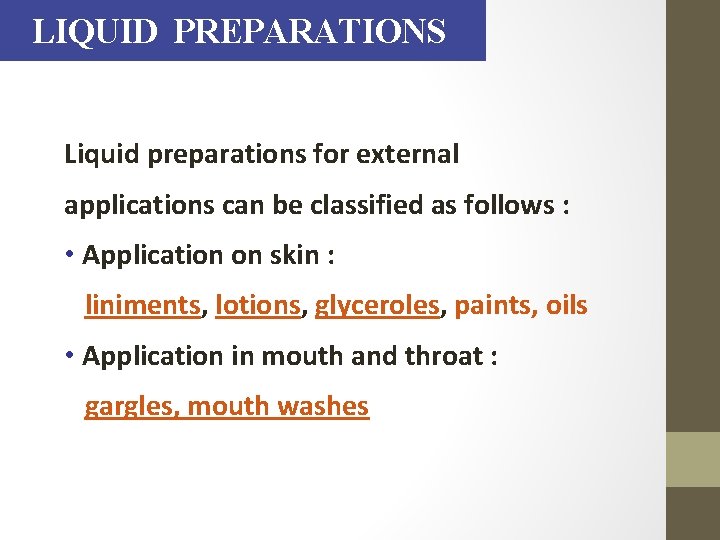
LIQUID PREPARATIONS Liquid preparations for external applications can be classified as follows : • Application on skin : liniments, lotions, glyceroles, paints, oils • Application in mouth and throat : gargles, mouth washes
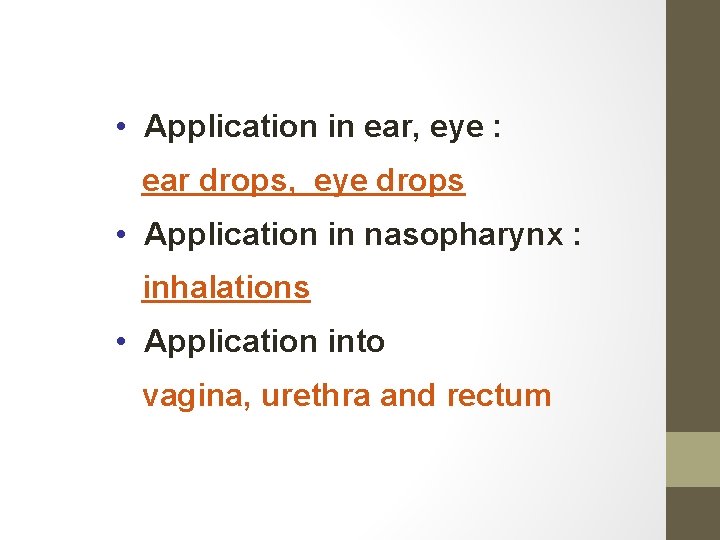
• Application in ear, eye : ear drops, eye drops • Application in nasopharynx : inhalations • Application into vagina, urethra and rectum
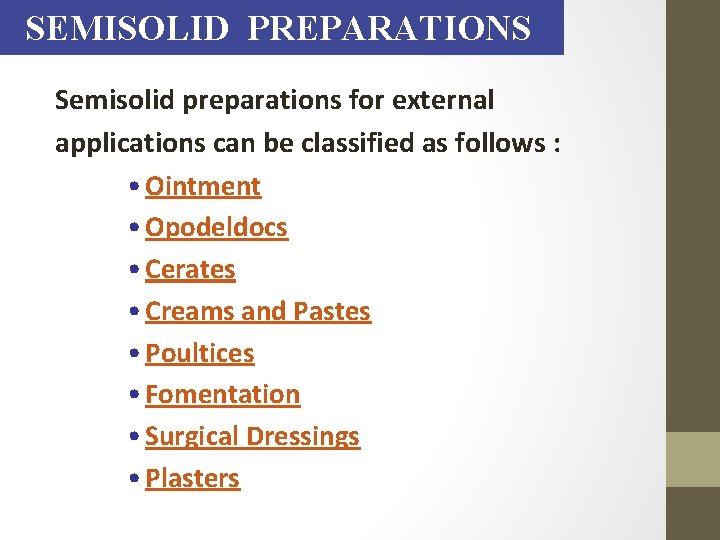
SEMISOLID PREPARATIONS Semisolid preparations for external applications can be classified as follows : • Ointment • Opodeldocs • Cerates • Creams and Pastes • Poultices • Fomentation • Surgical Dressings • Plasters
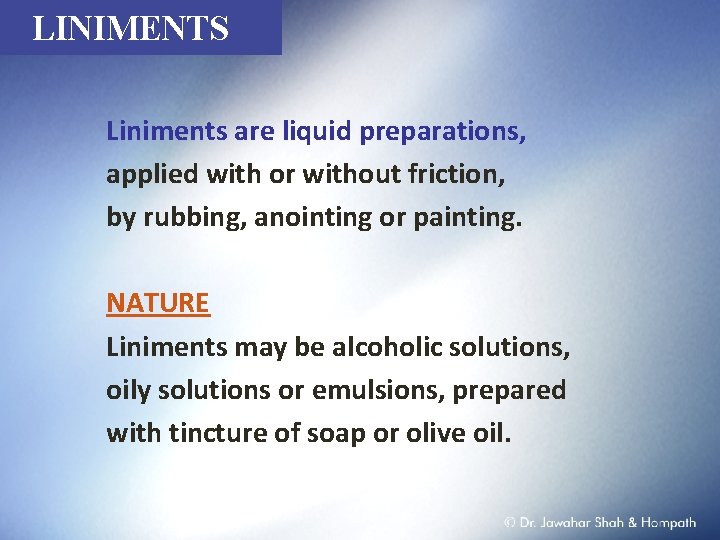
LINIMENTS Liniments are liquid preparations, applied with or without friction, by rubbing, anointing or painting. NATURE Liniments may be alcoholic solutions, oily solutions or emulsions, prepared with tincture of soap or olive oil.
PREPARATION Liniments are generally prepared by mixing one part of the required drug with four parts of olive oil or tincture of soap. UTILITY For relief of pain resulting from falls or blows; As stimulants, it may be massaged into skin; Soap liniment is used for sprains and bruises.
PRECAUTIONS Should be labeled ‘For external use only’. Should never be applied to broken skin, as they are irritating, especially if the solvent is alcohol. Cool storage is necessary since all liniments have volatile ingredients.
LOTIONS Lotions are external applications which are aqueous solutions, suspensions or dispersions of mother tincture in distilled water for application to the skin surface. If they contain insoluble solids in suspension, they are sometimes referred to as 'Shake Lotions'.
On application, water evaporates leaving a residue of the medicine on the skin. The evaporation also causes cooling. As water is an unstable media for preservation, aqueous lotions have a short shelf life.
• PREPARATION Lotions maybe prepared by diluting medicine with water in proportion of 1: 9 or 1: 99. • UTILITY Used in bruised pain without bloodshed. • PRECAUTIONS Should be labeled “For external use only” and “Shake well before use”.
GLYCEROLES Glyceroles are mixtures of solutions of mother tincture in glycerin. They are usually viscous with jelly like consistency. PREPARATION • Glyceroles are made by adding mother tincture of a drug to glycerin in various proportions. • All glyceroles (except of starch) are prepared by mixing one part of the required drug with four parts of glycerin.
UTILITY • Glyceroles are anti-fungal, anti-pruritic and used in cases of stomatitis and gingivitis. GLYCEROLE OF STARCH • 1 part of starch + 8 parts of glycerin. Transfer the mixture to porcelain dish. Apply heat, stir till starch particles are completely broken and a jelly like preparation is made. PRECAUTIONS • Should be labeled ‘For external use only’.
GURGLES AND MOUTHWASHES • Gurgles are aqueous solutions used after dilution with warm water. They bring the medicine in contact with throat and pharynx. The gargle is kept in throat and air from lungs is forced through for the solution to come in contact with the above membranes.
GURGLES AND MOUTHWASHES • Mouthwashes are similar to gargles but are intended to wash out the mouth. They are of value only for the local hygiene of the mouth.
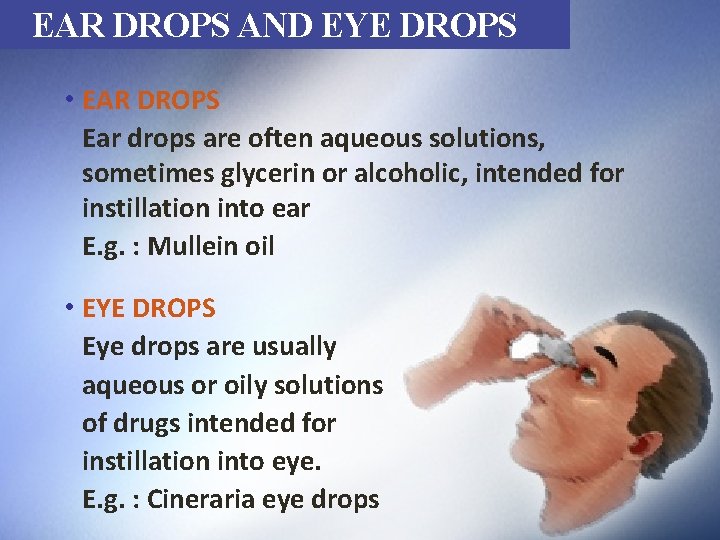
EAR DROPS AND EYE DROPS • EAR DROPS Ear drops are often aqueous solutions, sometimes glycerin or alcoholic, intended for instillation into ear E. g. : Mullein oil • EYE DROPS Eye drops are usually aqueous or oily solutions of drugs intended for instillation into eye. E. g. : Cineraria eye drops
INHALATIONS • Inhalations are solutions of medicaments administered by nasal or respiratory route, intended for local or systemic effects. Inhalations are applied in form of vapors that are to be inhaled alongwith breath from the surface of hot water. • Vehicles preferred are normal saline and other water based liquids. 1 tsp of medicine is poured to 1 pint of hot water, not boiling water.
OINTMENTS Ointments are semi-solid preparations used for application to the skin. They are used for emollient, protective or other surface effects. BASES • The bases used for ointments are VASELINE, BEES WAX & SPERMACETI. • Thus an ointment may be a suspension or emulsion of medicament in the base.
CHARACTERISTICS OF AN OINTMENT BASE • Compatible with the skin • Stable • Smooth and pliable • Able to readily release the medication • Inert • Easily washable • Non irritating • Non sensitizing • Compatible with a variety of medicaments
PREPARATION Ratio Between Tincture & Base = 1: 9 • Fusion method : When wax, spermaceti or other hard fusible bases are to be incorporated with soft, oleaginous materials, fusion method is employed. The insoluble solid medicament is finely powdered.
Mechanical incorporation or trituration method : This method is used when the base is soft and the medicament is either a solid insoluble in the base or a liquid present in small quantity. Mechanical incorporation is performed by trituration in a mortar or a glass slab with a spatula.
• UTILITY Ointments are used as dressings for torn, jagged wounds, ulcers, burns, etc. • PRECAUTIONS Ointments should be stored in cool dark place, out of contact with air. Preferably, all ointments can be refrigerated.
OPODELDOCS These are semi-solid liniments prepared by mixing White curd soap, Purified water, Alcohol fortis and Mother tincture of the drug PREPARATION • Specified quantities of white curd soap and purified water are heated gently till the solution becomes transparent. Strong alcohol is then added gradually. The mother tincture of the drug is then added and it is stirred well. The solution is then strained into a suitable phial.
OPODELDOCS RATIO OF INGREDIENTS 1. WHITE CURD SOAP : 140 gm 2. PURIFIED WATER : 266 ml 3. STRONG ALCOHOL : 444 ml 4. MOTHER TINCTURE : 100 ml USES: Sprains, Bruises, Rheumatic pains
CERATES Cerates are oily substances containing cera or wax. They can be easily spread at ordinary temperature upon gauze and not be so soft as to liquefy and run when applied to the skin. PREPARATION • Mix spermaceti 3 parts, white wax 6 parts and olive oil 14 parts. 1 part of mother tincture is mixed 9 parts of simple cerate. UTILITY • Used as dressings for inflamed areas.
CREAMS AND PASTES CREAMS • The term ' cream ' is applied to viscous emulsions of semi-solid consistency intended for application to the skin. • Creams may be w/o (water-in-oil or oily creams) or o/w (oil-in-water or aqueous creams).
PASTES • Pastes are similar to ointments but are non-greasy. Pastes are stiffer preparations than ointments and contain high proportions of powder.
POULTICES (CATAPLASMS) Poultices are soft, semi-solid external applications that either stimulate the body surface or alleviate an inflamed area by applying medicated substances in the presence of heat and moisture.
They are applied to promote maturation of boils and abscesses, to relieve pains in various parts and acute inflammatory diseases of the chest. EXAMPLE • Linseed poultice • Spongic-piline poultice • Hot salt or sand pad
FOMENTATION • Hot fomentation Wring a folded cloth out of hot water. If necessary, impregnate water with the indicated drug. Cover it with oiled silk and dry flannel to prevent evaporation and apply to the painful part or fill a rubber hot water bottle and apply to the affected part. • Cold fomentation Wet a folded cloth in cold water, leave it uncovered to favor evaporation and apply to the affected part.
SURGICAL DRESSINGS FEATURES OF AN IDEAL DRESSING • Porous to water vapor. • Capable of absorbing excess secretions. • Non adherent to granulating surfaces. • Free from substances that cause tissue reactions, allergy or hypersensitivity response.
• Impervious to micro-organisms. • Capable of following joint contours during movement. • Smooth on both surfaces. • Satisfactory tensile strength. • Sealable to the skin.
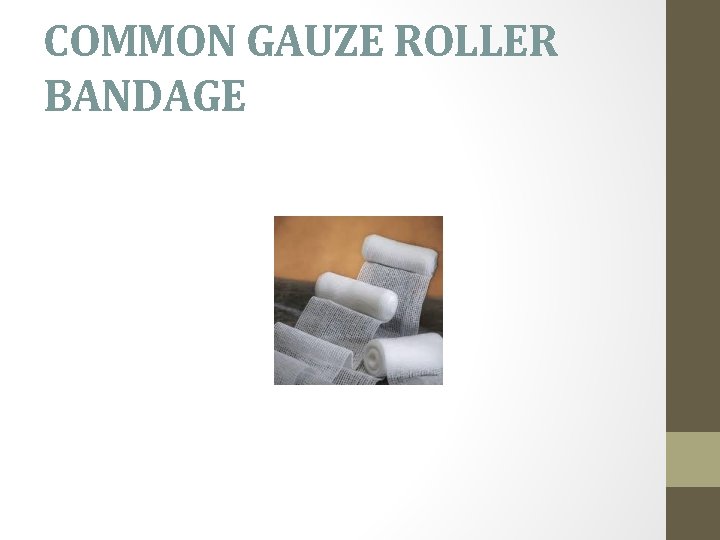
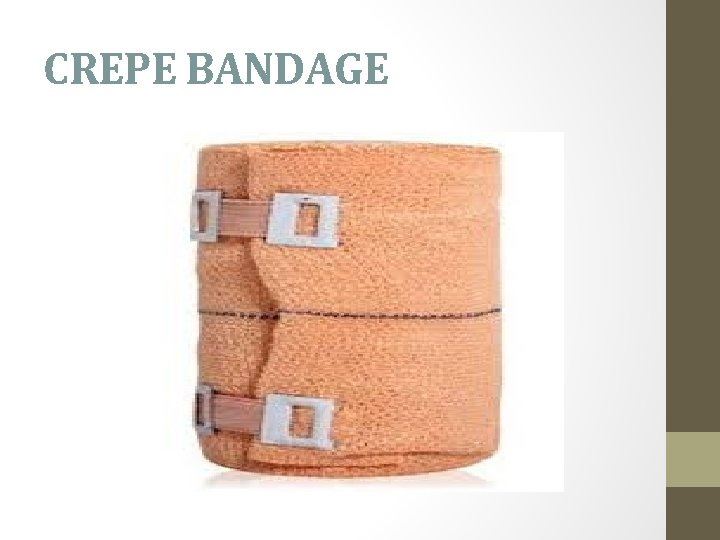
TYPES OF SURGICAL DRESSINGS : �FIBRES : Absorbent Cotton �FABRICS(surgical gauzes) : Absorbent Cotton Gauze, Gauze Pad BANDAGES : Gauze roller, Crepe, Adhesive, plaster of paris
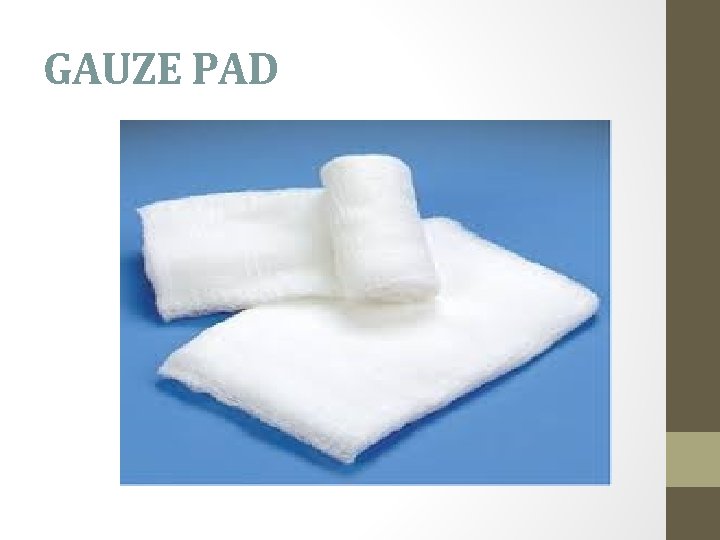
GAUZE PAD
COMMON GAUZE ROLLER BANDAGE
CREPE BANDAGE
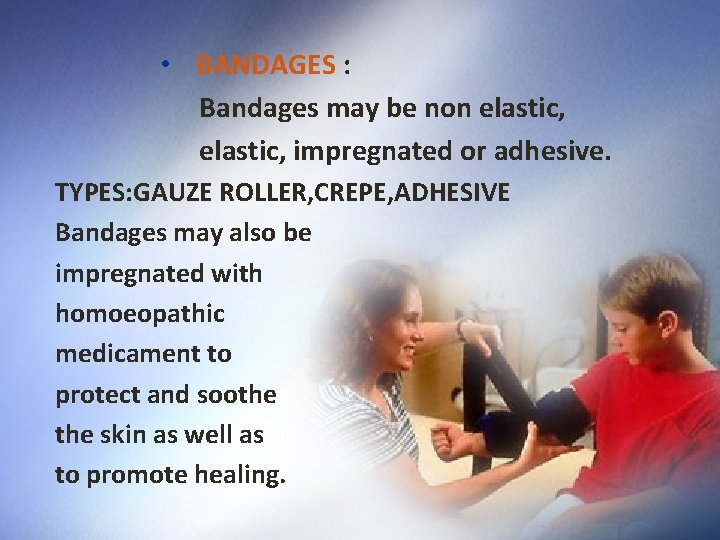
• BANDAGES : Bandages may be non elastic, impregnated or adhesive. TYPES: GAUZE ROLLER, CREPE, ADHESIVE Bandages may also be impregnated with homoeopathic medicament to protect and soothe skin as well as to promote healing.
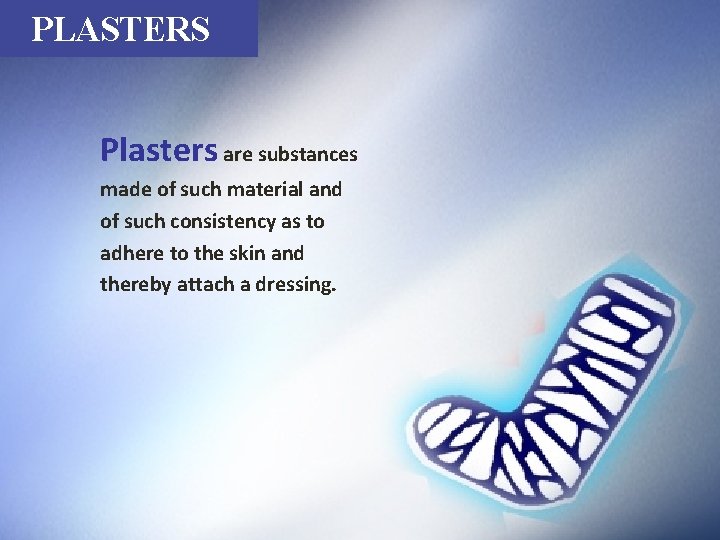
PLASTERS Plasters are substances made of such material and of such consistency as to adhere to the skin and thereby attach a dressing.
PREPARATION • 30 g isinglass in shreds - dissolve it first by digesting and then by boiling a sufficient quantity of purified water. • Filter - evaporate until it reduces to 300 g. • Spread half of it on a piece of linen or muslin. • Add mother tincture to remaining half and mix, with this complete the spreading. E. g. Arnica plaster, Calendula plaster.
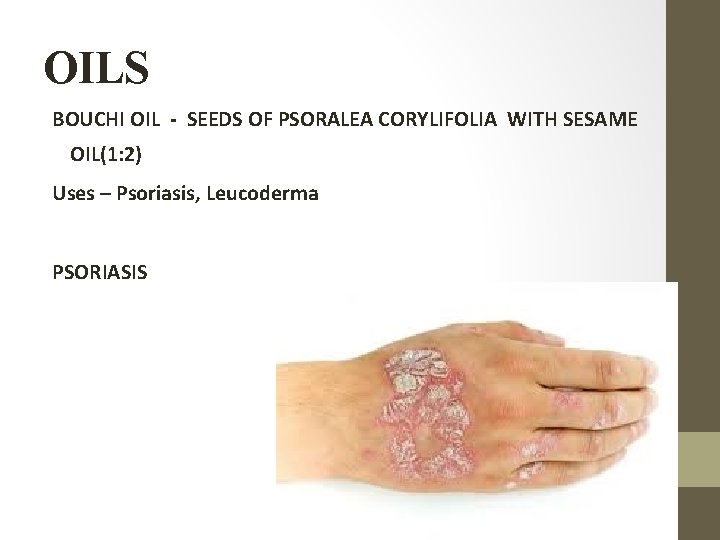
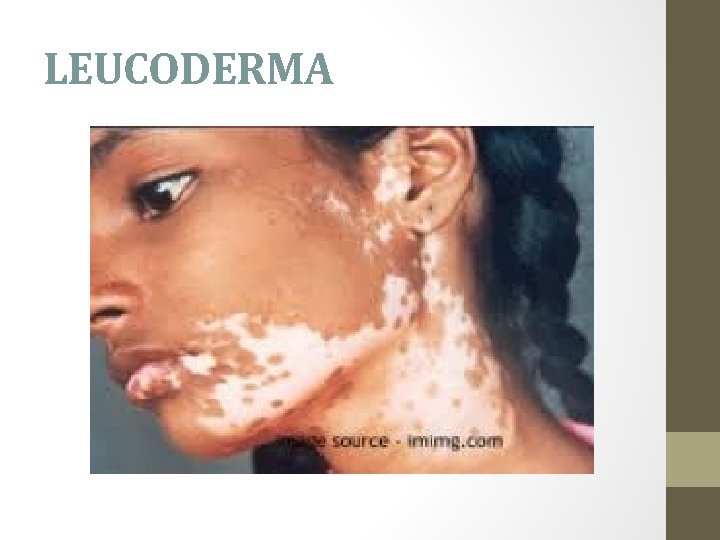
OILS BOUCHI OIL - SEEDS OF PSORALEA CORYLIFOLIA WITH SESAME OIL(1: 2) Uses – Psoriasis, Leucoderma PSORIASIS
LEUCODERMA
MULLEIN OIL - FLOWER OF VERBASCUM THAPSUS USES: EARACHE, ASOM, CSOM, IMPACTED WAX WINTERGREEN OIL – WHOLE PLANT OF GAULTHERIA FRAGRANTISSIMA USES: GOUT, RHEUMATISM
• OLIVE OIL – RIPE FRUIT OF OLEA EUROPOEA. Uses – Ulcers, Chapped skin • ARNICA OIL – ROOTS OF ARNICA MONTANA (1: 10). Uses – Hair growth, Bruises • ROSEMARY OIL – FLOWERS OF ROSEMARINUS OFFICINALIS
• • INJECTIONS : VAGINAL (5 ml injected using syringe) Drug – 15 ml Glycerine – 45 ml Purified water – 60 ml URETHRAL : Drug – 30 ml+ 600 ml purified water RECTAL : Drug + 60 ml arrowroot water