
EXTERNAL AND INTERNAL CONTAMINATION DECONTAMINATION AND DECORPORATION Module
- Slides: 44
EXTERNAL AND INTERNAL CONTAMINATION DECONTAMINATION AND DECORPORATION Module XV
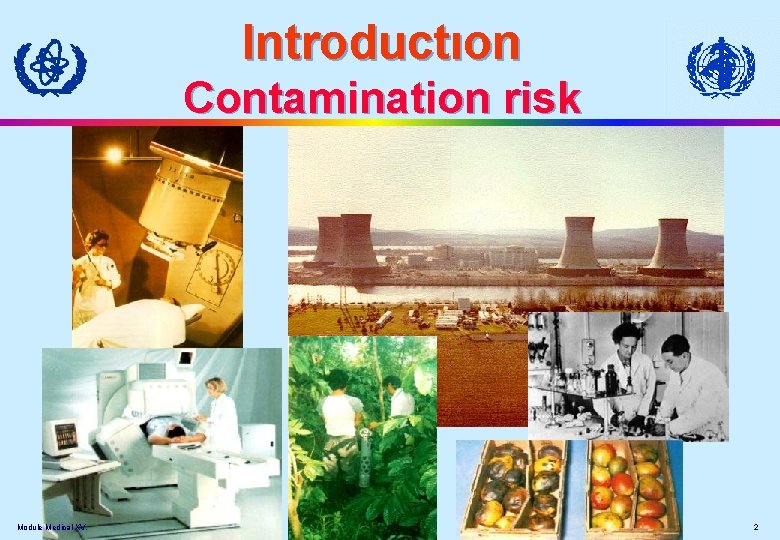
Introductıon Contamination risk Module Medical XV. 2
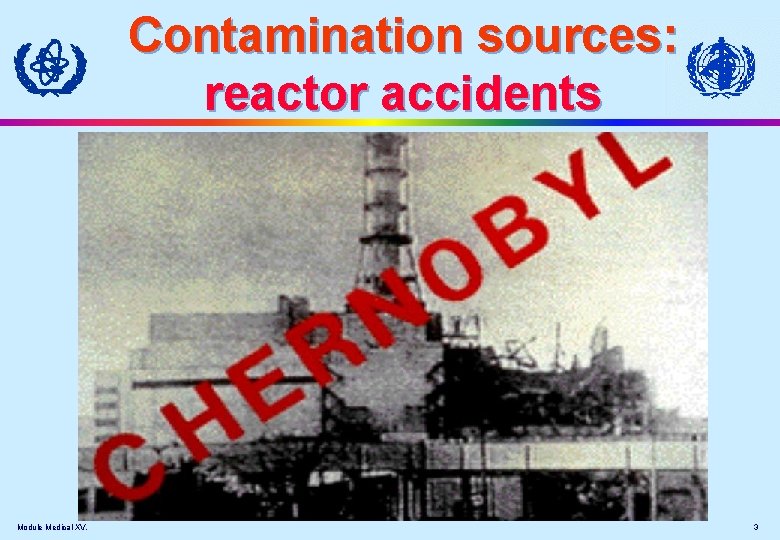
Contamination sources: reactor accidents Module Medical XV. 3
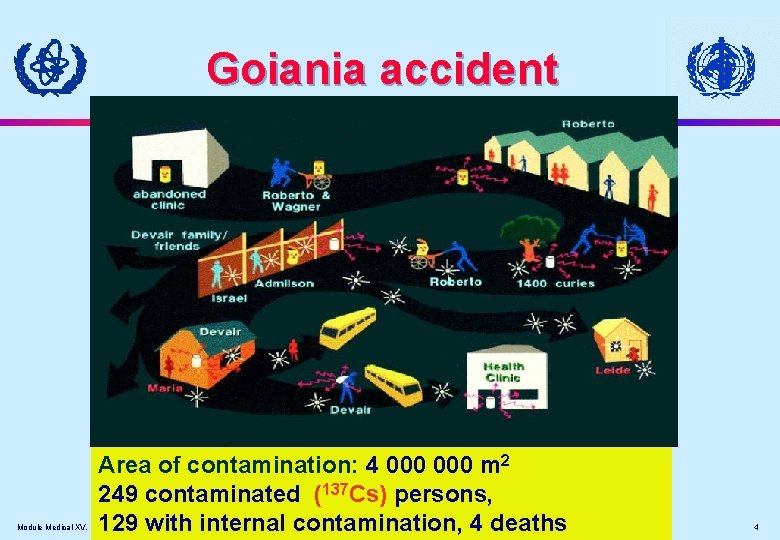
Goiania accident Module Medical XV. Area of contamination: 4 000 m 2 249 contaminated (137 Cs) persons, 129 with internal contamination, 4 deaths 4
External radionuclide contamination l External contamination: radioactive material, as dust, solid particles, aerosols or liquid, becomes attached to victim’s skin or clothes Module Medical XV. 5
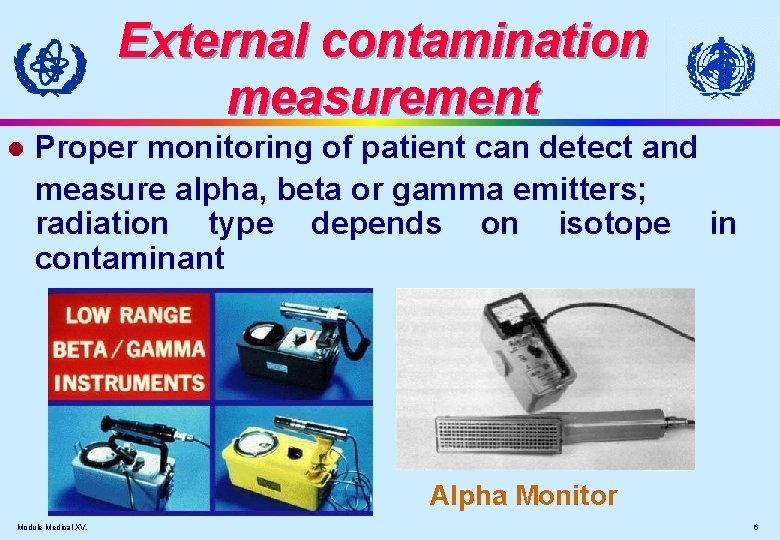
External contamination measurement l Proper monitoring of patient can detect and measure alpha, beta or gamma emitters; radiation type depends on isotope in contaminant Alpha Monitor Module Medical XV. 6
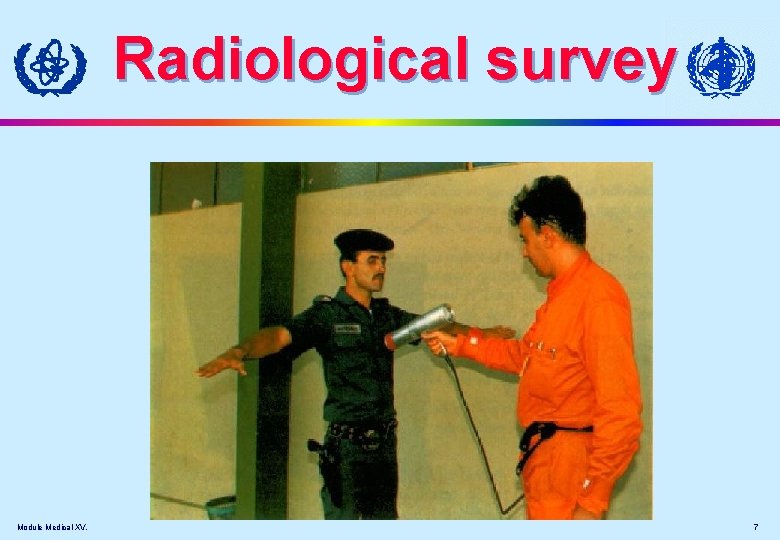
Radiological survey Module Medical XV. 7
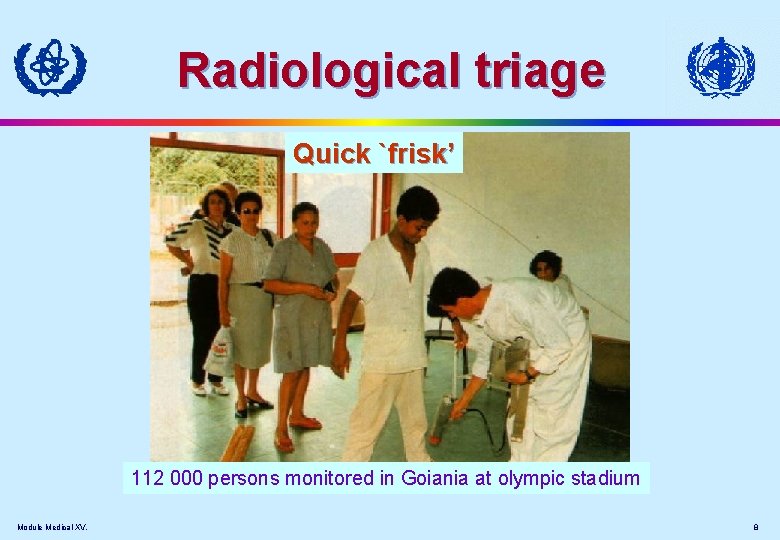
Radiological triage Quick `frisk’ 112 000 persons monitored in Goiania at olympic stadium Module Medical XV. 8
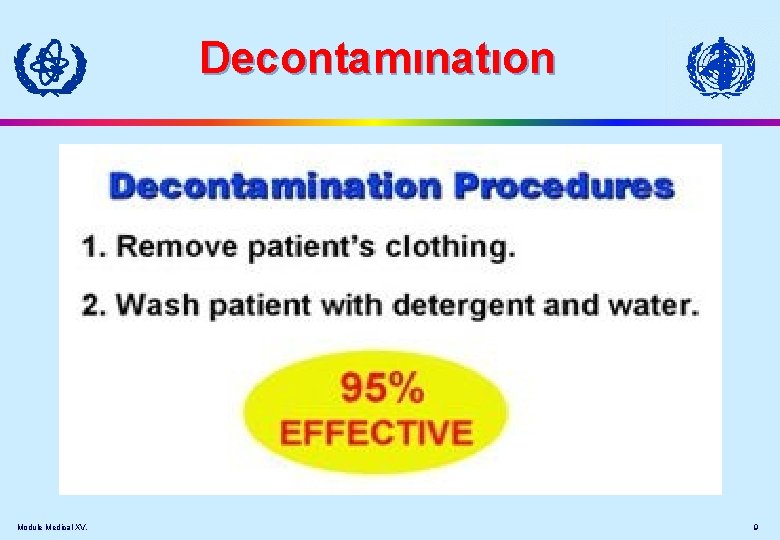
Decontamınatıon Module Medical XV. 9
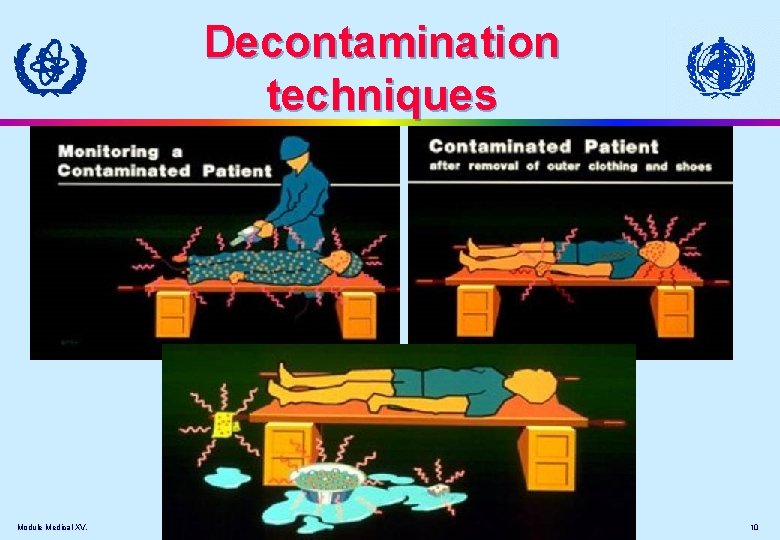
Decontamination techniques Module Medical XV. 10
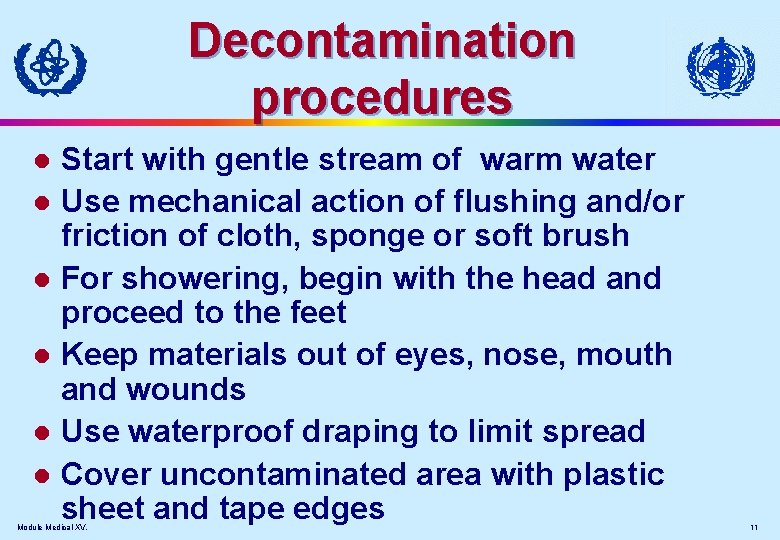
Decontamination procedures Start with gentle stream of warm water l Use mechanical action of flushing and/or friction of cloth, sponge or soft brush l For showering, begin with the head and proceed to the feet l Keep materials out of eyes, nose, mouth and wounds l Use waterproof draping to limit spread l Cover uncontaminated area with plastic sheet and tape edges l Module Medical XV. 11
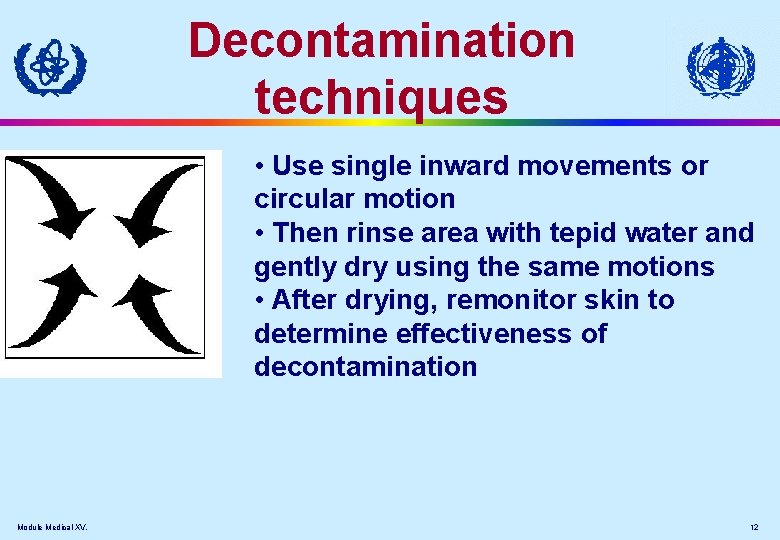
Decontamination techniques • Use single inward movements or circular motion • Then rinse area with tepid water and gently dry using the same motions • After drying, remonitor skin to determine effectiveness of decontamination Module Medical XV. 12
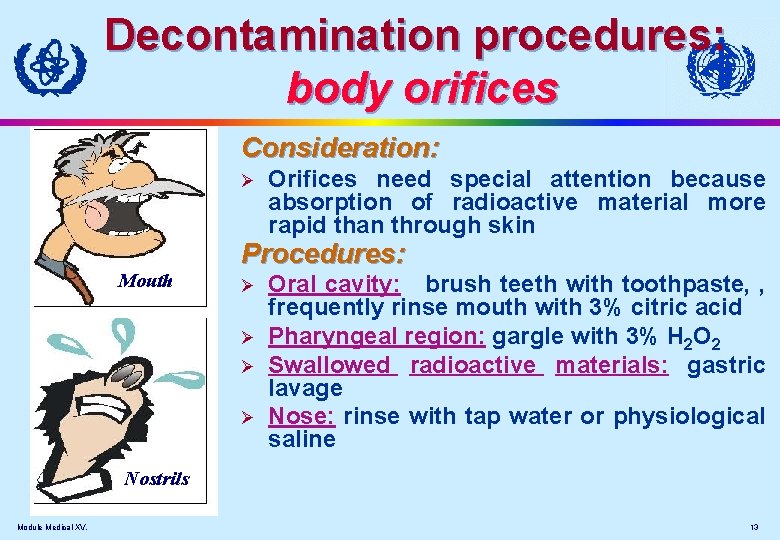
Decontamination procedures: body orifices Consideration: Ø Mouth Orifices need special attention because absorption of radioactive material more rapid than through skin Procedures: Ø Ø Oral cavity: brush teeth with toothpaste, , frequently rinse mouth with 3% citric acid Pharyngeal region: gargle with 3% H 2 O 2 Swallowed radioactive materials: gastric lavage Nose: rinse with tap water or physiological saline Nostrils Module Medical XV. 13
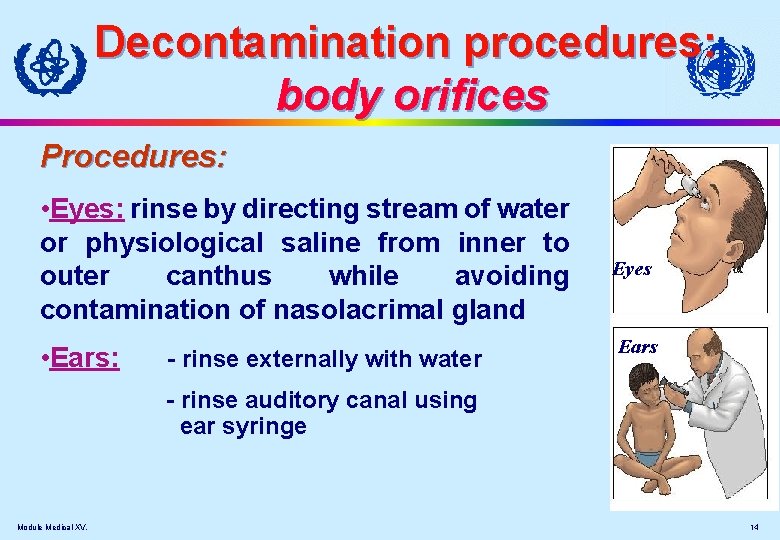
Decontamination procedures: body orifices Procedures: • Eyes: rinse by directing stream of water or physiological saline from inner to outer canthus while avoiding contamination of nasolacrimal gland • Ears: - rinse externally with water Eyes Ears - rinse auditory canal using ear syringe Module Medical XV. 14
Useful therapeutic agents for skin decontamination-I Common soap or detergent solution for skin and hair; low acidity (p. H ~5) recommended l Chelating agents: l solution of EDTA 10% for skin or hair contamination with transuranium, rare earth and transition metals n DTPA 1% in aqueous acid solution (p. H ~4) for washing skin after contamination with transuranics, lanthanides or metals (cobalt, iron, zinc, manganese) n Module Medical XV. 15
Useful therapeutic agents for skin decontamination-II l Potassium permanganate, 5% aqueous solution should be used carefully n n n l not recommended for face, natural orifices and genital regions use when conventional washing ineffective follow with application of reducing agent, then rinse with water Hydroxylamine or sodium hyposulfite, 5% freshly prepared aqueous solutions n reducing agents - apply after KMn 04 or Lugol, then wash with water Module Medical XV. 16
Useful therapeutic agents for skin decontamination-III l Antiphlogistic topical ointment: n To be applied for fixed contamination, especially useful for contamination of fingers Isotonic saline solution for eyes l Isotonic 1. 4% bicarbonate solution for removing uranium from body l Lugol solutions for iodine contamination l Acetic acid solution (p. H 4 to 5) or simply vinegar for decontamination of 32 P l Module Medical XV. 17
Internal contamination l Occurs when people ingest, inhale, or are injured by radioactive material l Metabolism of non-radioactive analogue determines radionuclide’s metabolic pathway Module Medical XV. 18
Extent of hazard l § § § Module Medical XV. Factors determining extent of contamination hazard: Amount of radionuclide(s) Energy and type of radiation Biological and radiological half-life Critical organ Chemical and physical properties of radionuclide 19
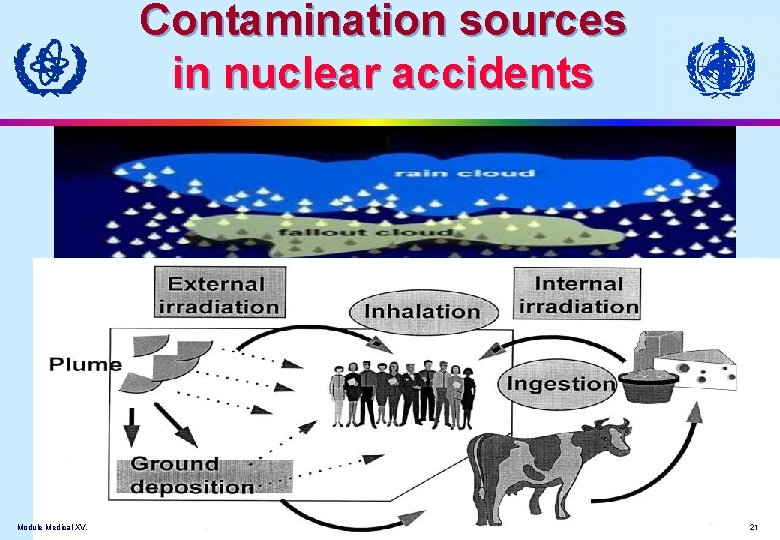
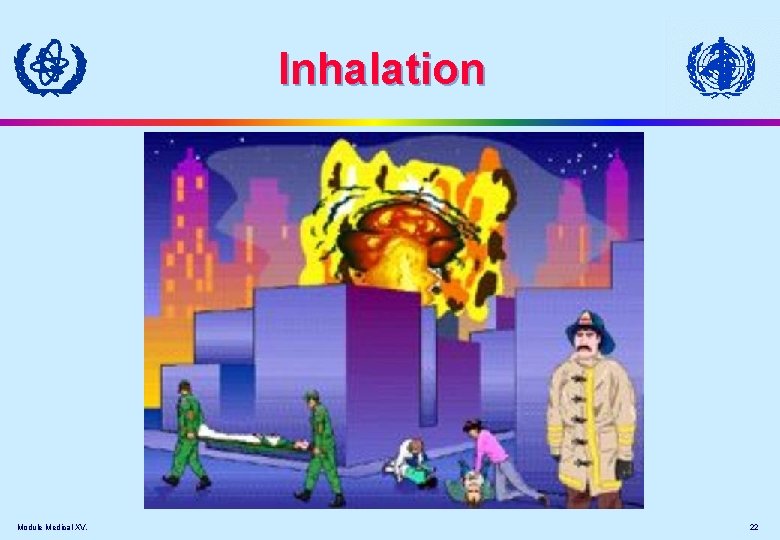
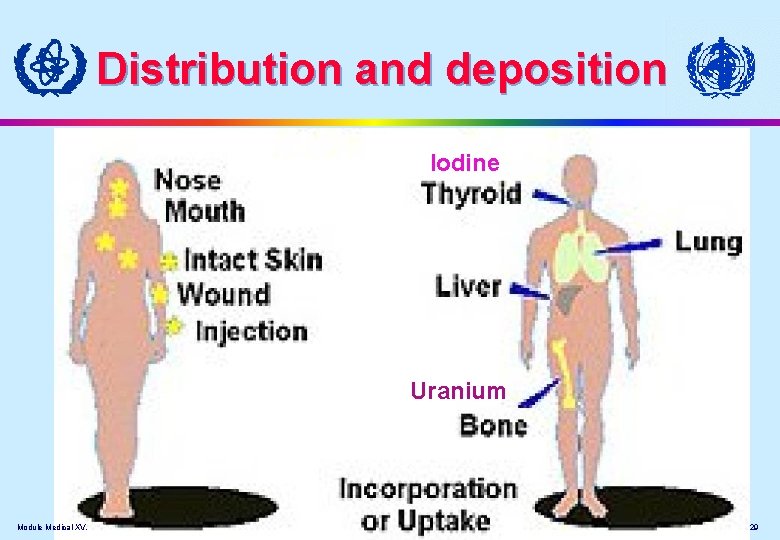
Intake routes In order of decreasing frequency, contaminants enter the body by four principle routes: Inhalation: Particularly likely with explosion or fire Particle characteristics important (size, chemical composition, solubility in body fluids) Ingestion: Critical for general public after accidental environmental release Wound contamination Absorption Module Medical XV. 20
Contamination sources in nuclear accidents Module Medical XV. 21
Inhalation Module Medical XV. 22
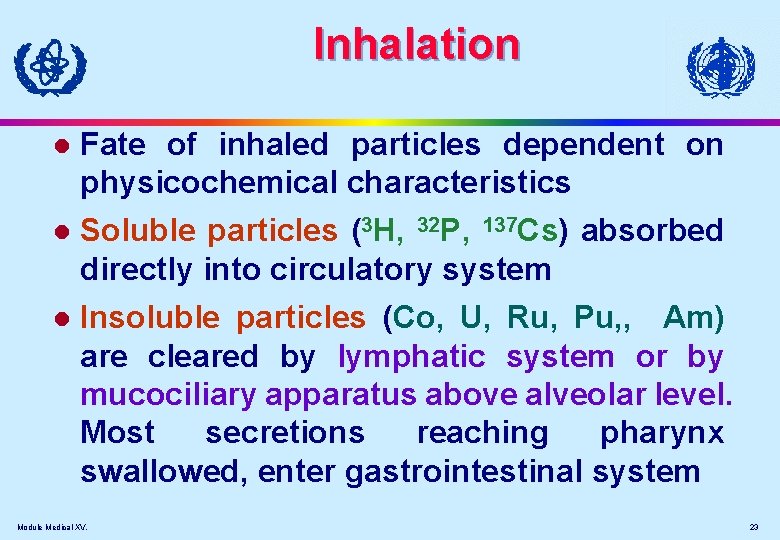
Inhalation l Fate of inhaled particles dependent on physicochemical characteristics l Soluble particles (3 H, 32 P, 137 Cs) absorbed directly into circulatory system l Insoluble particles (Co, U, Ru, Pu, , Am) are cleared by lymphatic system or by mucociliary apparatus above alveolar level. Most secretions reaching pharynx swallowed, enter gastrointestinal system Module Medical XV. 23
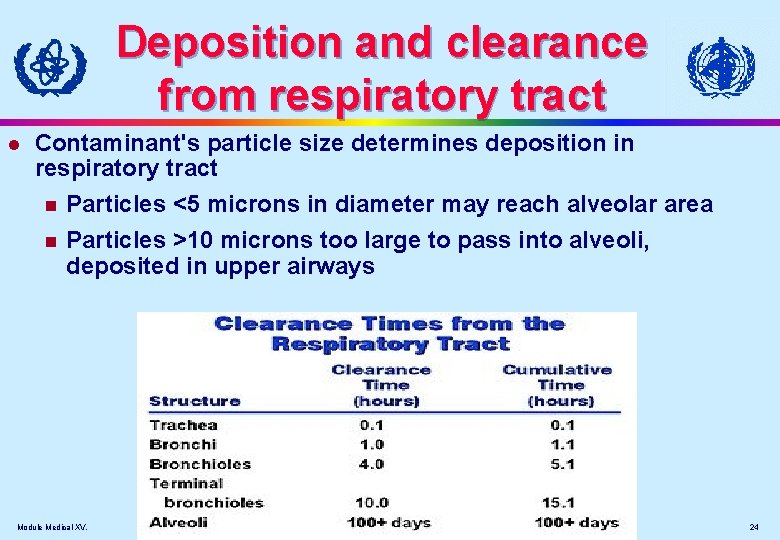
Deposition and clearance from respiratory tract l Contaminant's particle size determines deposition in respiratory tract n Particles <5 microns in diameter may reach alveolar area n Particles >10 microns too large to pass into alveoli, deposited in upper airways Module Medical XV. 24
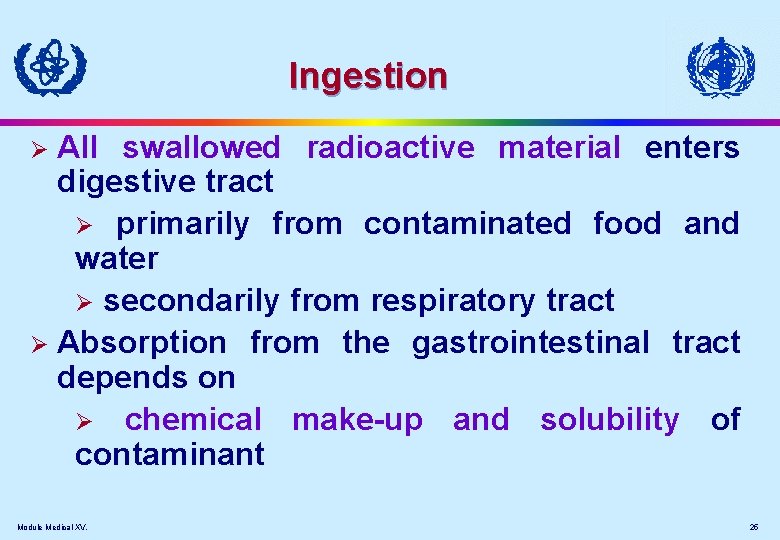
Ingestion All swallowed radioactive material enters digestive tract Ø primarily from contaminated food and water Ø secondarily from respiratory tract Ø Absorption from the gastrointestinal tract depends on Ø chemical make-up and solubility of contaminant Ø Module Medical XV. 25
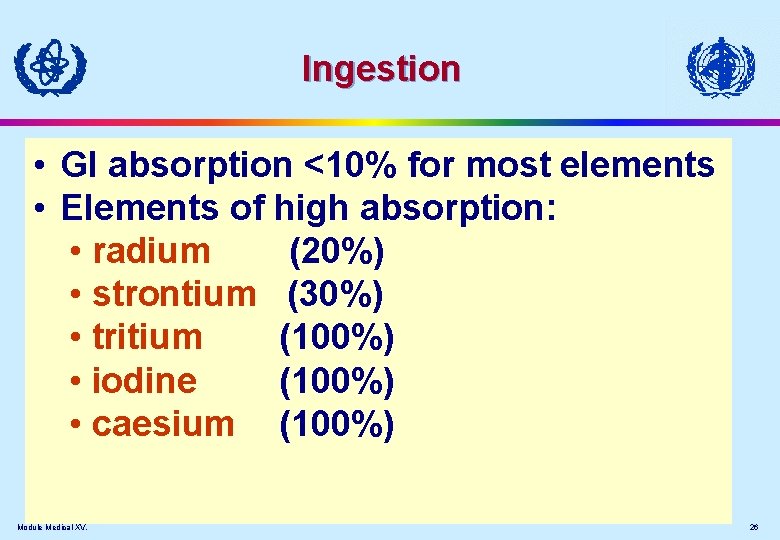
Ingestion • GI absorption <10% for most elements • Elements of high absorption: • radium (20%) • strontium (30%) • tritium (100%) • iodine (100%) • caesium (100%) Module Medical XV. 26
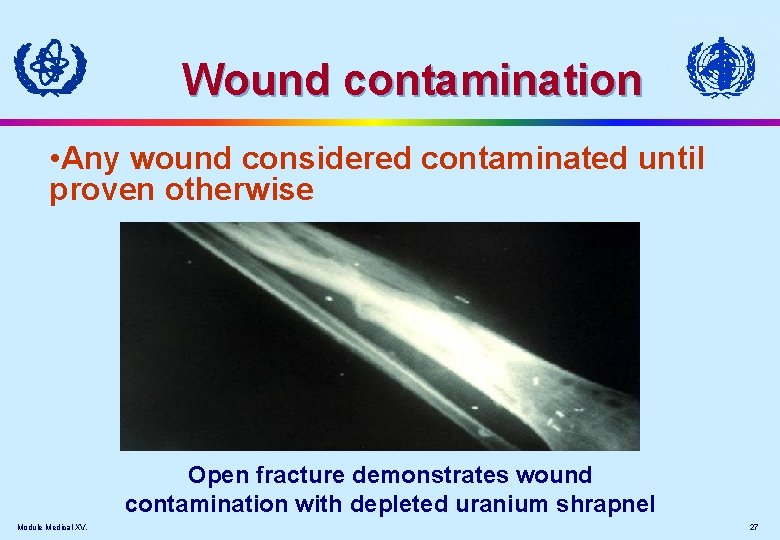
Wound contamination • Any wound considered contaminated until proven otherwise Open fracture demonstrates wound contamination with depleted uranium shrapnel Module Medical XV. 27
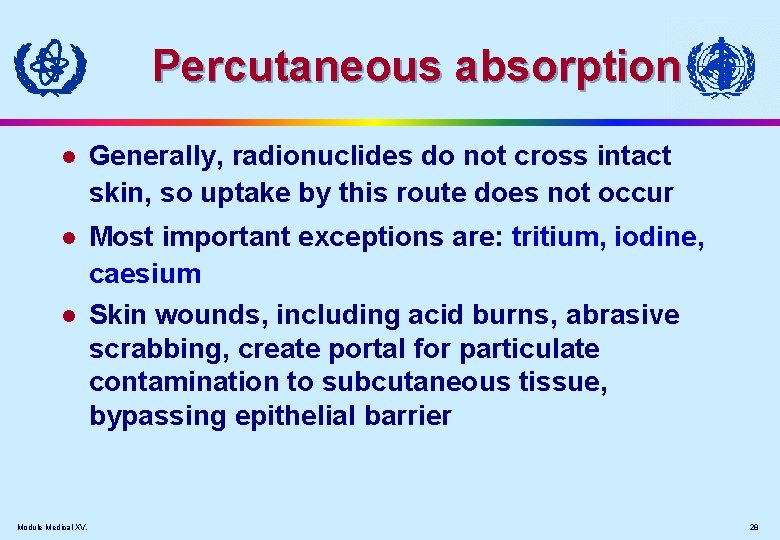
Percutaneous absorption l Generally, radionuclides do not cross intact skin, so uptake by this route does not occur l Most important exceptions are: tritium, iodine, caesium Skin wounds, including acid burns, abrasive scrabbing, create portal for particulate contamination to subcutaneous tissue, bypassing epithelial barrier l Module Medical XV. 28
Distribution and deposition Iodine Uranium Module Medical XV. 29
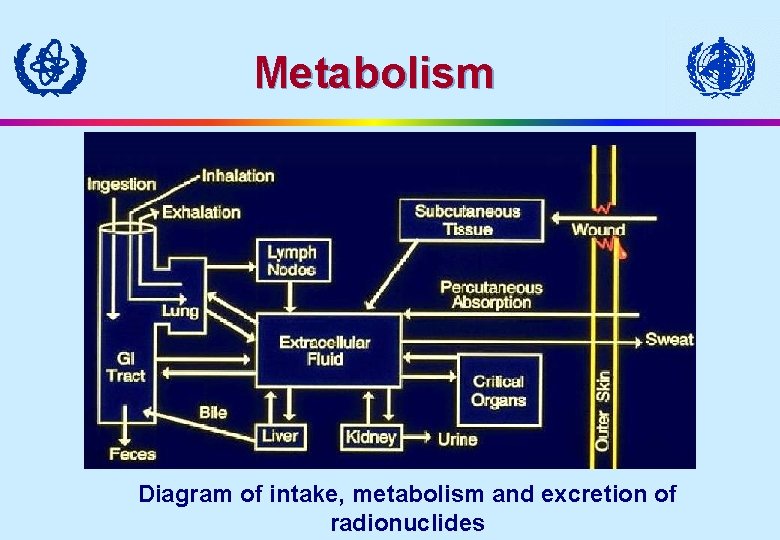
Metabolism Diagram of intake, metabolism and excretion of radionuclides
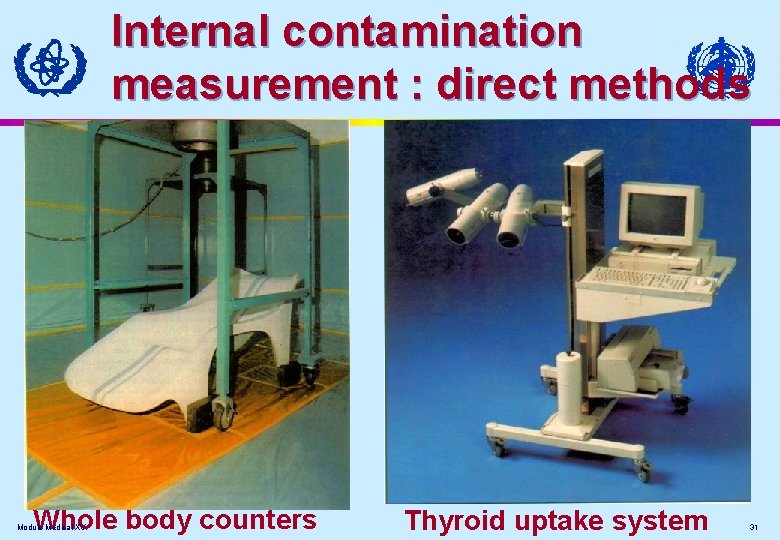
Internal contamination measurement : direct methods Whole body counters Module Medical XV. Thyroid uptake system 31
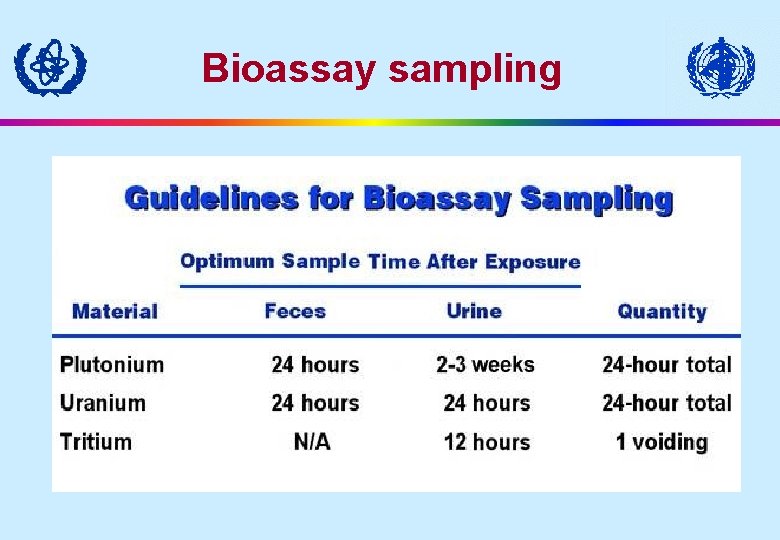
Indirect contamination measurement l l l Indirect measurement of contamination includes nasal swipes to determine respiratory intake of radioactive aerosols, and also urine and faeces sampling to establish internal contamination Alpha and beta emitters, the most hazardous internal contaminants, detected through bioassay sampling Accurate bioassays require carefully executed sampling over time and knowledge of type and time of contamination
Bioassay sampling
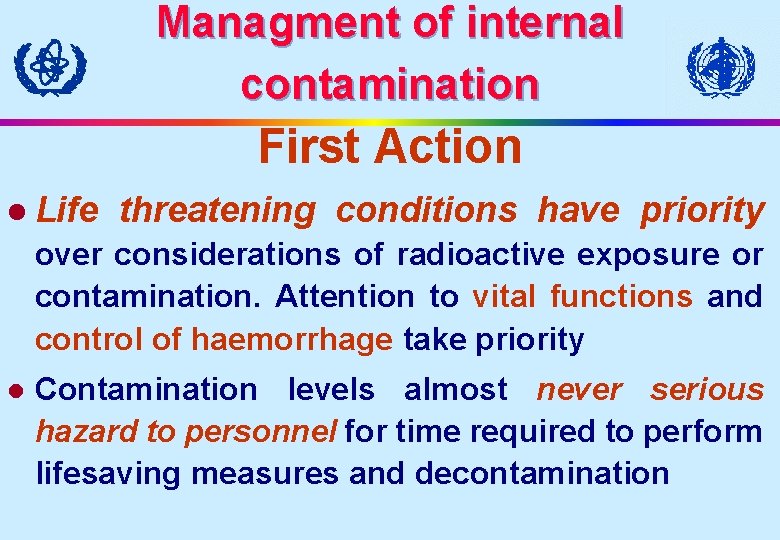
Managment of internal contamination First Action l Life threatening conditions have priority over considerations of radioactive exposure or contamination. Attention to vital functions and control of haemorrhage take priority l Contamination levels almost never serious hazard to personnel for time required to perform lifesaving measures and decontamination
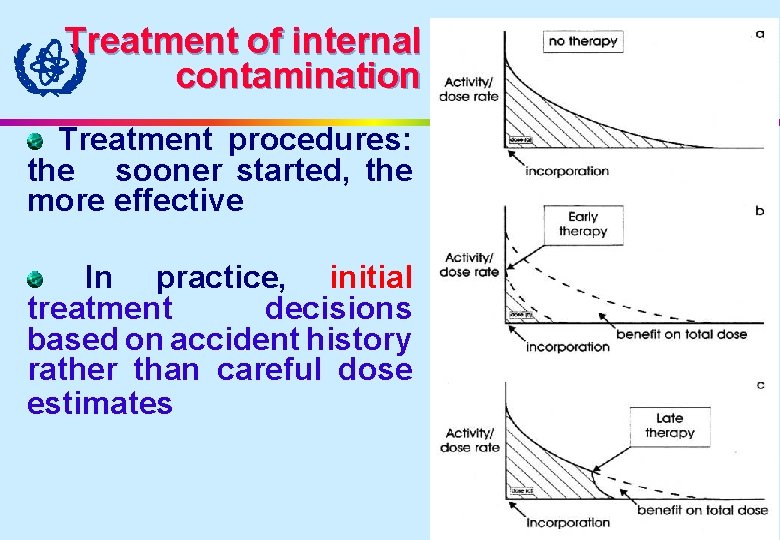
Treatment of internal contamination Treatment procedures: the sooner started, the more effective In practice, initial treatment decisions based on accident history rather than careful dose estimates
Basic principles of treatment reduce absorption and internal deposition l enhance excretion of absorbed contaminants l Module Medical XV. 36
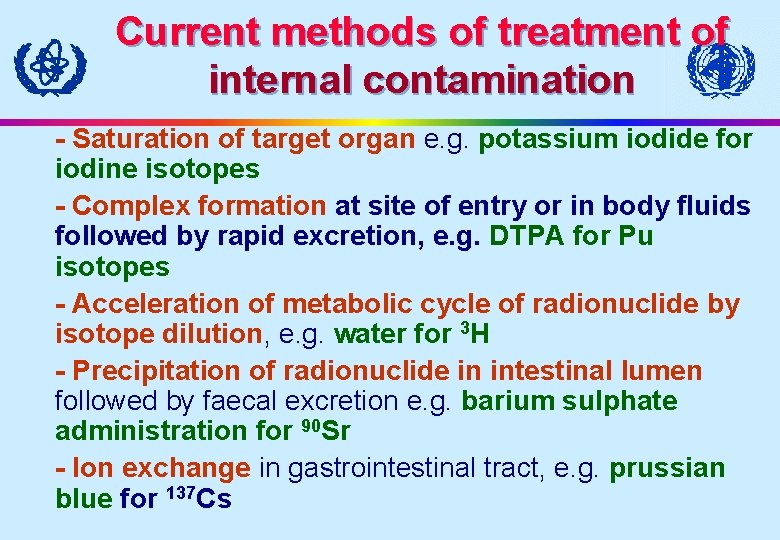
Current methods of treatment of internal contamination - Saturation of target organ e. g. potassium iodide for iodine isotopes - Complex formation at site of entry or in body fluids followed by rapid excretion, e. g. DTPA for Pu isotopes - Acceleration of metabolic cycle of radionuclide by isotope dilution, e. g. water for 3 H - Precipitation of radionuclide in intestinal lumen followed by faecal excretion e. g. barium sulphate administration for 90 Sr - Ion exchange in gastrointestinal tract, e. g. prussian blue for 137 Cs
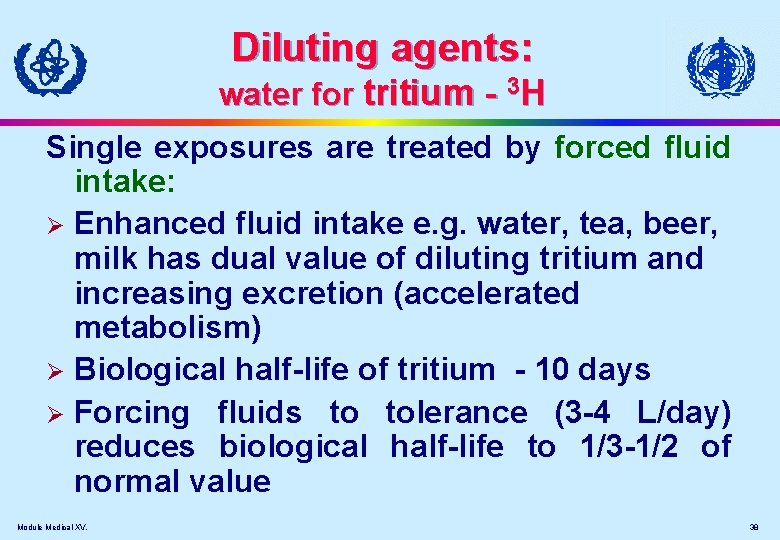
Diluting agents: water for tritium - 3 H Single exposures are treated by forced fluid intake: Ø Enhanced fluid intake e. g. water, tea, beer, milk has dual value of diluting tritium and increasing excretion (accelerated metabolism) Ø Biological half-life of tritium - 10 days Ø Forcing fluids to tolerance (3 -4 L/day) reduces biological half-life to 1/3 -1/2 of normal value Module Medical XV. 38
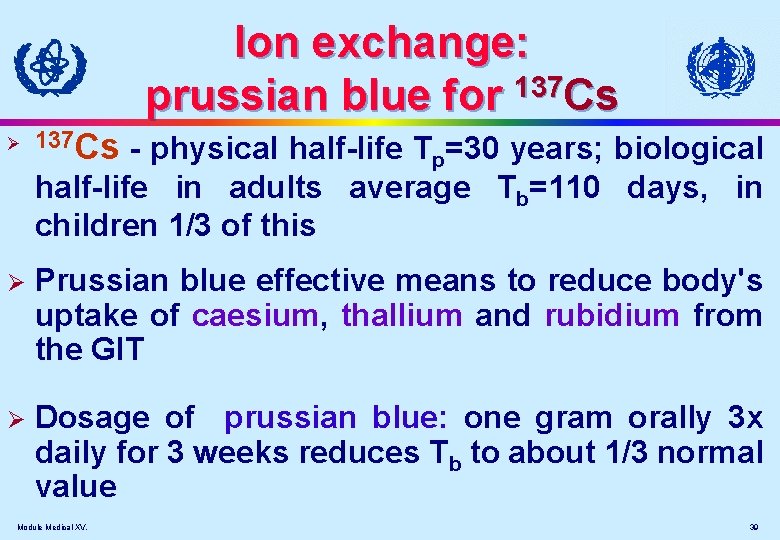
Ion exchange: prussian blue for 137 Cs Ø Prussian blue effective means to reduce body's uptake of caesium, thallium and rubidium from the GIT Ø Dosage of prussian blue: one gram orally 3 x daily for 3 weeks reduces Tb to about 1/3 normal value - physical half-life Tp=30 years; biological half-life in adults average Tb=110 days, in children 1/3 of this Module Medical XV. 39
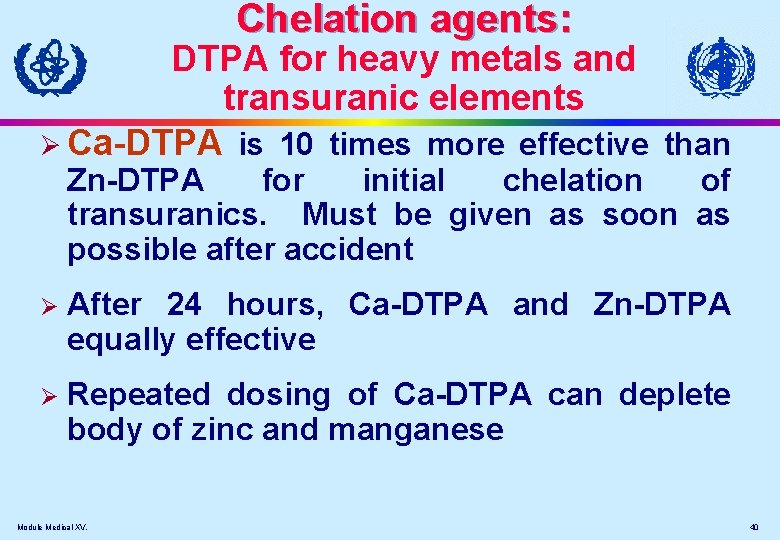
Chelation agents: DTPA for heavy metals and transuranic elements Ø Ca-DTPA is 10 times more effective than Zn-DTPA for initial chelation of transuranics. Must be given as soon as possible after accident Ø After 24 hours, Ca-DTPA and Zn-DTPA equally effective Ø Repeated dosing of Ca-DTPA can deplete body of zinc and manganese Module Medical XV. 40
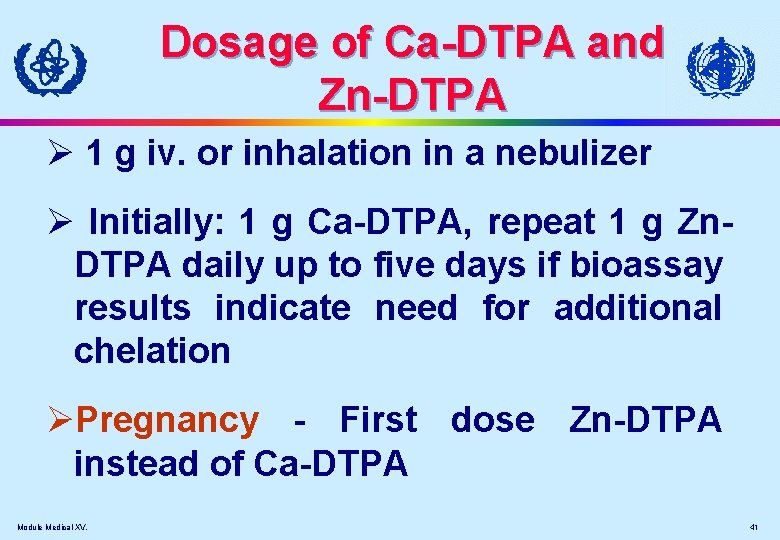
Dosage of Ca-DTPA and Zn-DTPA Ø 1 g iv. or inhalation in a nebulizer Ø Initially: 1 g Ca-DTPA, repeat 1 g Zn. DTPA daily up to five days if bioassay results indicate need for additional chelation ØPregnancy - First dose Zn-DTPA instead of Ca-DTPA Module Medical XV. 41
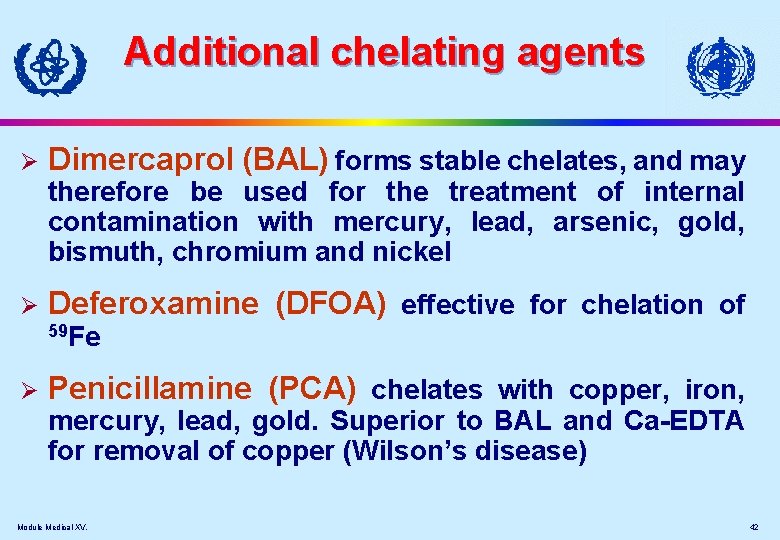
Additional chelating agents Ø Dimercaprol (BAL) forms stable chelates, and may therefore be used for the treatment of internal contamination with mercury, lead, arsenic, gold, bismuth, chromium and nickel Ø Deferoxamine (DFOA) effective for chelation of 59 Fe Ø Penicillamine (PCA) chelates with copper, iron, mercury, lead, gold. Superior to BAL and Ca-EDTA for removal of copper (Wilson’s disease) Module Medical XV. 42
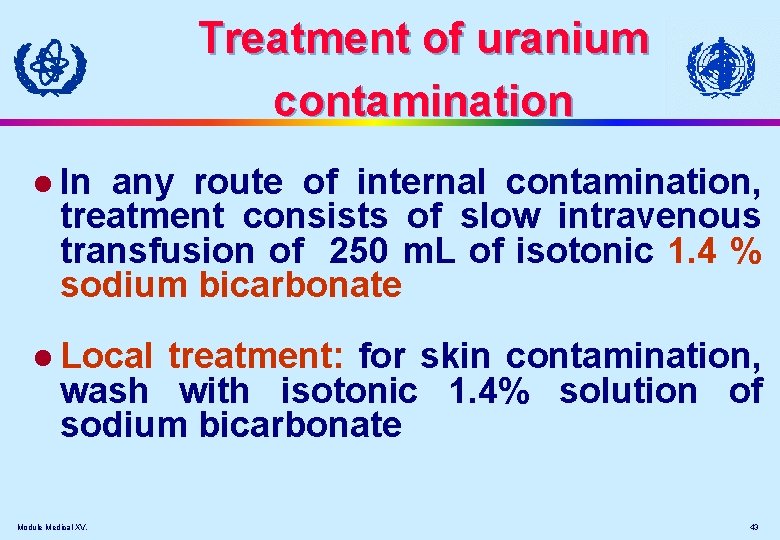
Treatment of uranium contamination l In any route of internal contamination, treatment consists of slow intravenous transfusion of 250 m. L of isotonic 1. 4 % sodium bicarbonate l Local treatment: for skin contamination, wash with isotonic 1. 4% solution of sodium bicarbonate Module Medical XV. 43
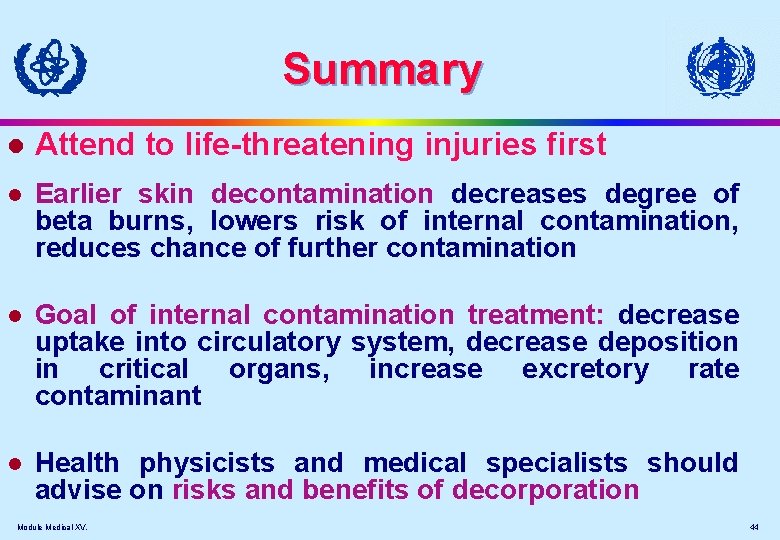
Summary l Attend to life-threatening injuries first l Earlier skin decontamination decreases degree of beta burns, lowers risk of internal contamination, reduces chance of further contamination l Goal of internal contamination treatment: decrease uptake into circulatory system, decrease deposition in critical organs, increase excretory rate contaminant l Health physicists and medical specialists should advise on risks and benefits of decorporation Module Medical XV. 44