
External Accountability Supreme Audit Institutions Budget Execution Course
External Accountability Supreme Audit Institutions Budget Execution Course January 10 -11, 2004 Anne Mondoloni, OPCFM-AFTFM
Overview n n n What is an SAI ? The Lima Declaration theory and practices Regional perspectives What is INTOSAI ? World Bank Strategy to support and strengthen SAIs
What is a Supreme Audit Institution ? The national audit body, independent of the executive, that issues reports on the use of public funds for the Legislature and Public
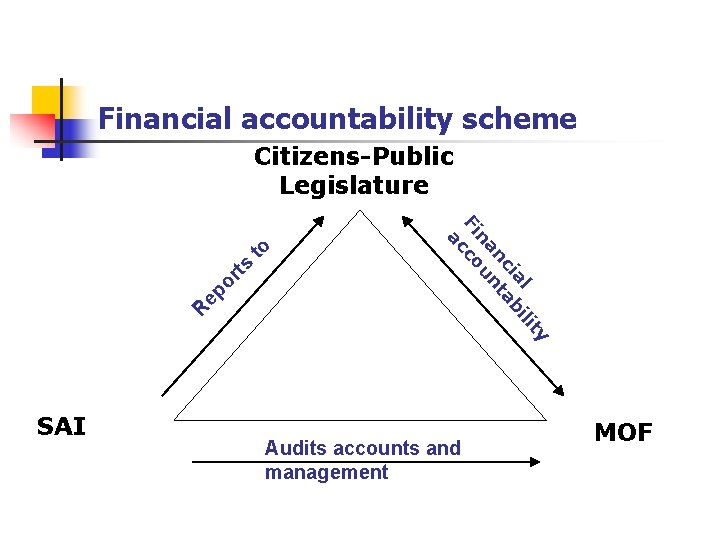
Financial accountability scheme s rt ep o R l i ia b nc nta na u Fi co ac to Citizens-Public Legislature y lit SAI Audits accounts and management MOF
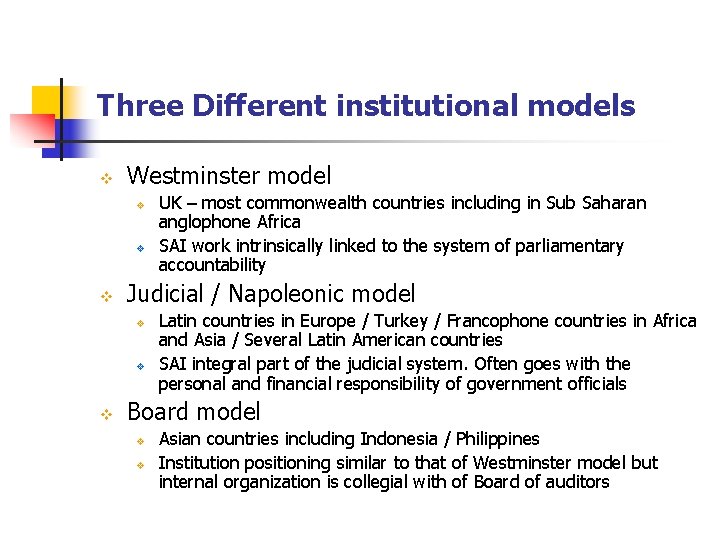
Three Different institutional models v Westminster model v v v Judicial / Napoleonic model v v v UK – most commonwealth countries including in Sub Saharan anglophone Africa SAI work intrinsically linked to the system of parliamentary accountability Latin countries in Europe / Turkey / Francophone countries in Africa and Asia / Several Latin American countries SAI integral part of the judicial system. Often goes with the personal and financial responsibility of government officials Board model v v Asian countries including Indonesia / Philippines Institution positioning similar to that of Westminster model but internal organization is collegial with of Board of auditors
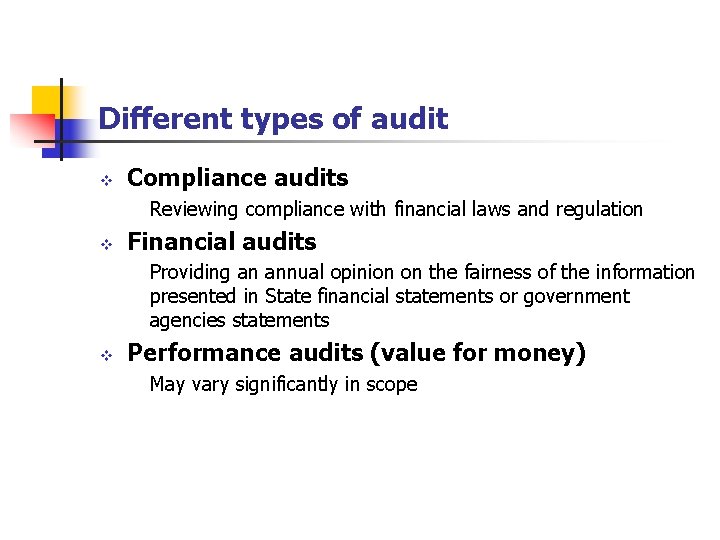
Different types of audit v Compliance audits Reviewing compliance with financial laws and regulation v Financial audits Providing an annual opinion on the fairness of the information presented in State financial statements or government agencies statements v Performance audits (value for money) May vary significantly in scope
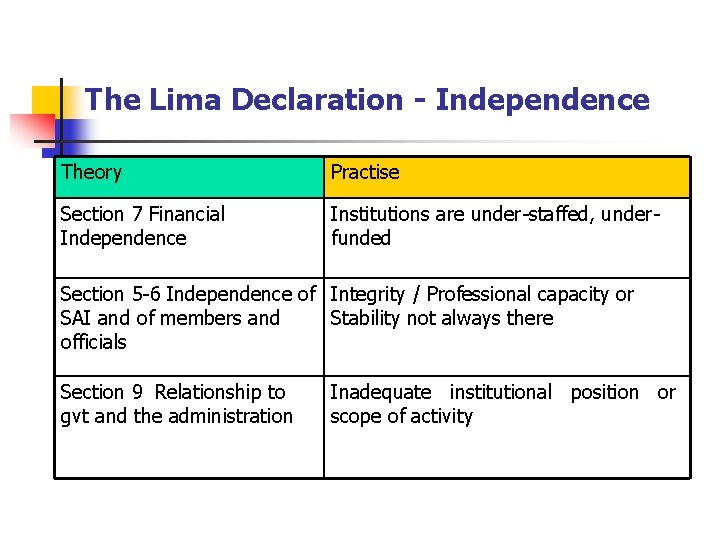
The Lima Declaration - Independence Theory Practise Section 7 Financial Independence Institutions are under-staffed, underfunded Section 5 -6 Independence of Integrity / Professional capacity or SAI and of members and Stability not always there officials Section 9 Relationship to gvt and the administration Inadequate institutional position or scope of activity
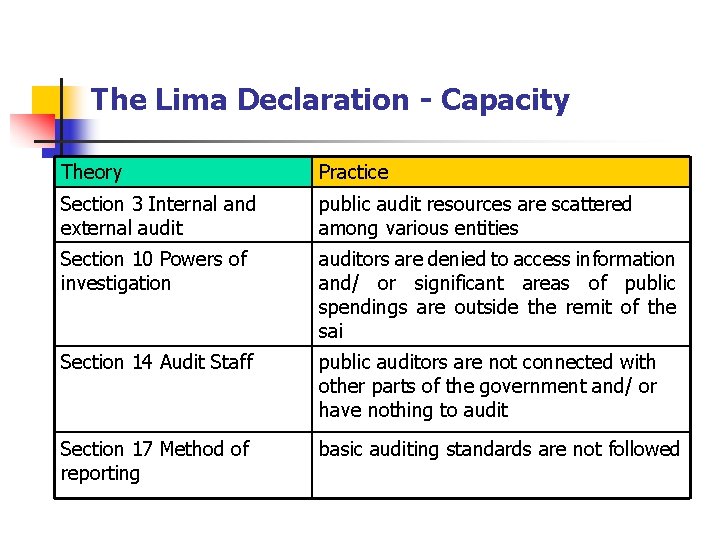
The Lima Declaration - Capacity Theory Practice Section 3 Internal and external audit public audit resources are scattered among various entities Section 10 Powers of investigation auditors are denied to access information and/ or significant areas of public spendings are outside the remit of the sai Section 14 Audit Staff public auditors are not connected with other parts of the government and/ or have nothing to audit Section 17 Method of reporting basic auditing standards are not followed
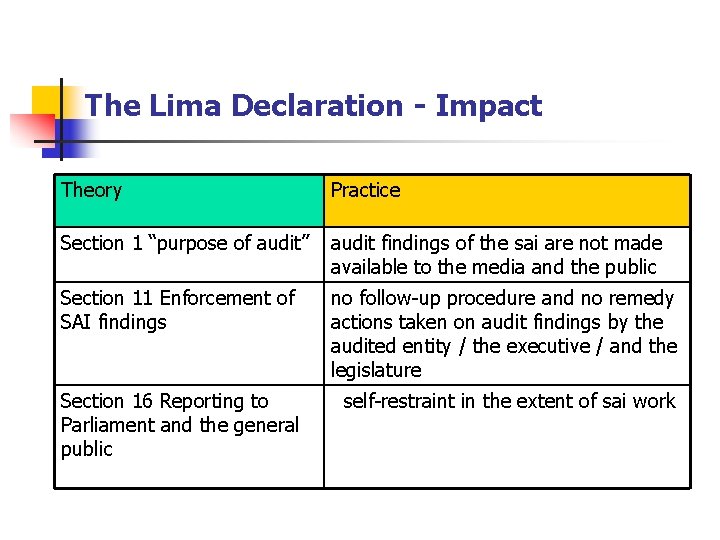
The Lima Declaration - Impact Theory Practice Section 1 “purpose of audit” audit findings of the sai are not made available to the media and the public Section 11 Enforcement of SAI findings no follow-up procedure and no remedy actions taken on audit findings by the audited entity / the executive / and the legislature Section 16 Reporting to Parliament and the general public self-restraint in the extent of sai work
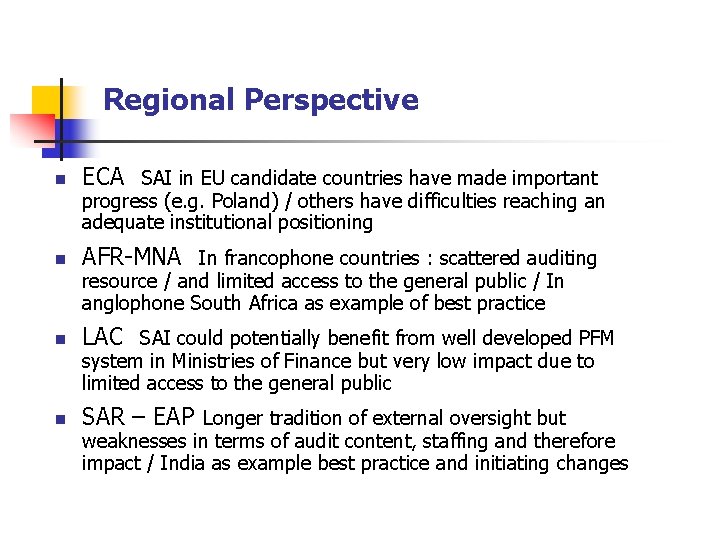
Regional Perspective n ECA SAI in EU candidate countries have made important n AFR-MNA In francophone countries : scattered auditing n LAC SAI could potentially benefit from well developed PFM n SAR – EAP Longer tradition of external oversight but progress (e. g. Poland) / others have difficulties reaching an adequate institutional positioning resource / and limited access to the general public / In anglophone South Africa as example of best practice system in Ministries of Finance but very low impact due to limited access to the general public weaknesses in terms of audit content, staffing and therefore impact / India as example best practice and initiating changes
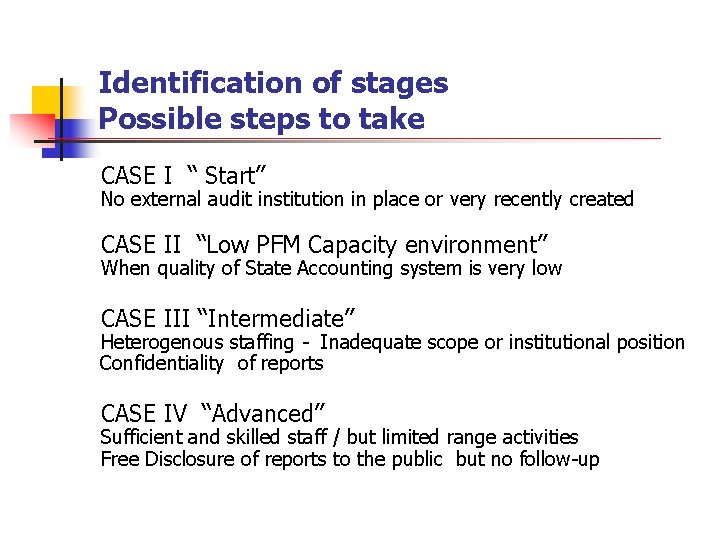
Identification of stages Possible steps to take CASE I “ Start” No external audit institution in place or very recently created CASE II “Low PFM Capacity environment” When quality of State Accounting system is very low CASE III “Intermediate” Heterogenous staffing - Inadequate scope or institutional position Confidentiality of reports CASE IV “Advanced” Sufficient and skilled staff / but limited range activities Free Disclosure of reports to the public but no follow-up
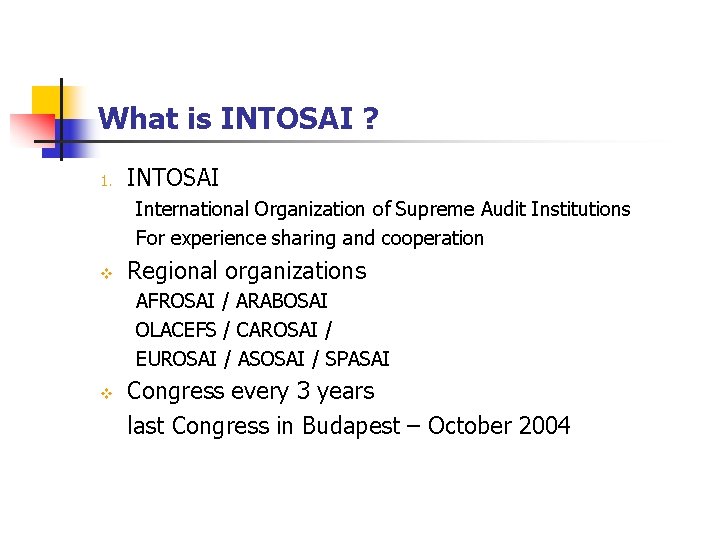
What is INTOSAI ? 1. INTOSAI International Organization of Supreme Audit Institutions For experience sharing and cooperation v Regional organizations AFROSAI / ARABOSAI OLACEFS / CAROSAI / EUROSAI / ASOSAI / SPASAI v Congress every 3 years last Congress in Budapest – October 2004
Outcomes of 2004 XVIII INTOSAI Congress 1. INTOSAI has adopted a Strategic Plan, that include a mission statement, a “vision” and a set of goals among which : 1. 2. 3. Accountability and Professional Standards as Goal 1 Institutional capacity building as Goal 2 Creation of a Working Group or Committee on SAI capacity building Full alignment with Bank’s SAI approach
Strategy paper : Objective Provide an overarching framework on how to make the most out of the commonality of interests between SAIs and donor agencies – which is based on ensuring that public / development funds are used in an effective manner to reduce poverty and are properly accounted for.
Strategy Paper : key ideas (1/2) v v Dealing with SAIs as potential partners in bringing about results, rather than as remote oversight institutions Advocacy / Policy dialogue v v need to work on acceptance by the executive branch / government of a relevant– independent external scrutiny of its management of public funds Leveraging the Bank’s portfolio v “acceptability” issue to be used as opportunity to engage dialogue / training program for enhancement of audit capacity
Strategy Paper : key ideas (2/2) Draw on external expertise through partnerships v with INTOSAI and its members v v Build on on-going initiatives within the SAI community that deal with SAI capacity building – Large amount of on-going bilateral cooperation among SAIs Support SAI capacity to audit budget execution v v On area of particular interest SAI – as the sole public auditor for annual state budgets – is the main source of information for citizens, the legislature, the government and ultimately for development partners. In line with new OP 8. 60 need for specific support in carrying out Financial Audit of State Accounts (Budget execution)
Lessons learned v v The need for a comprehensive approach of Public financial management Freedom of disclosure of reports as a necessary condition for having impact v Role of the Ministry of Finance and importance of the accounting system
For your consideration v v v Financial accountability and … Rule of Law ? Financial Accountability and… Corrupt environment ? Financial accountability and. . Authoritarian regimes ?
Thank you for your attention !
- Slides: 19