
Extent of Training of the Infection Prevention Contact
- Slides: 1
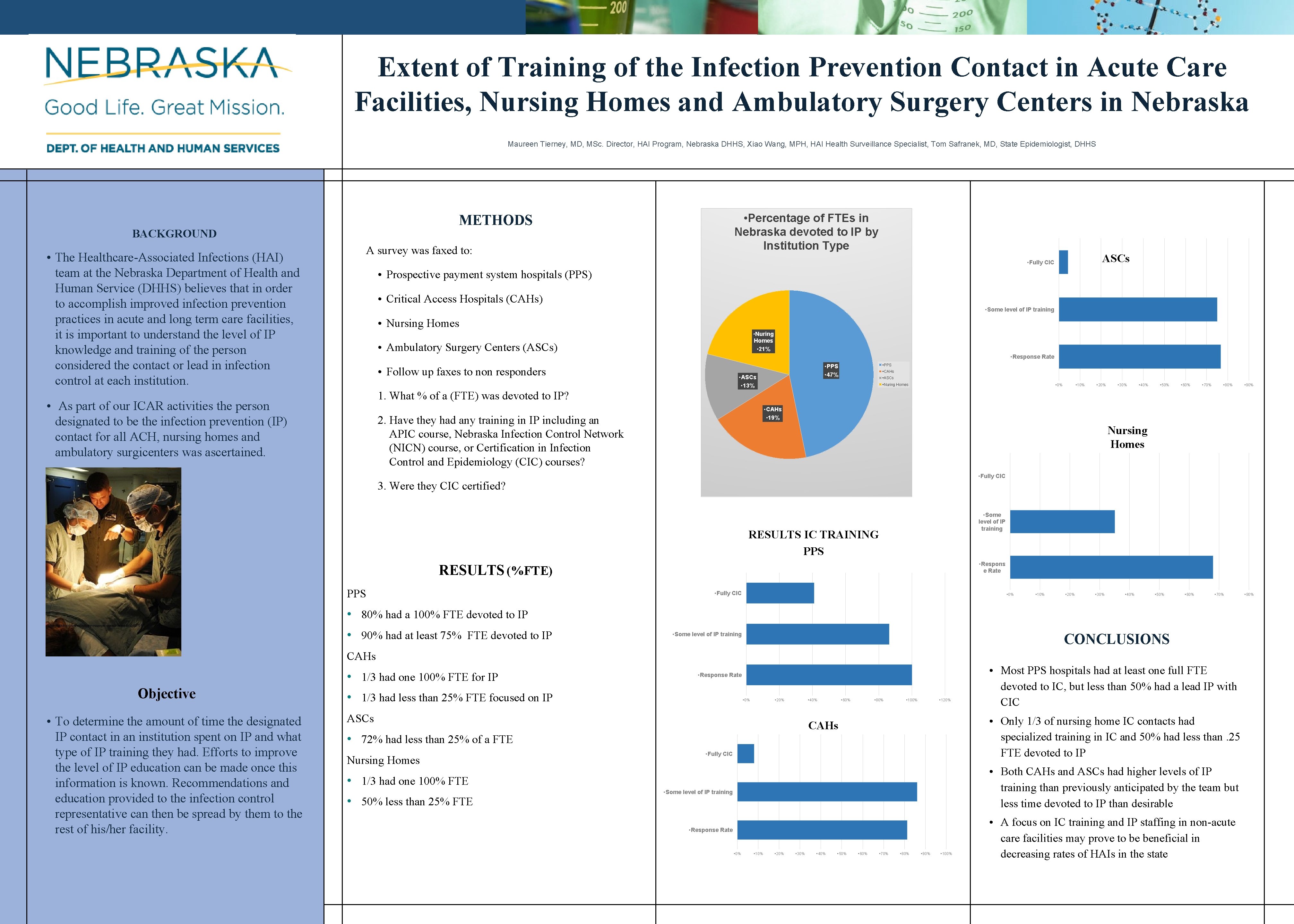
 Extent of Training of the Infection Prevention Contact in Acute Care Facilities, Nursing Homes and Ambulatory Surgery Centers in Nebraska Maureen Tierney, MD, MSc. Director, HAI Program, Nebraska DHHS, Xiao Wang, MPH, HAI Health Surveillance Specialist, Tom Safranek, MD, State Epidemiologist, DHHS BACKGROUND • The Healthcare-Associated Infections (HAI) team at the Nebraska Department of Health and Human Service (DHHS) believes that in order to accomplish improved infection prevention practices in acute and long term care facilities, it is important to understand the level of IP knowledge and training of the person considered the contact or lead in infection control at each institution. • Percentage of FTEs in Nebraska devoted to IP by Institution Type METHODS A survey was faxed to: ASCs • Fully CIC • Prospective payment system hospitals (PPS) • Critical Access Hospitals (CAHs) • Some level of IP training • Nursing Homes • Nuring Homes • 21% • Ambulatory Surgery Centers (ASCs) • Response Rate • Follow up faxes to non responders • PPS • 47% • ASCs • 13% • CAHs • ASCs • Nuring Homes • 0% • 10% • 20% • 30% • 40% • 50% • 60% • 70% • 80% 1. What % of a (FTE) was devoted to IP? • As part of our ICAR activities the person designated to be the infection prevention (IP) contact for all ACH, nursing homes and ambulatory surgicenters was ascertained. • CAHs • 19% 2. Have they had any training in IP including an APIC course, Nebraska Infection Control Network (NICN) course, or Certification in Infection Control and Epidemiology (CIC) courses? Nursing Homes • Fully CIC 3. Were they CIC certified? • Some level of IP training RESULTS IC TRAINING PPS • Respons e Rate RESULTS (%FTE) PPS • Fully CIC • 0% • 10% • 20% • 30% • 40% • 50% • 60% • 70% • 80% had a 100% FTE devoted to IP • https: //pixabay. com/en/surgery-surgeons-operation-medical-857140/ • 90% had at least 75% FTE devoted to IP • Some level of IP training CONCLUSIONS CAHs • 1/3 had one 100% FTE for IP Objective • To determine the amount of time the designated IP contact in an institution spent on IP and what type of IP training they had. Efforts to improve the level of IP education can be made once this information is known. Recommendations and education provided to the infection control representative can then be spread by them to the rest of his/her facility. • 90% • Response Rate • 1/3 had less than 25% FTE focused on IP • 0% • 20% • 40% ASCs • 80% • 100% • 120% • Only 1/3 of nursing home IC contacts had specialized training in IC and 50% had less than. 25 FTE devoted to IP CAHs • 72% had less than 25% of a FTE Nursing Homes • 60% • Fully CIC • Both CAHs and ASCs had higher levels of IP training than previously anticipated by the team but less time devoted to IP than desirable • 1/3 had one 100% FTE • 50% less than 25% FTE • Most PPS hospitals had at least one full FTE devoted to IC, but less than 50% had a lead IP with CIC • Some level of IP training • Response Rate • 0% • 10% • 20% • 30% • 40% • 50% • 60% • 70% • 80% • 90% • 100% • A focus on IC training and IP staffing in non-acute care facilities may prove to be beneficial in decreasing rates of HAIs in the state • 80%