
Extensiveform games applications n Stackelberg model n SpenceDixit
Extensive-form games: applications n Stackelberg model n Spence-Dixit model n Rubinstein bargaining model
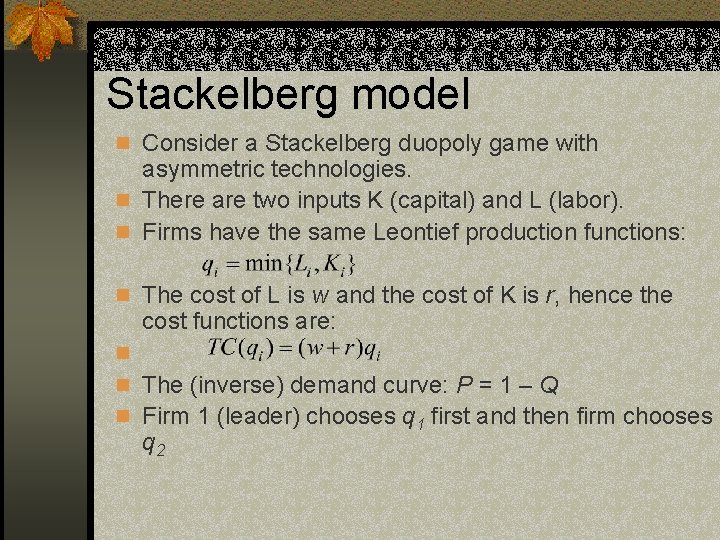
Stackelberg model n Consider a Stackelberg duopoly game with asymmetric technologies. n There are two inputs K (capital) and L (labor). n Firms have the same Leontief production functions: n The cost of L is w and the cost of K is r, hence the cost functions are: n n The (inverse) demand curve: P = 1 – Q n Firm 1 (leader) chooses q 1 first and then firm chooses q 2
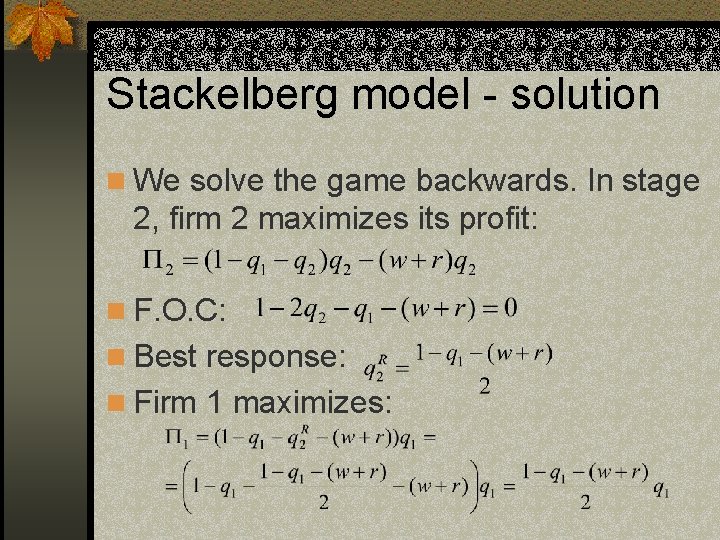
Stackelberg model - solution n We solve the game backwards. In stage 2, firm 2 maximizes its profit: n F. O. C: n Best response: n Firm 1 maximizes:
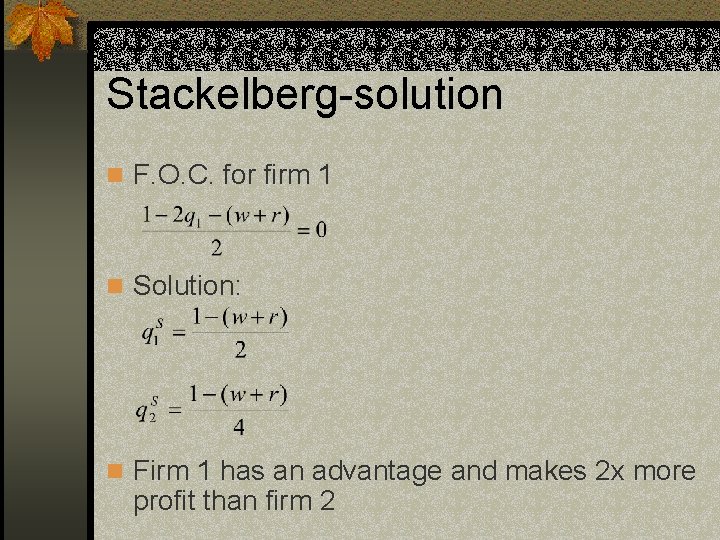
Stackelberg-solution n F. O. C. for firm 1 n Solution: n Firm 1 has an advantage and makes 2 x more profit than firm 2
Spence-Dixit model of entry deterrence n Step 1. An incumbent firm (1) chooses the capacity level k. Installing capacity costs r per unit. n Step 2. A potential entrant firm (2) decides whether to enter the market or not. If enters, pays the fixed cost F. n Step 3. Firm 1’s marginal cost is w for the first k units, and (w + r) for all units above k. If firm 2 stays out, firm 1 acts as a (static) monopolist. If firm 2 enters, they compete as in Cournot model, but firm 2’s marginal cost is (w + r) for all units.
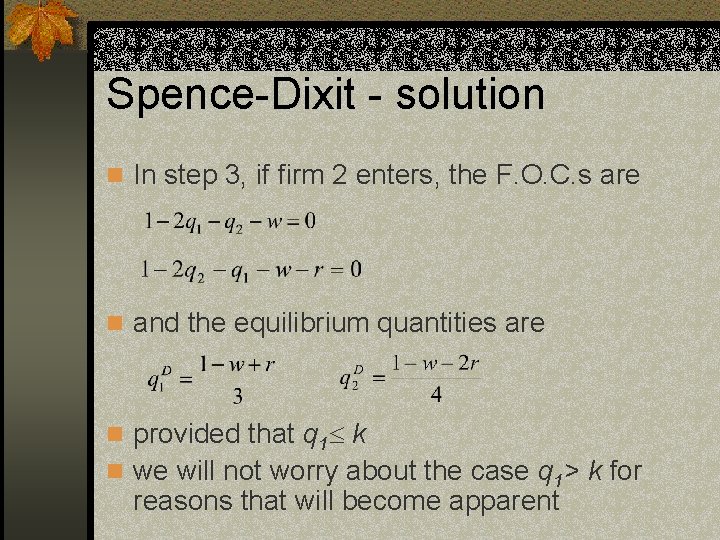
Spence-Dixit - solution n In step 3, if firm 2 enters, the F. O. C. s are n and the equilibrium quantities are n provided that q 1 k n we will not worry about the case q 1> k for reasons that will become apparent
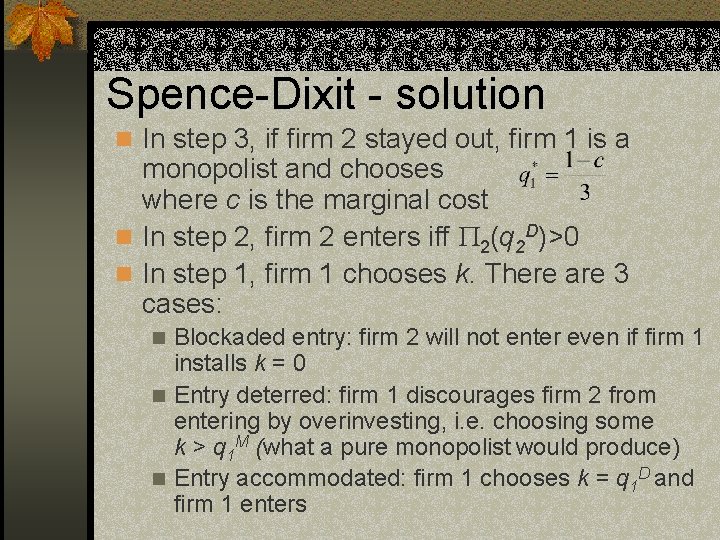
Spence-Dixit - solution n In step 3, if firm 2 stayed out, firm 1 is a monopolist and chooses where c is the marginal cost n In step 2, firm 2 enters iff 2(q 2 D)>0 n In step 1, firm 1 chooses k. There are 3 cases: Blockaded entry: firm 2 will not enter even if firm 1 installs k = 0 n Entry deterred: firm 1 discourages firm 2 from entering by overinvesting, i. e. choosing some k > q 1 M (what a pure monopolist would produce) n Entry accommodated: firm 1 chooses k = q 1 D and firm 1 enters n
Rubinstein bargaining model n This is a (potentially) infinitely repeated n n version of the ultimatum game Player 1 begins by offering a split of 1$ to player 2 Player 2 accepts or rejects If rejects, he makes the next offer of split, except the 1$ decreases to $ - discount factor Players alternate their offers until there is an agreement
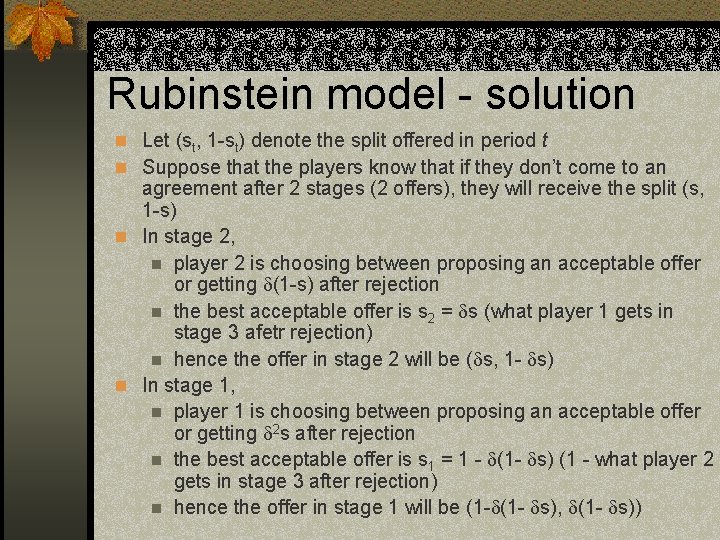
Rubinstein model - solution n Let (st, 1 -st) denote the split offered in period t n Suppose that the players know that if they don’t come to an agreement after 2 stages (2 offers), they will receive the split (s, 1 -s) n In stage 2, n player 2 is choosing between proposing an acceptable offer or getting (1 -s) after rejection n the best acceptable offer is s 2 = s (what player 1 gets in stage 3 afetr rejection) n hence the offer in stage 2 will be ( s, 1 - s) n In stage 1, n player 1 is choosing between proposing an acceptable offer or getting 2 s after rejection n the best acceptable offer is s 1 = 1 - (1 - s) (1 - what player 2 gets in stage 3 after rejection) n hence the offer in stage 1 will be (1 - s), (1 - s))
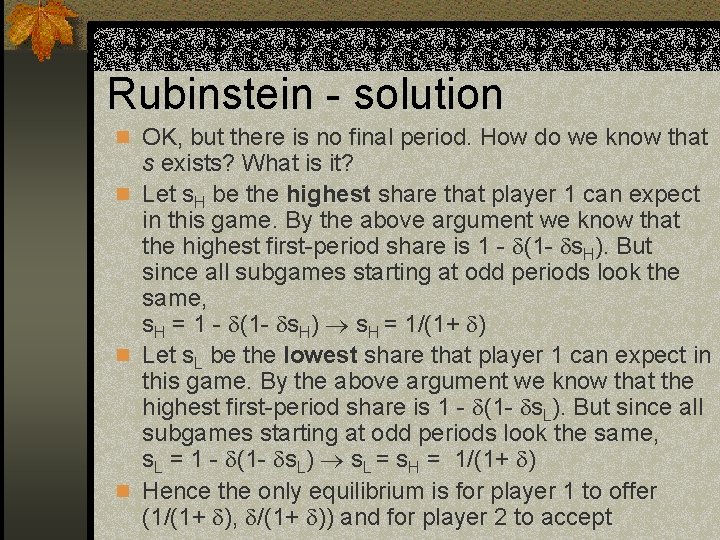
Rubinstein - solution n OK, but there is no final period. How do we know that s exists? What is it? n Let s. H be the highest share that player 1 can expect in this game. By the above argument we know that the highest first-period share is 1 - (1 - s. H). But since all subgames starting at odd periods look the same, s. H = 1 - (1 - s. H) s. H = 1/(1+ ) n Let s. L be the lowest share that player 1 can expect in this game. By the above argument we know that the highest first-period share is 1 - (1 - s. L). But since all subgames starting at odd periods look the same, s. L = 1 - (1 - s. L) s. L = s. H = 1/(1+ ) n Hence the only equilibrium is for player 1 to offer (1/(1+ ), /(1+ )) and for player 2 to accept
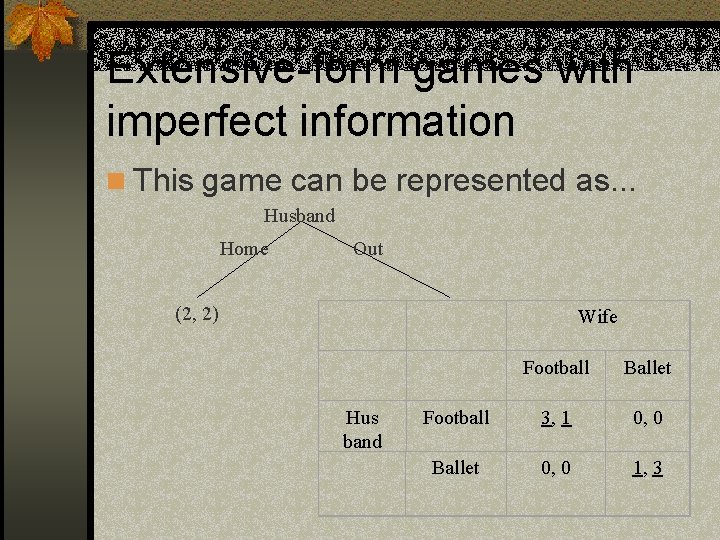
Extensive-form games with imperfect information n This game can be represented as. . . Husband Home (2, 2) Out Wife Football Ballet Hus band Football 3, 1 0, 0 Ballet 0, 0 1, 3
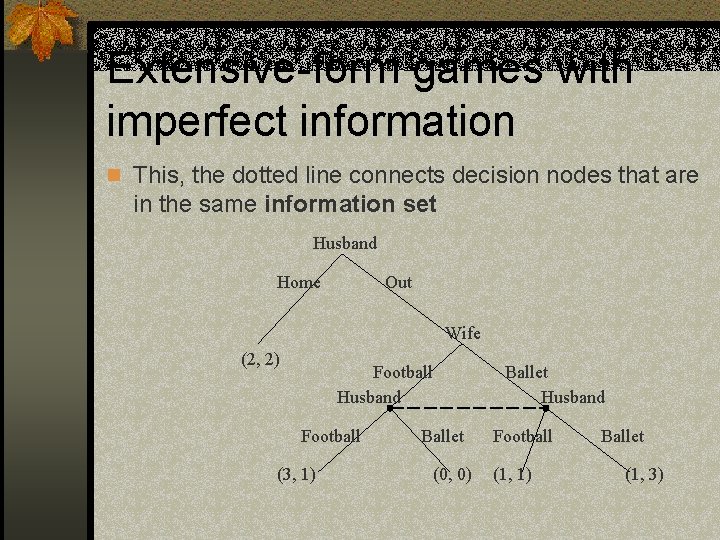
Extensive-form games with imperfect information n This, the dotted line connects decision nodes that are in the same information set Husband Home Out Wife (2, 2) Football Husband Football (3, 1) Ballet Husband Ballet (0, 0) Football (1, 1) Ballet (1, 3)
Repeated games n This is a special class of games in extensive form n An identical „stage game” is repeated several times n The payoffs are paid out after each „stage game” n The payoffs from future period are discounted ( the payoff u in period t is worth tu now)
Rubinstein - solution n Notation
Finitely Repeated Games: An Example
- Slides: 15