
Extension services and mobile units Dr Deepak Kumar
Extension services and mobile units Dr. Deepak Kumar Assist. Prof. COP, SV
Objectives �At the end of the lecture the students will be able to: �Describe in brief about Extension services �Explain in short about the mobile units

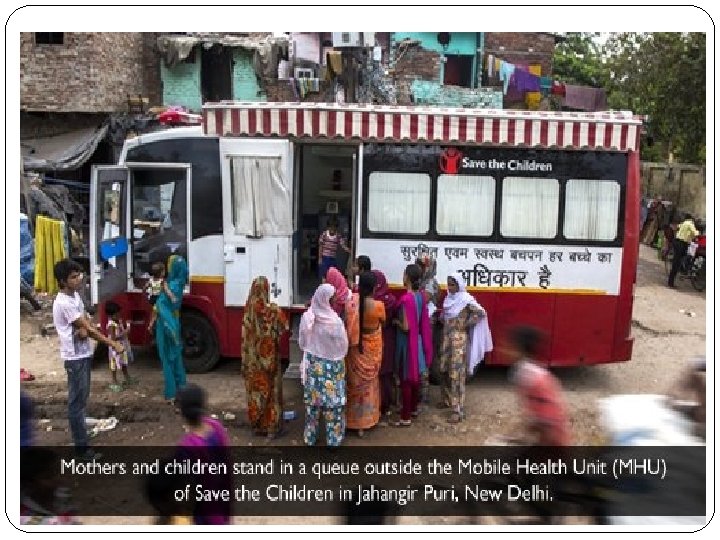
Mobile Medical Units (MMUs) �One major initiative under the NRHM was the operationalization of Mobile Medical Units (MMUs) to provide a range of health care services for populations living in remote, inaccessible, un-served and underserved areas mainly with the objective of taking healthcare service delivery to the doorsteps of these populations. �With the launch of NUHM, the MMUs services are also intended to cater to the urban poor and vulnerable population and provide fixed services in areas where there is no infrastructure.
Target Geography �In urban areas, MMUs would be deployed where there are habitations of marginalized communities (ragpickers, homeless, migrants) that live on the periphery of cities and towns, alongside highways just outside cities, or along railway tracks and under flyovers and bridges. �These are also often areas where dispensaries or Urban PHCs do not exist, and even if they do they are just not accessible to such populations. �The MMU could also be deployed in localities where slum populations live and where there is simply no space for creating fixed infrastructure.
�In rural areas, MMUs would continue to be deployed in areas with limited or a complete lack of access to health care services. Such areas include Tribal Areas, Conflict Affected Areas, Hilly and Desert Areas/Islands/flood affected and snow bound.
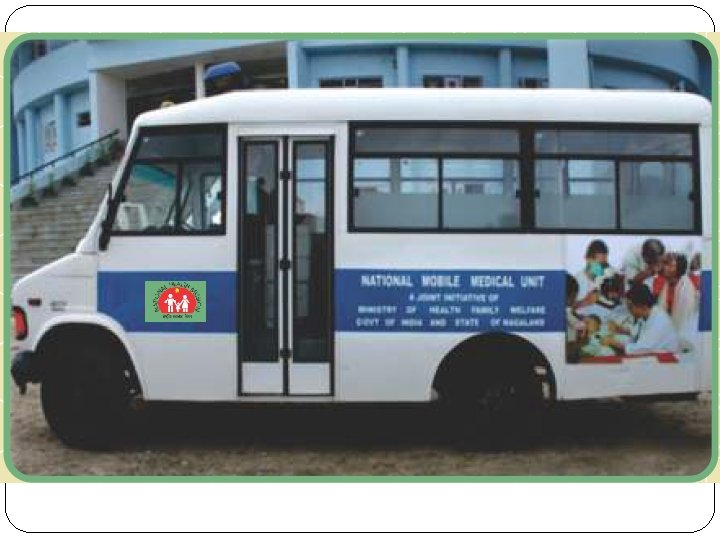
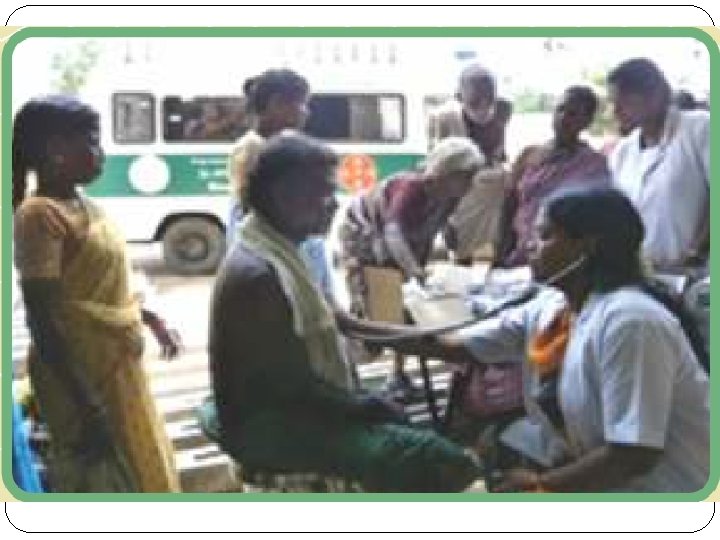
Nature of Services to be provided by an MMU An MMU is supposed to provide the following: �(i) Outreach services by ANMs in areas where no outreach services exist �(ii) Broader set of clinical services by a Medical Officer and her/his team, with ANM/ ASHA playing a mobilization role, (one vehicle outfitted as an outpatient clinic, with examination table, light and sufficient facilities for basic lab investigations and a second vehicle for team transport. �(iii) Facilitate referral back-up to a functional primary health care system and specialist services as required.
Type of Service Provided �Mobile Medical Units are envisaged to provide primary care services for common diseases including communicable and noncommunicable diseases, RCH (reproductive health and child health) services, carry out screening activities and provide referral linkage to appropriate higher faculties. �The services provided would of necessity be preventive, promotive and outpatient curative care. Where there are cases needing acute medical care on the day the MMU reaches the site, such care would be provided and patient referral organized.
In addition, the MMU is also expected to: �provide point of care diagnostics: Blood glucose, pregnancy testing, urine microscopy, albumin and sugar, Hb, Height/Weight, vision testing, �collect sputum/blood/urine samples, �screen populations over 35 years for Hypertension, Diabetes and Cancers annually and undertake follow-up checks during the monthly visit, including providing patients requiring drugs with a monthly supply (Hypertension, Diabetes, Epilepsy)
�work on a range of health topics like - improved preventive and promotive behaviours for maternal and child health, communicable diseases, including vector borne diseases, educate the community on lifestyle changes, the need for screening for non-communicable diseases, and early recognition and appropriate referral. �States can add on more services such as for eye care, dental care, etc.
Operational aspects of MMU �Officer-in-charge will be the Chief District Medical Officer at district level, who will be responsible for the operational aspects. �Rogi Kalyan Samitis will also be involved in operationalization of the MMU. �States can also explore the option of outsourcing the vehicle through public-private partnership with credible NGOs, which would follow the same norms, and be accountable for a similar set of services and outcomes.
�The Medical Officer in the nearest functional Primary Health Centre will provide support to the MMU team as required. Where there are functional sub centres, in these areas, the ANMs would be available on the day of the MMU visit to provide support. Referrals should be made to the nearest CHC, or DHC. �The planning and dissemination of the MMU route map is the responsibility of the CMO with support from the District team.
� Depending on distances, the MMU could make upto one visit a day to distant villages, planning for four hour travel time and about four to five hours in a given site. � For shorter distances additional villages could be covered, but these are to be planned based on local context. � The principle is regularity, with every area being visited on the same day in each month and preceded by active mobilization with a well publicized monthly schedule of visits through loudspeakers, announcements, etc. � While the MMU could work a six day week, Saturday and Sundays should compulsorily be
�The MMU may choose a service site in Villages with a weekly market/Haat or where people from nearby village clusters (which are otherwise inaccessible) tend to congregate. �In urban areas, the MMU should be located in the Mohallas or localities occupied by marginalised population. �If possible the services could be conducted in any adequate building with one or two rooms and toilets, such as an Anganwadi center or Panchayat Bhavan or primary school.
� Adequate arrangements for waiting area should be made by Gram Panchayat/village health sanitation and nutrition committee (VHSNC). � The ASHA and VHSNC would carry out the function of community mobilization, ensuring that people who need services are informed of the MMU schedule, can mobilize those in need of screening, those with communicable diseases or chronic conditions for follow up medical examinations, women in need of family planning services, children in need of medical care, follow up of children discharged from secondary or tertiary care facilities, and those with acute medical conditions.
�The MMU could also be used for natural or man-made calamities or in disaster situations and epidemics to provide services to affected populations. �The functioning of the MMUs in a district should be monitored regularly and be an essential part of the review by the CEO of the Zilla Parishad/District Collector. �Under the National Health Mission a universal name “National Medical Mobile Unit” along the colour coding has been prescribed. Adoption of a universal nomenclature with common colour scheme and design is intended to enhance its visibility and create better awareness amongst the target population.
� The currently approved norm is one MMU per district with a normative population of 10 lakhs, with a cap of five MMUs per district. This has been estimated as follows: a) District with population 10 lakhs- 1 MMU b) District with population of between 10 lakhs and 20 lakhs 2 MMUs. c) District with population of between 20 lakhs and 30 lakhs 3 MMUs d) District with population of between 30 lakhs and 40 lakhs-4 MMUs e) District with population of over 40 lakhs - 5 MMUs � This can be further relaxed for hilly and tribal areas, where the populations are widely dispersed and the geographical terrain is difficult.
Human Resources The suggested HR for an MMU is as under: �Medical Officer (MBBS only, preferably women) One �General Nurse Midwifery: One �Lab Technician: One �Pharmacist cum Administrative Assistant: One �Driver cum Support Staff: One �If additional services such as dental or ophthalmic services are being provided, including of paramedicals (ophthalmic assistant) in these fields may become necessary.
�If recruited on a contractual basis, salaries should be at par with the salaries of other staff and staff should receive additional benefits and hardship allowances (if any) in the particular districts (specifically tribal) as per the State’s policy. In case of medical officer or one of the staff going on leave, substitute officer could be appointed in those days. �For the MMUs that are operated by the State Government, staff should not be withdrawn from existing and functional facilities, which would render the facility dysfunctional.
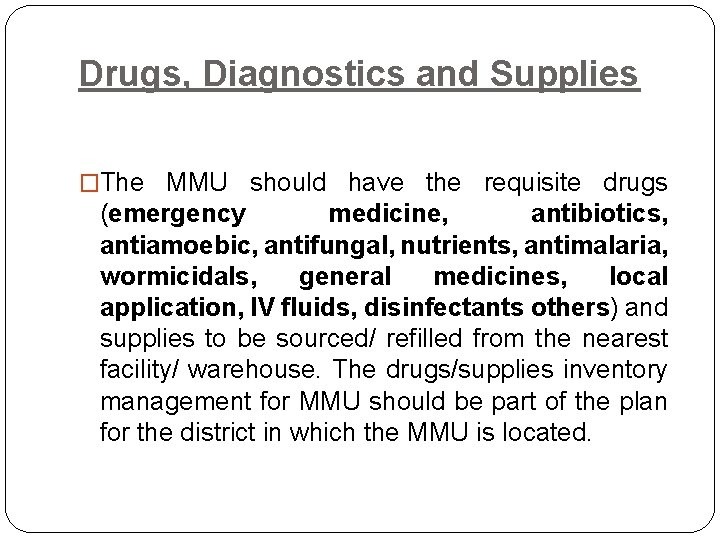
Drugs, Diagnostics and Supplies �The MMU should have the requisite drugs (emergency medicine, antibiotics, antiamoebic, antifungal, nutrients, antimalaria, wormicidals, general medicines, local application, IV fluids, disinfectants others) and supplies to be sourced/ refilled from the nearest facility/ warehouse. The drugs/supplies inventory management for MMU should be part of the plan for the district in which the MMU is located.
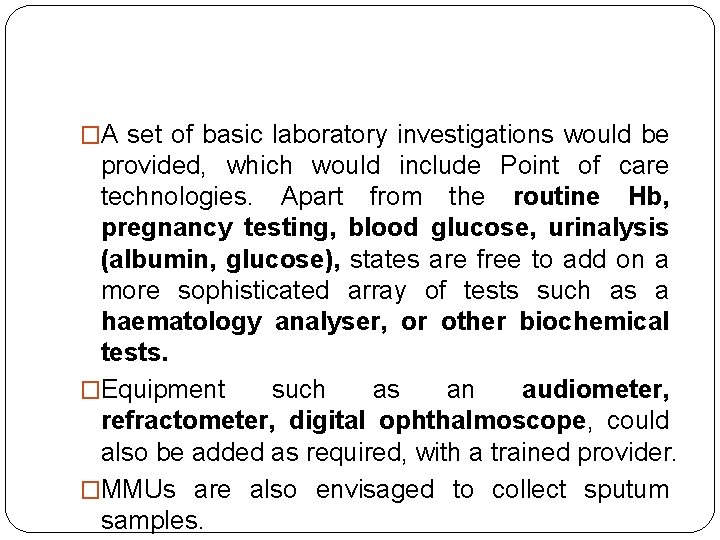
�A set of basic laboratory investigations would be provided, which would include Point of care technologies. Apart from the routine Hb, pregnancy testing, blood glucose, urinalysis (albumin, glucose), states are free to add on a more sophisticated array of tests such as a haematology analyser, or other biochemical tests. �Equipment such as an audiometer, refractometer, digital ophthalmoscope, could also be added as required, with a trained provider. �MMUs are also envisaged to collect sputum samples.
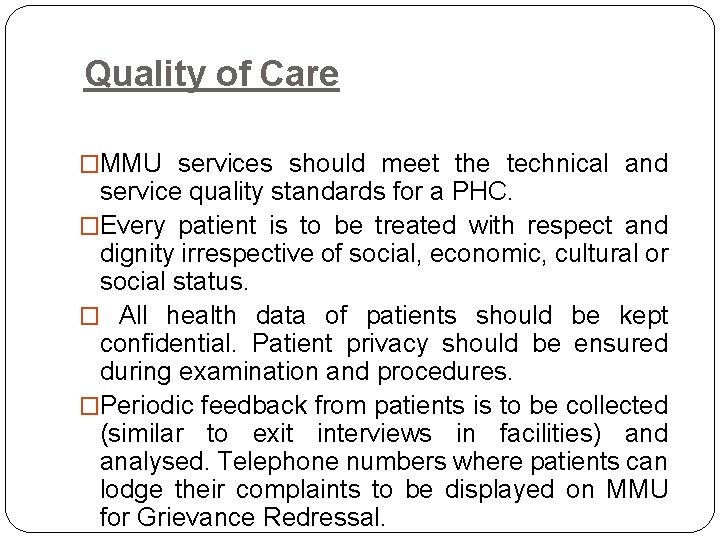
Quality of Care �MMU services should meet the technical and service quality standards for a PHC. �Every patient is to be treated with respect and dignity irrespective of social, economic, cultural or social status. � All health data of patients should be kept confidential. Patient privacy should be ensured during examination and procedures. �Periodic feedback from patients is to be collected (similar to exit interviews in facilities) and analysed. Telephone numbers where patients can lodge their complaints to be displayed on MMU for Grievance Redressal.
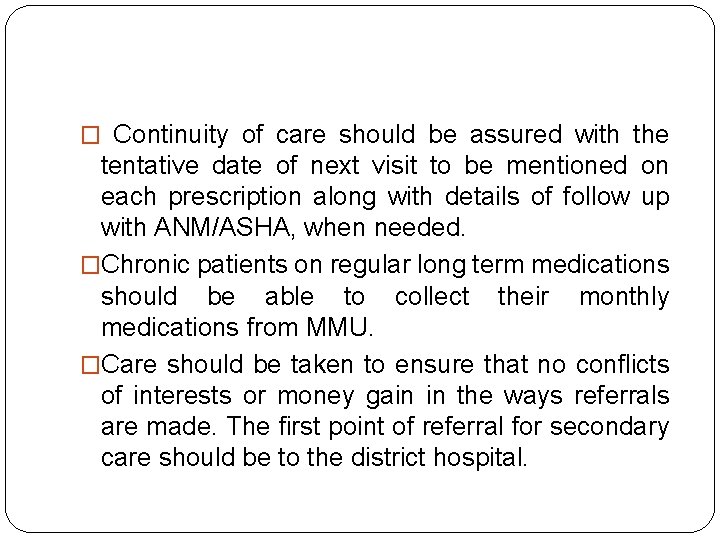
� Continuity of care should be assured with the tentative date of next visit to be mentioned on each prescription along with details of follow up with ANM/ASHA, when needed. �Chronic patients on regular long term medications should be able to collect their monthly medications from MMU. �Care should be taken to ensure that no conflicts of interests or money gain in the ways referrals are made. The first point of referral for secondary care should be to the district hospital.
Suggested Package of Services to be provided at MMU 1. Maternal Health 2. Neonatal and Infant Health ( 0 to 1 year old) 3. 4. 5. 6. Child and , Adolescent health, Reproductive health and Contraceptive Services, Management of chronic Communicable Diseases, Management of Common Communicable Diseases & Basic OPD care- (acute simple
7. Management of Common Non- Communicable 8. 9. 10. 11. Diseases- hypertension, diabetes, COPD etc. Dental Care, Eye Care/ENT care, Geriatric Care, Emergency Medicine- Snake bites, scorpion stings, insect bites, dog bites, Stabilization care in poisoning and referral first aid, trauma of any cause, Minor injury, abscess management
Extension services �Provided by an extension unit of health agency �Extension unit-A premise that is owned or rented by the rehabilitation agency from which services are rendered, is considered an extension unit of the rehabilitation agency. �An extension unit should be located sufficiently close to share administration, supervision, and services in a manner that renders it unnecessary for the extension location to independently meet the conditions of participation as a rehabilitation agency.
�Extension location -a location or site from which a rehabilitation agency provides services within a portion of the total geographic area served by the primary site. The extension location is part of the agency. �The extension location must be situated within a 30 mile (approx. 48 km) radius of where 90 percent of the agency’s primary site’s population lives. Sites beyond that area may require the location to be independently certified as a primary site. Consideration may be given for greater or shorter distances based on unusual geographic features.
�The extension services are the hospital services provided by the hospitals at the door steps of the beneficiaries. China’s concept of barefoot doctors or India’s National rural health mission encompassing immunization, nutrition services and implementation of reproductive and child health services and national health programmes are the living examples of extension services of hospital duties.
Extension services provided by extension unit Holding of free eye camps and medical camps, 2. family planning operation camps, 3. de-addiction services, 4. services to homeless and those in jails, mentally ill patients, 5. administration of vaccines, 6. mobile trauma and critical care teams, 7. specialized clinics of physiotherapy/imaging, 8. advanced services in various branches of medicine and clinics thereof, 9. prevention and treatment of lifestyle diseases, 10. HIV/sexually transmitted diseases and other infections, 11. supplements for malnutrition containment viz. vitamin and iron deficiency, iodine deficiency diseases, 12. delivery huts for safe and hygienic childbirth, school 1.
�It also entails services like sending nurses or care -givers for the chronically ill at home or services like hospice for the terminally ill. Often it may mean providing medical services or wellness services at the door steps of the patient/person. �In private sector, some hospitals provide free follow up care through extension services which is aiming to provide patients with better medical care through further consultations and check-ups on medicines and lifestyle. It also hopes the added service will enhance its competitive position in the medical care market.
�It also give more information about patients to doctors, which is important to improve the level of medical science and technology.
Thank you
Questions � 1. Mobile Medical Units (MMUs) to provide a range of health care services for populations living in A. Inaccessible areas B. un-served areas C. underserved areas D. All of above � 2. All drugs and investigations by MMU are provided at A. Free of cost B. Minimal charges C. Cost set by Govt D. Cost set by CMO
� 3. laboratory investigations which is not provided by MMU A. Pregnancy testing B. Blood glucose C. Urinalysis D. MRI � 4. The currently approved norm is A. 1 -2 MMU per district B. 1 -4 MMU per district C. 1 -3 MMU per district D. Any of above
� 5. The MMU should have the requisite drugs A. Emergency medicine Antibiotics C. Antiamoebic D. All of them B.
- Slides: 37