
Extension of the Common Information Model with a

![The description of a network Node 1 Breaker Busbar [Busbar. Section] Terminal 1 Connectivity.](https://slidetodoc.com/presentation_image_h2/b303275c2893d7ec4e122a15ddf2d882/image-4.jpg "The description of a network Node 1 Breaker Busbar [Busbar. Section] Terminal 1 Connectivity.")

![Test results CPU Time [s] CIM model with proposed changes 78 73 the histogram](https://slidetodoc.com/presentation_image_h2/b303275c2893d7ec4e122a15ddf2d882/image-12.jpg "Test results CPU Time [s] CIM model with proposed changes 78 73 the histogram")
- Slides: 14
Extension of the Common Information Model with a Catalog of Topologies Proposal for IEC TC 57 WG 14 Ph. D. Dragan S. Popović MSc. Ervin Varga
Motivation To raise performance of the system with maximum knowledge about the physics of the problem. To encourage the DMS vendors to use more of CIM based solution in the new generation of DMS software. To get closer to internal CIM compatibility on modular level (efficient interoperability tests).
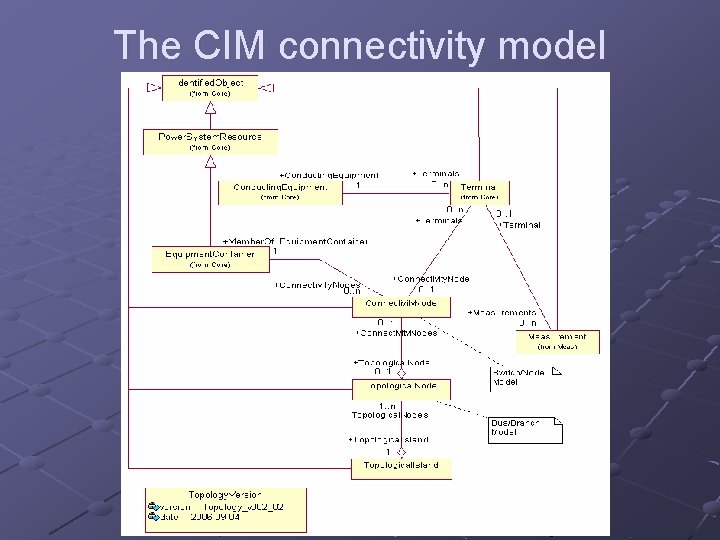
The CIM connectivity model
The description of a network Node 1 Breaker Busbar [Busbar. Section] Terminal 1 Connectivity. Node 1 Terminal 2 Breaker Node 2 Disconnector Terminal 3 Connectivity. Node 2 Terminal 4 Disconnector Bay Node 3 ACLine Segment a) Terminal 5 Connectivity. Node 3 Terminal 6 ACLine Segment b) a) the physical representation b) CIM connectivity model
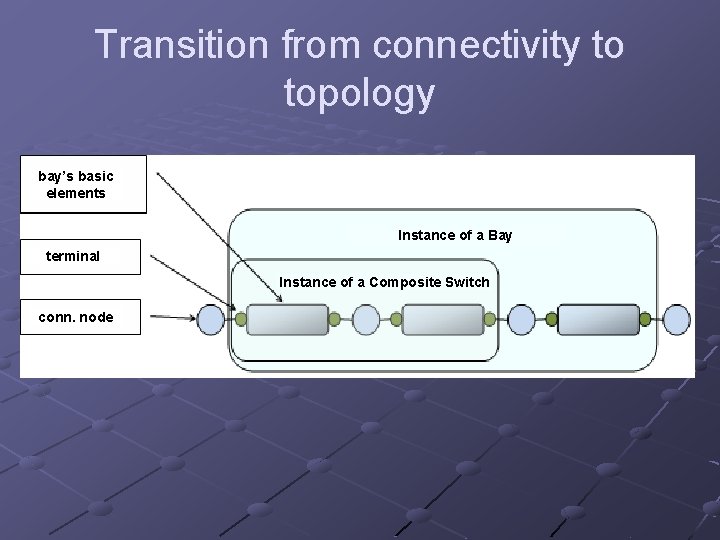
Transition from connectivity to topology bay’s basic elements Instance of a Bay terminal Instance of a Composite Switch conn. node
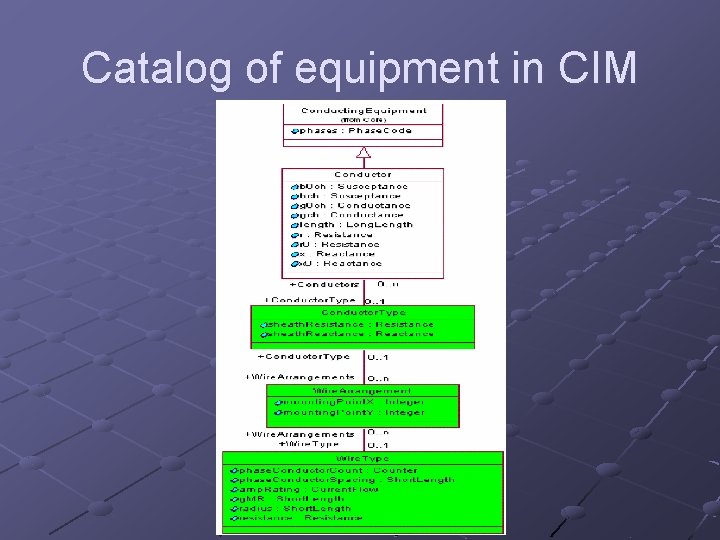
Catalog of equipment in CIM
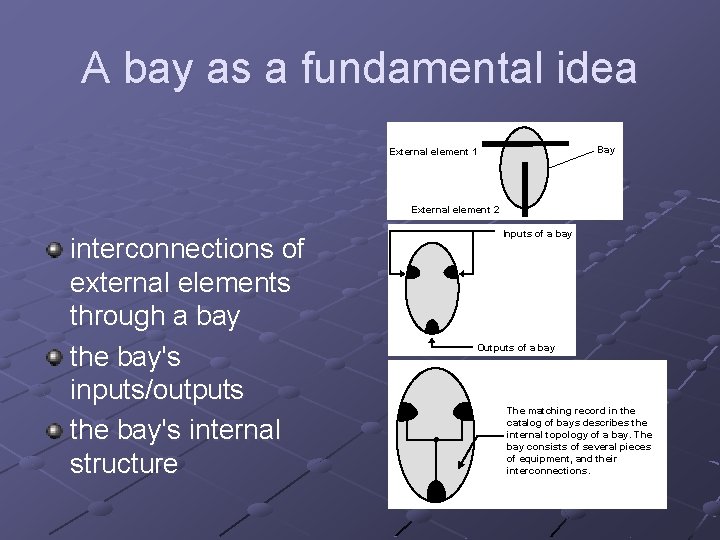
A bay as a fundamental idea Bay External element 1 External element 2 interconnections of external elements through a bay the bay's inputs/outputs the bay's internal structure Inputs of a bay Outputs of a bay The matching record in the catalog of bays describes the internal topology of a bay. The bay consists of several pieces of equipment, and their interconnections.
The 2 -layer model of the catalog of bays 1 2 Disc_1 Busbar_1 Disc _2 Busbar_2 1 2 4 Current Transf_1 5 The core bay Breaker_ 1 6 Disc_3 3 Line_1 (segment) 3 a) b) a) the core abstract bay definition b) the non-core abstract bay definition
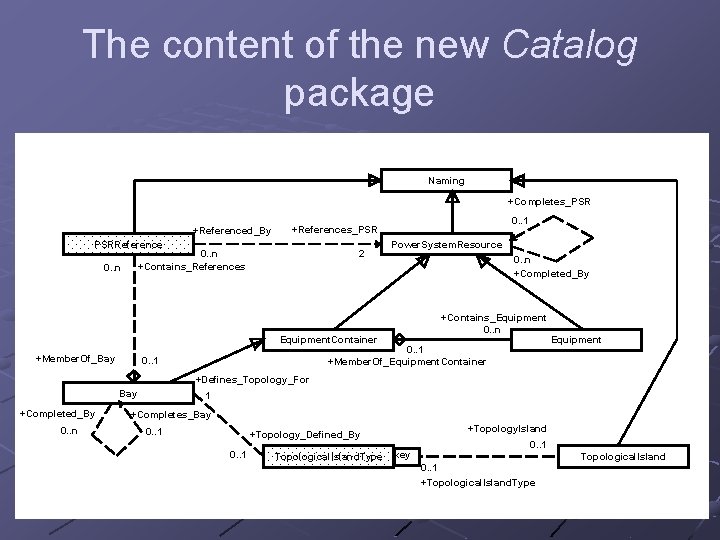
The content of the new Catalog package Naming +Completes_PSR +Referenced_By PSRReference 0. . n +Contains_References 0. . n 0. . 1 +References_PSR 2 Power. System. Resource 0. . n +Completed_By +Contains_Equipment 0. . n Equipment. Container +Member. Of_Bay 0. . 1 +Member. Of_Equipment. Container 0. . 1 Equipment +Defines_Topology_For Bay +Completed_By 0. . n 1 +Completes_Bay 0. . 1 +Topology. Island +Topology_Defined_By 0. . 1 Topological. Island. Type key 0. . 1 +Topological. Island. Type Topological. Island
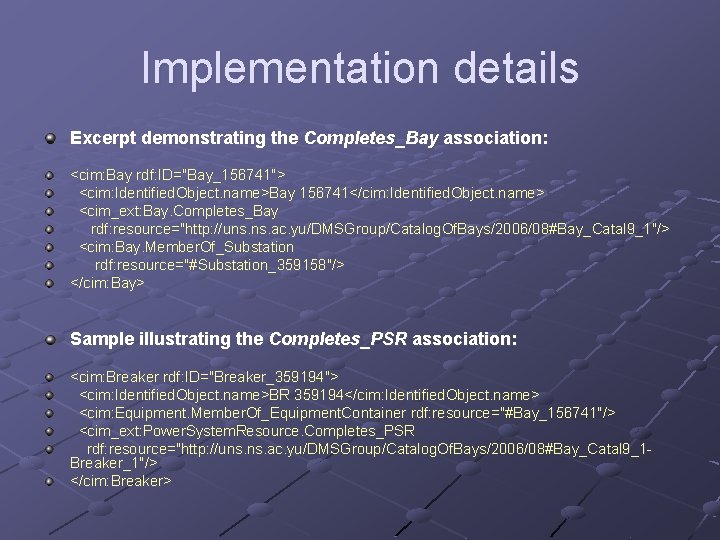
Implementation details Excerpt demonstrating the Completes_Bay association: <cim: Bay rdf: ID="Bay_156741"> <cim: Identified. Object. name>Bay 156741</cim: Identified. Object. name> <cim_ext: Bay. Completes_Bay rdf: resource="http: //uns. ac. yu/DMSGroup/Catalog. Of. Bays/2006/08#Bay_Catal 9_1"/> <cim: Bay. Member. Of_Substation rdf: resource="#Substation_359158"/> </cim: Bay> Sample illustrating the Completes_PSR association: <cim: Breaker rdf: ID="Breaker_359194"> <cim: Identified. Object. name>BR 359194</cim: Identified. Object. name> <cim: Equipment. Member. Of_Equipment. Container rdf: resource="#Bay_156741"/> <cim_ext: Power. System. Resource. Completes_PSR rdf: resource="http: //uns. ac. yu/DMSGroup/Catalog. Of. Bays/2006/08#Bay_Catal 9_1 Breaker_1"/> </cim: Breaker>
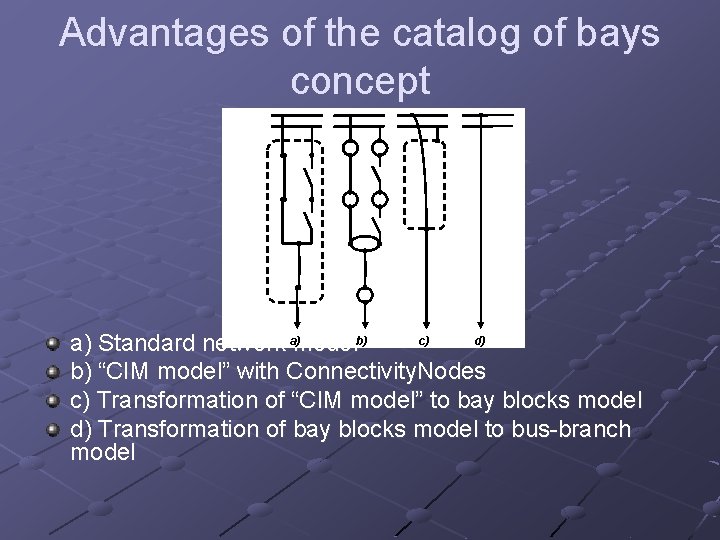
Advantages of the catalog of bays concept c) d) a) Standard network a)modelb) b) “CIM model” with Connectivity. Nodes c) Transformation of “CIM model” to bay blocks model d) Transformation of bay blocks model to bus-branch model
Test results CPU Time [s] CIM model with proposed changes 78 73 the histogram showing the CPU times for serializing the networks of Novi Sad and Puebla the histogram showing the topology analysis times for the networks of Novi Sad and Puebla 19, 1 15, 1 Novi Sad Puebla CPU Time [ms] 937 875 Tested networks CIM model with proposed changes 313 188 Novi Sad Puebla Tested networks
Conclusion The size of the CIM/XML document containing exported data about the network is reduced. The speed of processing the topology of the network is also significantly reduced. Accepting the proposal on an international level paves the way for standardizing the catalog of topologies. The data management (input and verification) is enhanced. The checking of allowed switching operations within the bays is lot simpler.
Changes in basic CIM model or the application database Introduction of the catalog of topologies is a natural extension of modeling topology parameters that already exists in CIM. Introducing the catalog of topologies does not impose any limits to general modeling, or violate CIM compatibility, but provides many benefits. Incorporating the catalog of topologies into an application database is useful for all applications, but very time consuming. Therefore, it would be better to apply it in the basic model.