
Extension of EDCTP participation to other member states
Extension of EDCTP participation to other member states Joachim Krebser, member of the EDCTP General Assembly, German Federal Ministry of Education and Research, Division of Health Research, Deputy Head, September 28, 2010
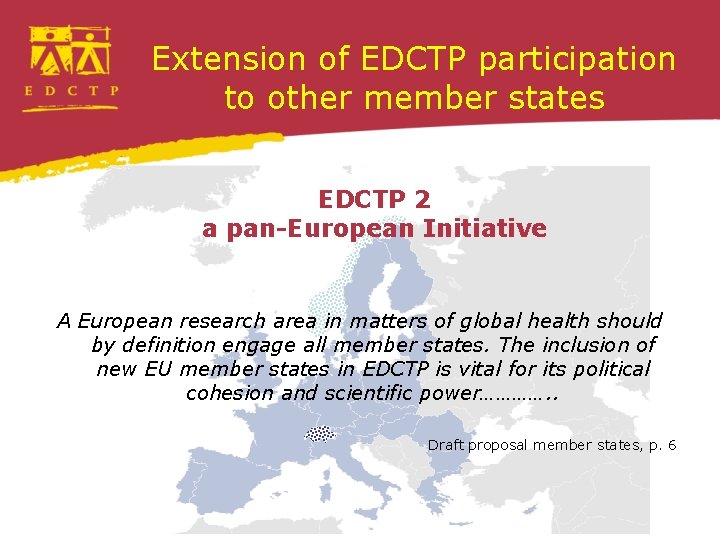
Extension of EDCTP participation to other member states EDCTP 2 a pan-European Initiative A European research area in matters of global health should by definition engage all member states. The inclusion of new EU member states in EDCTP is vital for its political cohesion and scientific power…………. . Draft proposal member states, p. 6

Extension of EDCTP participation to other member states Status quo: • Current Member States: v NO, SE, DEN, IR, UK, NL, DE, BE, LU, FR, AT, PT, ES, IT, GR, CH (ass. Memb. ) v LAT (observer since 2010) • Consultations with other member states on possible participation during EDCTP I (2008 – 2010): v BUL, CYP, CZ, EST, HUN, MAL, PL, RO, SK & SLO
Extension of EDCTP participation to other member states Possible benefits for new member states: Political: • Participation in an EU initiative with high visibility and reputation • Using EDCTP research networks as an entry door • Active contribution to achieve Millennium Development goals (4, 5, 6) • Getting involved in cooperation and development in Africa without strong traditional ties (colonies, trade) for participation in other research consortia (FP 7 and beyond), take profit of “side” contacts (ERA-Nets, Art. 185 - measures, NCPs) due to overlapping activities of EDCTP member institutions and persons. Scientific: • Participation in strong research networks • Possibility to participate in state-of-the-art multicenter ct‘s with spin off effects for urgent national health problems (HIV/ AIDs and TB )
Extension of EDCTP participation to other member states Benefits EDCTP will definitely get from participation of new members • High and partially different experience dealing with (MR-) TB and HIV/AIDs • • Interesting public health approaches, Epidemiology, etc Different traditions and cultures in cooperation with the developing world
Extension of EDCTP participation to other member states Possible drawbacks for new member states (and possible ways to overcome them): • Participation requires financial commitment • • Worries about a possible extension of EDCTP’s “disease portfolio” to NTDs, which may not be in agreement with national research priorities • • Provide possibility of a stepwise approach to full membership in EDCTP II (no cofunding/ observer -> occasional cofunder / associated member -> upfront commitment / full member) HIV/ AIDS and TB will remain top priorities. There are certainly more, but this is up to the discussion…………
Thank you! Joachim Krebser, German Federal Ministry of Education and Research, Division of Health Research joachim. krebser@bmbf. bund. de
- Slides: 7