
Extension I English An Introduction English Extension I



- Slides: 25
Extension I English An Introduction
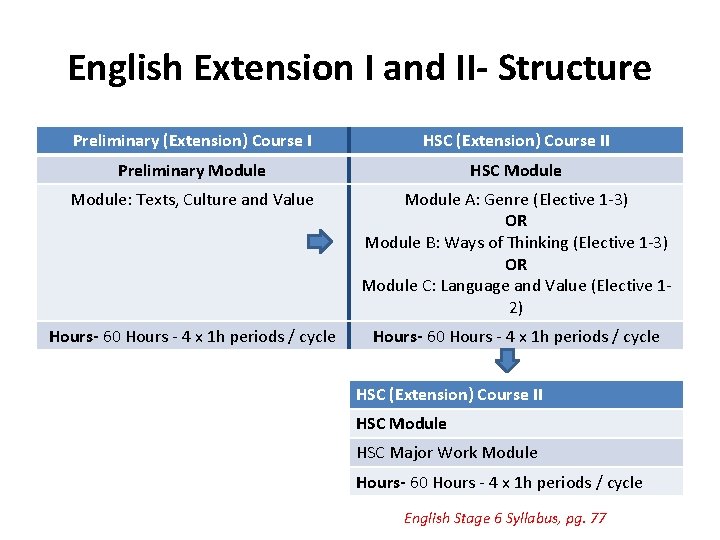
English Extension I and II- Structure Preliminary (Extension) Course I HSC (Extension) Course II Preliminary Module HSC Module: Texts, Culture and Value Module A: Genre (Elective 1 -3) OR Module B: Ways of Thinking (Elective 1 -3) OR Module C: Language and Value (Elective 12) Hours- 60 Hours - 4 x 1 h periods / cycle HSC (Extension) Course II HSC Module HSC Major Work Module Hours- 60 Hours - 4 x 1 h periods / cycle English Stage 6 Syllabus, pg. 77
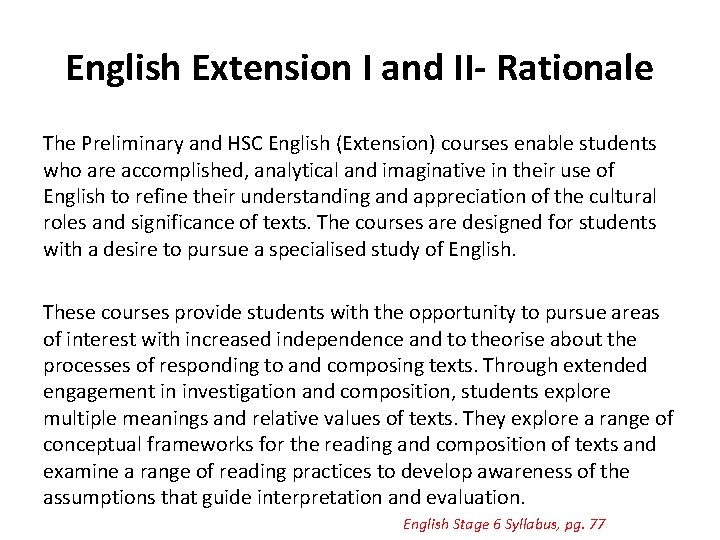
English Extension I and II- Rationale The Preliminary and HSC English (Extension) courses enable students who are accomplished, analytical and imaginative in their use of English to refine their understanding and appreciation of the cultural roles and significance of texts. The courses are designed for students with a desire to pursue a specialised study of English. These courses provide students with the opportunity to pursue areas of interest with increased independence and to theorise about the processes of responding to and composing texts. Through extended engagement in investigation and composition, students explore multiple meanings and relative values of texts. They explore a range of conceptual frameworks for the reading and composition of texts and examine a range of reading practices to develop awareness of the assumptions that guide interpretation and evaluation. English Stage 6 Syllabus, pg. 77
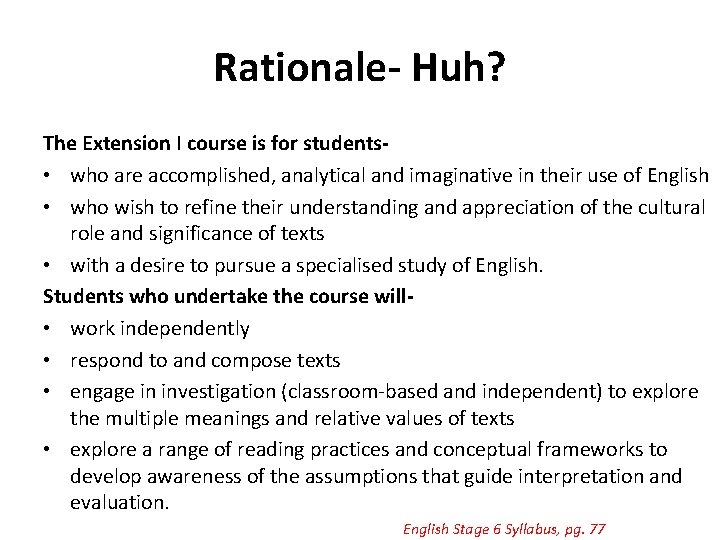
Rationale- Huh? The Extension I course is for students • who are accomplished, analytical and imaginative in their use of English • who wish to refine their understanding and appreciation of the cultural role and significance of texts • with a desire to pursue a specialised study of English. Students who undertake the course will • work independently • respond to and compose texts • engage in investigation (classroom-based and independent) to explore the multiple meanings and relative values of texts • explore a range of reading practices and conceptual frameworks to develop awareness of the assumptions that guide interpretation and evaluation. English Stage 6 Syllabus, pg. 77
English (Extension) Objectives Students will develop knowledge and understanding of: • How and why texts are valued. Students will develop skills in: • Extensive independent investigation • Theorising about texts and values based on analysis of complex ideas • Sustained composition. Students will come to value and appreciate: • The role of language in developing positive interaction and cooperation • Their developing skills as users of English • The pleasure and diversity of language and literature • The role of language and literature in their lives • The study and use of English as a key to learning • Reflection on their own processes of learning • Appropriateness, subtlety and aesthetics in language use. English Stage 6 Syllabus, pg. 78
Preliminary English (Extension) Course Requirements Preliminary Outcomes • A student understands how and why texts are valued in and appropriated into a range of contexts. • A student develops skills in independent investigation, involving particular texts and their manifestations in various forms, and within particular cultural contexts. • A student develops skills in extended composition in a range of modes and media for different audiences and purposes. English Stage 6 Syllabus, pg. 79
Preliminary English (Extension) Course Module: Texts, Culture and Value Students explore the ways in which aspects of texts from the past have been appropriated into popular culture. The module develops students’ understanding of how and why cultural values are maintained and changed. Students examine a key text from the past and its manifestations in one or more popular cultures. Through close study they: • consider the relationships between the text and its culture • explore the language of the texts and examine the ways in which language shapes and reflects values • consider the effects of different ways of responding to texts • consider the ways and reasons the original and later manifestations of the text are valued. Students also explore, analyse and critically evaluate different examples of such appropriations in a range of contexts and media, including some appropriations of their own choosing. Students develop a range of imaginative, interpretive and analytical compositions, including some which explore the relationships between key texts from the past and texts in popular culture. These compositions may be realised in various forms and media. Students investigate topics and ideas, engage in independent learning activities and develop skills in sustained composition.
What does that mean for me? You will: - Explore a key text from the past and its appropriation into popular culture - Investigate how and why the cultural values of the text/s are maintained and changed. - Consider the relationship between text and the culture in which it is created and enjoyed. - Consider how language shapes and reflects the values of the society, author and audience. - Consider different ways of responding to texts, such as critical readings or lenses - Consider, explore, analyse and critically evaluate why the original, and its various appropriations, are valued. - Find your own examples of appropriations - Compose sustained imaginative, analytical and critical responses based on your investigations using a range of forms and media.
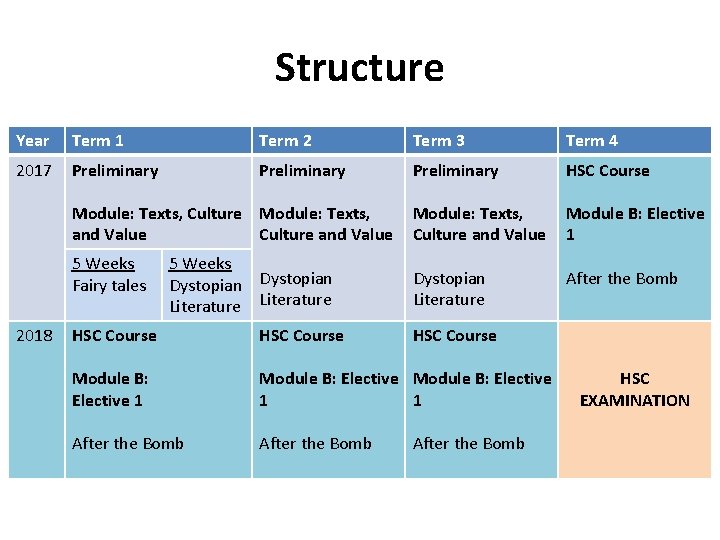
Structure Year Term 1 Term 2 Term 3 Term 4 2017 Preliminary HSC Course Module: Texts, Culture and Value Module B: Elective 1 Dystopian Literature After the Bomb Module: Texts, Culture Module: Texts, and Value Culture and Value 5 Weeks Fairy tales 2018 5 Weeks Dystopian Literature HSC Course Module B: Elective 1 1 After the Bomb HSC EXAMINATION
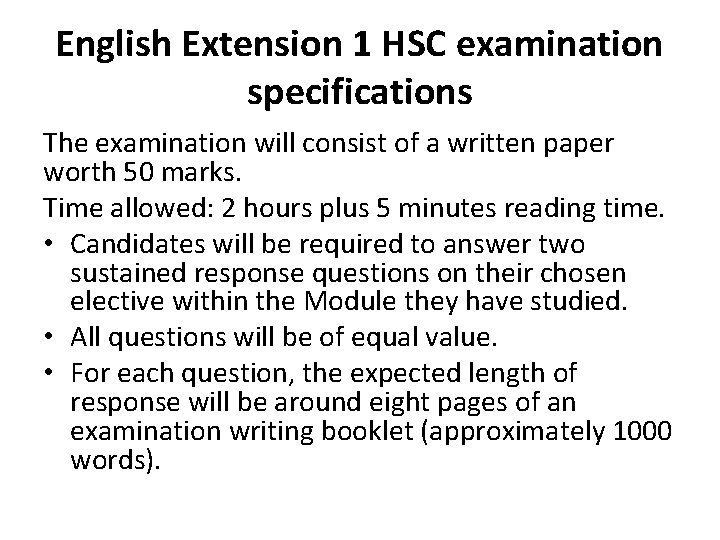
English Extension 1 HSC examination specifications The examination will consist of a written paper worth 50 marks. Time allowed: 2 hours plus 5 minutes reading time. • Candidates will be required to answer two sustained response questions on their chosen elective within the Module they have studied. • All questions will be of equal value. • For each question, the expected length of response will be around eight pages of an examination writing booklet (approximately 1000 words).
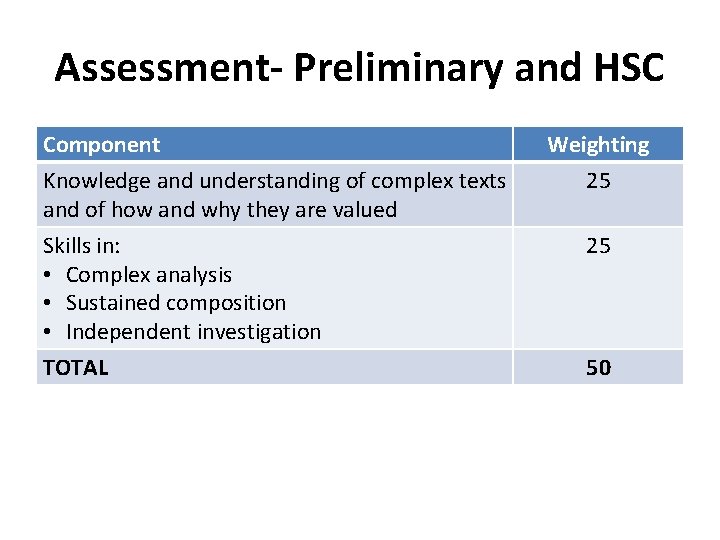
Assessment- Preliminary and HSC Component Knowledge and understanding of complex texts and of how and why they are valued Skills in: • Complex analysis • Sustained composition • Independent investigation TOTAL Weighting 25 25 50
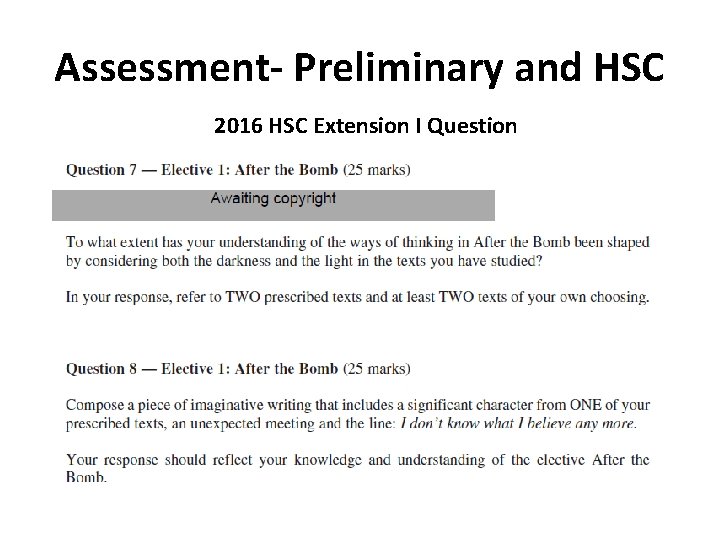
Assessment- Preliminary and HSC 2016 HSC Extension I Question
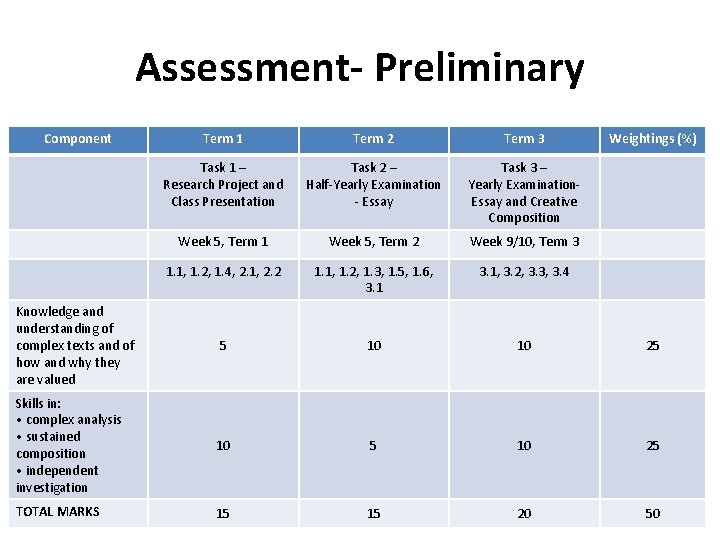
Assessment- Preliminary Component Term 1 Term 2 Term 3 Weightings (%) Task 1 – Research Project and Class Presentation Task 2 – Half-Yearly Examination - Essay Task 3 – Yearly Examination. Essay and Creative Composition Week 5, Term 1 Week 5, Term 2 Week 9/10, Term 3 1. 1, 1. 2, 1. 4, 2. 1, 2. 2 1. 1, 1. 2, 1. 3, 1. 5, 1. 6, 3. 1, 3. 2, 3. 3, 3. 4 Knowledge and understanding of complex texts and of how and why they are valued 5 10 10 25 Skills in: • complex analysis • sustained composition • independent investigation 10 5 10 25 TOTAL MARKS 15 15 20 50
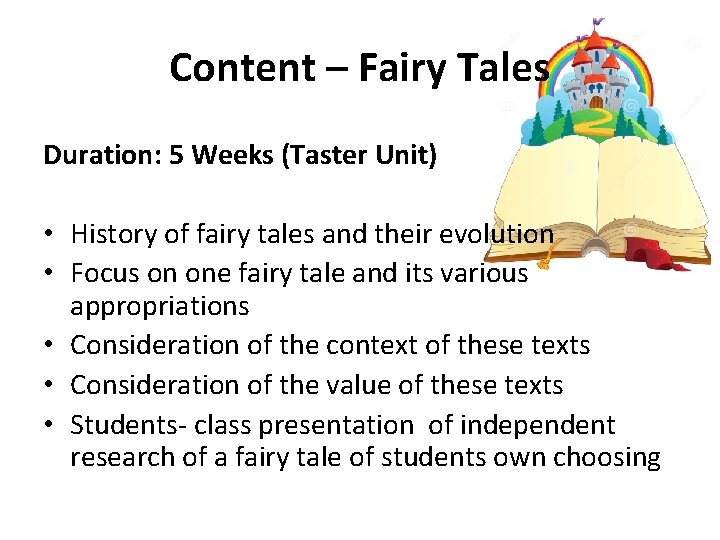
Content – Fairy Tales Duration: 5 Weeks (Taster Unit) • History of fairy tales and their evolution • Focus on one fairy tale and its various appropriations • Consideration of the context of these texts • Consideration of the value of these texts • Students- class presentation of independent research of a fairy tale of students own choosing
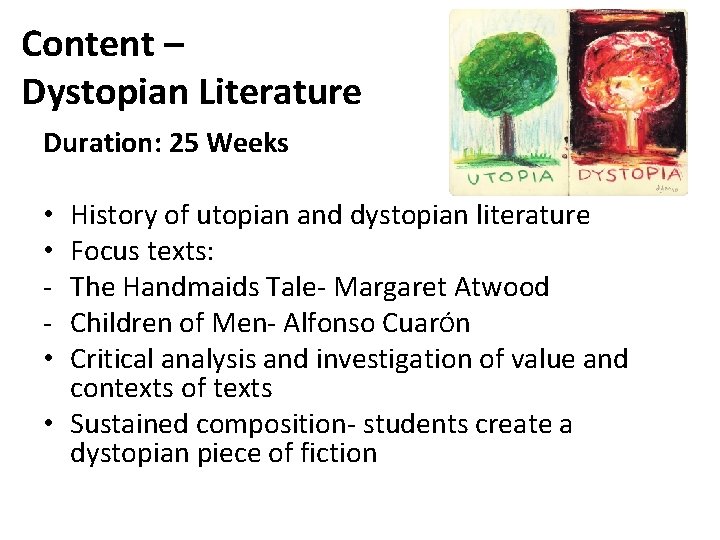
Content – Dystopian Literature Duration: 25 Weeks History of utopian and dystopian literature Focus texts: The Handmaids Tale- Margaret Atwood Children of Men- Alfonso CuarÓn Critical analysis and investigation of value and contexts of texts • Sustained composition- students create a dystopian piece of fiction • • •
TO BE SUCCESSFUL…
Attend class regularly…
Catch up on any missed work…
Do your best…
Be organised…
Meet your responsibilities…
Constantly seek to improve…
Ask for help when you need it…
Contacting me Email: bronwyn. k. reed@det. nsw. edu. au