
Extensible Kernels Exokernel and SPIN Presented by Hakim
Extensible Kernels: Exokernel and SPIN Presented by Hakim Weatherspoon (Based on slides from Edgar Velázquez-Armendáriz and Ken Birman)
Traditional OS services – Management and Protection • Provides a set of abstractions – Processes, Threads, Virtual Memory, Files, IPC – Sys calls and APIs (eg: Win 32, POSIX) • Resource Allocation and Management • Accounting • Protection and Security – Concurrent execution 2
Context for these papers • Researchers (mostly) were doing special purpose O/S hacks • Commercial market complaining that O/S imposed big overheads on them • O/S research community began to ask what the best way to facilitate customization might be. In the spirit of the Flux OS toolkit…
Problems (examples coming-up) • Extensibility – Abstractions overly general – Apps cannot dictate management – Implementations are fixed • Performance – Crossing over into the kernel is expensive – Generalizations and hiding information affect performance • Protection and Management offered with loss in Extensibility and Performance 4
Need for Application controlled management (examples) • Buffer Pool Management In DBs (*) – LRU, prefetch (locality Vs suggestion), flush (commit) • Shared Virtual Memory (+) – use a page fault to retrieve page from disk / another processor 5
Examples (cont. ) • Concurrent Checkpointing (+) – Overlap checkpointing and program being checkpointed – Change rights to R-only on dirty pages – Copy each page and reset rights – Allow reads; Use write faults to {copy, reset rights, restart} * OS Support for Database Management (Stonebraker) + Virtual Memory Primitives for User Programs (Andrew W. Appel and Kai Li) 6
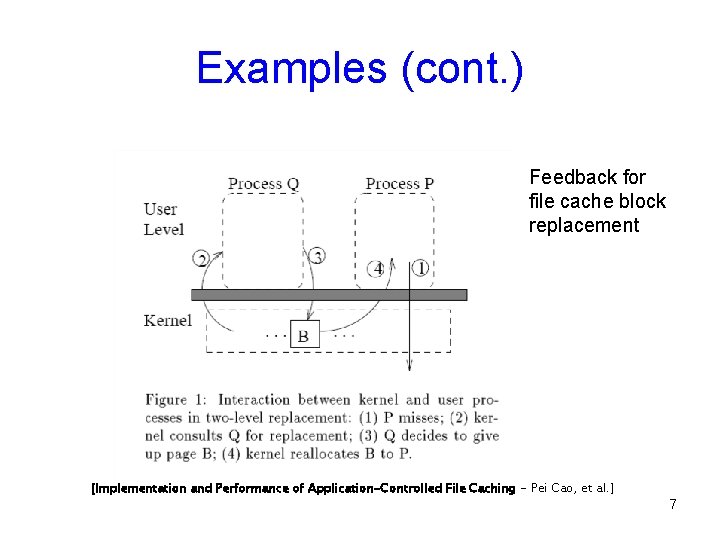
Examples (cont. ) Feedback for file cache block replacement [Implementation and Performance of Application-Controlled File Caching - Pei Cao, et al. ] 7
Down with monarchy! French Revolution - Execution of Louis XVI 8
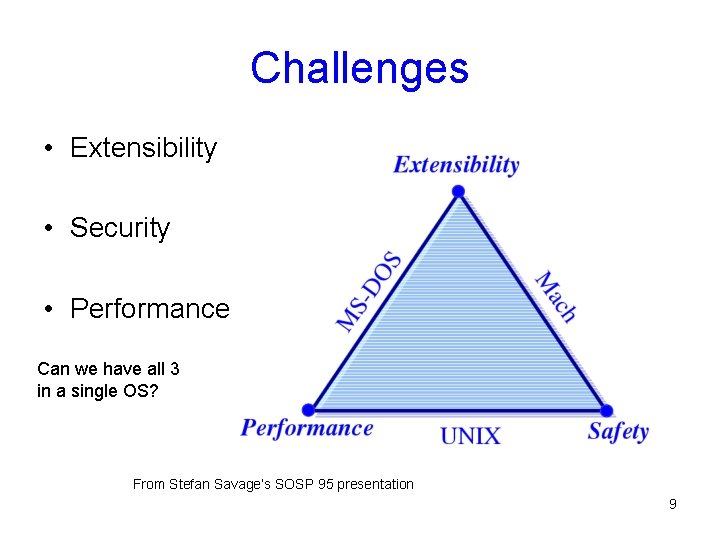
Challenges • Extensibility • Security • Performance Can we have all 3 in a single OS? From Stefan Savage’s SOSP 95 presentation 9
Extensible Kernels • Exokernel (SOSP 1995): safely exports machine resources – – Kernel only multiplexes hardware resources (Aegis) Higher-level abstractions in Library OS (Ex. OS) Secure binding, Visible resource revocation, Abort Apps link with the Lib. OS of their choice • SPIN (SOSP 1995): kernel extensions (imported) safely specialize OS services – Extensions dynamically linked into OS kernel – Safety ensured by Programming Language facilities 10
Notice difference in pt. of view • Exokernel assumes that very significant extensions to the kernel are needed in many settings and that home-brew kernels may remain common for long into the future – Goal is to enable this sort of work while reducing risk that developer will trash the file system, debugging tools, etc • SPIN is more focused on protecting standard OS against a device driver run amok. – Sees this as the more common need…
Exokernel • Dawson R. Engler, M. Frans Kaashoek and James O’Toole Jr. • Engler’s Master’s Thesis. • Follow-up publications on 1997 and 2002. • Kaashoek later worked on Corey.
Exokernels - Motivation • Existing Systems offer fixed high-level abstractions which is bad – Hurt app performance (generalization – eg: LRU) – Hide information (eg: page fault) – Limit functionality (infrequent changes – cool ideas don’t make it through) 13
Motivation (cont. ) • Separate protection from management, mgmt in user space • Apps should use domain specific knowledge to influence OS services • Small and simple kernel – adaptable and maintainable 14

OS Component Layout Exokernel 15
Exokernel main ideas • Kernel – Resource sharing, not policies • Library Operating System – Responsible for the abstractions • • IPC VM Scheduling Networking
Lib OS and the Exokernel • Lib OS (untrusted) can implement traditional OS abstractions (compatibility) • Efficient (Lib OS in user space) • Apps link with Lib OS of their choice • Kernel allows Lib. OS to manage resources, protects Lib. Oss 17
Exokernel vs Microkenels vs VM • Exokernel defines only a low-level interface. • A microkernel also runs almost everything on user-level, but has fixed abstractions. • A VM emulates the whole machine, doesn’t provide direct access.
SPIN • University of Washington. • Brian N. Bershad, Stefan Savage, Emin Gun Sirer, Marc E. Fiuczynski, David Becker, Craig Chambers, Susan Eggers • Main ideas continue on Singularity, a C# system by MSR and U. W.
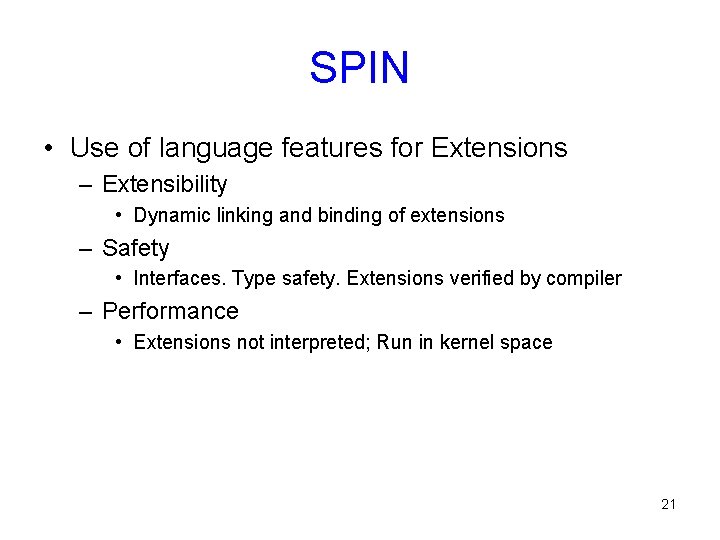
SPIN • Use of language features for Extensions – Extensibility • Dynamic linking and binding of extensions – Safety • Interfaces. Type safety. Extensions verified by compiler – Performance • Extensions not interpreted; Run in kernel space 21
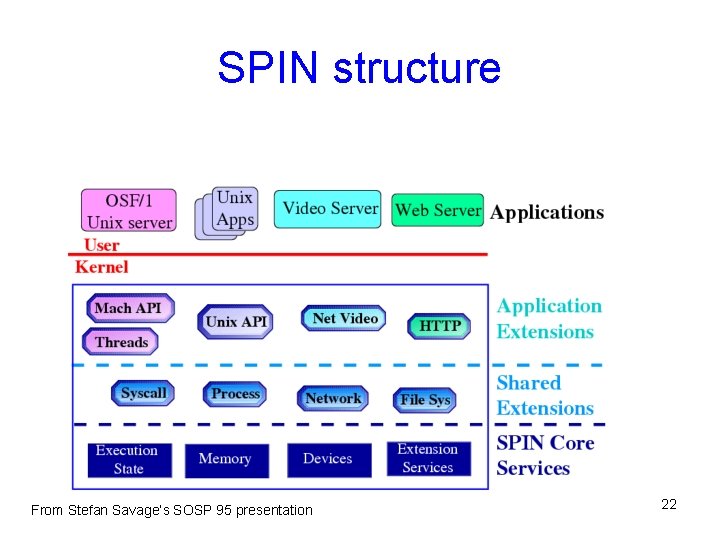
SPIN structure From Stefan Savage’s SOSP 95 presentation 22
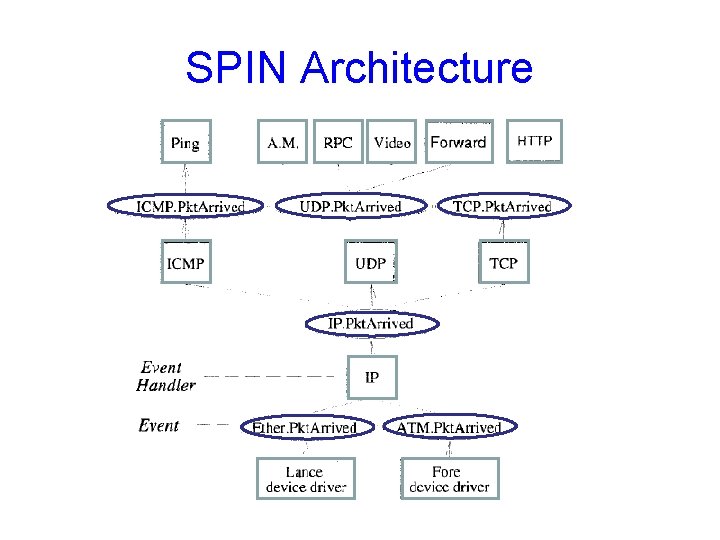
SPIN Architecture
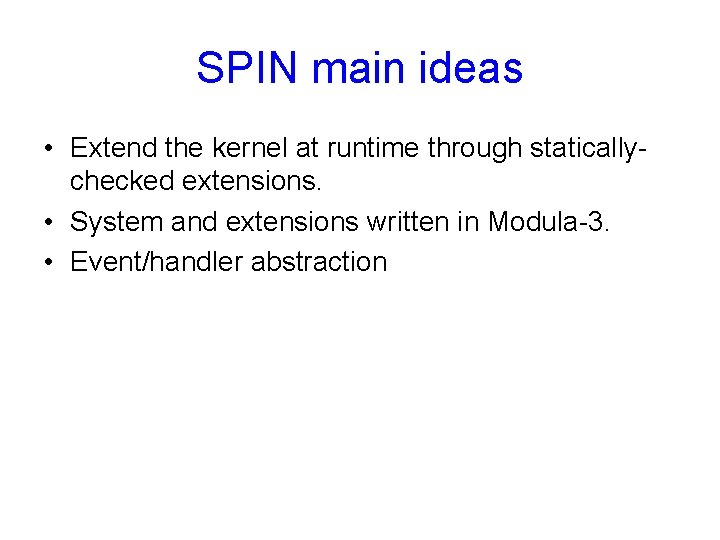
SPIN main ideas • Extend the kernel at runtime through staticallychecked extensions. • System and extensions written in Modula-3. • Event/handler abstraction
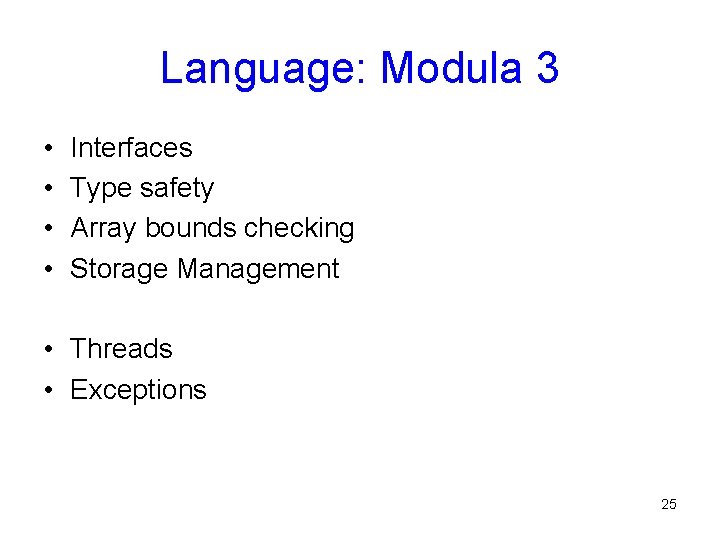
Language: Modula 3 • • Interfaces Type safety Array bounds checking Storage Management • Threads • Exceptions 25
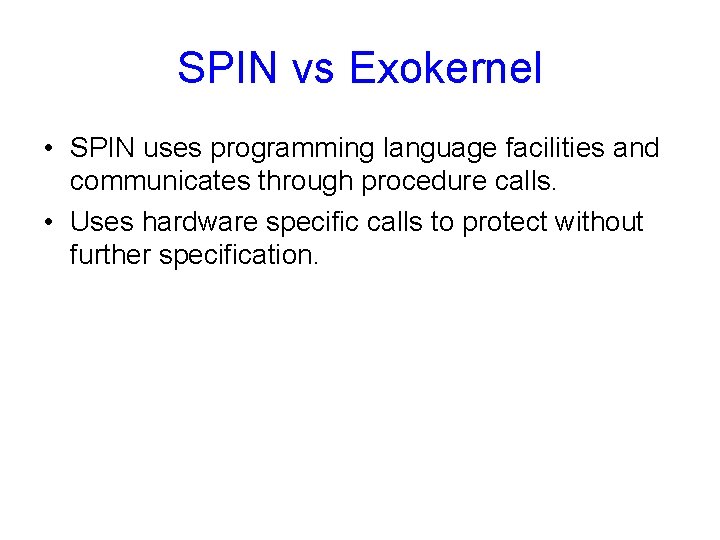
SPIN vs Exokernel • SPIN uses programming language facilities and communicates through procedure calls. • Uses hardware specific calls to protect without further specification.
Agenda • Overview • Design – – – Protection Memory Sharing Scheduling network • Implementations
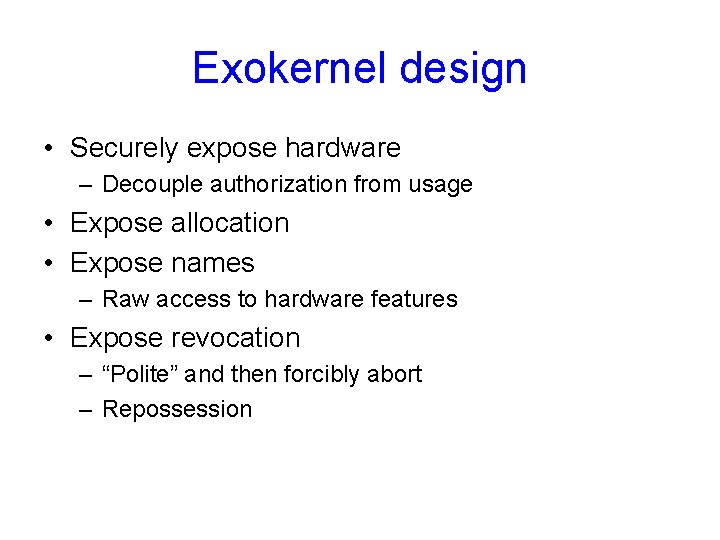
Exokernel design • Securely expose hardware – Decouple authorization from usage • Expose allocation • Expose names – Raw access to hardware features • Expose revocation – “Polite” and then forcibly abort – Repossession
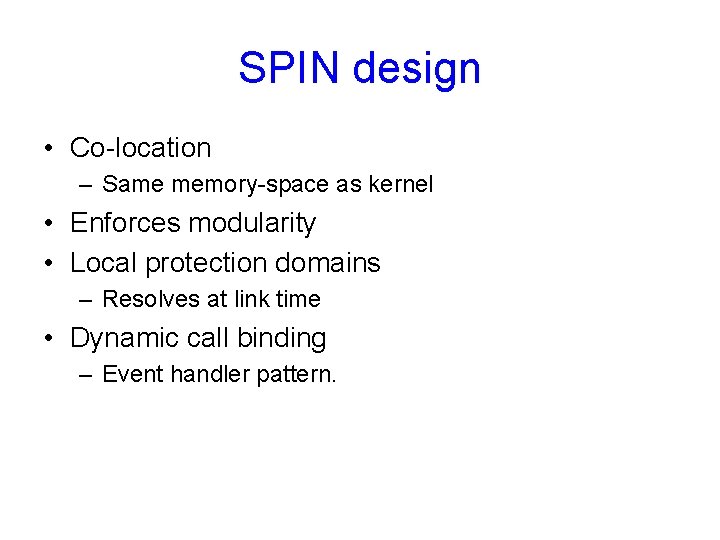
SPIN design • Co-location – Same memory-space as kernel • Enforces modularity • Local protection domains – Resolves at link time • Dynamic call binding – Event handler pattern.
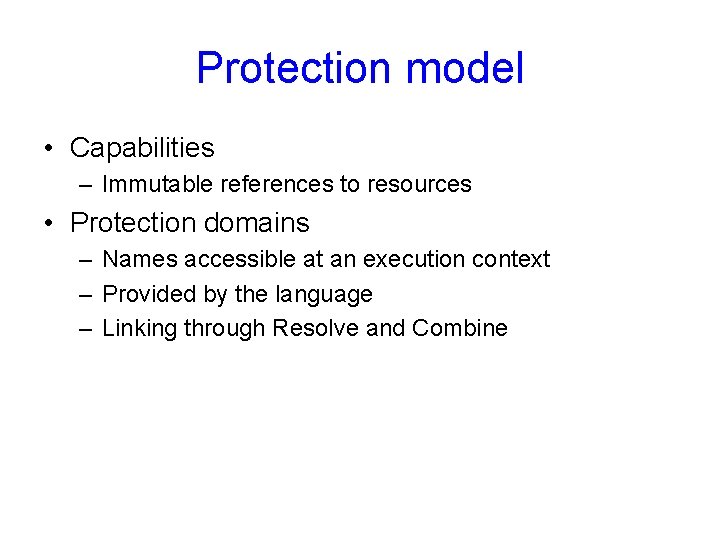
Protection model • Capabilities – Immutable references to resources • Protection domains – Names accessible at an execution context – Provided by the language – Linking through Resolve and Combine
Exokernel Memory • Guard TLB loads and DMA • Large Software TLB • Library Operating System handles page faults if it’s allowed to.
SPIN Memory • The kernel controls allocation of physical and virtual addresses capabilities. • Extension react to page faults and error through handlers.
Exokernel processor sharing • Round robin allocation of slices. • Library operating system responsible for context switching. – Can implement own scheduling policy: donate timeslice • It the time a process takes is excessive, it is killed.
SPIN processor sharing • Based on Modula-3 threads. • Organized in strands. • Communicates through Block, Unblock, Checkpoint and Resume events. • Preemptive round-robin schedule of strands
Exokernel Network • Downloadable filters • Application-specific Safe Handlers • Respond directly to traffic
SPIN Network • Protocol stack. • Packet pulled by handlers.
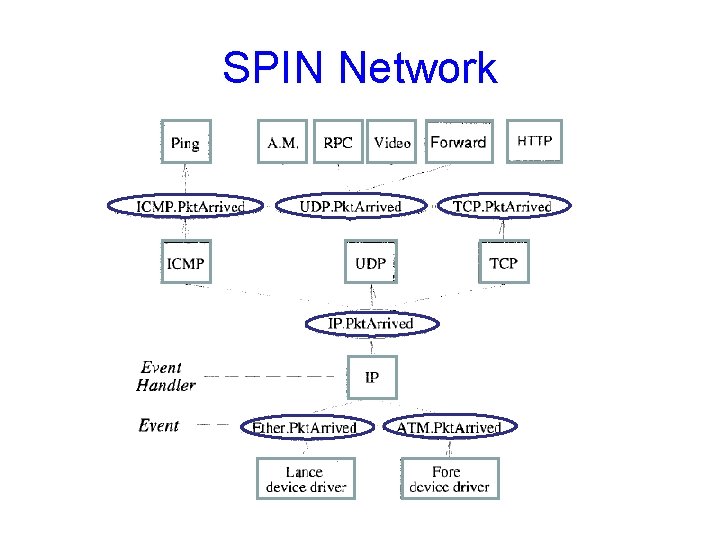
SPIN Network
Agenda • Overview • Design • Implementations
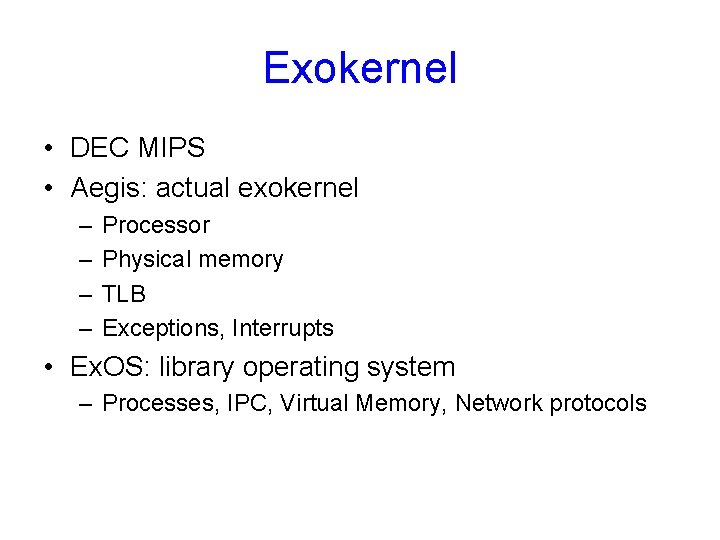
Exokernel • DEC MIPS • Aegis: actual exokernel – – Processor Physical memory TLB Exceptions, Interrupts • Ex. OS: library operating system – Processes, IPC, Virtual Memory, Network protocols

Microbenchmark results
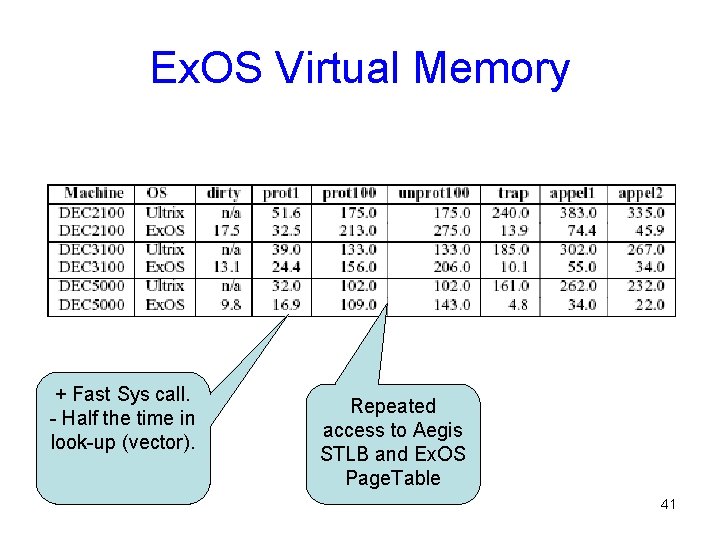
Ex. OS Virtual Memory + Fast Sys call. - Half the time in look-up (vector). Repeated access to Aegis STLB and Ex. OS Page. Table 41
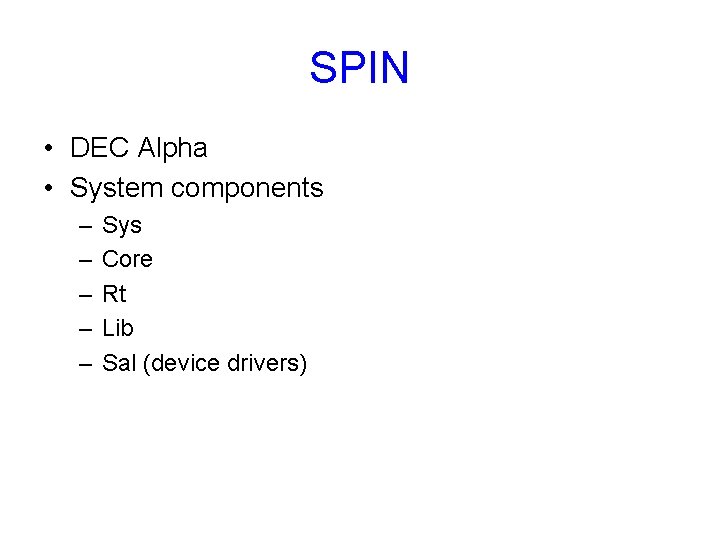
SPIN • DEC Alpha • System components – – – Sys Core Rt Lib Sal (device drivers)
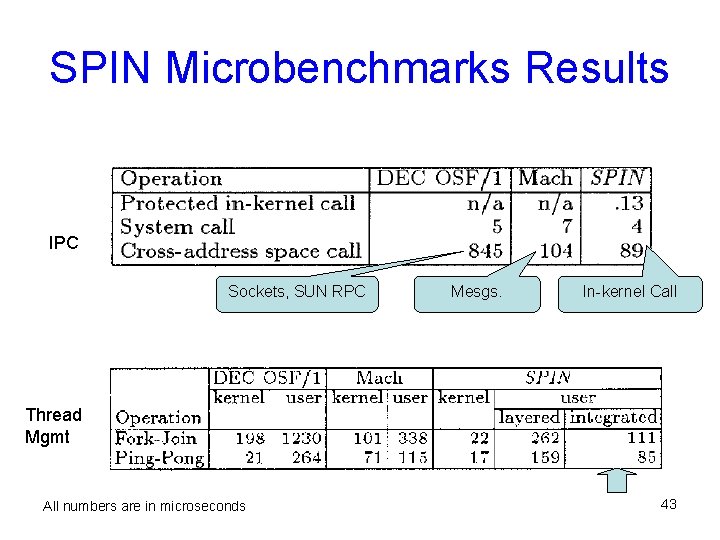
SPIN Microbenchmarks Results IPC Sockets, SUN RPC Mesgs. In-kernel Call Thread Mgmt All numbers are in microseconds 43
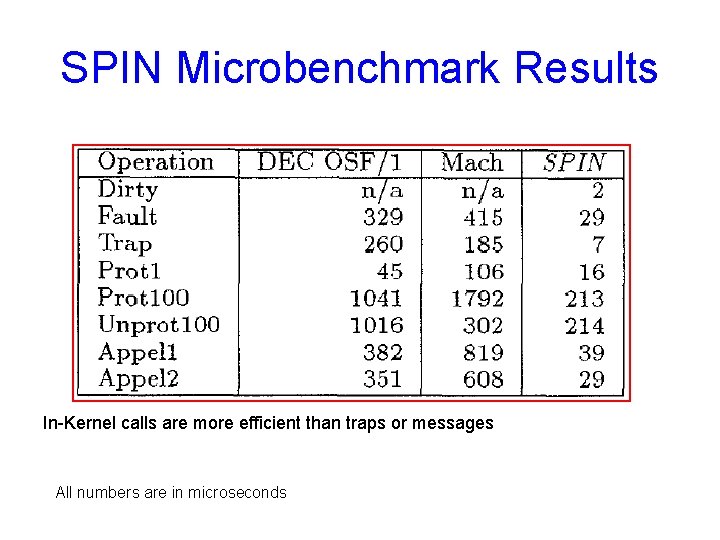
SPIN Microbenchmark Results In-Kernel calls are more efficient than traps or messages All numbers are in microseconds
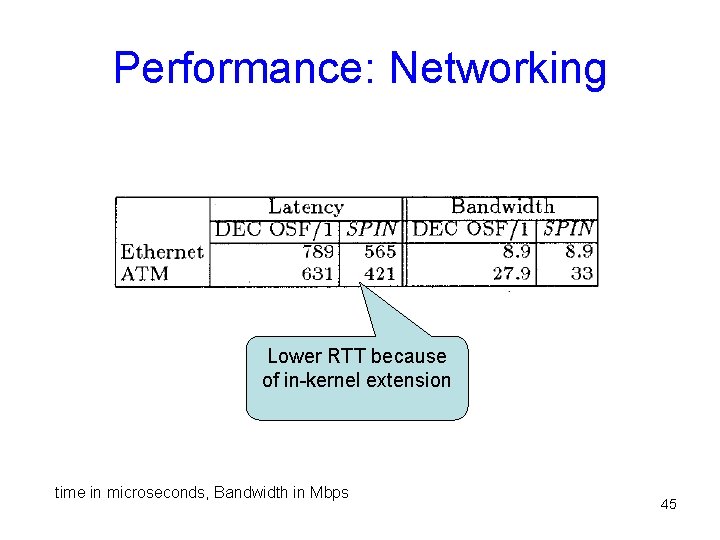
Performance: Networking Lower RTT because of in-kernel extension time in microseconds, Bandwidth in Mbps 45
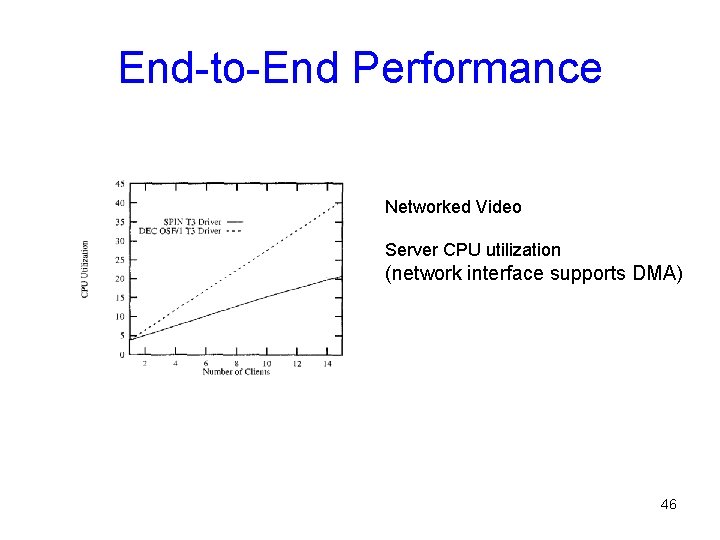
End-to-End Performance Networked Video Server CPU utilization (network interface supports DMA) 46
Issues • Dispatcher scalability • Handler scheduling • Garbage collection 47
Perspective • • • Extensible kernels are actually fast. End-to-end arguments. Efficient implementations. High level languages are not terrible! Extensibility without loss of security or performance – Exokernels • Safely export machine resources • Decouple protection from management – SPIN • kernel extensions (imported) safely specialize OS services • Safety ensured by Programming Language facilities
Next Time • Read and write review: – Disco: Running Commodity Operating Systems on Scalable Multiprocessors, Bugnion et al. 16 th SOSP, 1997 – Tornado: maximizing locality and concurrency in a shared memory multiprocessor operating system, Gamsa et al. 3 rd OSDI, Feb 1999.

Next Time • Read and write review: • Project Proposal – Return comments later today • Project Survey Paper due next Thursday • Check website for updated schedule
- Slides: 49