
Extending the Reach of Financial Aid to NonTraditional
- Slides: 12
Extending the Reach of Financial Aid to Non-Traditional Students Laurie Gavrin Director for Research and Policy State Student Assistance Commission of Indiana SFARN conference June 10 -12, 2009 Indianapolis
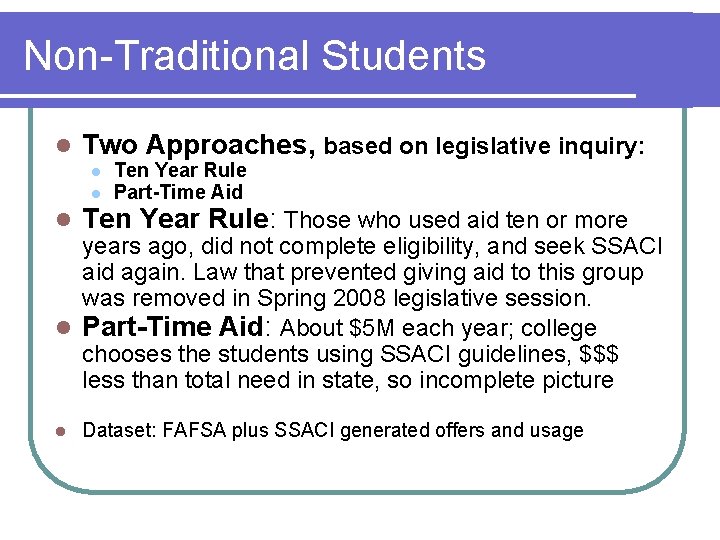
Non-Traditional Students l Two Approaches, based on legislative inquiry: l l l Ten Year Rule Part-Time Aid Ten Year Rule: Those who used aid ten or more years ago, did not complete eligibility, and seek SSACI aid again. Law that prevented giving aid to this group was removed in Spring 2008 legislative session. l Part-Time Aid: About $5 M each year; college chooses the students using SSACI guidelines, $$$ less than total need in state, so incomplete picture l Dataset: FAFSA plus SSACI generated offers and usage
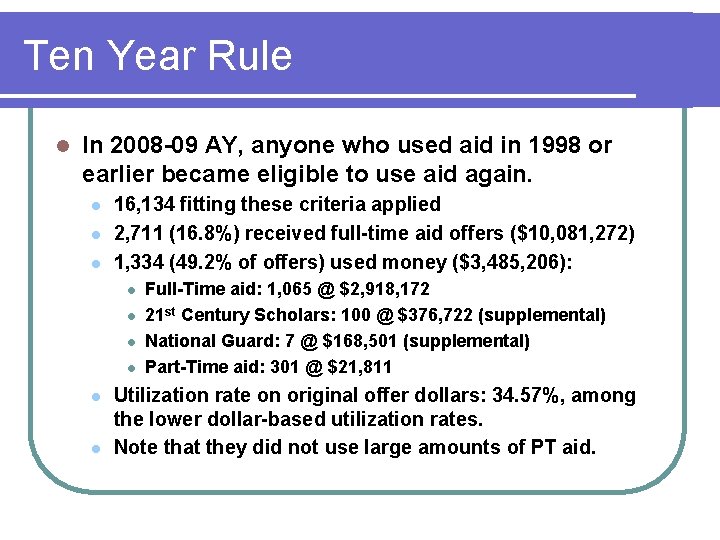
Ten Year Rule l In 2008 -09 AY, anyone who used aid in 1998 or earlier became eligible to use aid again. l l l 16, 134 fitting these criteria applied 2, 711 (16. 8%) received full-time aid offers ($10, 081, 272) 1, 334 (49. 2% of offers) used money ($3, 485, 206): l l l Full-Time aid: 1, 065 @ $2, 918, 172 21 st Century Scholars: 100 @ $376, 722 (supplemental) National Guard: 7 @ $168, 501 (supplemental) Part-Time aid: 301 @ $21, 811 Utilization rate on original offer dollars: 34. 57%, among the lower dollar-based utilization rates. Note that they did not use large amounts of PT aid.
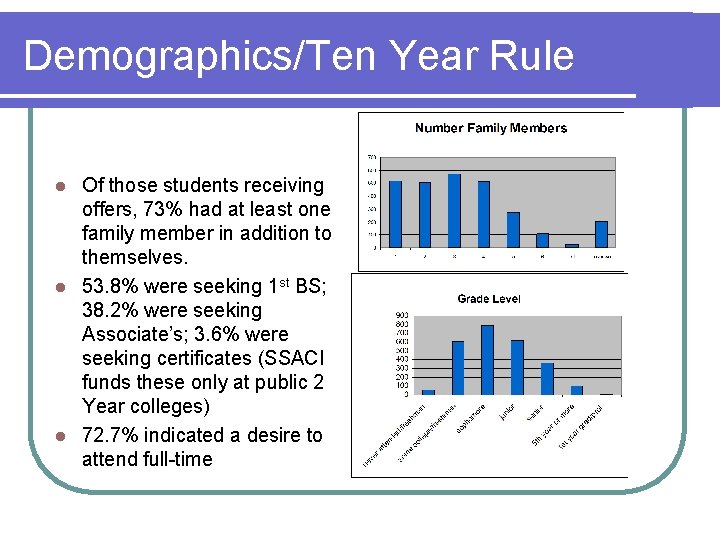
Demographics/Ten Year Rule Of those students receiving offers, 73% had at least one family member in addition to themselves. l 53. 8% were seeking 1 st BS; 38. 2% were seeking Associate’s; 3. 6% were seeking certificates (SSACI funds these only at public 2 Year colleges) l 72. 7% indicated a desire to attend full-time l
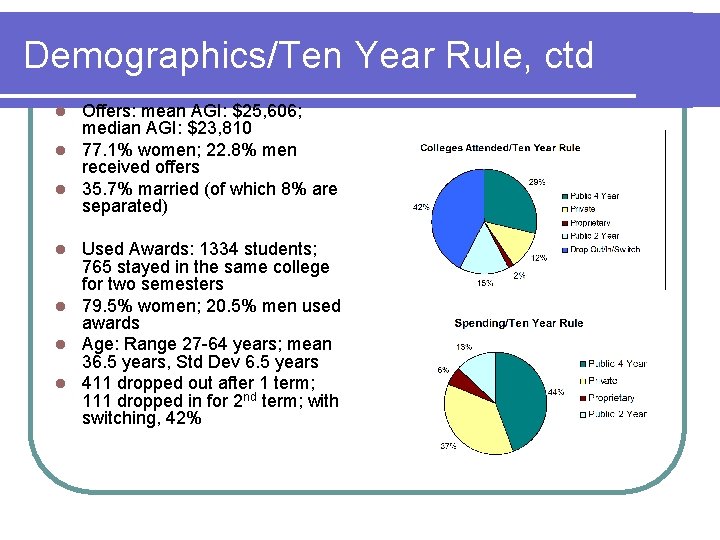
Demographics/Ten Year Rule, ctd Offers: mean AGI: $25, 606; median AGI: $23, 810 l 77. 1% women; 22. 8% men received offers l 35. 7% married (of which 8% are separated) l Used Awards: 1334 students; 765 stayed in the same college for two semesters l 79. 5% women; 20. 5% men used awards l Age: Range 27 -64 years; mean 36. 5 years, Std Dev 6. 5 years l 411 dropped out after 1 term; 111 dropped in for 2 nd term; with switching, 42% l
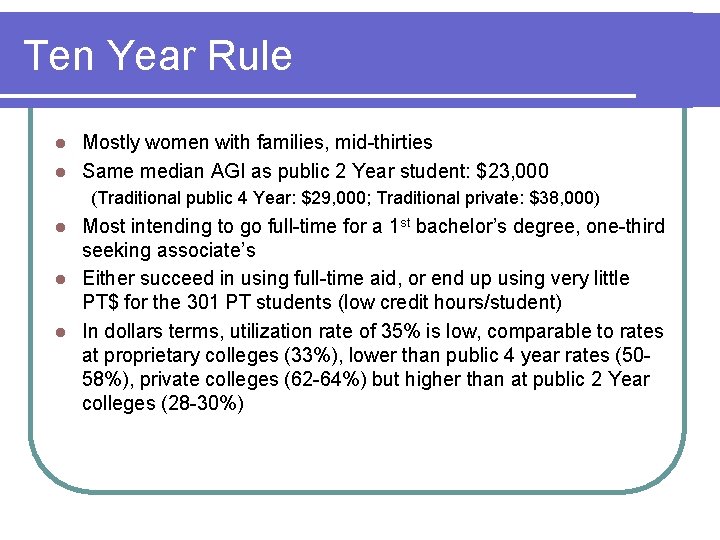
Ten Year Rule Mostly women with families, mid-thirties l Same median AGI as public 2 Year student: $23, 000 l (Traditional public 4 Year: $29, 000; Traditional private: $38, 000) Most intending to go full-time for a 1 st bachelor’s degree, one-third seeking associate’s l Either succeed in using full-time aid, or end up using very little PT$ for the 301 PT students (low credit hours/student) l In dollars terms, utilization rate of 35% is low, comparable to rates at proprietary colleges (33%), lower than public 4 year rates (5058%), private colleges (62 -64%) but higher than at public 2 Year colleges (28 -30%) l
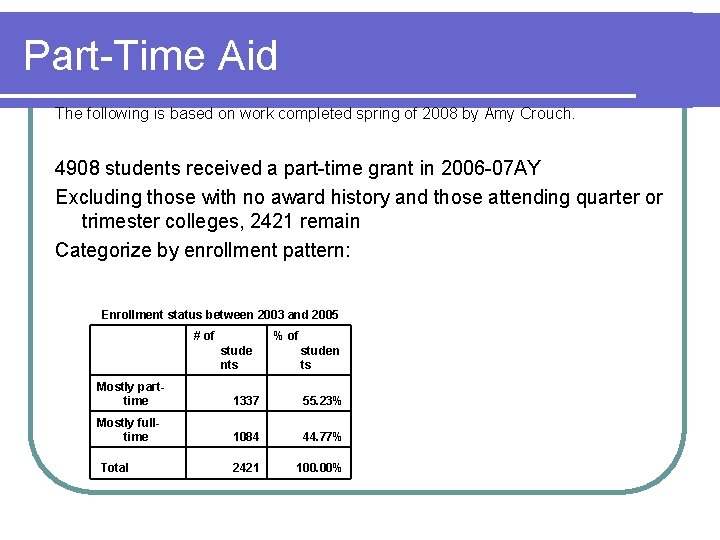
Part-Time Aid The following is based on work completed spring of 2008 by Amy Crouch. 4908 students received a part-time grant in 2006 -07 AY Excluding those with no award history and those attending quarter or trimester colleges, 2421 remain Categorize by enrollment pattern: Enrollment status between 2003 and 2005 # of % of stude nts studen ts Mostly parttime 1337 55. 23% Mostly fulltime 1084 44. 77% Total 2421 100. 00%
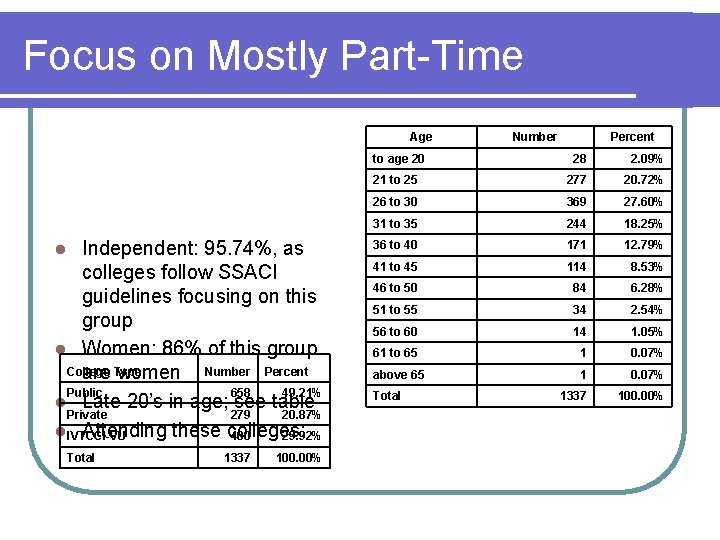
Focus on Mostly Part-Time Age to age 20 Independent: 95. 74%, as colleges follow SSACI guidelines focusing on this group l Women: 86% of this group College are Type women Number Percent Public 658 49. 21% l Late 20’s in age; see table Private 279 20. 87% l. IVTCCI-VU Attending these colleges: 400 29. 92% l Total 1337 100. 00% Number Percent 28 2. 09% 21 to 25 277 20. 72% 26 to 30 369 27. 60% 31 to 35 244 18. 25% 36 to 40 171 12. 79% 41 to 45 114 8. 53% 46 to 50 84 6. 28% 51 to 55 34 2. 54% 56 to 60 14 1. 05% 61 to 65 1 0. 07% above 65 1 0. 07% 1337 100. 00% Total
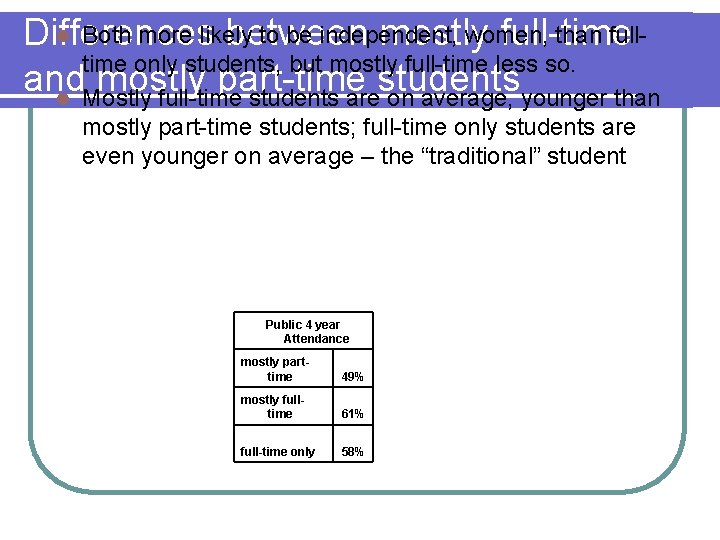
l Both more likely to be independent, women, than full. Differences between mostly full-time only students, but mostly full-time less so. and mostly part-time students l Mostly full-time students are on average, younger than mostly part-time students; full-time only students are even younger on average – the “traditional” student Public 4 year Attendance mostly parttime 49% mostly fulltime 61% full-time only 58%
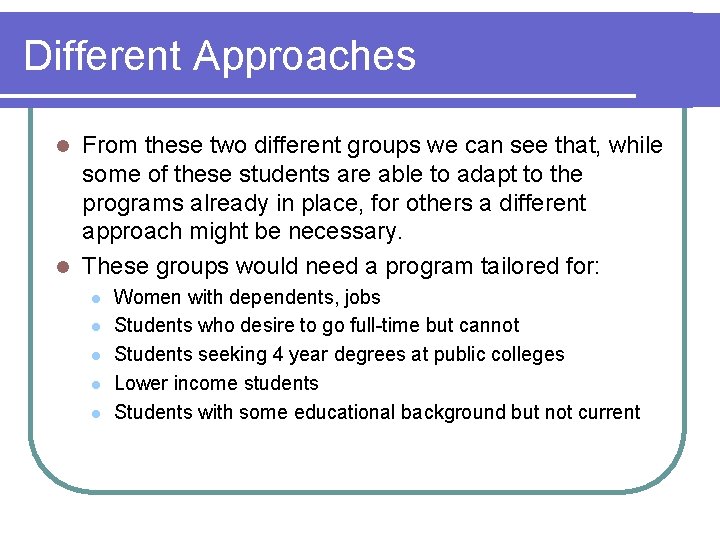
Different Approaches From these two different groups we can see that, while some of these students are able to adapt to the programs already in place, for others a different approach might be necessary. l These groups would need a program tailored for: l l l Women with dependents, jobs Students who desire to go full-time but cannot Students seeking 4 year degrees at public colleges Lower income students Students with some educational background but not current
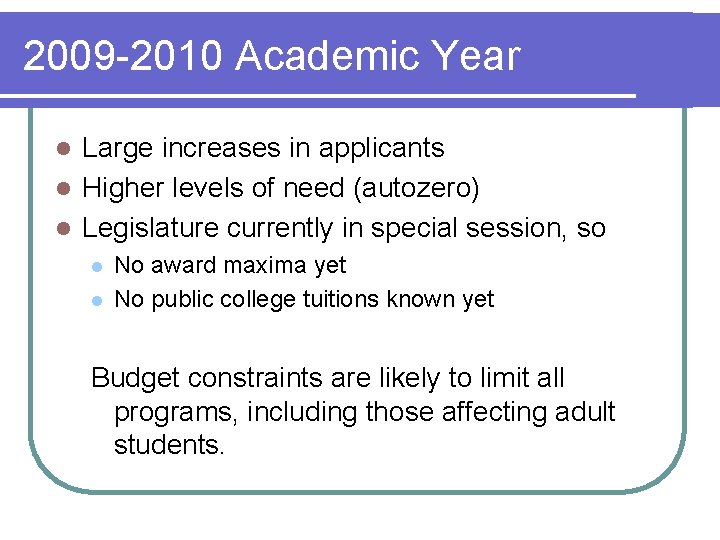
2009 -2010 Academic Year Large increases in applicants l Higher levels of need (autozero) l Legislature currently in special session, so l l l No award maxima yet No public college tuitions known yet Budget constraints are likely to limit all programs, including those affecting adult students.
Comments/Questions l Contact l l l Information: lgavrin@ssaci. in. gov 317 -234 -5134 150 W. Market St. Ste 500 Indianapolis, IN 46204