
Extending the Legacy of Morris Janowitz Pragmatism International
![Hull-House 1890 - 1910 Great Migration – new immigrants [diversity] Problems - Poverty, Health,](https://slidetodoc.com/presentation_image/04b44975b7f20cbc2f84f5240686c299/image-7.jpg "Hull-House 1890 - 1910 Great Migration – new immigrants [diversity] Problems - Poverty, Health,")
![Constabulary Force revisited Definition: “continuously prepared to act, [was] committed to the minimum use](https://slidetodoc.com/presentation_image/04b44975b7f20cbc2f84f5240686c299/image-10.jpg "Constabulary Force revisited Definition: “continuously prepared to act, [was] committed to the minimum use")
- Slides: 20
Extending the Legacy of Morris Janowitz Pragmatism, International Relations and Peacekeeping: Patricia M. Shields Texas State University ps 07@txstate. edu Joseph Soeters Netherlands Defence Academy Tilburg University Jmlm. soeters@nlda. nl Presented at the European Research Group on Armed Forces & Society Biannual Conference, June 4 -7, 2013, Madrid
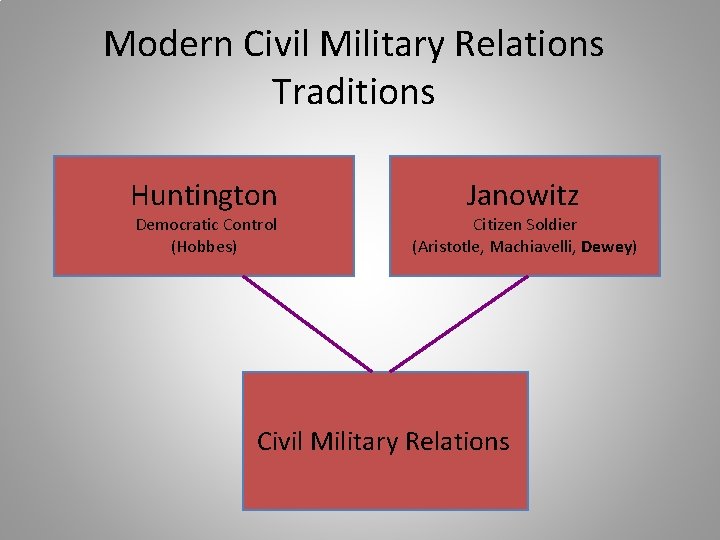
Modern Civil Military Relations Traditions Huntington Democratic Control (Hobbes) Janowitz Citizen Soldier (Aristotle, Machiavelli, Dewey) Civil Military Relations
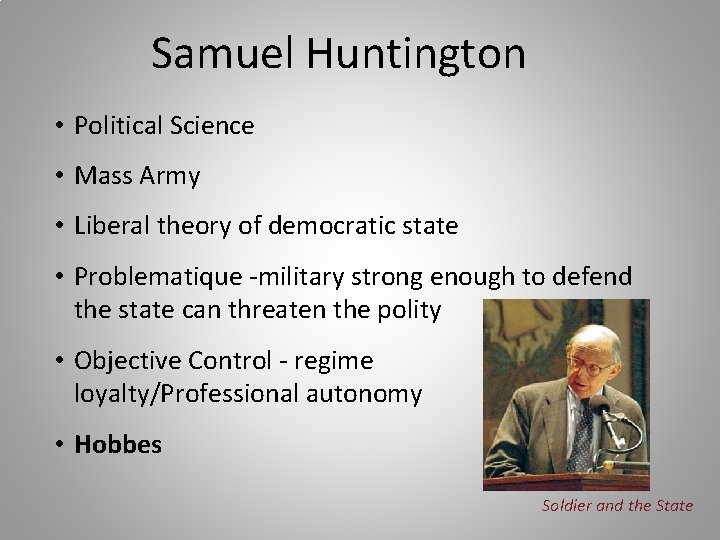
Samuel Huntington • Political Science • Mass Army • Liberal theory of democratic state • Problematique -military strong enough to defend the state can threaten the polity • Objective Control - regime loyalty/Professional autonomy • Hobbes Soldier and the State
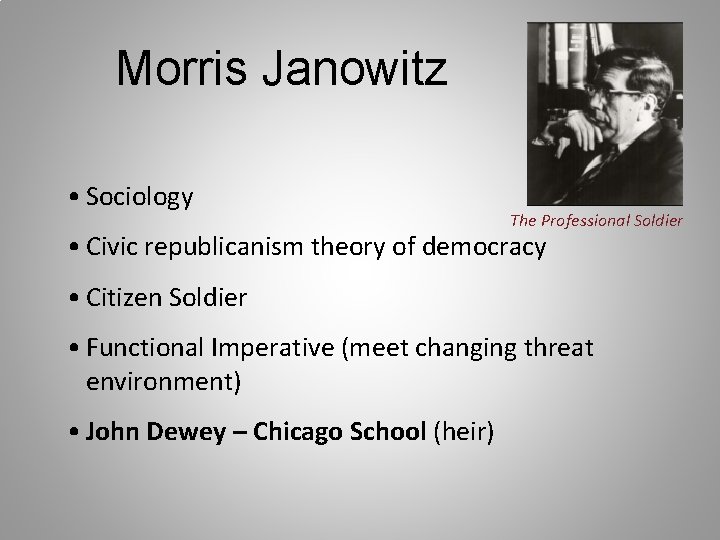
Morris Janowitz • Sociology The Professional Soldier • Civic republicanism theory of democracy • Citizen Soldier • Functional Imperative (meet changing threat environment) • John Dewey – Chicago School (heir)
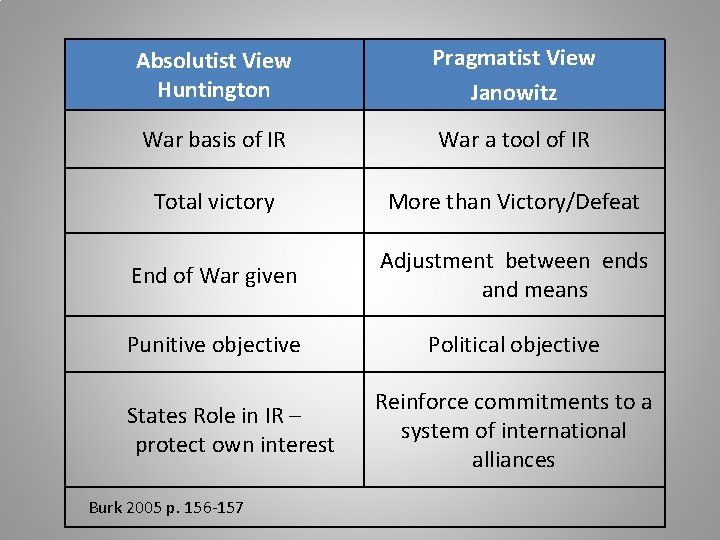
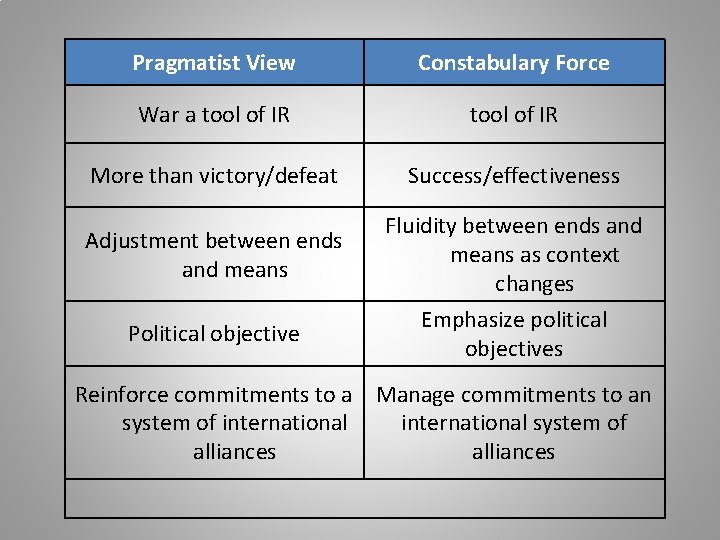
Absolutist View Huntington Pragmatist View Janowitz War basis of IR War a tool of IR Total victory More than Victory/Defeat End of War given Adjustment between ends and means Punitive objective Political objective States Role in IR – protect own interest Burk 2005 p. 156 -157 Reinforce commitments to a system of international alliances
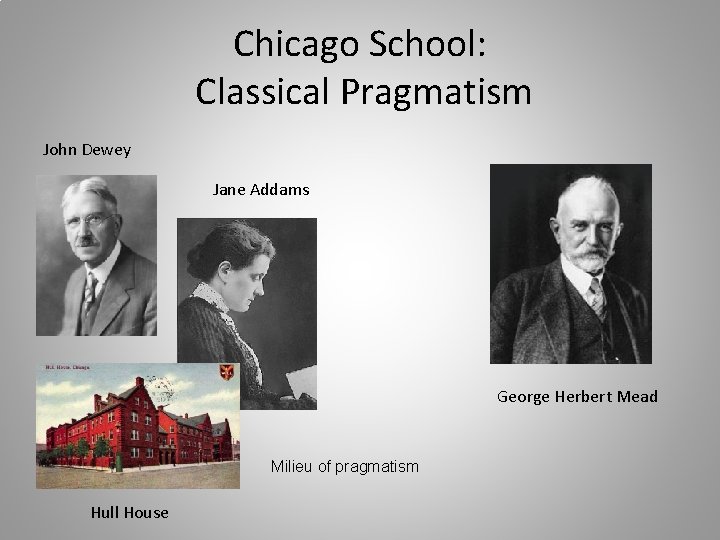
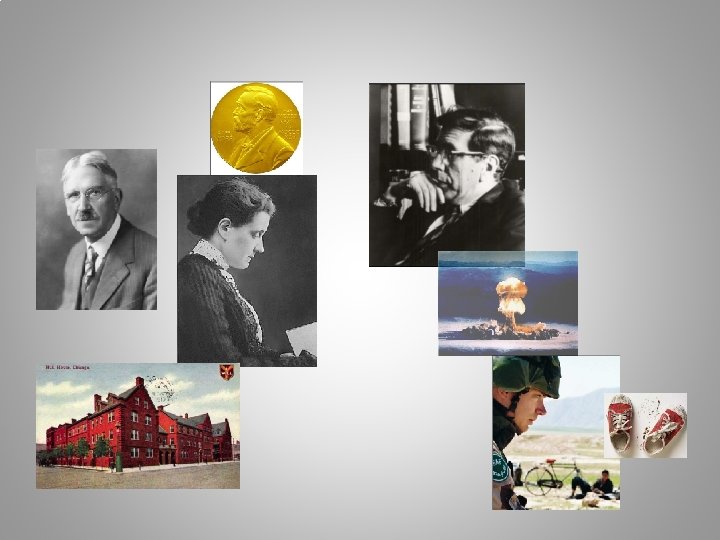
Chicago School: Classical Pragmatism John Dewey Jane Addams George Herbert Mead Milieu of pragmatism Hull House
Hull-House 1890 - 1910 Great Migration – new immigrants [diversity] Problems - Poverty, Health, Corruption, child labor, ethnic strife, weak Courts/police system, violent labor/industry strife, language barriers Hull House “Experimental effort to aid in the solution of the social and industrial problems which are engendered by the modern conditions of live in a great city. ” (Addams, 1930/1910 p. 125) • Residents without political power – democracy • Asked to mediate conflicts (labor/management; young/old; Old world/New world; ongoing ethnic conflict; ) • Education mission *Dewey & Mead active board of directors
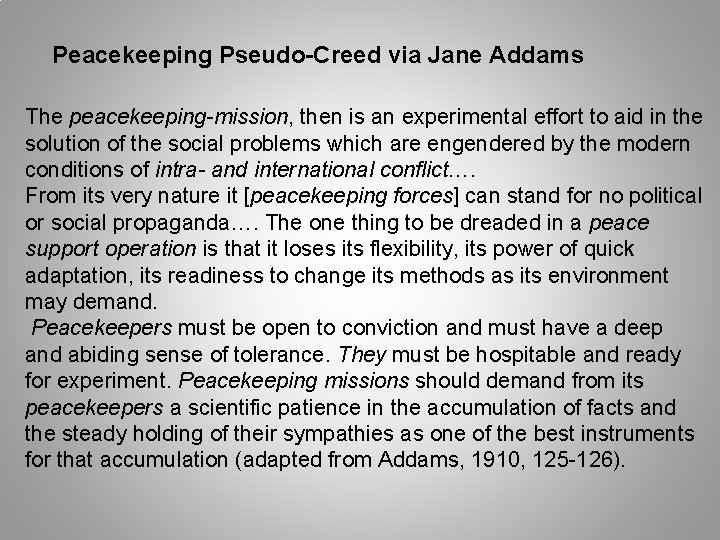
Peacekeeping Pseudo-Creed via Jane Addams The peacekeeping-mission, then is an experimental effort to aid in the solution of the social problems which are engendered by the modern conditions of intra- and international conflict…. From its very nature it [peacekeeping forces] can stand for no political or social propaganda…. The one thing to be dreaded in a peace support operation is that it loses its flexibility, its power of quick adaptation, its readiness to change its methods as its environment may demand. Peacekeepers must be open to conviction and must have a deep and abiding sense of tolerance. They must be hospitable and ready for experiment. Peacekeeping missions should demand from its peacekeepers a scientific patience in the accumulation of facts and the steady holding of their sympathies as one of the best instruments for that accumulation (adapted from Addams, 1910, 125 -126).
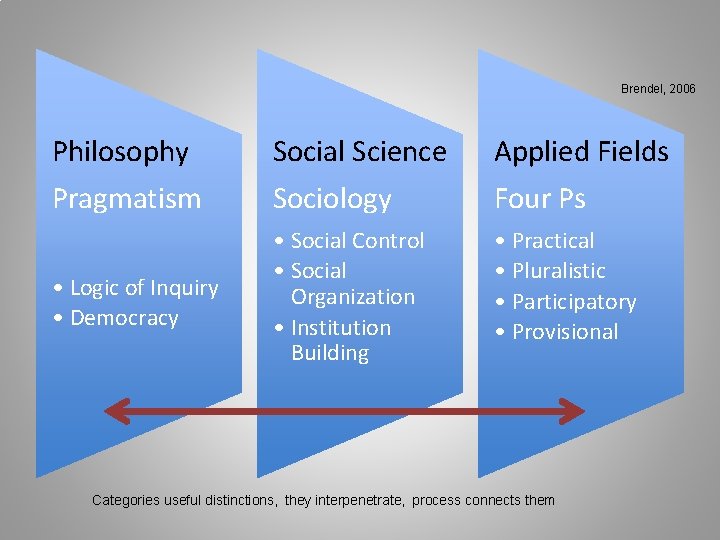
Brendel, 2006 Philosophy Pragmatism Social Science Sociology Applied Fields Four Ps • Logic of Inquiry • Democracy • Social Control • Social Organization • Institution Building • Practical • Pluralistic • Participatory • Provisional Categories useful distinctions, they interpenetrate, process connects them
Constabulary Force revisited Definition: “continuously prepared to act, [was] committed to the minimum use of force, and [sought] viable international relations rather than [military] victory” (Janowitz, 1971, 418) • Approach to the use of force • Does not specify a unique structure
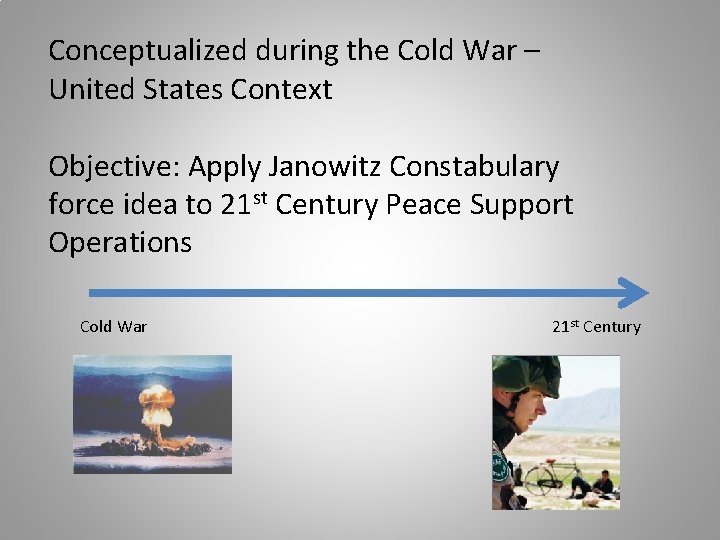
Conceptualized during the Cold War – United States Context Objective: Apply Janowitz Constabulary force idea to 21 st Century Peace Support Operations Cold War 21 st Century
Pragmatist View Constabulary Force War a tool of IR More than victory/defeat Success/effectiveness Adjustment between ends and means Political objective Fluidity between ends and means as context changes Emphasize political objectives Reinforce commitments to a Manage commitments to an system of international system of alliances
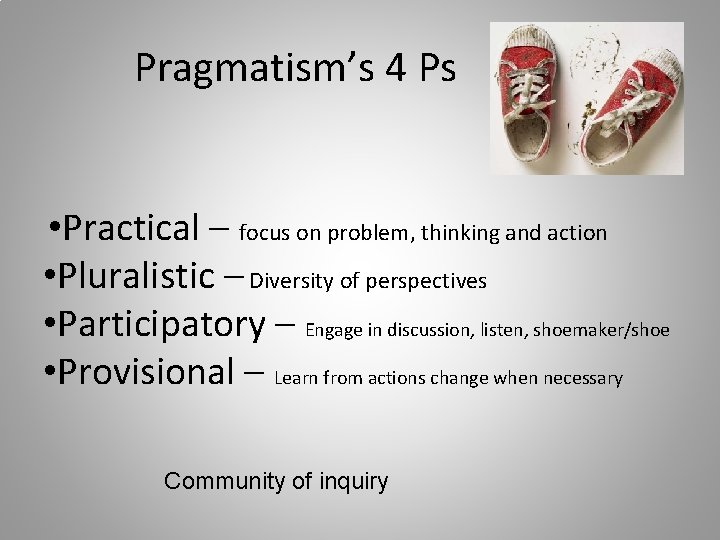
Pragmatism’s 4 Ps • Practical – focus on problem, thinking and action • Pluralistic – Diversity of perspectives • Participatory – Engage in discussion, listen, shoemaker/shoe • Provisional – Learn from actions change when necessary Community of inquiry
The 4 P’s in DR Congo (MONUSCO); Explaining the Catch 22 Being Practical… Being Pluralistic… • Too much budget spent on itself (“beast that feeds it self”) • Too far away from where the evil happens (“too far, too little, too late”) • Issues addressed are too general (“no filling of potholes”) • Force Commander is “son of Africa” • Language problems (No French, no indigenous languages) • Pluralism of having civilians and military insufficiently used -> no integration
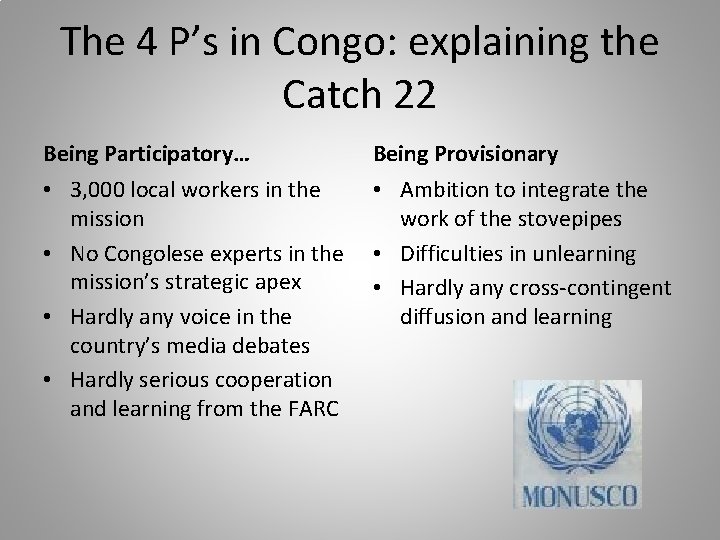
The 4 P’s in Congo: explaining the Catch 22 Being Participatory… Being Provisionary • 3, 000 local workers in the • Ambition to integrate the mission work of the stovepipes • No Congolese experts in the • Difficulties in unlearning mission’s strategic apex • Hardly any cross-contingent • Hardly any voice in the diffusion and learning country’s media debates • Hardly serious cooperation and learning from the FARC
Exploring Civil-Military Relations: Janowitz, Pragmatism & Peace Support Operations Exploring – Preliminary analysis of CMR Janowitz – reexamining and extending his pragmatism - Connections between Dewey and Addams - Beyond Cold War (constabulary force) - Extensions to Applied Fields| - Use four 4’s to theorize about and evaluate peace support operations
Useful References Addams, Jane. 1930/1910. Twenty Years at Hull-House. New York: Mc. Millan Co. Addams, Jane. 1902. Democracy and Social Ethics. New York: Macmillan Co. Brendel. David C. 2006. Healing psychiatry: Bridging the science/humanism divide. Cambridge MA: MIT Press. Burk, James. 2005. Strategic Assumptions and Moral Implications of the Constabulary Force. Journal of Military Ethics Vol. 4, No. 3. pp 155 -167. Burk, James. 1991. Introduction: A Pragmatic Sociology in Morris Janowitz: On Social Organization and Social Control ed. James Burk pp. 1 -58, Chicago: University of Chicago Press. Burk, James. 2002. Theories of Democratic Civil-Military Relations. Armed Forces & Society, Vol. 29. No. 1 pp. 7029. Dewey, John. 1916 a. Democracy and Education. New York: Mac. Millan. Dewey, John. 1916 b. Essays in Experimental Logic. New York: Dover Publications. Dewey, John. 1910. How We Think. New York: D. C. Heath & Co. . Dewey, John. 1929 The Quest for Certainty. New York: Minton, Balch. Dewey, John. 1925. Experience and nature. Chicago: Open Court Publishing Dewey, John. 1934. Art as Experience New York: Minton Balch. Dewey, John. 1938. Logic: Theory of Inquiry. New York: Holt, Rinehart and Winston.
Dewey, John. 1946 The Problems of Men. New York: The Philosophical Library. Dewey, John. 1948. Reconstruction in Philosophy enlarged edition. Boston: Beacon Press. Dewey, John. 1954. The Public and its Problem. Chicago: Swallow Press. Dewey, John and James Tufts. 1932. Ethics. New York H. Holt & Co. Huntington, Samuel P. 1957/1964. The Soldier and the State. New York: Vintage Books. Janowitz, Morris. 1971. The Professional Soldier. New York: Free Press. Janowitz, Morris. 1975 Sociological Theory and Social Control. American Journal of Sociology Vol. 81, No. 1 pp. 82 -87. Janowitz, Morris. 1974. Institution Building for Military Stabilization. World Politics. Vol. 26, no. 4. pp. 499 -508. Janowitz, Morris. 1977. Epilogue: Toward Conceptual refortulation, in E. P. Stern (Ed. ), The limits of Military Intervention, pp. 369 -389. Johansson, Eva. 1996. In a blue beret, four Swedish UN battalions in Bosnia. Presented at the ERGOMAS conference, Zurich. Schmidtchen, David. 2006. The rise of the strategic private: Technology, control and change in a network enabled military. Commonwealth of Australia: Land Warfare Studies Centre. Shields, Patricia M. 1996. Pragmatism: Exploring Public Administration’s Policy Imprint. Administration & Society, 28(4), 390 -411. Shields, Patricia M. 1998. Pragmatism as Philosophy of Science: a Tool for Public Administration. Research in Public Administration 4: 195 -226.
Shields, Patricia M. 2003. The Community of Inquiry: Classical Pragmatism and Public Administration & Society, 35(5), 510 -538. Shields, Patricia M. 2004. Classical pragmatism: Engaging practitioner experience. Administration & Society, 36(3), 351 -361. Shields, Patricia M. 2005 a. Classical Pragmatism does Not Need an Upgrade: Lessons for Public Administration & Society 37(4): 504 -518. Shields, Patricia M. 2005 b Classical Pragmatism: Roots and Promise for a PA Feminist Theory. Administrative Theory & Praxis 27(2): 370 -376. Shields, Patricia M. 2006. Democracy and the Social Feminist Ethics of Jane Addams: A Vision for Public Administration. Administrative Theory & Praxis 28(3) 418 -443. Soeters, J. and T. Szvirczev Tresch (2010). ‘Towards cultural integration in multinational peace operations’. Defence Studies, 10(1 -2), 272 -287. van Osch, Ingrid and Joseph Soeters, 2010. Fragile support: MONUC's reputation and legitimacy in the Democratic Republic of Congo, in: C. Leuprecht, J. Troy and D. Last (eds. ), Mission Critical. Smaller Democracies' Role in Global Stability Operations, Montreal and Kingston: Queen's Policy Studies Series, Mc. Gill-Queen's University Press, pp. 77 -100. Whetsell, T. and P. Shields (2011). ‘Reconciling the varieties of pragmatism in public administration’, Administration & Society. July 43(4): 474 -483.