
Extending computer guideline system with advanced AI and

- Slides: 36
Extending computer guideline system with advanced AI and DB facilities Alessio Bottrighi
A clinical guidelines is sistematically developments statemnts to assist pratictioners and patient decision about appropriate health care for specific clinical circumstance Alessio Bottrighi 's Ph. d. Dissertation 2
Our work • Decision theory support • Model checking in clinical guidelines • Cooperative update Alessio Bottrighi 's Ph. d. Dissertation 3
Decision System Support • decision making is a central issue in clinical practice. • it is frequent that it is not possible define if an alternative is really “better” than other, for a clinical point of view Alessio Bottrighi 's Ph. d. Dissertation 4
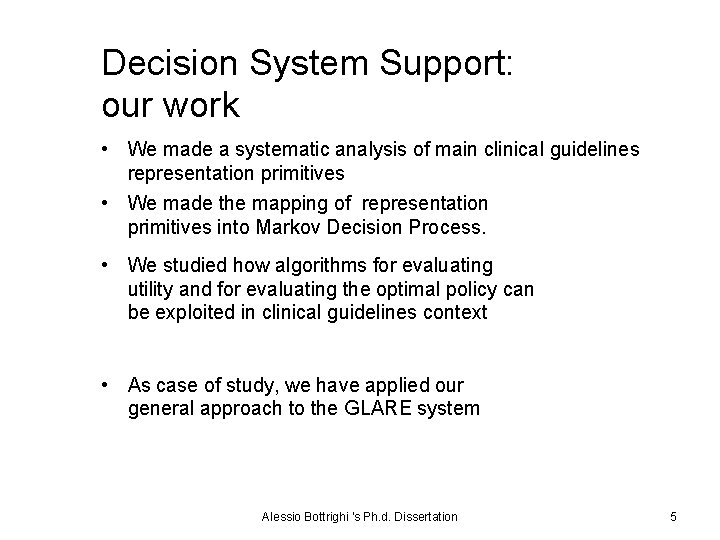
Decision System Support: our work • We made a systematic analysis of main clinical guidelines representation primitives • We made the mapping of representation primitives into Markov Decision Process. • We studied how algorithms for evaluating utility and for evaluating the optimal policy can be exploited in clinical guidelines context • As case of study, we have applied our general approach to the GLARE system Alessio Bottrighi 's Ph. d. Dissertation 5
Decision System Support: publication • S. Montani, P. Terenziani, A. Bottrighi, Exploiting decision theory for supporting therapy selection in computerized clinical guidelines, Proc. European Conference on Artificial Intelligence in Medicine (AIME) 2005, July 2005 • P. Terenziani, S. Montani, A. Bottrighi, M. Torchio, G. Molino, G. Correndo, Managing clinical guidelines contextualization in the GLARE system, Proc. Congresso Nazionale dell'Associazione Italiana per l'Intelligenza Artificiale (AI*IA) 2005, September 2005 Alessio Bottrighi 's Ph. d. Dissertation 6
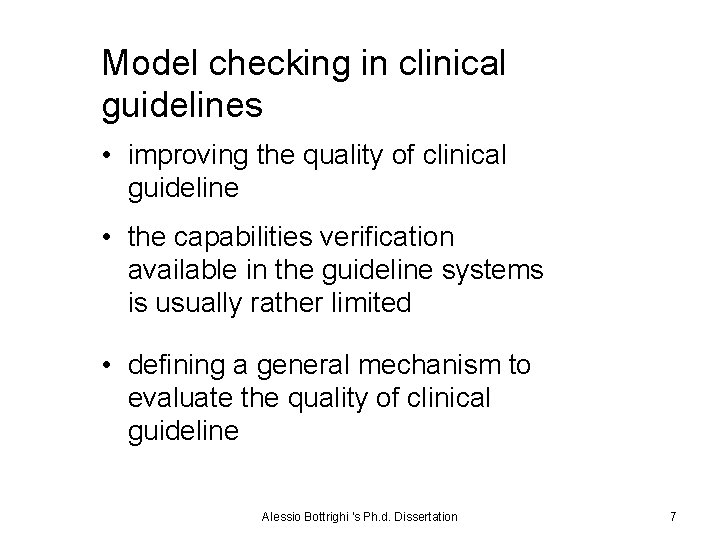
Model checking in clinical guidelines • improving the quality of clinical guideline • the capabilities verification available in the guideline systems is usually rather limited • defining a general mechanism to evaluate the quality of clinical guideline Alessio Bottrighi 's Ph. d. Dissertation 7
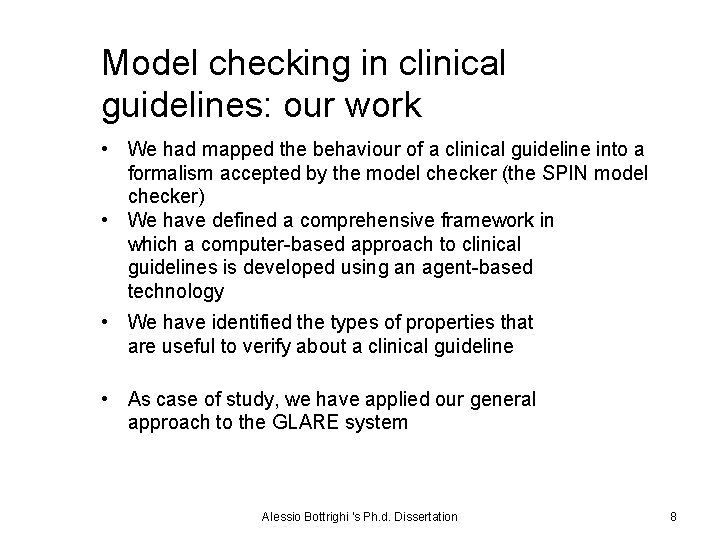
Model checking in clinical guidelines: our work • We had mapped the behaviour of a clinical guideline into a formalism accepted by the model checker (the SPIN model checker) • We have defined a comprehensive framework in which a computer-based approach to clinical guidelines is developed using an agent-based technology • We have identified the types of properties that are useful to verify about a clinical guideline • As case of study, we have applied our general approach to the GLARE system Alessio Bottrighi 's Ph. d. Dissertation 8
Model checking in clinical guidelines: publication • P. Terenziani, L. Giordano, A. Bottrighi, S. Montani, L. Donzella, Spin Model Ckecking for the verification of Clinical Guidelines, Workshop on AI techniques in healthcare: evidence-based guidelines and protocols, ECAI 2006, August 2006 ● L. Giordano, P. Terenziani, A. Bottrighi, S. Montani, L. Donzella, Model checking for clinical guidelines: an agent-based approach, American Medical Informatics Association (AMIA), November 2006 Alessio Bottrighi 's Ph. d. Dissertation 9
Cooperative Update: introduction (1) • Important, e. g. software development – Multiple alternative proposals – Selection • Software engineering tools • Analogous problems using Database to model complex domains Alessio Bottrighi 's Ph. d. Dissertation 10
Cooperative Update: introduction (2) The case of clinical guidelines: • General guideline proposed by a standardization committee • Proposals of update – Local contextualization – New therapies • Evaluation of proposals Guideline to be stored in a DB Alessio Bottrighi 's Ph. d. Dissertation 11
Cooperative Update: introduction (3) Augmenting DB approaches to support cooperative work, i. e. : • distinction between two phases: – proposals and acceptance/rejection – history of the evolution of the proposals • alternative proposals Alessio Bottrighi 's Ph. d. Dissertation 12
Cooperative Update: introduction (4) • Both validity time and transaction time should be supported • “Consensus” approach (TSQL 2) with a high-level semantics (BCDM) • BCDM supports several Temporal Database implementations (not only TSQL 2) Alessio Bottrighi 's Ph. d. Dissertation 13
Cooperative Update: goal • Extending BCDM to support cooperative updates • Propose vs accept/reject • Alternative proposals of updates Alessio Bottrighi 's Ph. d. Dissertation 14
Cooperative Update: criteria (1) • Under-constrained policy: – Super user vs user – Super user operations: standard + accept/reject proposals – User operations: • delete (not proposals) • insert • update (chains allowed) Alessio Bottrighi 's Ph. d. Dissertation 15
Cooperative Update: criteria (2) • “Minimal” extension of BCDM: – Upward compatibility (manipulation operations) – Reducibility (algebra) Alessio Bottrighi 's Ph. d. Dissertation 16
Cooperative Update: our work • Data model • Manipulation operations • Algebra Alessio Bottrighi 's Ph. d. Dissertation 17
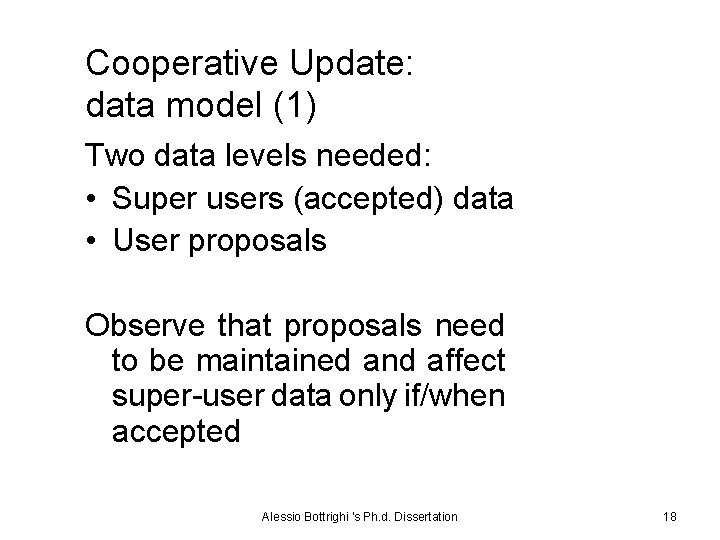
Cooperative Update: data model (1) Two data levels needed: • Super users (accepted) data • User proposals Observe that proposals need to be maintained and affect super-user data only if/when accepted Alessio Bottrighi 's Ph. d. Dissertation 18
Cooperative Update: data model (2) Authoring: • author as a data attribute • Basically a “standard” data attribute (however, author cannot be modified) Alessio Bottrighi 's Ph. d. Dissertation 19
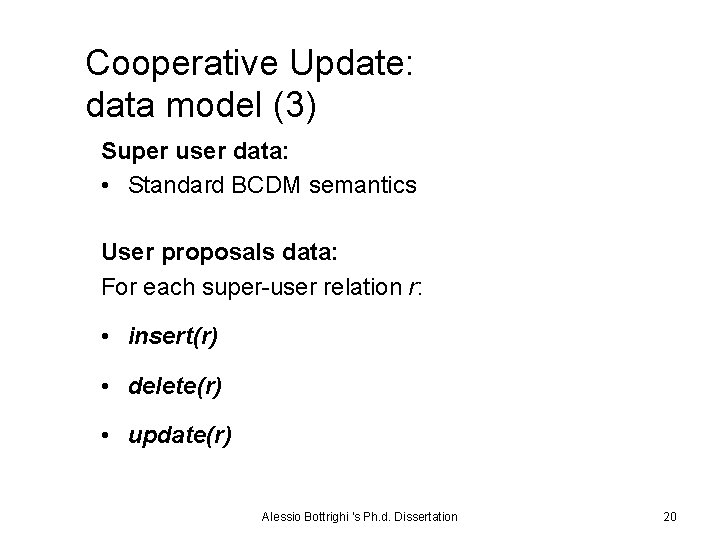
Cooperative Update: data model (3) Super user data: • Standard BCDM semantics User proposals data: For each super-user relation r: • insert(r) • delete(r) • update(r) Alessio Bottrighi 's Ph. d. Dissertation 20
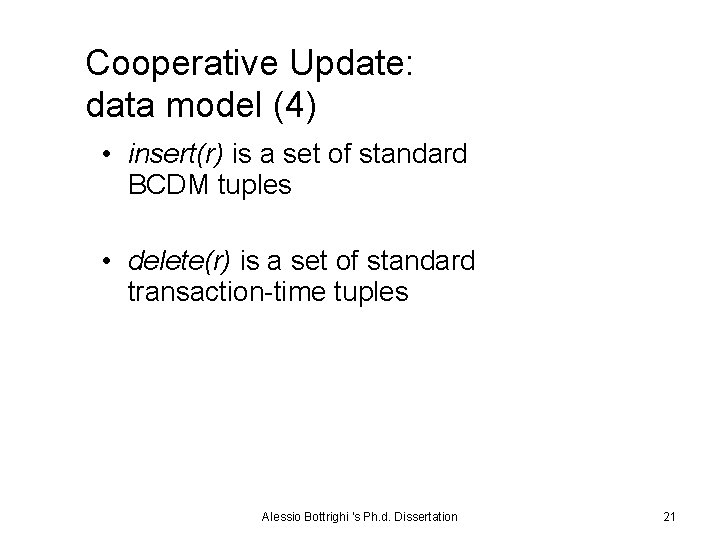
Cooperative Update: data model (4) • insert(r) is a set of standard BCDM tuples • delete(r) is a set of standard transaction-time tuples Alessio Bottrighi 's Ph. d. Dissertation 21
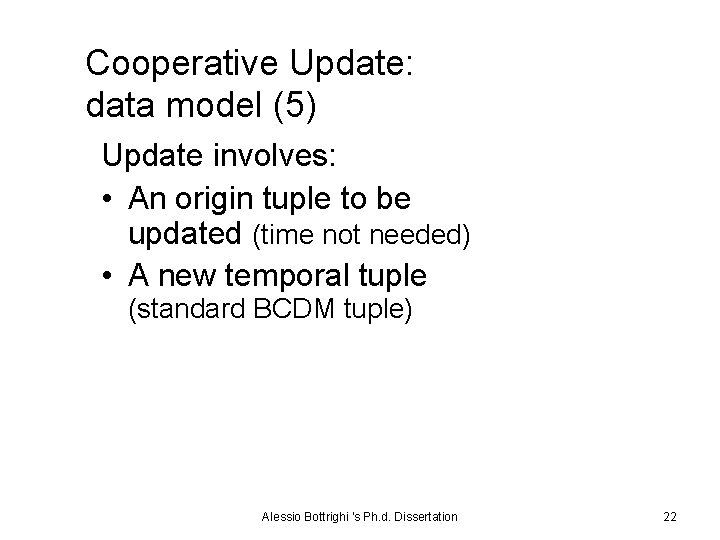
Cooperative Update: data model (5) Update involves: • An origin tuple to be updated (time not needed) • A new temporal tuple (standard BCDM tuple) Alessio Bottrighi 's Ph. d. Dissertation 22
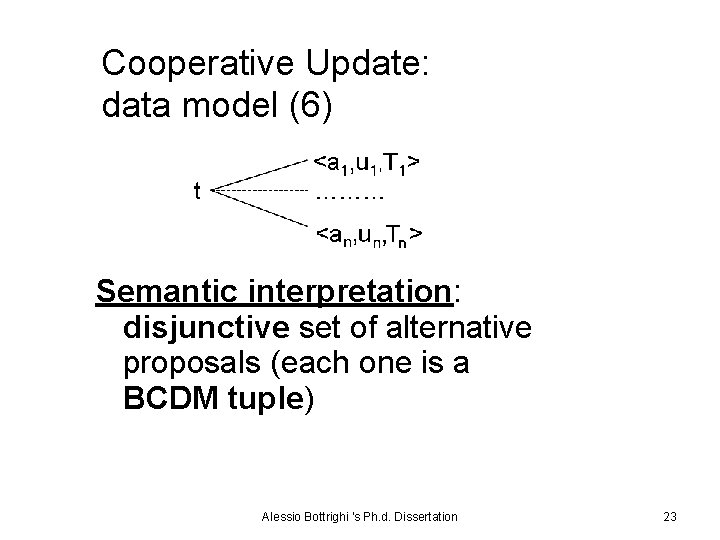
Cooperative Update: data model (6) Semantic interpretation: disjunctive set of alternative proposals (each one is a BCDM tuple) Alessio Bottrighi 's Ph. d. Dissertation 23
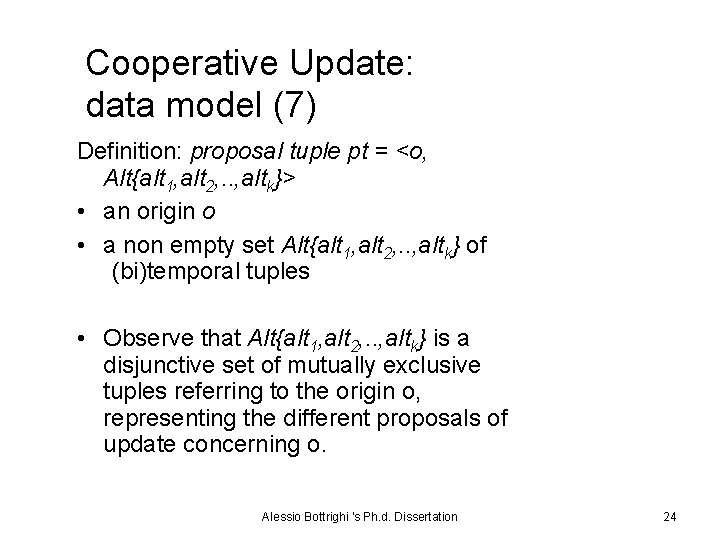
Cooperative Update: data model (7) Definition: proposal tuple pt = <o, Alt{alt 1, alt 2, . . , altk}> • an origin o • a non empty set Alt{alt 1, alt 2, . . , altk} of (bi)temporal tuples • Observe that Alt{alt 1, alt 2, . . , altk} is a disjunctive set of mutually exclusive tuples referring to the origin o, representing the different proposals of update concerning o. Alessio Bottrighi 's Ph. d. Dissertation 24
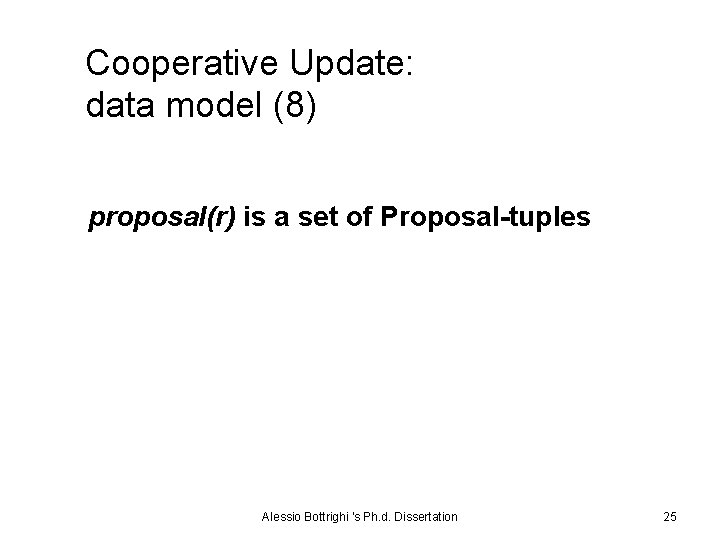
Cooperative Update: data model (8) proposal(r) is a set of Proposal-tuples Alessio Bottrighi 's Ph. d. Dissertation 25
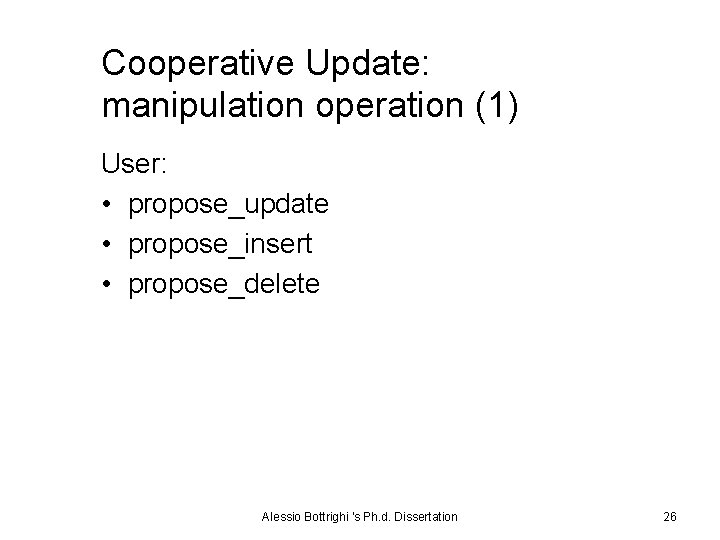
Cooperative Update: manipulation operation (1) User: • propose_update • propose_insert • propose_delete Alessio Bottrighi 's Ph. d. Dissertation 26
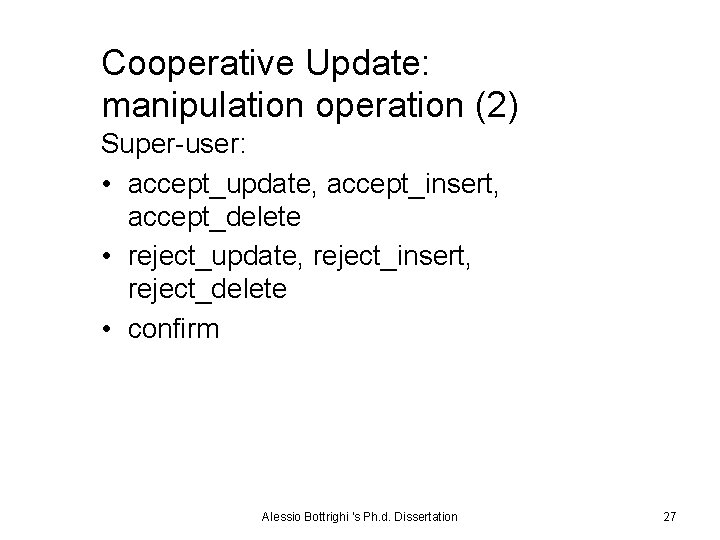
Cooperative Update: manipulation operation (2) Super-user: • accept_update, accept_insert, accept_delete • reject_update, reject_insert, reject_delete • confirm Alessio Bottrighi 's Ph. d. Dissertation 27
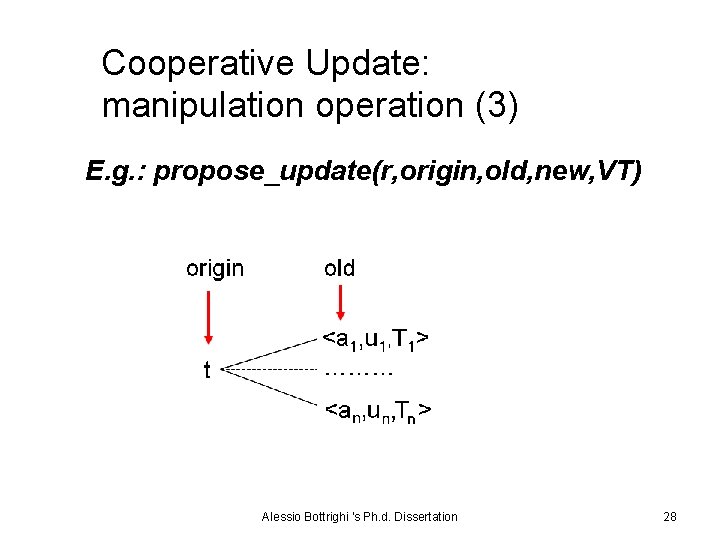
Cooperative Update: manipulation operation (3) E. g. : propose_update(r, origin, old, new, VT) Alessio Bottrighi 's Ph. d. Dissertation 28
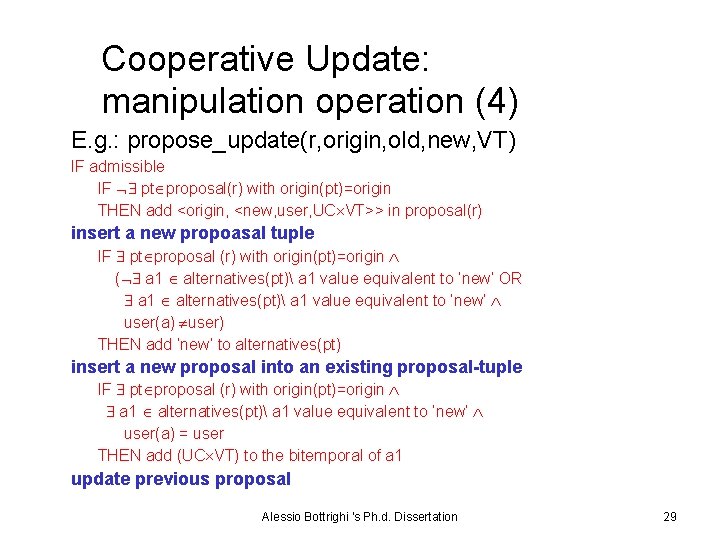
Cooperative Update: manipulation operation (4) E. g. : propose_update(r, origin, old, new, VT) IF admissible IF pt proposal(r) with origin(pt)=origin THEN add <origin, <new, user, UC VT>> in proposal(r) insert a new propoasal tuple IF pt proposal (r) with origin(pt)=origin ( a 1 alternatives(pt) a 1 value equivalent to ‘new’ OR a 1 alternatives(pt) a 1 value equivalent to ‘new’ user(a) user) THEN add ‘new’ to alternatives(pt) insert a new proposal into an existing proposal-tuple IF pt proposal (r) with origin(pt)=origin a 1 alternatives(pt) a 1 value equivalent to ‘new’ user(a) = user THEN add (UC VT) to the bitemporal of a 1 update previous proposal Alessio Bottrighi 's Ph. d. Dissertation 29
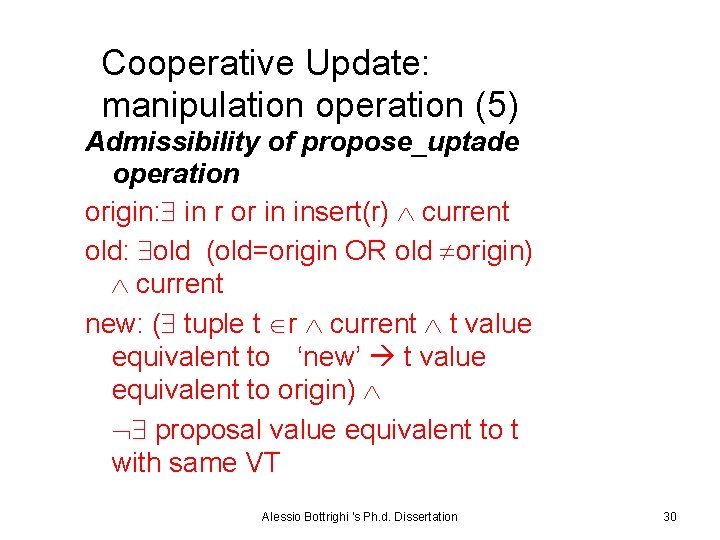
Cooperative Update: manipulation operation (5) Admissibility of propose_uptade operation origin: in r or in insert(r) current old: old (old=origin OR old origin) current new: ( tuple t r current t value equivalent to ‘new’ t value equivalent to origin) proposal value equivalent to t with same VT Alessio Bottrighi 's Ph. d. Dissertation 30
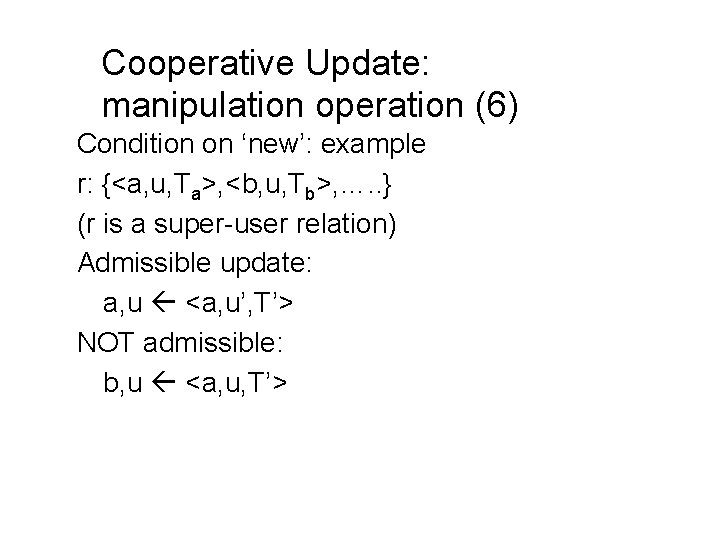
Cooperative Update: manipulation operation (6) Condition on ‘new’: example r: {<a, u, Ta>, <b, u, Tb>, …. . } (r is a super-user relation) Admissible update: a, u <a, u’, T’> NOT admissible: b, u <a, u, T’>
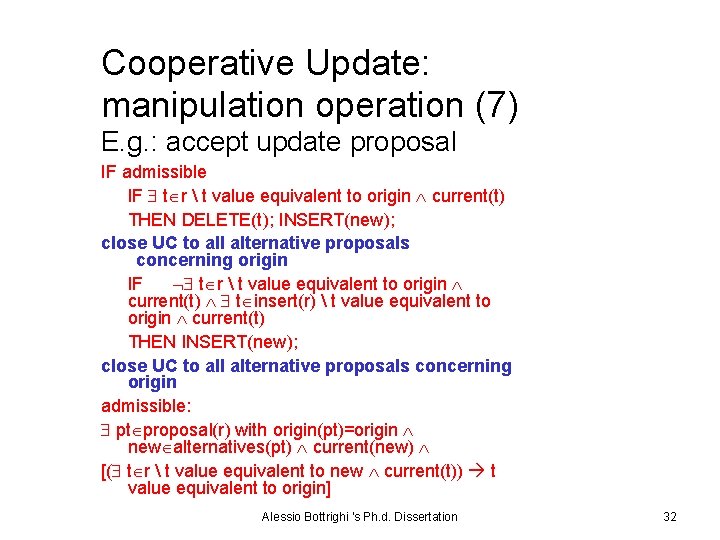
Cooperative Update: manipulation operation (7) E. g. : accept update proposal IF admissible IF t r t value equivalent to origin current(t) THEN DELETE(t); INSERT(new); close UC to all alternative proposals concerning origin IF t r t value equivalent to origin current(t) t insert(r) t value equivalent to origin current(t) THEN INSERT(new); close UC to all alternative proposals concerning origin admissible: pt proposal(r) with origin(pt)=origin new alternatives(pt) current(new) [( t r t value equivalent to new current(t)) t value equivalent to origin] Alessio Bottrighi 's Ph. d. Dissertation 32
Cooperative Update: algebra(1) • Standard BCDM algebraic operations for super-user and for insert(r), delete(r) • New algebraic operations on Proposal-relations Alessio Bottrighi 's Ph. d. Dissertation 33
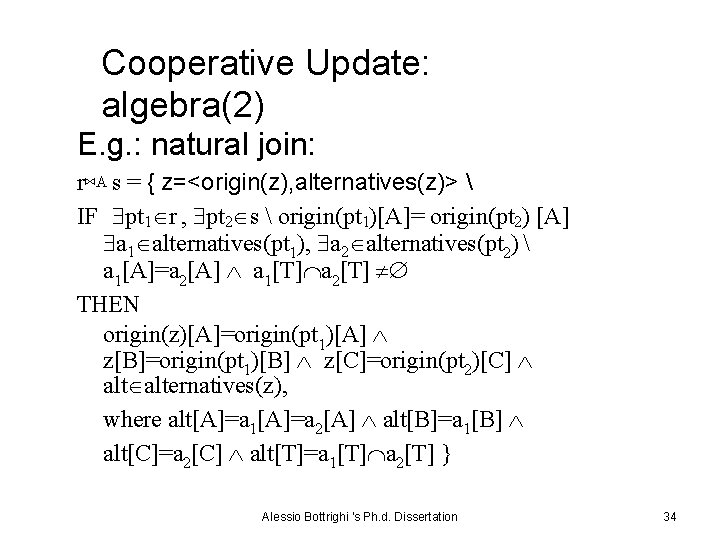
Cooperative Update: algebra(2) E. g. : natural join: r⋈A s = { z=<origin(z), alternatives(z)> IF pt 1 r , pt 2 s origin(pt 1)[A]= origin(pt 2) [A] a 1 alternatives(pt 1), a 2 alternatives(pt 2) a 1[A]=a 2[A] a 1[T] a 2[T] THEN origin(z)[A]=origin(pt 1)[A] z[B]=origin(pt 1)[B] z[C]=origin(pt 2)[C] alternatives(z), where alt[A]=a 1[A]=a 2[A] alt[B]=a 1[B] alt[C]=a 2[C] alt[T]=a 1[T] a 2[T] } Alessio Bottrighi 's Ph. d. Dissertation 34
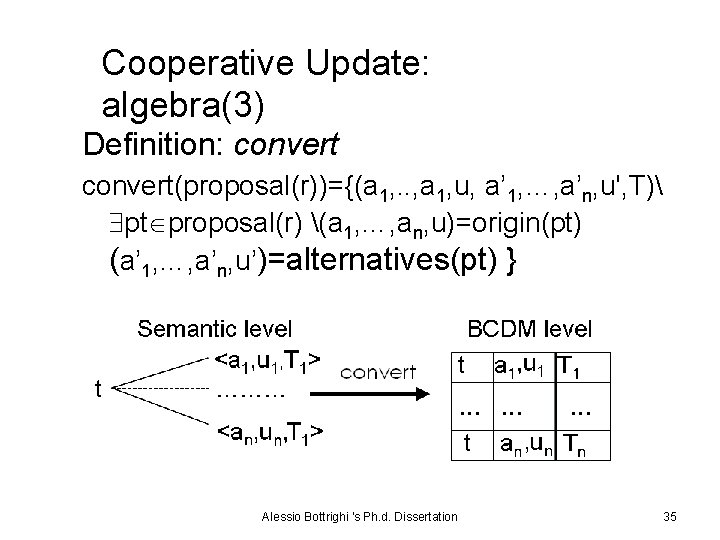
Cooperative Update: algebra(3) Definition: convert(proposal(r))={(a 1, . . , a 1, u, a’ 1, …, a’n, u', T) pt proposal(r) (a 1, …, an, u)=origin(pt) (a’ 1, …, a’n, u’)=alternatives(pt) } Alessio Bottrighi 's Ph. d. Dissertation 35
End Thanks!! Alessio Bottrighi 's Ph. d. Dissertation 36