
ExtendedConnectivity Fingerprints how ECFPs are generated My phase







- Slides: 28
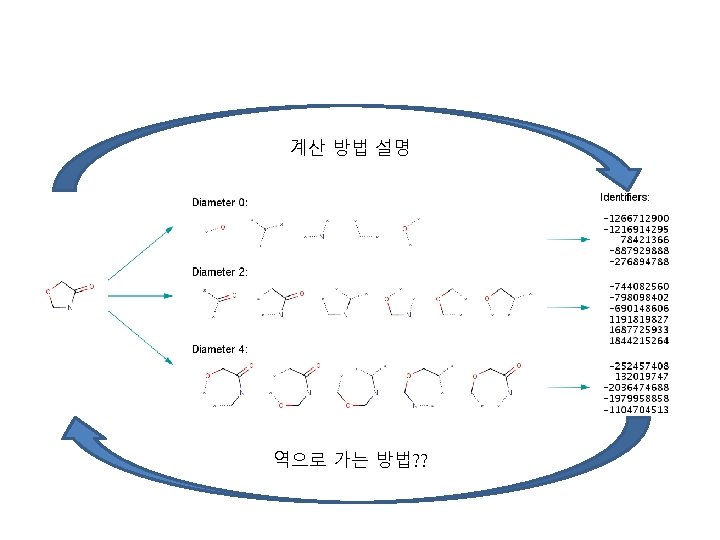
Extended-Connectivity Fingerprints how ECFPs are generated? +기존에 제기한 의문에 대한 대답
My phase II models • Classifier used – Random Forest • Descriptors used – ECFP: Extended-Connectivity Fingerprints
• We can get important substructures from statistical analysis of RF • Need discussions about – Structure versus ECFP atom identifiers relationship – Mean depth in RF
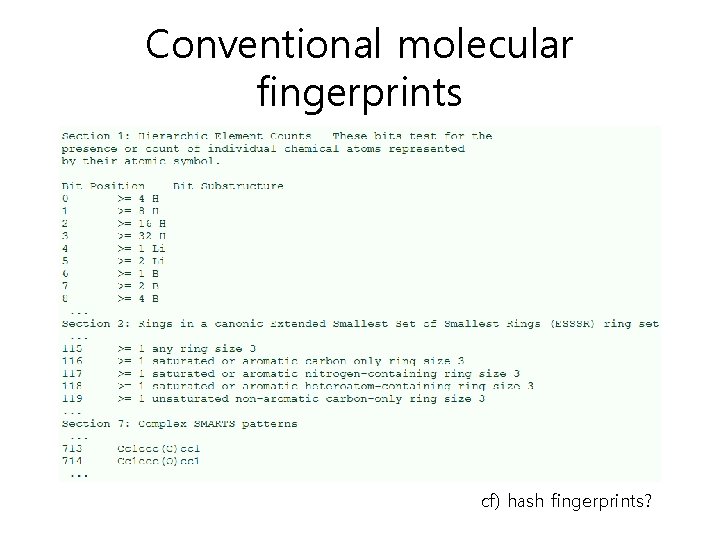
Conventional molecular fingerprints cf) hash fingerprints?
Introduction • Extended-connectivity fingerprints (ECFPs) • topological fingerprints for molecular characterization • capture molecular features relevant to molecular activity
ECFP Generation Process • An initial assignment stage in which each atom has an integer identifier assigned to it. • An iterative updating stage in which each atom identifier is updated to reflect the identifiers of each atom's neighbors, including identification of whether it is a structural duplicate of other features. • A duplicate identifier removal stage in which multiple occurrences of the same feature are reduced to a single representative in the final feature list. (The occurrence count may be retained if one requires a set of counts rather than a standard binary fingerprint. )
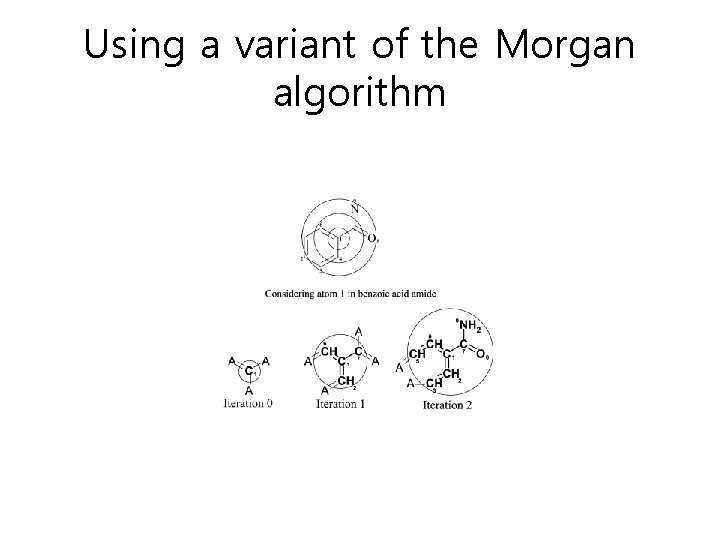
Using a variant of the Morgan algorithm
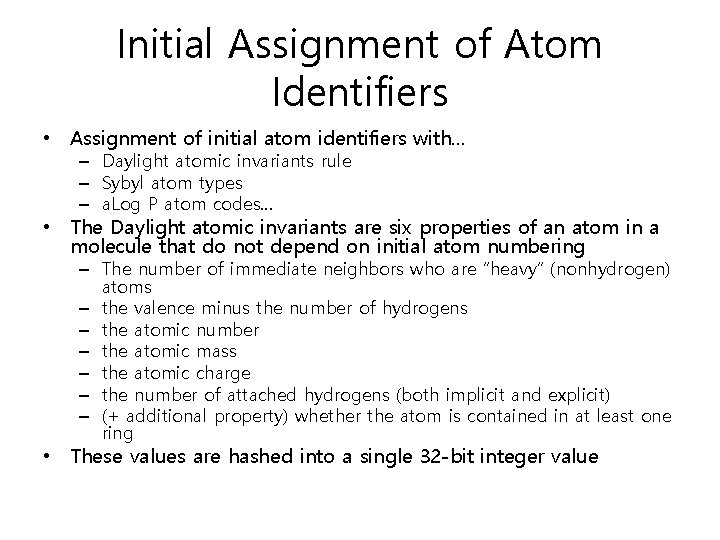
Initial Assignment of Atom Identifiers • Assignment of initial atom identifiers with… – Daylight atomic invariants rule – Sybyl atom types – a. Log P atom codes… • The Daylight atomic invariants are six properties of an atom in a molecule that do not depend on initial atom numbering – The number of immediate neighbors who are “heavy” (nonhydrogen) atoms – the valence minus the number of hydrogens – the atomic number – the atomic mass – the atomic charge – the number of attached hydrogens (both implicit and explicit) – (+ additional property) whether the atom is contained in at least one ring • These values are hashed into a single 32 -bit integer value
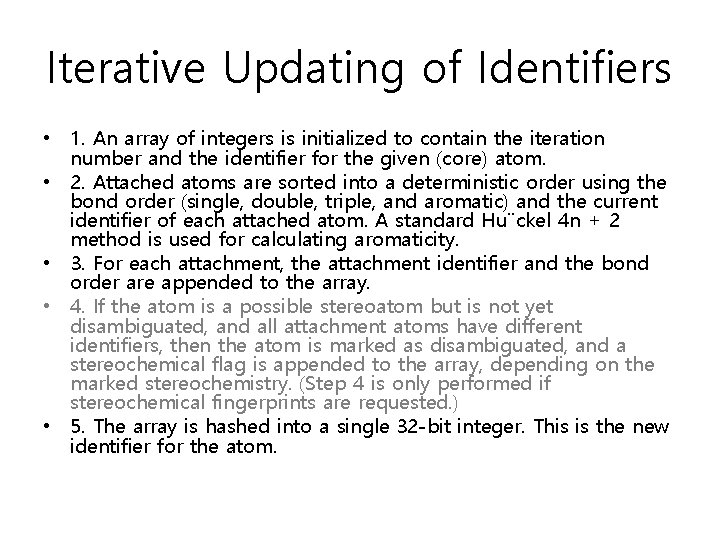
Iterative Updating of Identifiers • 1. An array of integers is initialized to contain the iteration number and the identifier for the given (core) atom. • 2. Attached atoms are sorted into a deterministic order using the bond order (single, double, triple, and aromatic) and the current identifier of each attached atom. A standard Hu¨ckel 4 n + 2 method is used for calculating aromaticity. • 3. For each attachment, the attachment identifier and the bond order are appended to the array. • 4. If the atom is a possible stereoatom but is not yet disambiguated, and all attachment atoms have different identifiers, then the atom is marked as disambiguated, and a stereochemical flag is appended to the array, depending on the marked stereochemistry. (Step 4 is only performed if stereochemical fingerprints are requested. ) • 5. The array is hashed into a single 32 -bit integer. This is the new identifier for the atom.
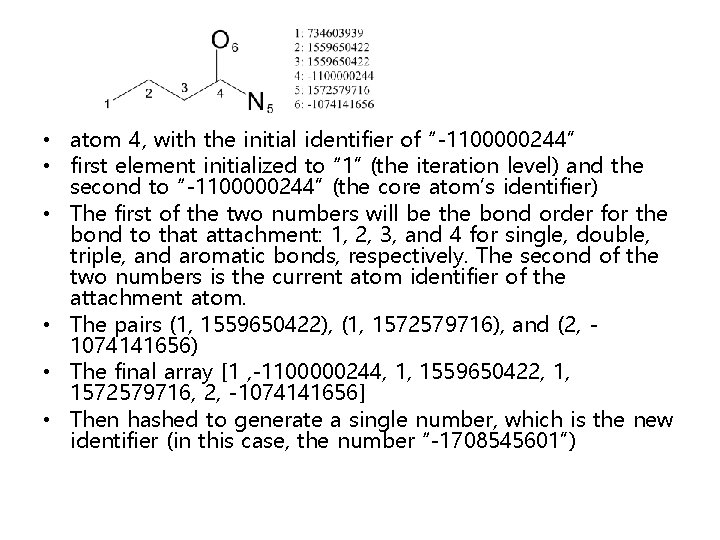
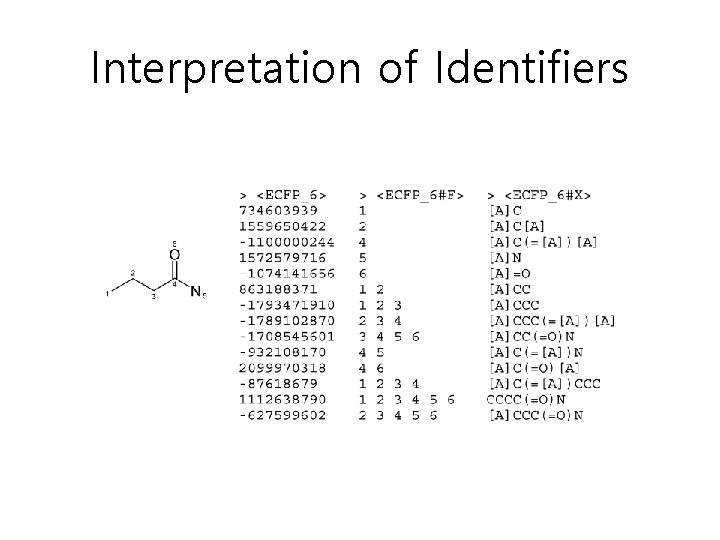
• atom 4, with the initial identifier of “-1100000244” • first element initialized to “ 1” (the iteration level) and the second to “-1100000244” (the core atom’s identifier) • The first of the two numbers will be the bond order for the bond to that attachment: 1, 2, 3, and 4 for single, double, triple, and aromatic bonds, respectively. The second of the two numbers is the current atom identifier of the attachment atom. • The pairs (1, 1559650422), (1, 1572579716), and (2, 1074141656) • The final array [1 , -1100000244, 1, 1559650422, 1, 1572579716, 2, -1074141656] • Then hashed to generate a single number, which is the new identifier (in this case, the number “-1708545601”)
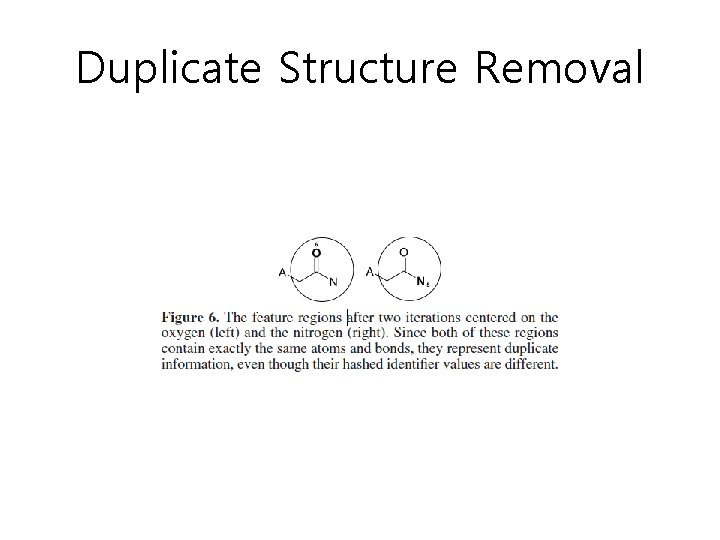
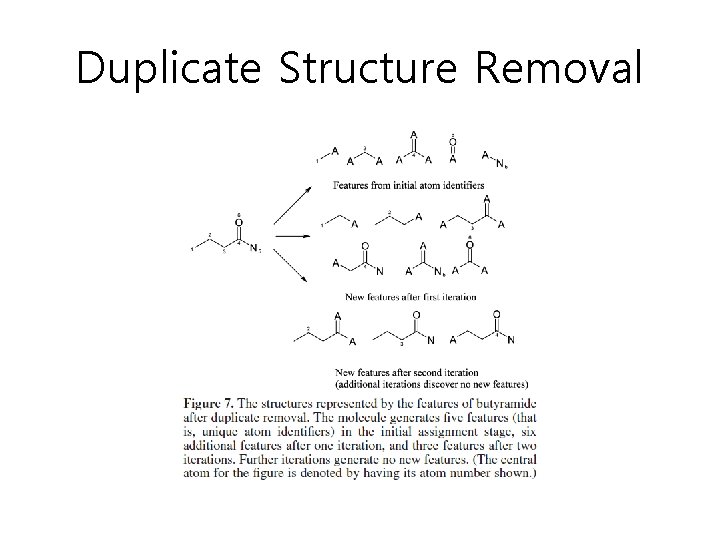
Duplicate Structure Removal
Duplicate Structure Removal
Duplicate Structure Removal • 1. If the features were generated from a different number of iterations, the feature from the larger number of iterations is rejected. • 2. If the features were generated from the same number of iterations, then the larger hashed identifier value (interpreted as an integer) is rejected. • ECFP_0 ⊂ ECFP_2 ⊂ ECFP_4 ⊂ ECFP_6… • Because butyramide is only 4 bonds wide, all possible structures are discovered by diameter 4, so ECFP_4 and ECFP_6 are identical
Duplicate Identifier Removal • Similar with last step…
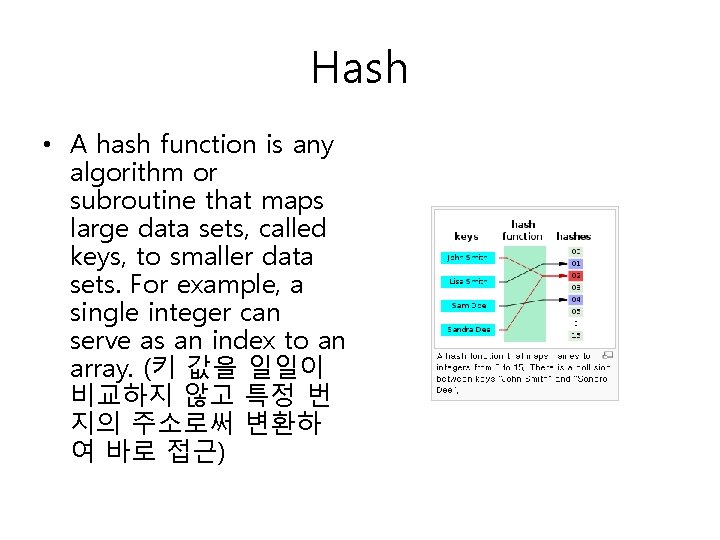
Hash • A hash function is any algorithm or subroutine that maps large data sets, called keys, to smaller data sets. For example, a single integer can serve as an index to an array. (키 값을 일일이 비교하지 않고 특정 번 지의 주소로써 변환하 여 바로 접근)
• What is most important is to have the hash function map arrays of integers randomly and uniformly into the 232 size space of all possible integers; without uniform coverage, the collision rate may increase, leading to a loss of information.
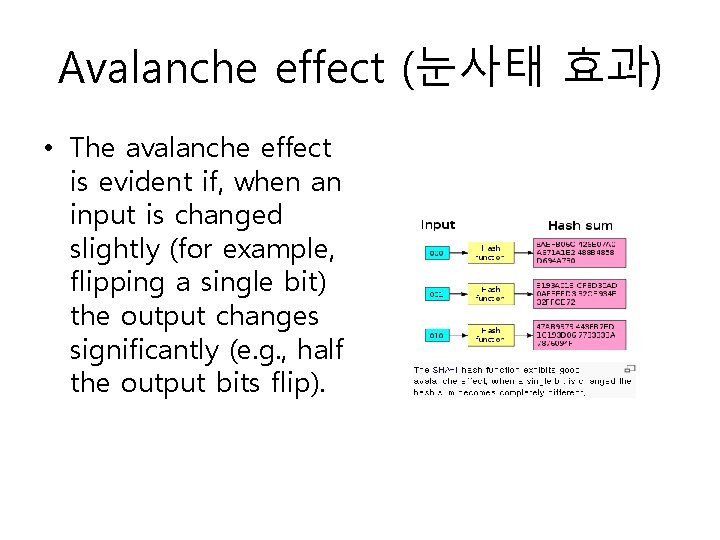
Avalanche effect (눈사태 효과) • The avalanche effect is evident if, when an input is changed slightly (for example, flipping a single bit) the output changes significantly (e. g. , half the output bits flip).
Functional-Class Fingerprints • A chlorine or a bromine substituent on a ring may be functionally equivalent but would be distinguished by the ECFP process • Catalyst pharmacophore identifiers – Each atom is identified by a six-bit code: hydrogen-bond acceptor and donor; negatively and positively ionizable; aromatic; and halogen • 나머진 ECFP와 같음
Interpretation of Identifiers