
Extended Theorems for Signal Induction in Particle Detectors
- Slides: 34
Extended Theorems for Signal Induction in Particle Detectors Werner Riegler, CERN RD 51 workshop, Dec. 9 th 2015 Principle of Signal Induction in Particle Detectors, Ramo’s Theorem n. Quasistatic Approximation of Maxwell’s Equations, Applications n. Generalized Signal Theorems n. Signals in Resistive Plate Chambers n. Signals in Silicon Strip Detectors n Werner Riegler, CERN 1
Werner Riegler, CERN 2
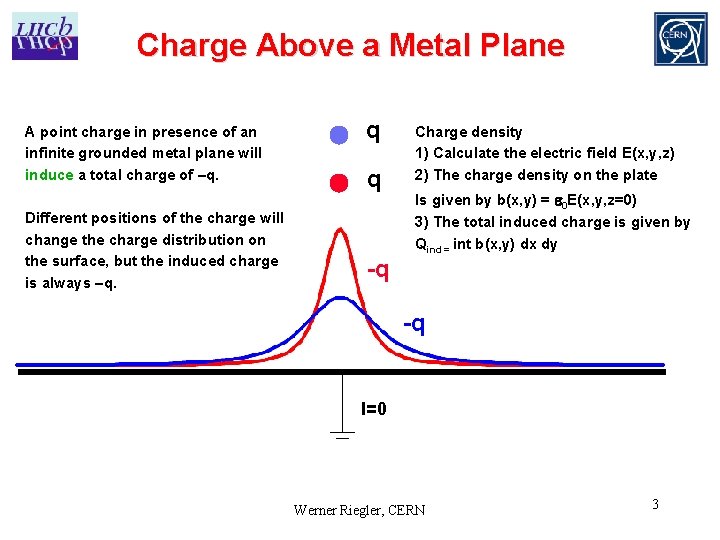
Charge Above a Metal Plane A point charge in presence of an infinite grounded metal plane will induce a total charge of –q. Different positions of the charge will change the charge distribution on the surface, but the induced charge is always –q. q q -q Charge density 1) Calculate the electric field E(x, y, z) 2) The charge density on the plate Is given by b(x, y) = 0 E(x, y, z=0) 3) The total induced charge is given by Qind = int b(x, y) dx dy -q I=0 Werner Riegler, CERN 3
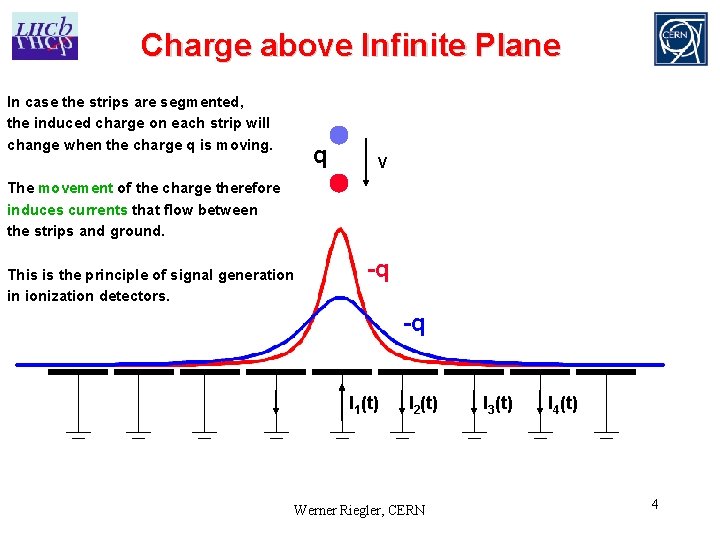
Charge above Infinite Plane In case the strips are segmented, the induced charge on each strip will change when the charge q is moving. q V The movement of the charge therefore induces currents that flow between the strips and ground. This is the principle of signal generation in ionization detectors. -q -q I 1(t) I 2(t) Werner Riegler, CERN I 3(t) I 4(t) 4
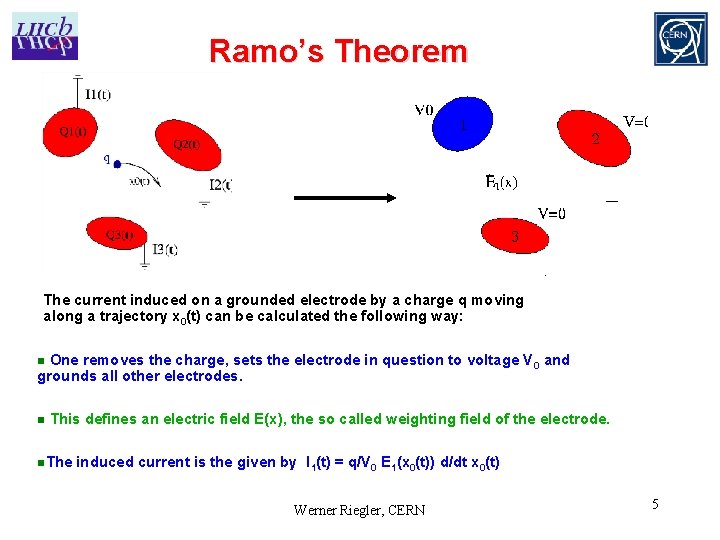
Ramo’s Theorem The current induced on a grounded electrode by a charge q moving along a trajectory x 0(t) can be calculated the following way: One removes the charge, sets the electrode in question to voltage V 0 and grounds all other electrodes. n n This defines an electric field E(x), the so called weighting field of the electrode. n. The induced current is the given by I 1(t) = q/V 0 E 1(x 0(t)) d/dt x 0(t) Werner Riegler, CERN 5
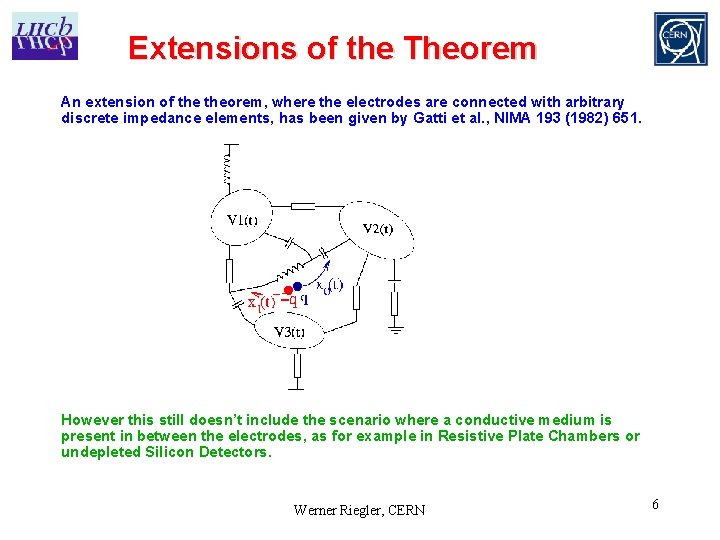
Extensions of the Theorem An extension of theorem, where the electrodes are connected with arbitrary discrete impedance elements, has been given by Gatti et al. , NIMA 193 (1982) 651. However this still doesn’t include the scenario where a conductive medium is present in between the electrodes, as for example in Resistive Plate Chambers or undepleted Silicon Detectors. Werner Riegler, CERN 6
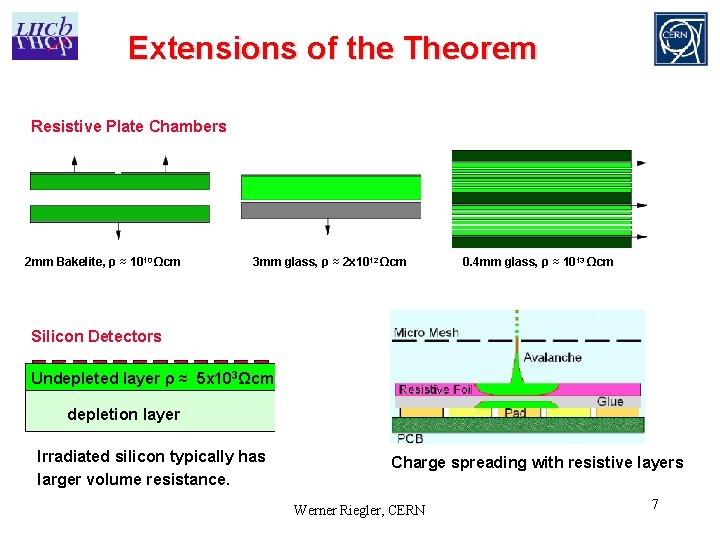
Extensions of the Theorem Resistive Plate Chambers 2 mm Bakelite, ρ ≈ 1010 Ωcm 3 mm glass, ρ ≈ 2 x 10¹² Ωcm 0. 4 mm glass, ρ ≈ 1013 Ωcm Silicon Detectors Undepleted layer ρ ≈ 5 x 10³Ωcm depletion layer Irradiated silicon typically has larger volume resistance. Charge spreading with resistive layers Werner Riegler, CERN 7
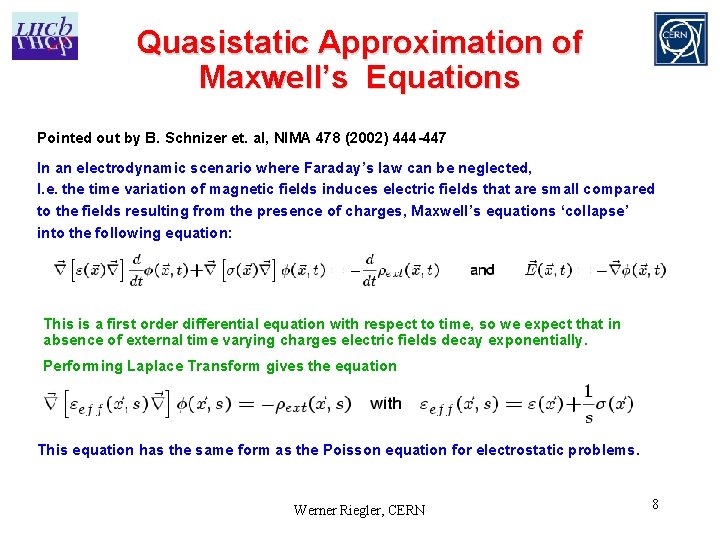
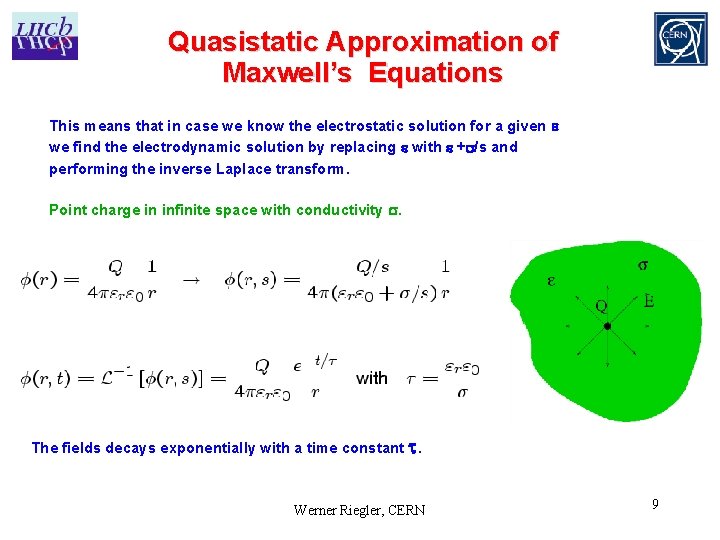
Quasistatic Approximation of Maxwell’s Equations Pointed out by B. Schnizer et. al, NIMA 478 (2002) 444 -447 In an electrodynamic scenario where Faraday’s law can be neglected, I. e. the time variation of magnetic fields induces electric fields that are small compared to the fields resulting from the presence of charges, Maxwell’s equations ‘collapse’ into the following equation: This is a first order differential equation with respect to time, so we expect that in absence of external time varying charges electric fields decay exponentially. Performing Laplace Transform gives the equation This equation has the same form as the Poisson equation for electrostatic problems. Werner Riegler, CERN 8
Quasistatic Approximation of Maxwell’s Equations This means that in case we know the electrostatic solution for a given we find the electrodynamic solution by replacing with + /s and performing the inverse Laplace transform. Point charge in infinite space with conductivity . The fields decays exponentially with a time constant . Werner Riegler, CERN 9
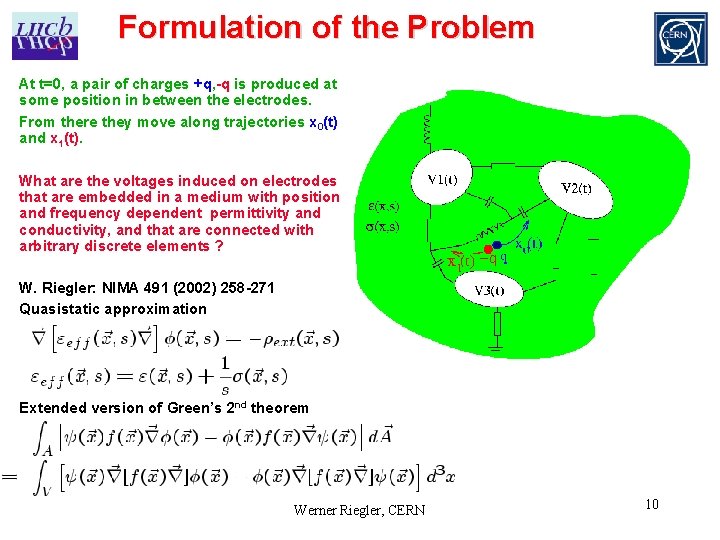
Formulation of the Problem At t=0, a pair of charges +q, -q is produced at some position in between the electrodes. From there they move along trajectories x 0(t) and x 1(t). What are the voltages induced on electrodes that are embedded in a medium with position and frequency dependent permittivity and conductivity, and that are connected with arbitrary discrete elements ? W. Riegler: NIMA 491 (2002) 258 -271 Quasistatic approximation Extended version of Green’s 2 nd theorem Werner Riegler, CERN 10
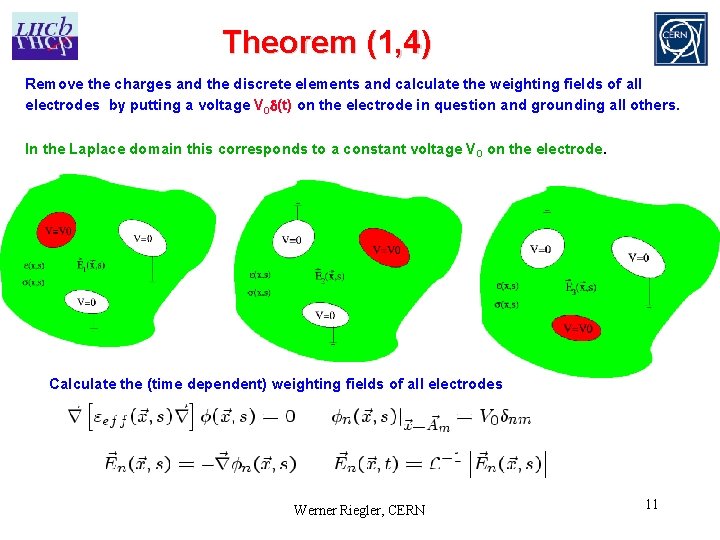
Theorem (1, 4) Remove the charges and the discrete elements and calculate the weighting fields of all electrodes by putting a voltage V 0 (t) on the electrode in question and grounding all others. In the Laplace domain this corresponds to a constant voltage V 0 on the electrode. Calculate the (time dependent) weighting fields of all electrodes Werner Riegler, CERN 11
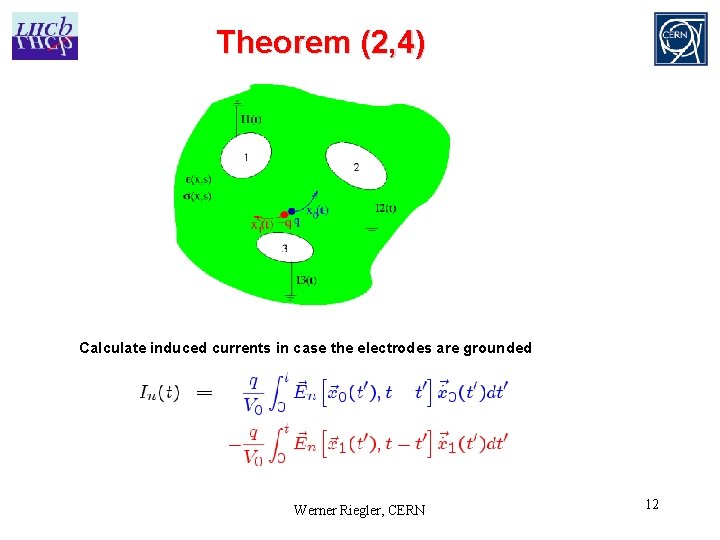
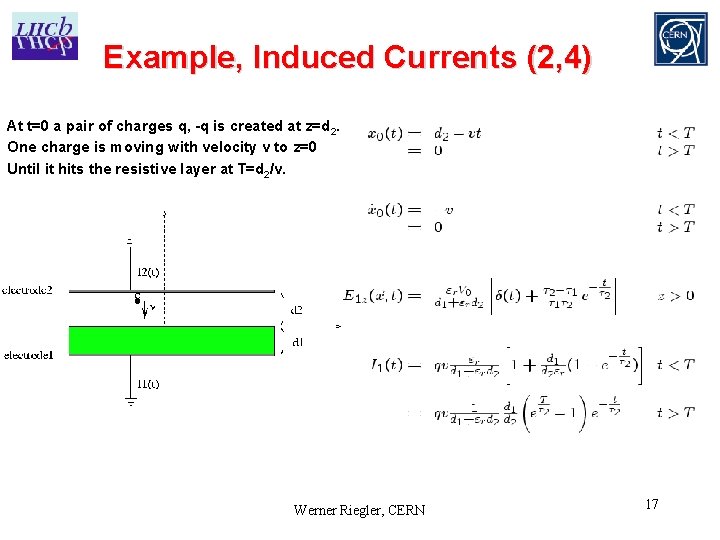
Theorem (2, 4) Calculate induced currents in case the electrodes are grounded Werner Riegler, CERN 12
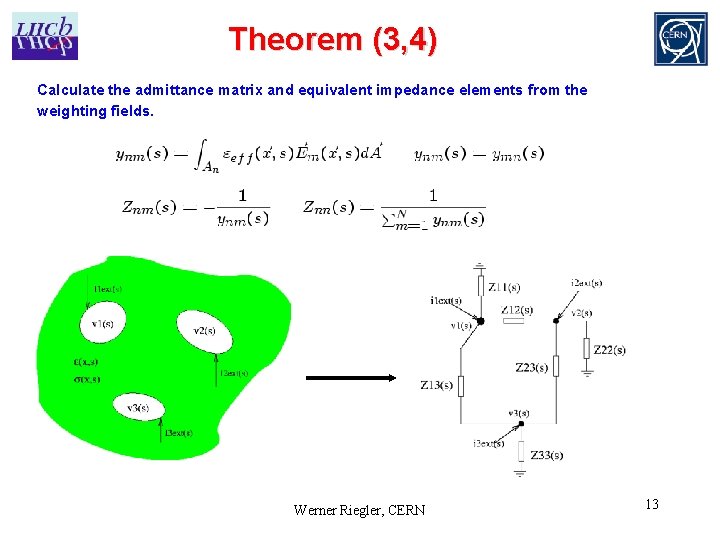
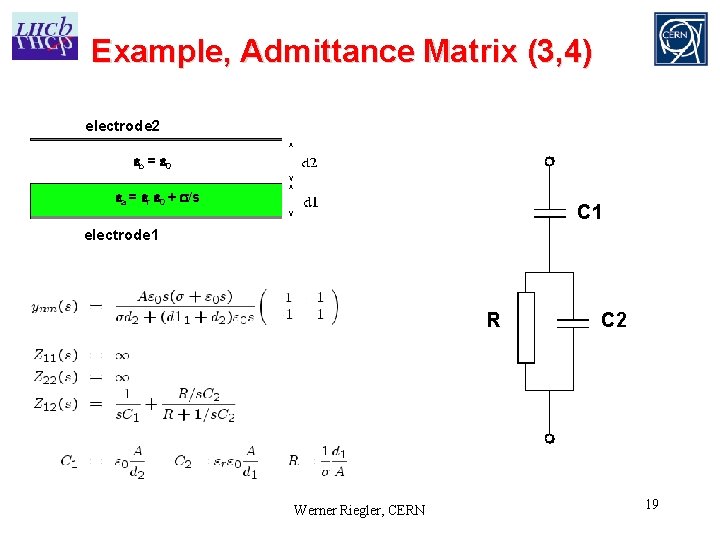
Theorem (3, 4) Calculate the admittance matrix and equivalent impedance elements from the weighting fields. Werner Riegler, CERN 13
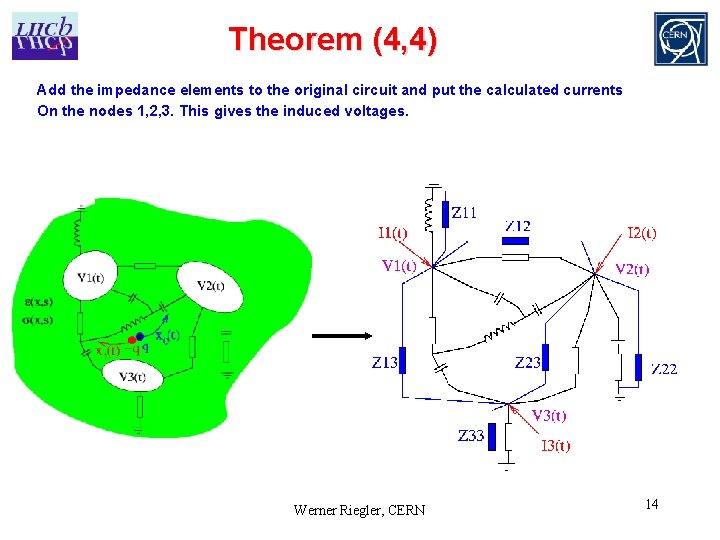
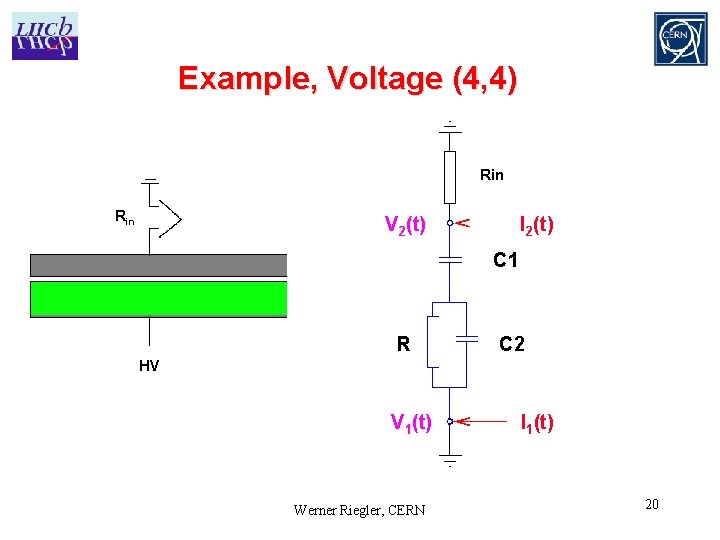
Theorem (4, 4) Add the impedance elements to the original circuit and put the calculated currents On the nodes 1, 2, 3. This gives the induced voltages. Werner Riegler, CERN 14
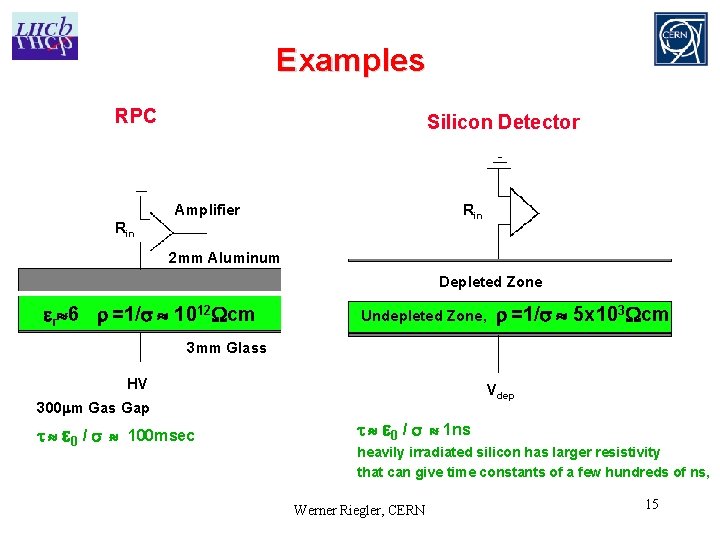
Examples RPC Silicon Detector Amplifier Rin 2 mm Aluminum Depleted Zone r 6 =1/ 1012 cm Undepleted Zone, =1/ 5 x 103 cm 3 mm Glass HV 300 m Gas Gap 0 / 100 msec Vdep 0 / 1 ns heavily irradiated silicon has larger resistivity that can give time constants of a few hundreds of ns, Werner Riegler, CERN 15
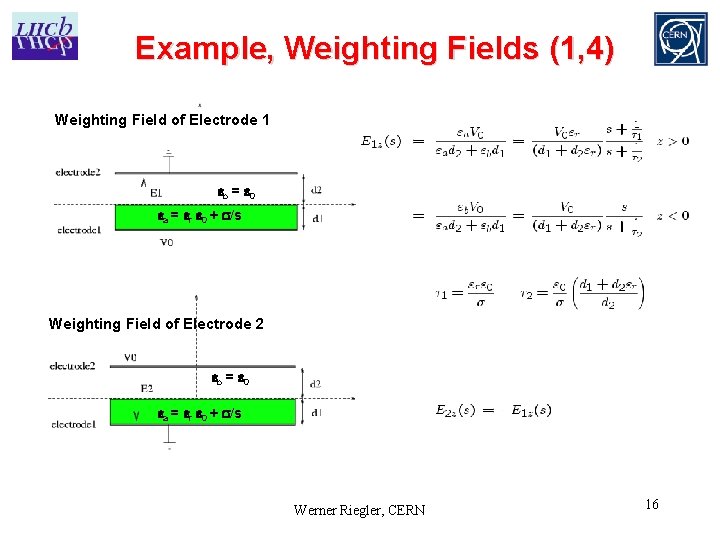
Example, Weighting Fields (1, 4) Weighting Field of Electrode 1 b = 0 a = r 0 + /s Weighting Field of Electrode 2 b = 0 a = r 0 + /s Werner Riegler, CERN 16
Example, Induced Currents (2, 4) At t=0 a pair of charges q, -q is created at z=d 2. One charge is moving with velocity v to z=0 Until it hits the resistive layer at T=d 2/v. Werner Riegler, CERN 17
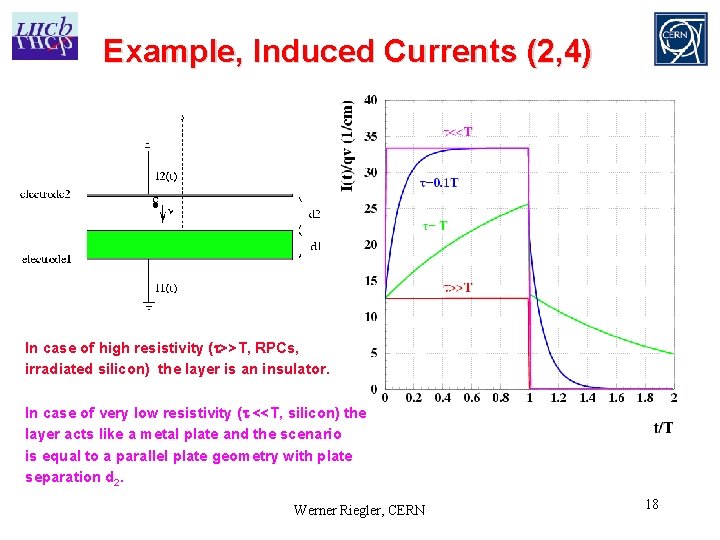
Example, Induced Currents (2, 4) In case of high resistivity ( >>T, RPCs, irradiated silicon) the layer is an insulator. In case of very low resistivity ( <<T, silicon) the layer acts like a metal plate and the scenario is equal to a parallel plate geometry with plate separation d 2. Werner Riegler, CERN 18
Example, Admittance Matrix (3, 4) electrode 2 b = 0 a = r 0 + /s C 1 electrode 1 R Werner Riegler, CERN C 2 19
Example, Voltage (4, 4) Rin V 2(t) I 2(t) C 1 R C 2 HV V 1(t) Werner Riegler, CERN I 1(t) 20
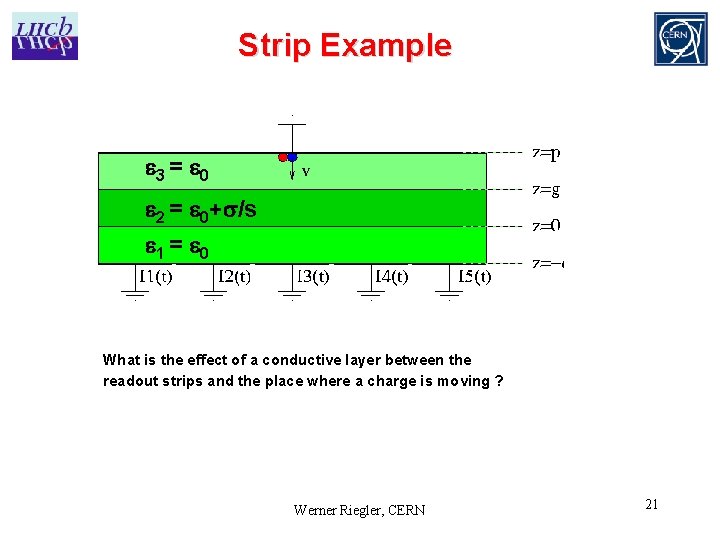
Strip Example 3 = 0 2 = 0+ /s 1 = 0 What is the effect of a conductive layer between the readout strips and the place where a charge is moving ? Werner Riegler, CERN 21
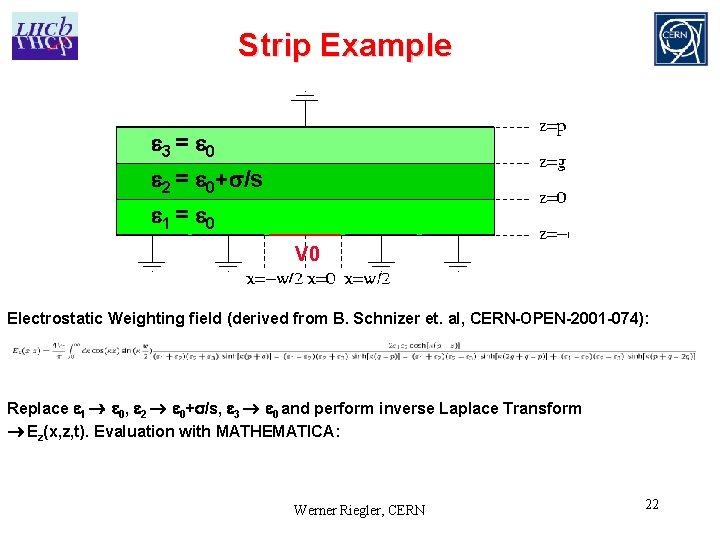
Strip Example 3 = 0 2 = 0+ /s 1 = 0 V 0 Electrostatic Weighting field (derived from B. Schnizer et. al, CERN-OPEN-2001 -074): Replace 1 0, 2 0+ /s, 3 0 and perform inverse Laplace Transform Ez(x, z, t). Evaluation with MATHEMATICA: Werner Riegler, CERN 22
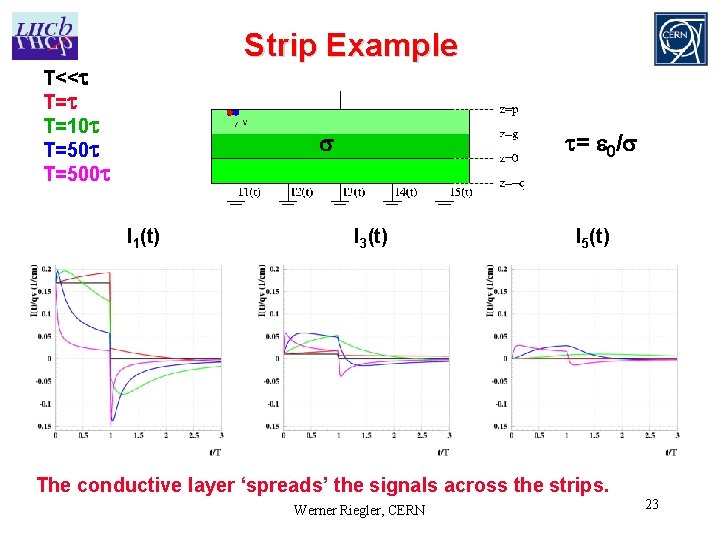
Strip Example T<< T= T=10 T=500 = 0/ I 1(t) I 3(t) I 5(t) The conductive layer ‘spreads’ the signals across the strips. Werner Riegler, CERN 23
Examples for different geometries with thin resistive layers Werner Riegler, CERN 24
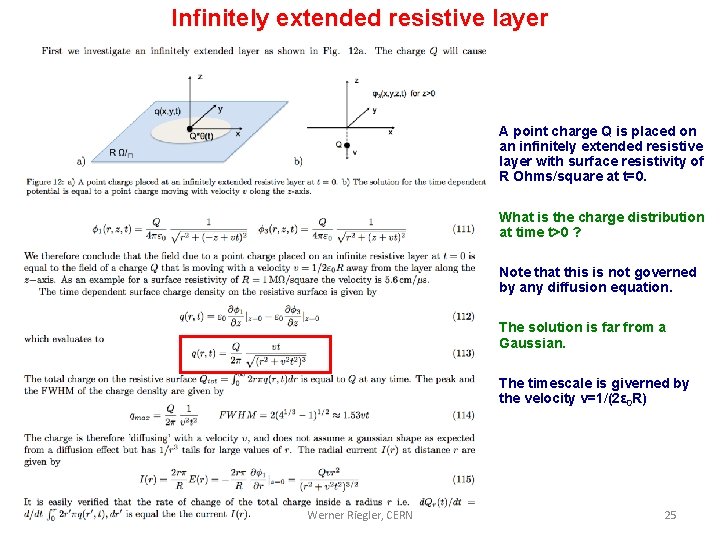
Infinitely extended resistive layer A point charge Q is placed on an infinitely extended resistive layer with surface resistivity of R Ohms/square at t=0. What is the charge distribution at time t>0 ? Note that this is not governed by any diffusion equation. The solution is far from a Gaussian. The timescale is giverned by the velocity v=1/(2ε 0 R) Werner Riegler, CERN 25
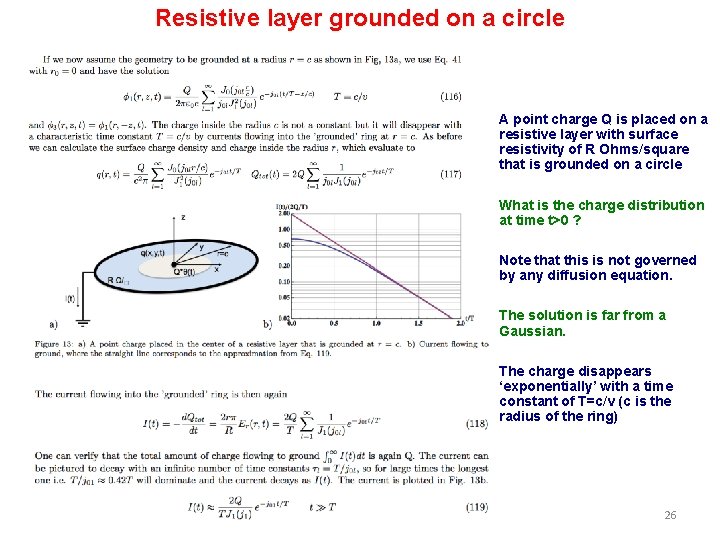
Resistive layer grounded on a circle A point charge Q is placed on a resistive layer with surface resistivity of R Ohms/square that is grounded on a circle What is the charge distribution at time t>0 ? Note that this is not governed by any diffusion equation. The solution is far from a Gaussian. The charge disappears ‘exponentially’ with a time constant of T=c/v (c is the radius of the ring) 26
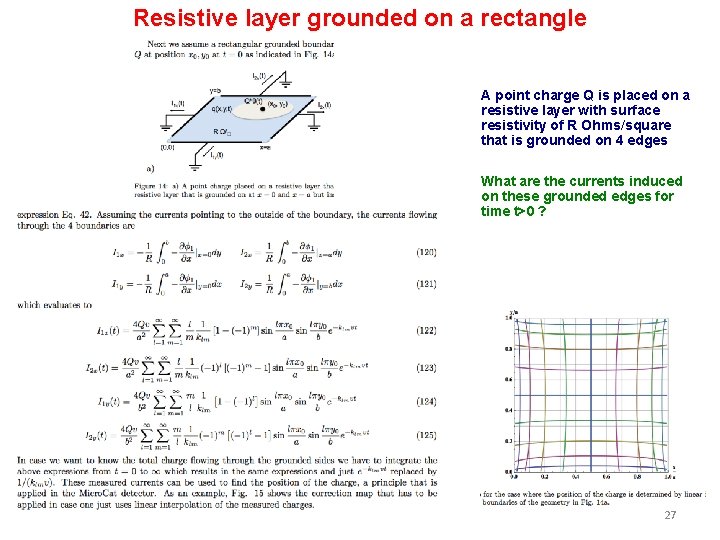
Resistive layer grounded on a rectangle A point charge Q is placed on a resistive layer with surface resistivity of R Ohms/square that is grounded on 4 edges What are the currents induced on these grounded edges for time t>0 ? 27
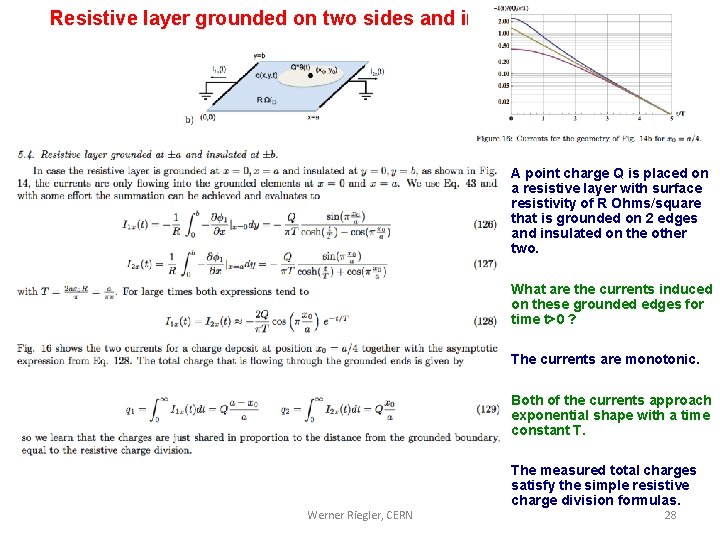
Resistive layer grounded on two sides and insulated on the other A point charge Q is placed on a resistive layer with surface resistivity of R Ohms/square that is grounded on 2 edges and insulated on the other two. What are the currents induced on these grounded edges for time t>0 ? The currents are monotonic. Both of the currents approach exponential shape with a time constant T. Werner Riegler, CERN The measured total charges satisfy the simple resistive charge division formulas. 28
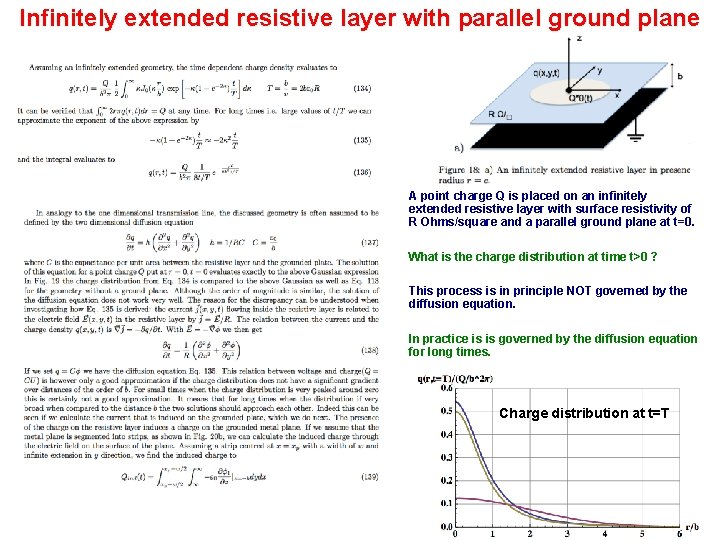
Infinitely extended resistive layer with parallel ground plane A point charge Q is placed on an infinitely extended resistive layer with surface resistivity of R Ohms/square and a parallel ground plane at t=0. What is the charge distribution at time t>0 ? This process is in principle NOT governed by the diffusion equation. In practice is is governed by the diffusion equation for long times. Charge distribution at t=T 29
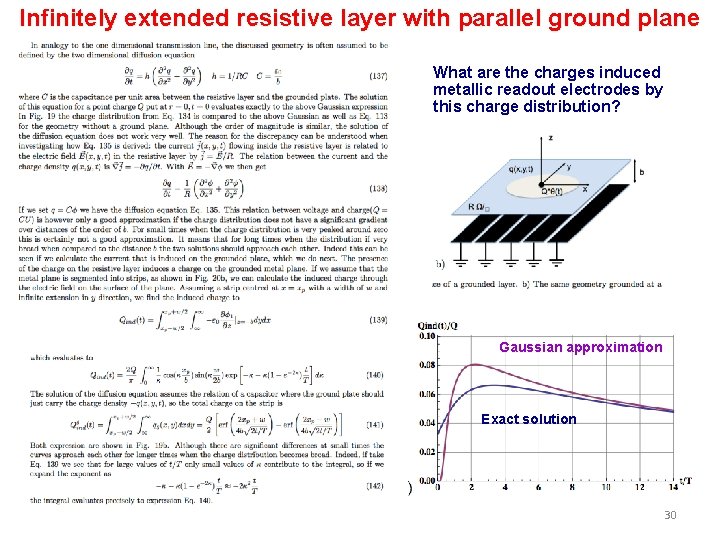
Infinitely extended resistive layer with parallel ground plane What are the charges induced metallic readout electrodes by this charge distribution? Gaussian approximation Exact solution 30
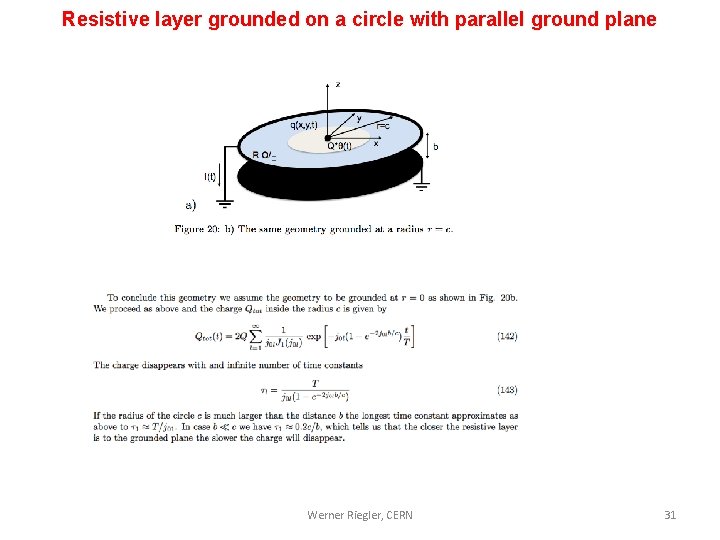
Resistive layer grounded on a circle with parallel ground plane Werner Riegler, CERN 31
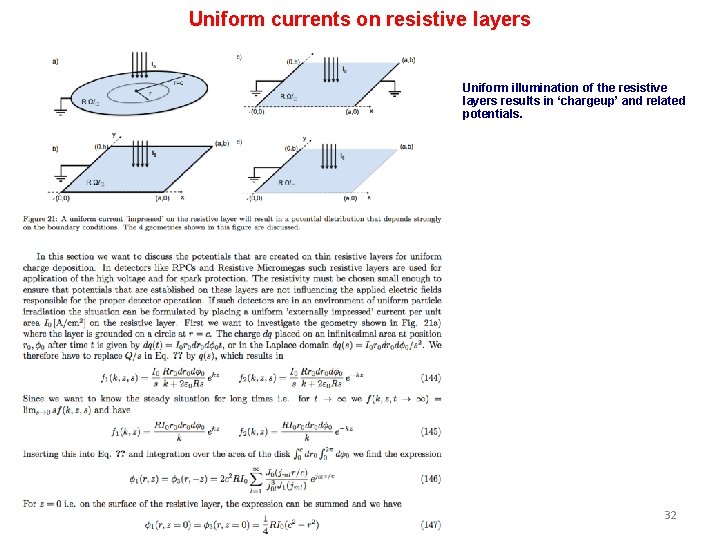
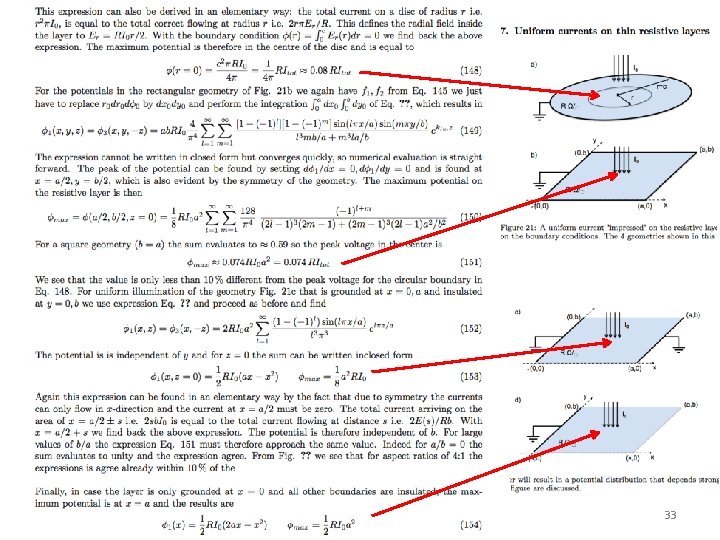
Uniform currents on resistive layers Uniform illumination of the resistive layers results in ‘chargeup’ and related potentials. 32
33
Summary Theorems for calculating fields and signals in detectors with resistive elements exist. Exact solutions for a few basic geometries were given. The diffusion equation is only an approximate description of charge diffusion on thin resistive layers. Under well defined conditions, specifically when the gradient of the charge distributions over distances on the order of the ground plane distance are small (t >> T) the diffusion equation which leads to Gaussian charge distributions can be applied. 34