
EXTENDED SURFACE HEAT TRANSFER EXPERIMENT Objectives To show
EXTENDED SURFACE HEAT TRANSFER EXPERIMENT

Objectives � To show heat transfer (convection and radiation) from the surface of a solid bar or rod. � To show you can predict temperature and the flow through the solid bar to its surroundings.

Introduction � The temperature should produce a curve that goes down with respect to distance along the bar, showing that the bar transfers most of its heat from that pat nearest the heat source.

�A solid bar with an electric heater (heat source) at one end. � The bar has a matt black coating for a consistent and predictable emissivity value. � Heat conducts along the bar and transfers to the local surroundings by natural convection and radiation. � Thermocouples measure the temperature along the surface of the bar at equally spaced intervals.
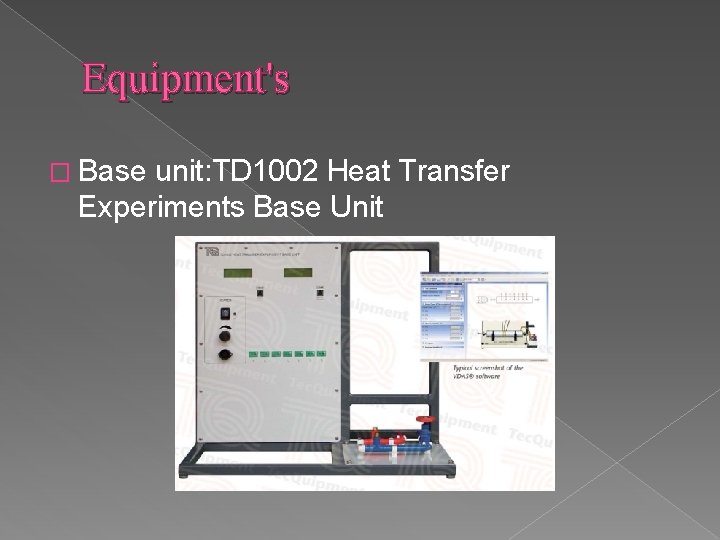
Equipment's � Base unit: TD 1002 Heat Transfer Experiments Base Unit
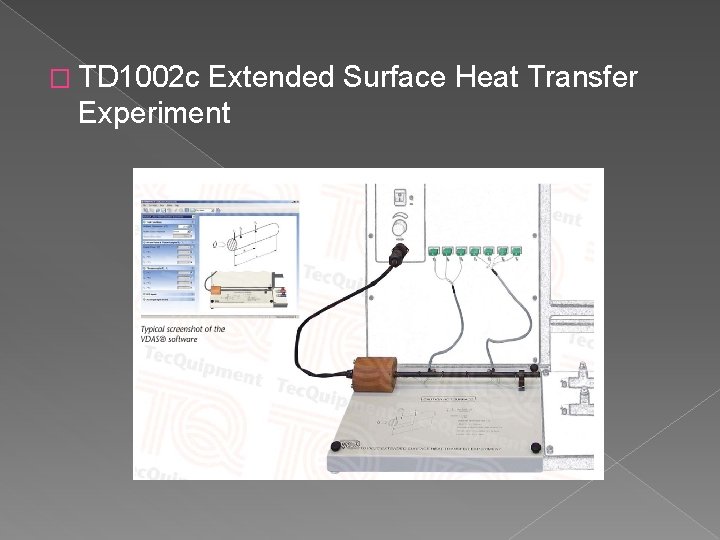
� TD 1002 c Extended Surface Heat Transfer Experiment
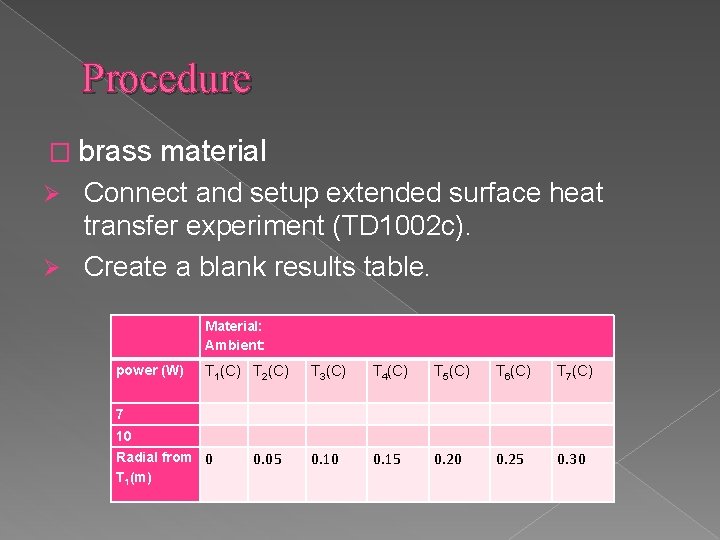
Procedure � brass material Connect and setup extended surface heat transfer experiment (TD 1002 c). Ø Create a blank results table. Ø Material: Ambient: power (W) T 1(C) T 2(C) T 3(C) T 4(C) T 5(C) T 6(C) T 7(C) 0. 10 0. 15 0. 20 0. 25 0. 30 7 10 Radial from 0 T 1(m) 0. 05

Ø Ø Ø Use accurate thermometer to check the local ambient air temperature for reference. Switch on the heater and set to 7 watts power. Adjust the power until T 1 settles at around 90 C. Wait at least 30 minutes for the temperature to stabilize and then record T 1 to T 7. For the comparison, repeat the test at heater powers 10 W. Switch off the heater.
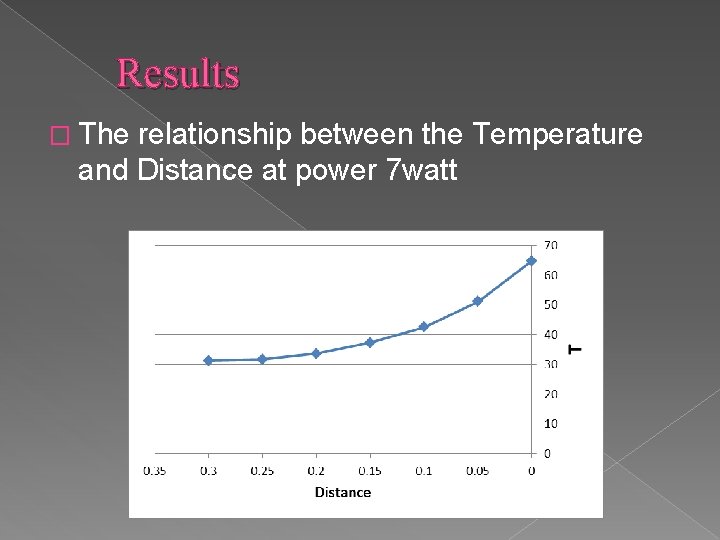
Results � The relationship between the Temperature and Distance at power 7 watt

� The relationship between the Temperature and Distance at power 10 watt
- Slides: 10