
Extended Project Qualification Jennifer Obaditch Head of Curriculum
Extended Project Qualification Jennifer Obaditch Head of Curriculum Projects at AQA HELOA North East, Yorkshire & the Humber 10 December 2018
Agenda • Benefits of EPQ and student led projects • EPQ Specification • What makes an EPQ? Taught skills, Production Log, project product and presentation • The role of the EPQ supervisor • Curriculum models of delivery in schools - timelines • EPQ marking information – the assessment objectives for EPQ and how they are evidenced 2 Copyright © AQA and its licensors. All rights reserved.
Student led projects • Undertaking EPQ benefits performance in A level (Jones, 2015) • The odds of being awarded grades A* to B increased by 29% for students entering for EPQ (Jones, 2015) • Students more likely to obtain a first or upper second class degree of they have taken EPQ (Gill, 2017 b) • Students with an EPQ were less likely to leave university after the first year (Thompson and Jones, 2016) • Valued by higher education, can reduce entry requirements • Can help address shortcoming in the post 16 curriculum • AOs reflect those expected by university level programmes 3 Copyright © AQA and its licensors. All rights reserved.
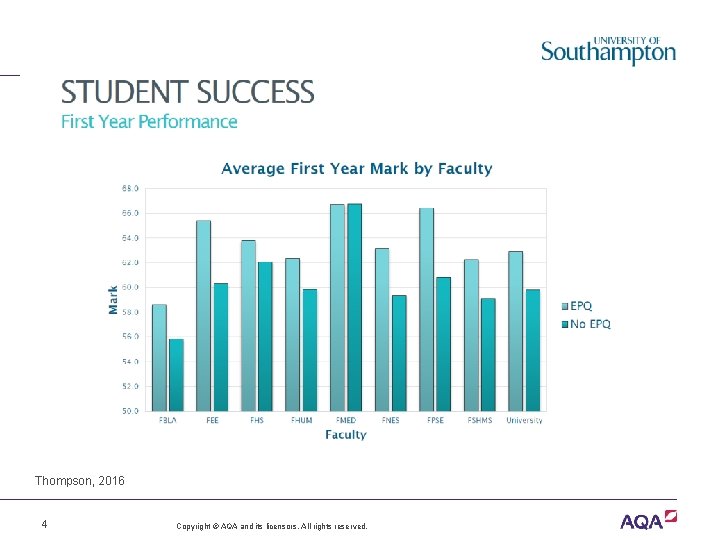
Thompson, 2016 4 Copyright © AQA and its licensors. All rights reserved.
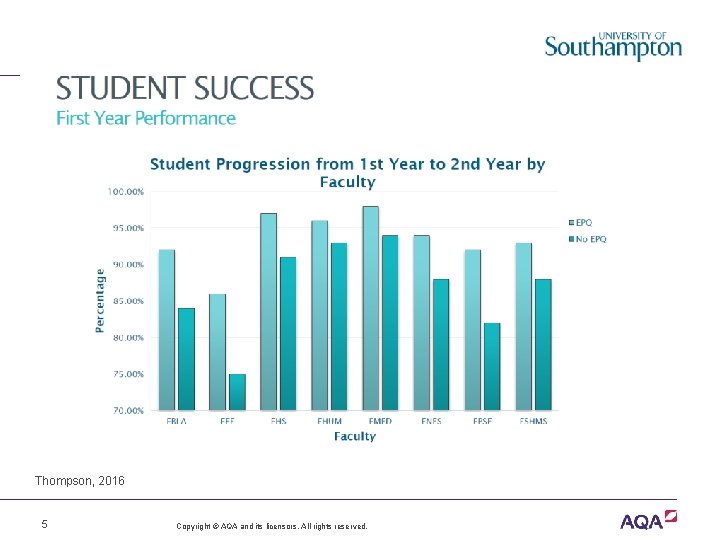
Thompson, 2016 5 Copyright © AQA and its licensors. All rights reserved.
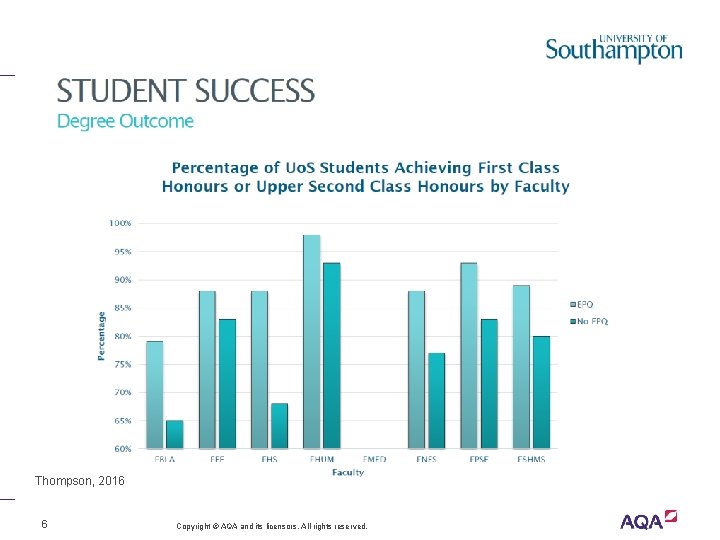
Thompson, 2016 6 Copyright © AQA and its licensors. All rights reserved.
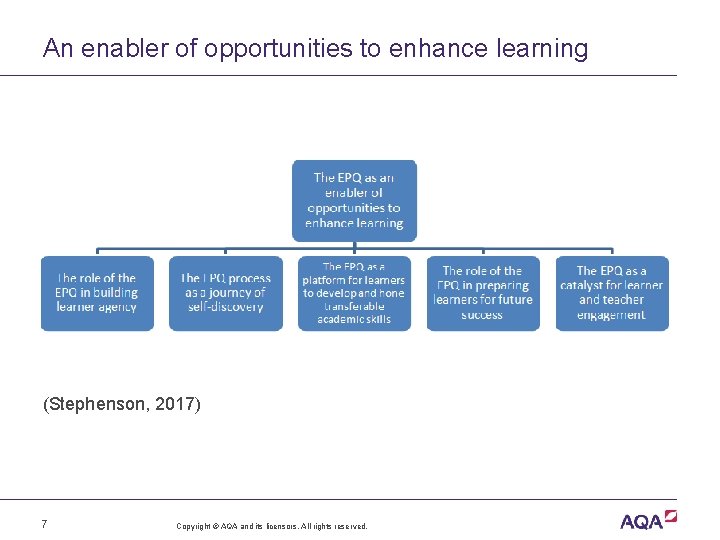
An enabler of opportunities to enhance learning (Stephenson, 2017) 7 Copyright © AQA and its licensors. All rights reserved.
Specification 8 Copyright © AQA and its licensors. All rights reserved.
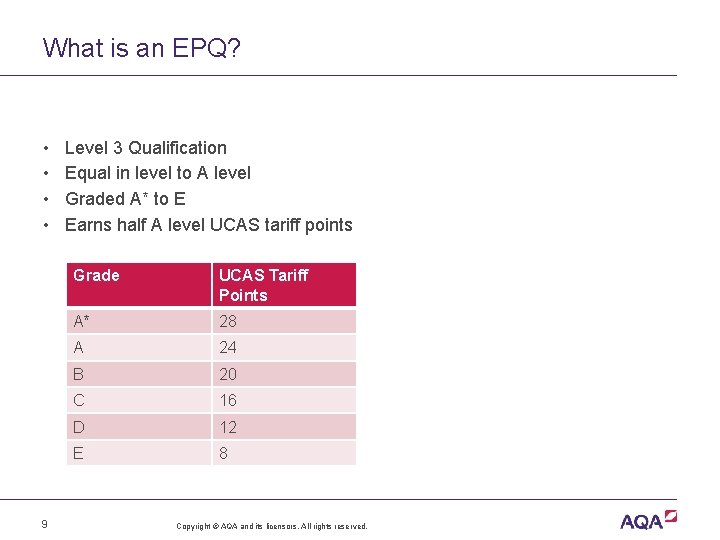
What is an EPQ? • • 9 Level 3 Qualification Equal in level to A level Graded A* to E Earns half A level UCAS tariff points Grade UCAS Tariff Points A* 28 A 24 B 20 C 16 D 12 E 8 Copyright © AQA and its licensors. All rights reserved.
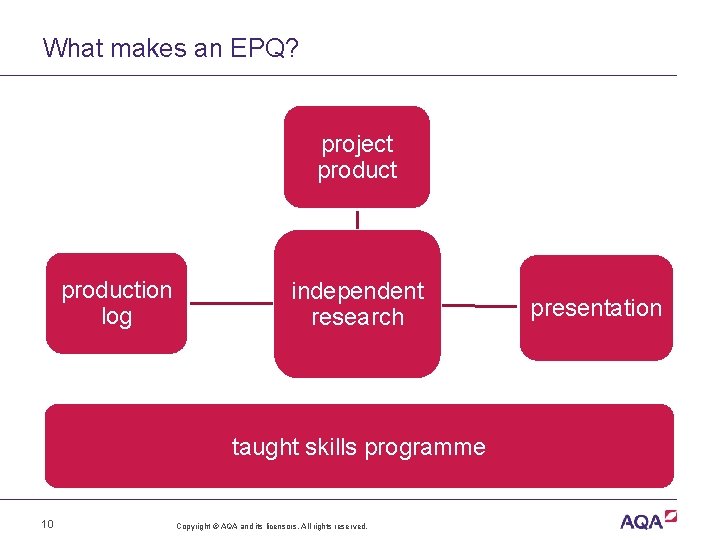
What makes an EPQ? project production log independent research taught skills programme 10 Copyright © AQA and its licensors. All rights reserved. presentation
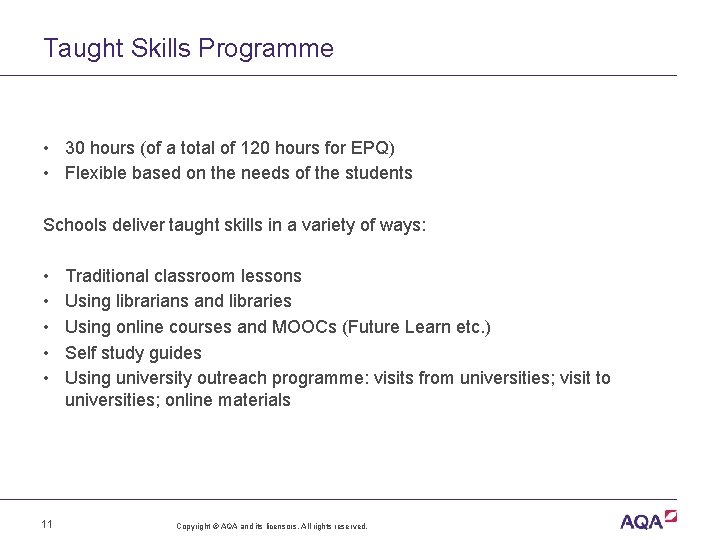
Taught Skills Programme • 30 hours (of a total of 120 hours for EPQ) • Flexible based on the needs of the students Schools deliver taught skills in a variety of ways: • • • 11 Traditional classroom lessons Using librarians and libraries Using online courses and MOOCs (Future Learn etc. ) Self study guides Using university outreach programme: visits from universities; visit to universities; online materials Copyright © AQA and its licensors. All rights reserved.
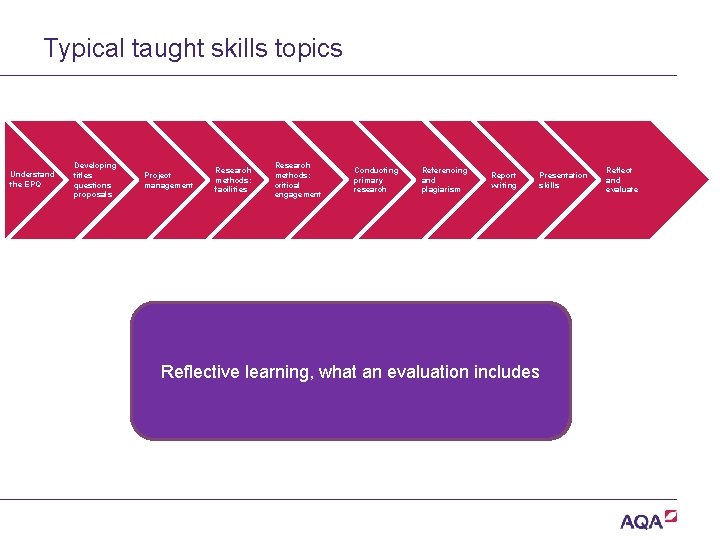
Typical taught skills topics Understand the EPQ Developing titles questions proposals Project management Research methods: facilities Research methods: critical engagement Conducting primary research Referencing and plagiarism Report writing Presentation skills What is plagiarism? What is referencing? Harvard Report structure, developing arguments, using Crucial to do well Research ethics, risk assessment, data collection Analysis and evaluation, awareness of bias and Time management, project planning techniques Question words, ambiguity, narrowing focus, What to include, presentation media, public Use of IT, internet, JSTOR etc. , and other forms of referencing, use of referencing Reflective learning, what an evaluation includes Students must understand the project process, research materials, logical structures, proof libraries, museums, galleries, other media and software, setting aims and objectives reliability, synthesising key information techniques, qualitative vs quantitative speaking skills and practice suitability for EPQ AOs, paperwork and outcomes reading, editing, conclusions software tools Reflect and evaluate
Independent research • • • 13 Detailed research A wide range of relevant resources Selecting and evaluating resources Critical analysis of resources Synthesis of sources creating clear links to theories and concepts Copyright © AQA and its licensors. All rights reserved.
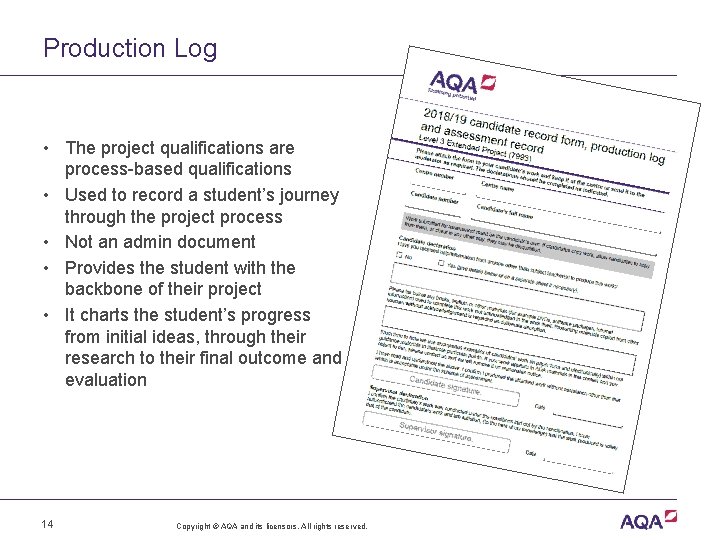
Production Log • The project qualifications are process-based qualifications • Used to record a student’s journey through the project process • Not an admin document • Provides the student with the backbone of their project • It charts the student’s progress from initial ideas, through their research to their final outcome and evaluation 14 Copyright © AQA and its licensors. All rights reserved.
Project Product • The outcome of the research process • 5000 word research based written report OR • 1000 word research based written report AND artefact as an outcome of the research An artefact can be a physical outcome such as a book or piece of art work, or it can be a presentation to a specific audience such as a play, fashion show or a musical evening. In fact there is almost no limit to what can constitute an artefact, as long as it has research at its core. 15 Copyright © AQA and its licensors. All rights reserved.
Example projects • Time to look at some projects • artefacts video • See how students and teachers complete the Production Log • What was the initial title of the project? • What is the final title of the project? How did this develop? • At planning review and mid project review, what key ways did the student develop their project? • What did the student learn from taking an EPQ? 16 Copyright © AQA and its licensors. All rights reserved.
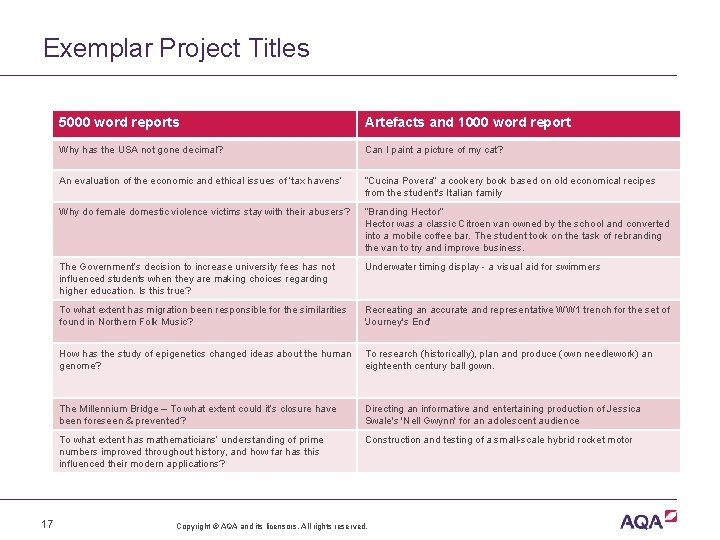
Exemplar Project Titles 17 5000 word reports Artefacts and 1000 word report Why has the USA not gone decimal? Can I paint a picture of my cat? An evaluation of the economic and ethical issues of ‘tax havens’ “Cucina Povera” a cookery book based on old economical recipes from the student's Italian family Why do female domestic violence victims stay with their abusers? “Branding Hector” Hector was a classic Citroen van owned by the school and converted into a mobile coffee bar. The student took on the task of rebranding the van to try and improve business. The Government’s decision to increase university fees has not influenced students when they are making choices regarding higher education. Is this true? Underwater timing display - a visual aid for swimmers To what extent has migration been responsible for the similarities found in Northern Folk Music? Recreating an accurate and representative WW 1 trench for the set of 'Journey's End' How has the study of epigenetics changed ideas about the human genome? To research (historically), plan and produce (own needlework) an eighteenth century ball gown. The Millennium Bridge – To what extent could it’s closure have been foreseen & prevented? Directing an informative and entertaining production of Jessica Swale's 'Nell Gwynn' for an adolescent audience To what extent has mathematicians’ understanding of prime numbers improved throughout history, and how far has this influenced their modern applications? Construction and testing of a small-scale hybrid rocket motor Copyright © AQA and its licensors. All rights reserved.
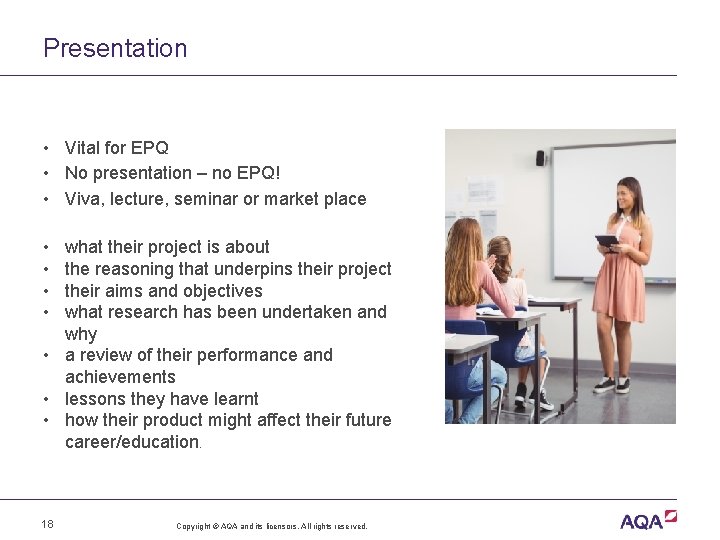
Presentation • Vital for EPQ • No presentation – no EPQ! • Viva, lecture, seminar or market place • • what their project is about the reasoning that underpins their project their aims and objectives what research has been undertaken and why • a review of their performance and achievements • lessons they have learnt • how their product might affect their future career/education. 18 Copyright © AQA and its licensors. All rights reserved.
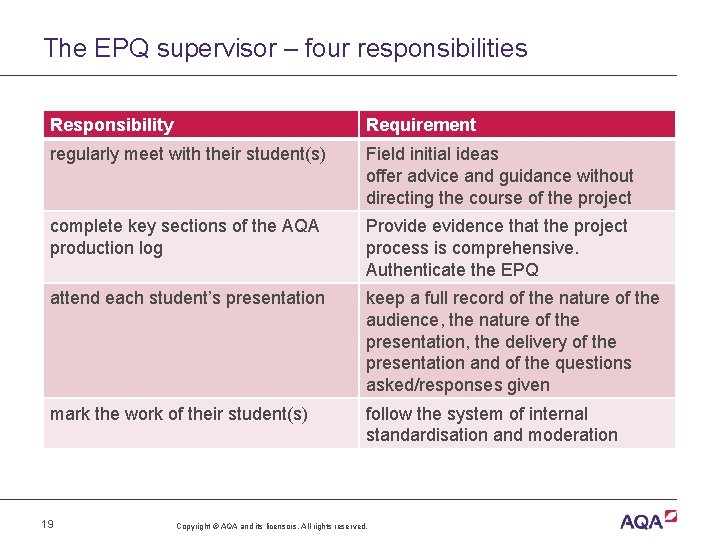
The EPQ supervisor – four responsibilities Responsibility Requirement regularly meet with their student(s) Field initial ideas offer advice and guidance without directing the course of the project complete key sections of the AQA production log Provide evidence that the project process is comprehensive. Authenticate the EPQ attend each student’s presentation keep a full record of the nature of the audience, the nature of the presentation, the delivery of the presentation and of the questions asked/responses given mark the work of their student(s) follow the system of internal standardisation and moderation 19 Copyright © AQA and its licensors. All rights reserved.
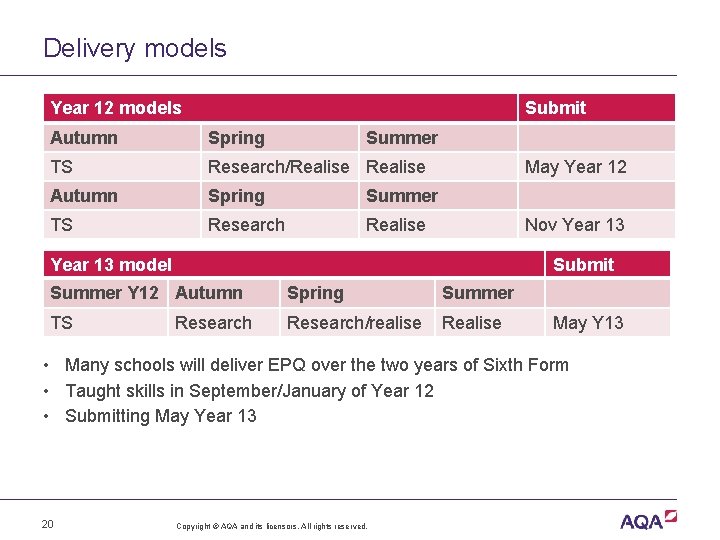
Delivery models Year 12 models Submit Autumn Spring Summer TS Research/Realise Autumn Spring Summer TS Research Realise May Year 12 Nov Year 13 model Submit Summer Y 12 Autumn Spring Summer TS Research/realise Research May Y 13 • Many schools will deliver EPQ over the two years of Sixth Form • Taught skills in September/January of Year 12 • Submitting May Year 13 20 Copyright © AQA and its licensors. All rights reserved.
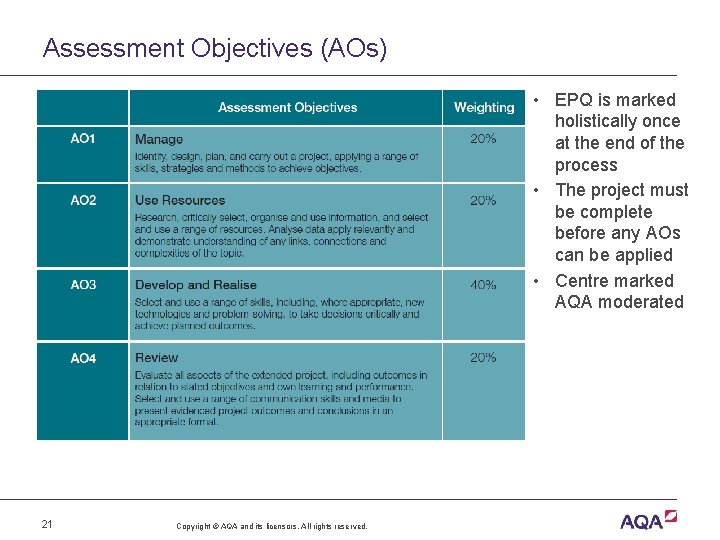
Assessment Objectives (AOs) • EPQ is marked holistically once at the end of the process • The project must be complete before any AOs can be applied • Centre marked AQA moderated 21 Copyright © AQA and its licensors. All rights reserved.
Questions Jennifer Obaditch projects@aqa. org. uk 0161 957 3980 22 Copyright © AQA and its licensors. All rights reserved.
References Gill, T. (2017 a). An analysis of the effect of taking the EPQ on performance in other Level 3 qualifications. Research Matters: A Cambridge Assessment publication, 23. Retrieved from: http: //www. cambridgeassessment. org. uk/Images/375447 -an-analysis-of-the-effect-of-taking-the-epq-on-performancein-other-level-3 -qualifications. pdf Gill, T. (2017 b). Preparing students for university study: a statistical comparison of different post-16 qualifications. Research Papers in Education, 1 -19. doi: 10. 1080/02671522. 2017. 1302498 Jones, B. (2015). Does the Extended Project Qualification enhance students’ GCE A level performance? CERP_TR_BEJ_21052015. Manchester, UK: AQA Centre for Education Research and Policy. Stephenson, C. (2017) “An antidote to A-levels”? Exploring students’ and teachers’ experiences of the Extended Project Qualification Manchester, UK: AQA Centre for Education Research and Policy. Thompson, E. , & Jones, B. (2016, July). The Extended Project Qualification (EPQ): Its influence and impact. Paper session presented at UCAS Annual Competitive Admissions Conference, Warwick. 23 Copyright © AQA and its licensors. All rights reserved.
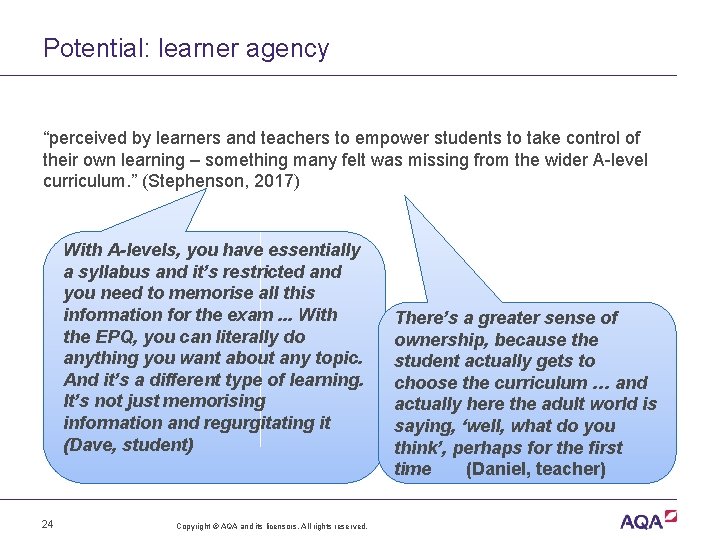
Potential: learner agency “perceived by learners and teachers to empower students to take control of their own learning – something many felt was missing from the wider A-level curriculum. ” (Stephenson, 2017) With A-levels, you have essentially a syllabus and it’s restricted and you need to memorise all this information for the exam. . . With the EPQ, you can literally do anything you want about any topic. And it’s a different type of learning. It’s not just memorising information and regurgitating it (Dave, student) 24 Copyright © AQA and its licensors. All rights reserved. There’s a greater sense of ownership, because the student actually gets to choose the curriculum … and actually here the adult world is saying, ‘well, what do you think’, perhaps for the first time (Daniel, teacher)
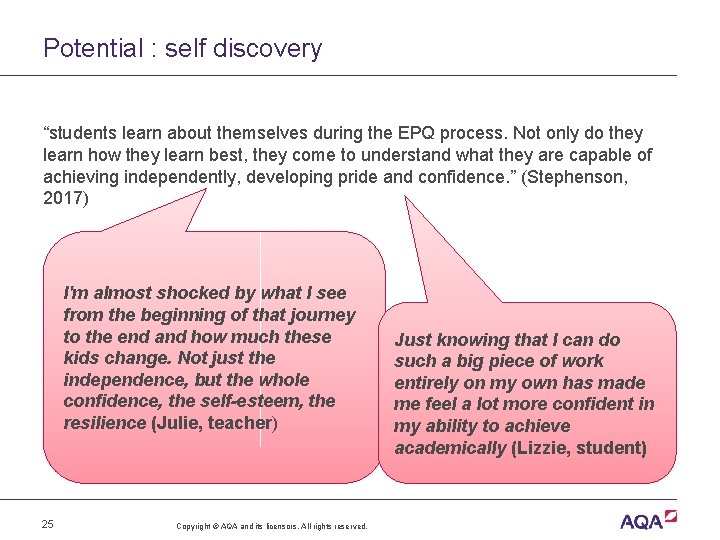
Potential : self discovery “students learn about themselves during the EPQ process. Not only do they learn how they learn best, they come to understand what they are capable of achieving independently, developing pride and confidence. ” (Stephenson, 2017) I'm almost shocked by what I see from the beginning of that journey to the end and how much these kids change. Not just the independence, but the whole confidence, the self-esteem, the resilience (Julie, teacher) 25 Copyright © AQA and its licensors. All rights reserved. Just knowing that I can do such a big piece of work entirely on my own has made me feel a lot more confident in my ability to achieve academically (Lizzie, student)
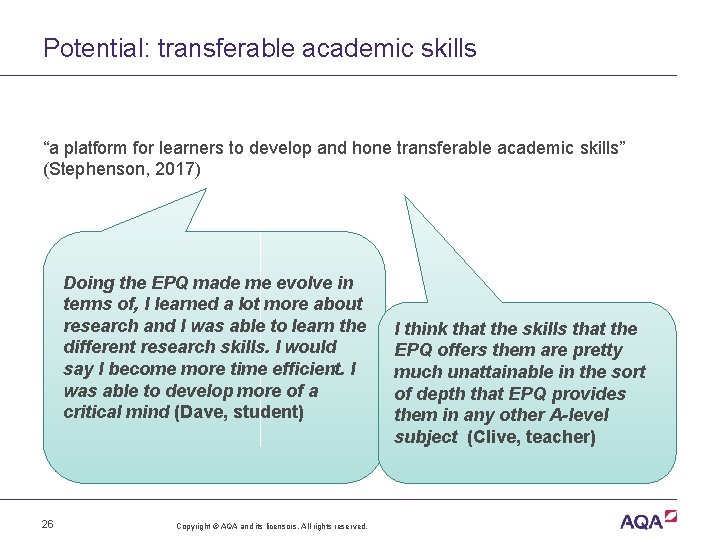
Potential: transferable academic skills “a platform for learners to develop and hone transferable academic skills” (Stephenson, 2017) Doing the EPQ made me evolve in terms of, I learned a lot more about research and I was able to learn the different research skills. I would say I become more time efficient. I was able to develop more of a critical mind (Dave, student) 26 Copyright © AQA and its licensors. All rights reserved. I think that the skills that the EPQ offers them are pretty much unattainable in the sort of depth that EPQ provides them in any other A-level subject (Clive, teacher)
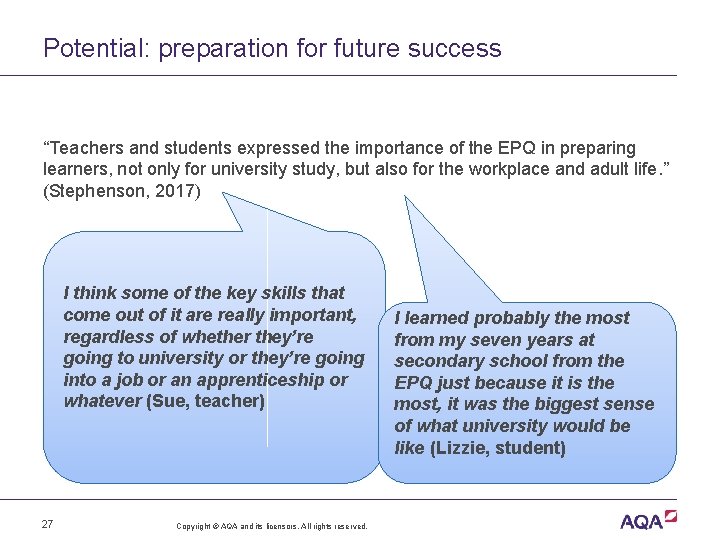
Potential: preparation for future success “Teachers and students expressed the importance of the EPQ in preparing learners, not only for university study, but also for the workplace and adult life. ” (Stephenson, 2017) I think some of the key skills that come out of it are really important, regardless of whether they’re going to university or they’re going into a job or an apprenticeship or whatever (Sue, teacher) 27 Copyright © AQA and its licensors. All rights reserved. I learned probably the most from my seven years at secondary school from the EPQ just because it is the most, it was the biggest sense of what university would be like (Lizzie, student)
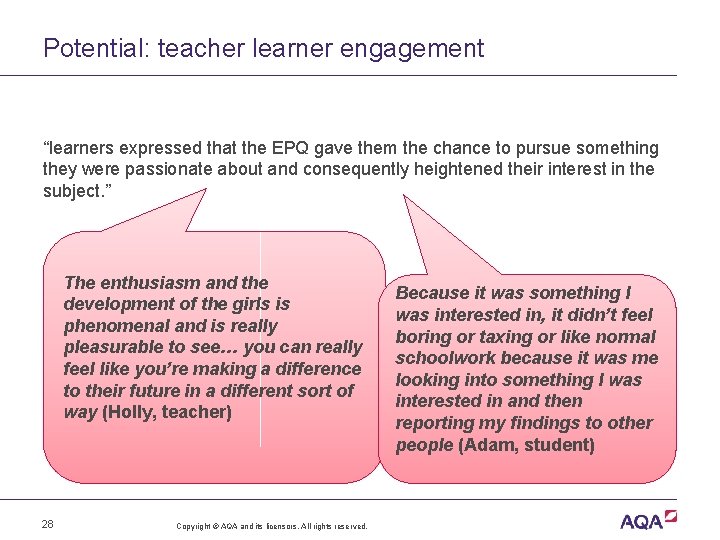
Potential: teacher learner engagement “learners expressed that the EPQ gave them the chance to pursue something they were passionate about and consequently heightened their interest in the subject. ” The enthusiasm and the development of the girls is phenomenal and is really pleasurable to see… you can really feel like you’re making a difference to their future in a different sort of way (Holly, teacher) 28 Copyright © AQA and its licensors. All rights reserved. Because it was something I was interested in, it didn’t feel boring or taxing or like normal schoolwork because it was me looking into something I was interested in and then reporting my findings to other people (Adam, student)
- Slides: 28