
Extended Project 2015 16 Session 1 Introduction Introduction



- Slides: 34
Extended Project 2015 -16 Session 1 - Introduction
Introduction Session Aims By the end of today you should have: • Developed an understanding of the EPQ • Formulated an initial idea for your project and considered the focus for your question • Begun to fill in your production log By the end of tomorrow you should have: • Developed an understanding of planning and research • Started your project plan • Started your bibliography • Started researching your initial idea
What is the Extended Project? What will you do? 1. Choose an area of interest. 2. Draft a title and aims of the project formal approval by your supervisor / co-ordinator 3. Plan, research and carry out your project (this can be an essay, artefact, performance etc. ) 4. Deliver a presentation to a specified audience 5. Provide evidence of all stages of project development and production for assessment.
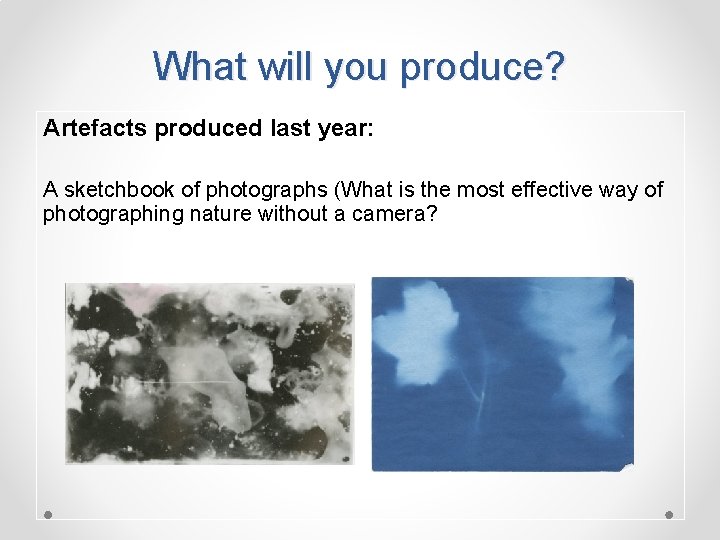
What will you produce? Artefacts produced last year: A sketchbook of photographs (What is the most effective way of photographing nature without a camera?
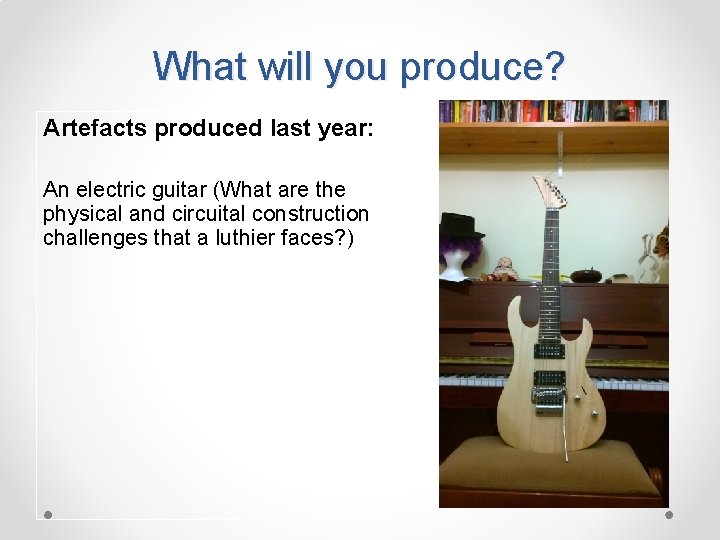
What will you produce? Artefacts produced last year: An electric guitar (What are the physical and circuital construction challenges that a luthier faces? )
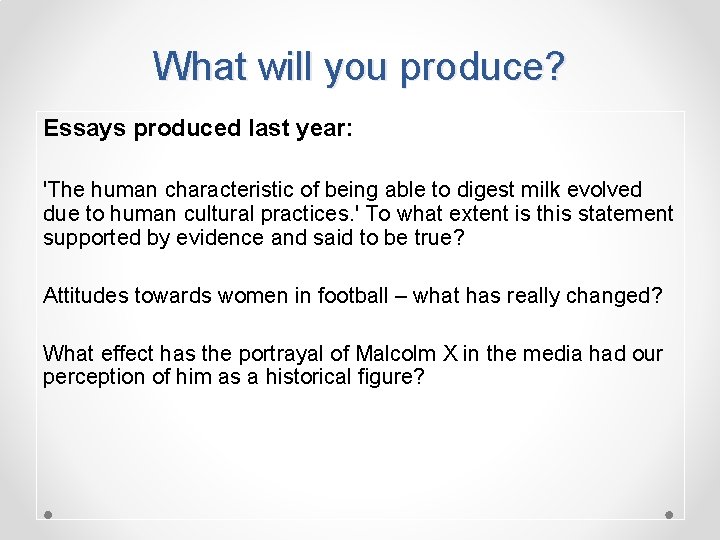
What will you produce? Essays produced last year: 'The human characteristic of being able to digest milk evolved due to human cultural practices. ' To what extent is this statement supported by evidence and said to be true? Attitudes towards women in football – what has really changed? What effect has the portrayal of Malcolm X in the media had our perception of him as a historical figure?
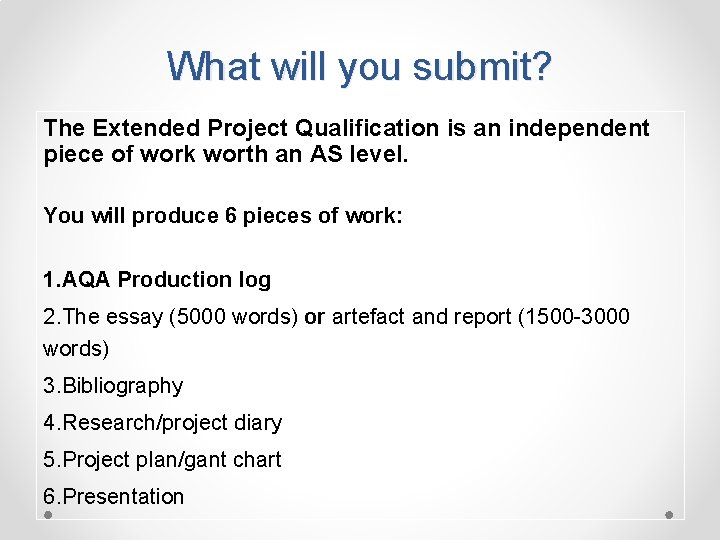
What will you submit? The Extended Project Qualification is an independent piece of work worth an AS level. You will produce 6 pieces of work: 1. AQA Production log 2. The essay (5000 words) or artefact and report (1500 -3000 words) 3. Bibliography 4. Research/project diary 5. Project plan/gant chart 6. Presentation
Production log
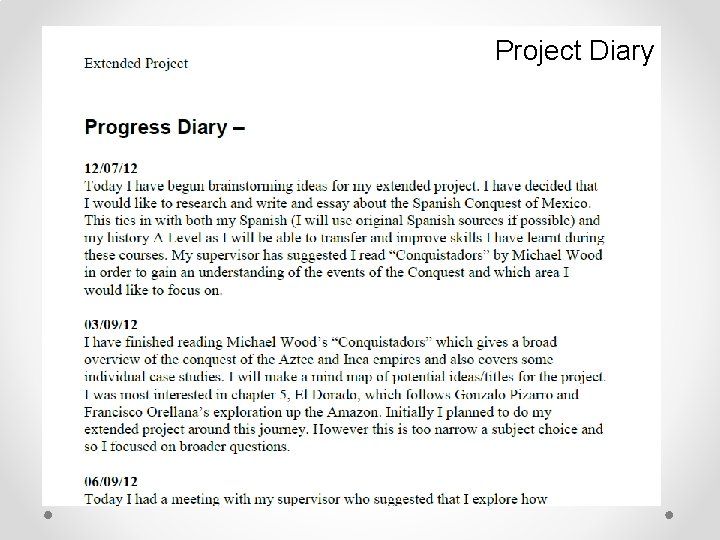
Project Diary
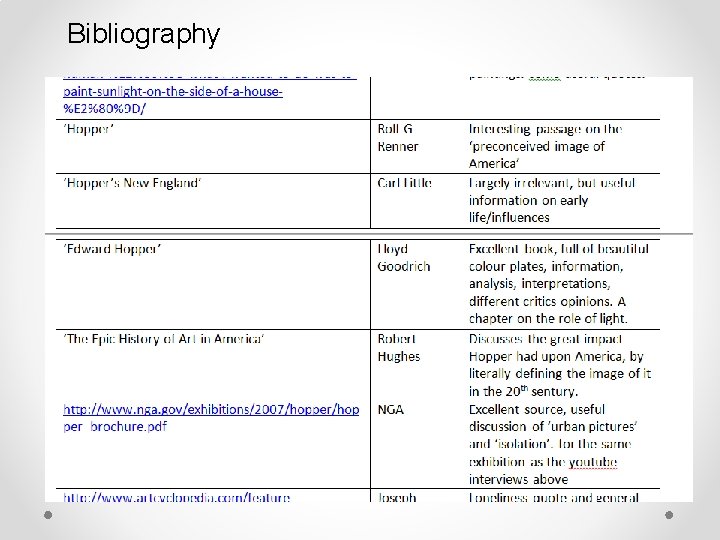
Bibliography
The taught element will include: • Professional codes of practice, ethical guidelines, research methodology. • ICT skills to enhance the production of the report and the development of the project covering research, analysis and execution. • Research skills including the ability to search for and identify suitable sources of information, prior research, or relevant work already available. • Project management skills including time, resource and task management. • The format and structure of accepted academic forms of research report to include: abstract, introduction, background research, further research content with all sources cited, discussion, conclusion, references, including the evaluation of sources.
How will you be assessed Manage - AO 1 (20%) Identify, design, plan, and carry out a project, applying a range of skills, strategies and methods to achieve objectives. Use Resources - AO 2 (20%) Research, critically select, organise and use information, and a range of resources. Analyse data apply relevantly and demonstrate understanding of any links, connections and complexities of the topic. Develop and Realise - AO 3 (40%) Select and use a range of skills, including, where appropriate, new technologies and problem-solving, to take decisions critically and achieve planned outcomes. Review - AO 4 (20%) Evaluate all aspects of the extended project, including outcomes in relation to stated objectives and own learning and performance. Select and use a range of communication skills and media to present evidenced project outcomes and conclusions in an appropriate format.
The importance of process You must complete the Production Log as you carry out your project, NOT AT THE END! It records the following key information: 1. Planning review meeting between you and your supervisor following project approval 2. Mid-project review with your supervisor 3. End-of-project review with your supervisor 4. Summary and evaluation of the project 5. A record of the presentation 6. Reflection on the complete project process
Short Term Objectives Over the next 2 days you will need to: • Develop your initial idea for a project into a question with a clear outline of your research plans • Discuss your ideas with an EPQ supervisor. • Download and begin your production log, specifically your Record of Initial Planning • Carry out some research to develop your ideas sufficiently to make a formal project proposal in September. • Create an overall plan of how you will use your time in order to realise your project (including what you will do over the summer)
Coming up with an idea • Title must be clear and focused – not too broad • Must be a completely new piece of work and not be relative to subject topics studied at A 2 • Must be achievable - How might resource and timescale restrictions affect you in your choice? • Will you enjoy the topic you are studying?
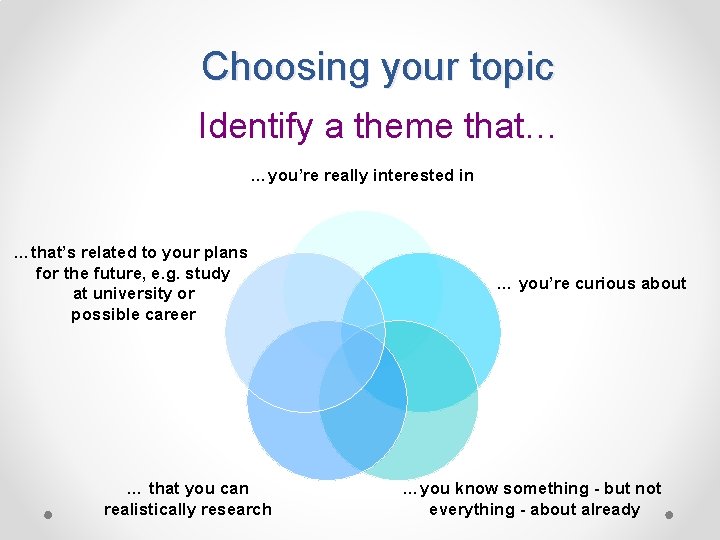
Choosing your topic Identify a theme that… …you’re really interested in …that’s related to your plans for the future, e. g. study at university or possible career … that you can realistically research … you’re curious about …you know something - but not everything - about already
Things to avoid 1. Avoid a topic that is overly ambitious 2. Avoid emotive issues – you may lack objectivity 3. Avoid a topic in which you have a personal axe to grind. 4. Avoid anything you have already covered in your AS level courses 5. Don’t try to be too original – you may struggle to research 6. Avoid being too narrow or too broad.
Groups You will now split into 4 groups and work in the following areas to develop your initial ideas: • • Sixth Form Study Area 130 A 130 B 133 A
Group Session Forming your title
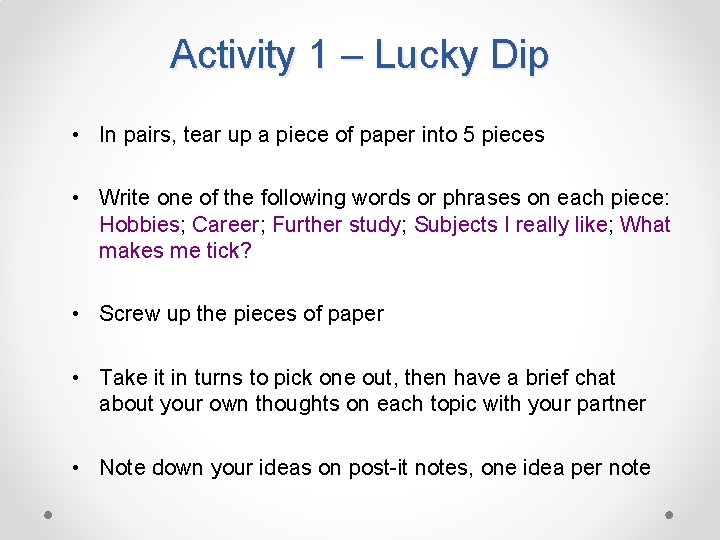
Activity 1 – Lucky Dip • In pairs, tear up a piece of paper into 5 pieces • Write one of the following words or phrases on each piece: Hobbies; Career; Further study; Subjects I really like; What makes me tick? • Screw up the pieces of paper • Take it in turns to pick one out, then have a brief chat about your own thoughts on each topic with your partner • Note down your ideas on post-it notes, one idea per note
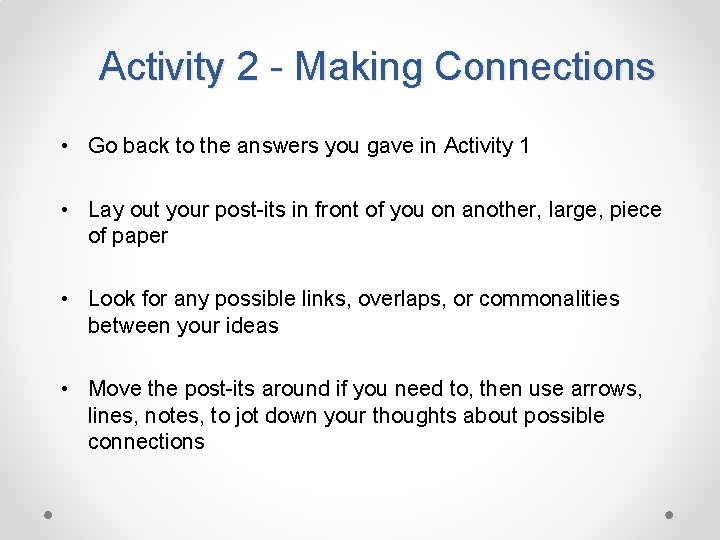
Activity 2 - Making Connections • Go back to the answers you gave in Activity 1 • Lay out your post-its in front of you on another, large, piece of paper • Look for any possible links, overlaps, or commonalities between your ideas • Move the post-its around if you need to, then use arrows, lines, notes, to jot down your thoughts about possible connections
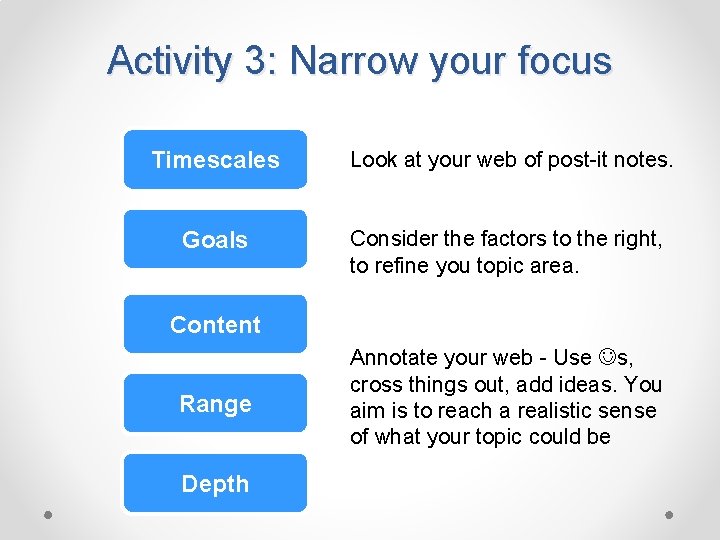
Activity 3: Narrow your focus Timescales Look at your web of post-it notes. Goals Consider the factors to the right, to refine you topic area. Content Range Depth Annotate your web - Use s, cross things out, add ideas. You aim is to reach a realistic sense of what your topic could be
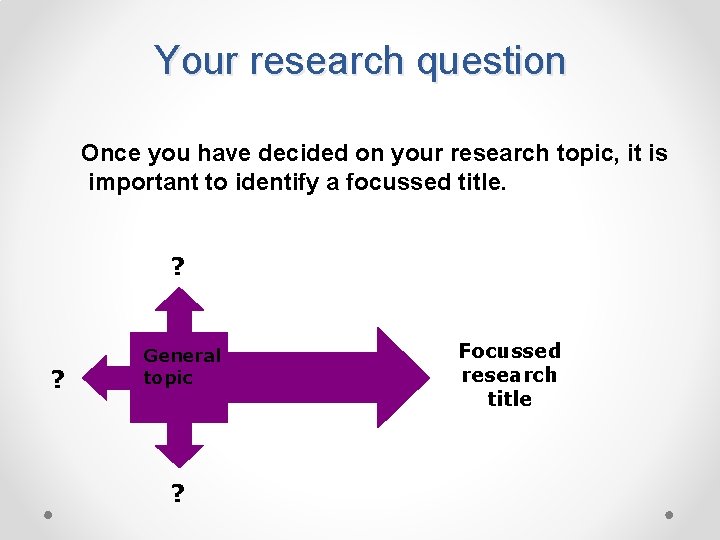
Your research question Once you have decided on your research topic, it is important to identify a focussed title. ? ? General topic ? Focussed research title
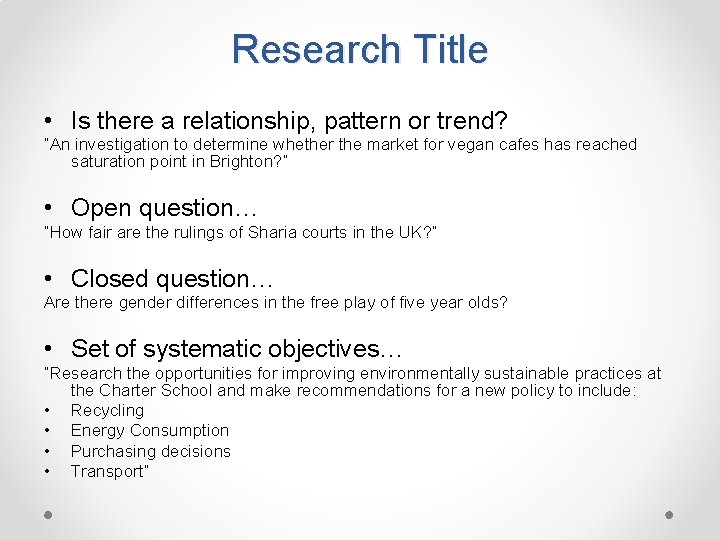
Research Title • Is there a relationship, pattern or trend? “An investigation to determine whether the market for vegan cafes has reached saturation point in Brighton? ” • Open question… “How fair are the rulings of Sharia courts in the UK? ” • Closed question… Are there gender differences in the free play of five year olds? • Set of systematic objectives… “Research the opportunities for improving environmentally sustainable practices at the Charter School and make recommendations for a new policy to include: • Recycling • Energy Consumption • Purchasing decisions • Transport”
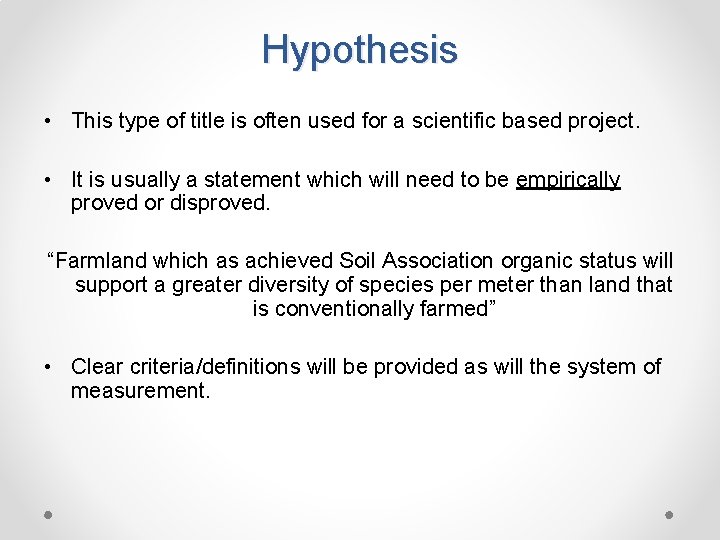
Hypothesis • This type of title is often used for a scientific based project. • It is usually a statement which will need to be empirically proved or disproved. “Farmland which as achieved Soil Association organic status will support a greater diversity of species per meter than land that is conventionally farmed” • Clear criteria/definitions will be provided as will the system of measurement.
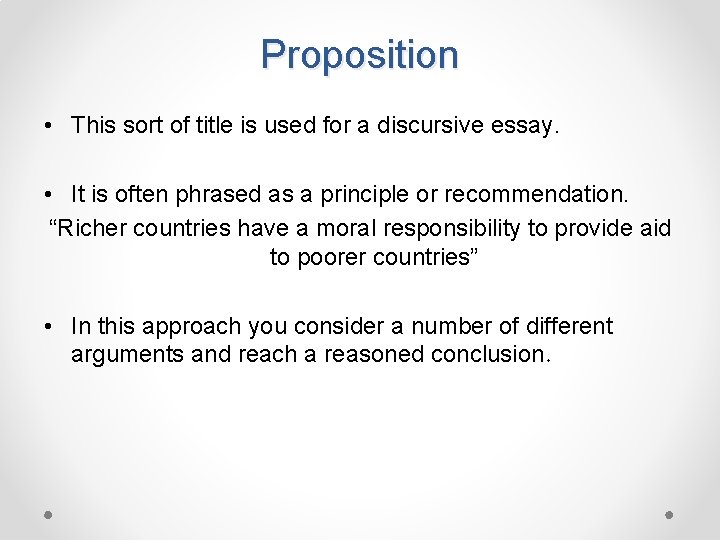
Proposition • This sort of title is used for a discursive essay. • It is often phrased as a principle or recommendation. “Richer countries have a moral responsibility to provide aid to poorer countries” • In this approach you consider a number of different arguments and reach a reasoned conclusion.
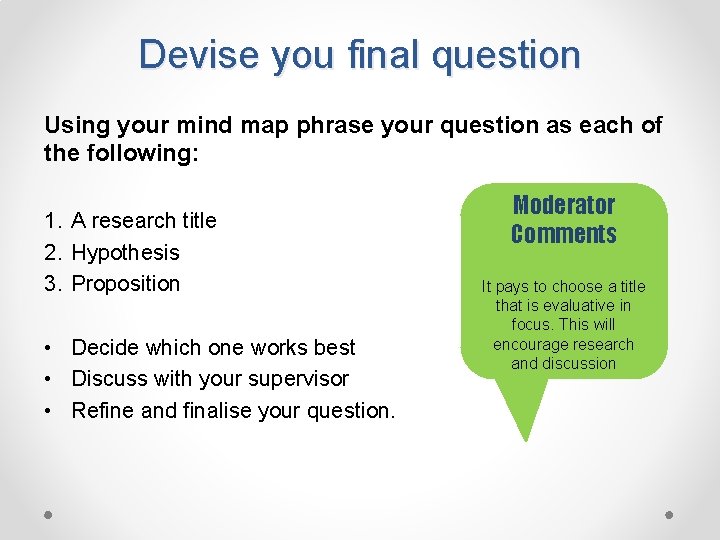
Devise you final question Using your mind map phrase your question as each of the following: 1. A research title 2. Hypothesis 3. Proposition • Decide which one works best • Discuss with your supervisor • Refine and finalise your question. Moderator Comments It pays to choose a title that is evaluative in focus. This will encourage research and discussion
Using questions during your research • Always keep your title question in mind • Keep revisiting your question, you need to be prepared to revise it • It is often useful to break your main question down into subquestions – ‘smaller’ questions that you need to answer in order to answer your main question. If you’re doing a practical project, sub-questions may be smaller activities or problems you need to solve. • Use sub-questions to guide your research and also to form sub-headings within the body of your writing
Reflection • If you need to revise your question along the way, this doesn‘t mean you ‘got it wrong’ to begin with • Modifying your question later may show that you’re taking on board what you learn from your research – this is a good thing! • Don’t forget - keep all your notes from today’s session as you will now need to record your thoughts and discussions in your production log.
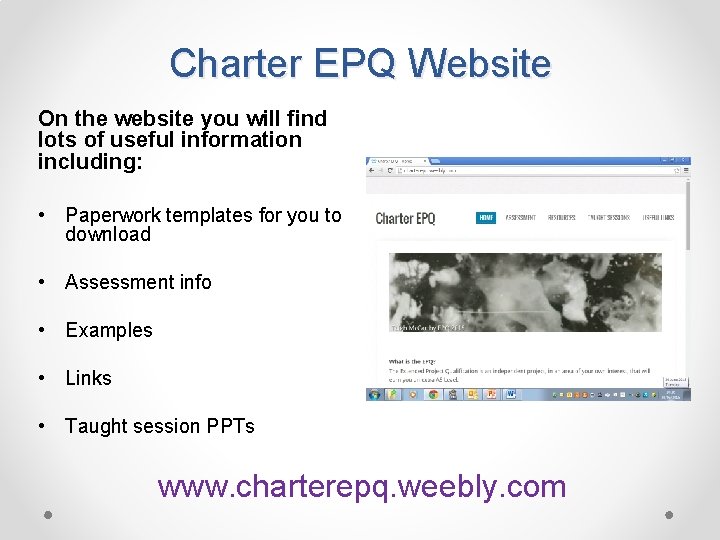
Charter EPQ Website On the website you will find lots of useful information including: • Paperwork templates for you to download • Assessment info • Examples • Links • Taught session PPTs www. charterepq. weebly. com
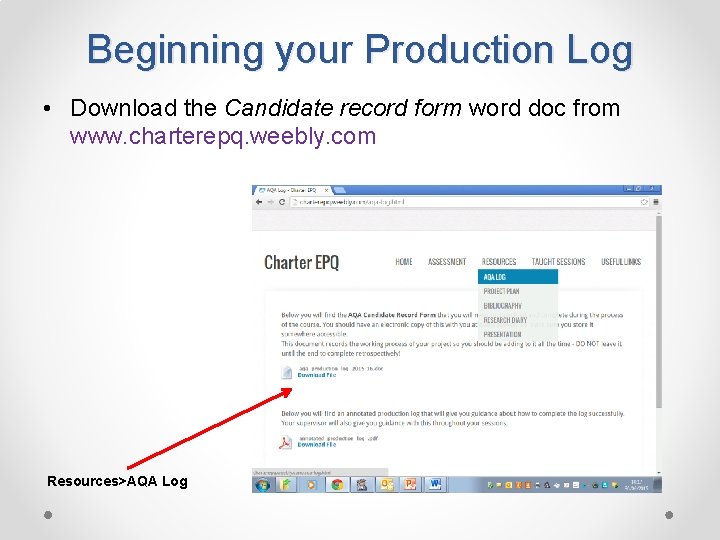
Beginning your Production Log • Download the Candidate record form word doc from www. charterepq. weebly. com Resources>AQA Log
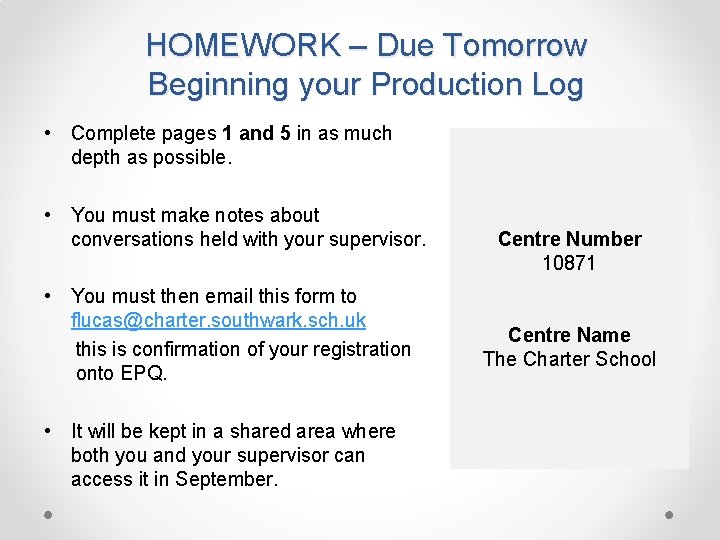
HOMEWORK – Due Tomorrow Beginning your Production Log • Complete pages 1 and 5 in as much depth as possible. • You must make notes about conversations held with your supervisor. • You must then email this form to flucas@charter. southwark. sch. uk this is confirmation of your registration onto EPQ. • It will be kept in a shared area where both you and your supervisor can access it in September. Centre Number 10871 Centre Name The Charter School
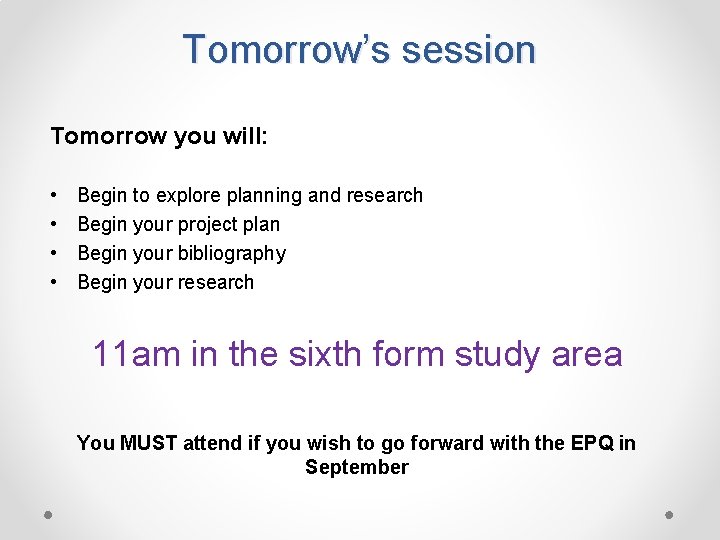
Tomorrow’s session Tomorrow you will: • • Begin to explore planning and research Begin your project plan Begin your bibliography Begin your research 11 am in the sixth form study area You MUST attend if you wish to go forward with the EPQ in September
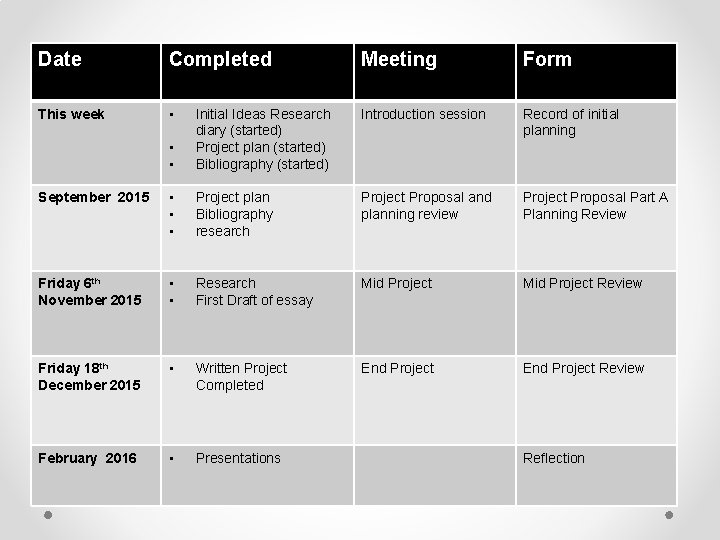
Date Completed Meeting Form This week • Introduction session Record of initial planning • • Initial Ideas Research diary (started) Project plan (started) Bibliography (started) September 2015 • • • Project plan Bibliography research Project Proposal and planning review Project Proposal Part A Planning Review Friday 6 th November 2015 • • Research First Draft of essay Mid Project Review Friday 18 th December 2015 • Written Project Completed End Project Review February 2016 • Presentations Reflection