
Extended Learning Opportunities Creating Alternative Pathways for Students
- Slides: 13
Extended Learning Opportunities Creating Alternative Pathways for Students to Achieve Academic Credit in School The contents of this Power. Point were developed under a grant from the US Department of Education, H 323 A 120003. However, those contents do not necessarily represent the policy of the US Department of Education, and you should not assume endorsement by the Federal Government. Project Officer, Corinne Weidenthal
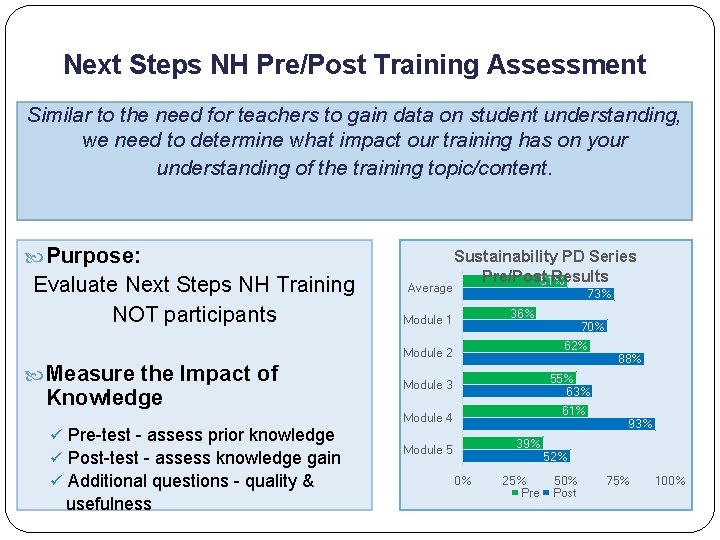
Next Steps NH Pre/Post Training Assessment Similar to the need for teachers to gain data on student understanding, we need to determine what impact our training has on your understanding of the training topic/content. Purpose: Evaluate Next Steps NH Training NOT participants Average Sustainability PD Series Pre/Post 51% Results 73% 36% Module 1 62% Module 2 Measure the Impact of Knowledge usefulness 88% 55% 63% Module 3 61% Module 4 ü Pre-test - assess prior knowledge ü Post-test - assess knowledge gain ü Additional questions - quality & 70% 39% Module 5 0% 25% Pre 93% 52% 50% Post 75% 100%
Next Steps NH • Funding for this training comes from a State Personnel Development Grant (SPDG) from the U. S. Department of Education, Office of Special Education Programs (OSEP) • The purpose of the Next Steps NH grant is to develop and sustain the skills of New Hampshire school district personnel and families to increase the number of students with disabilities graduating from high school that are college and career ready. • Extended Learning Opportunities (ELOs) are a main focus of the Next Steps NH grant.
Materials For This Presentation �Come from a variety of sources including but not limited to: www. beyondclassroom. org www. nextsteps-nh. org �New Hampshire Department of Education �Lebanon High School �Pittsfield Middle High School �Q. E. D. Foundation
Learning Objectives • Participants will learn how to develop ELOs • Participants will learn the role of students, families, educators and community partners in developing and implementing ELOs
Guiding Principle ELOs, like transition, do not happen in isolation. This training is about ELOs and the framework needed to build a program. Actual building needs to include other partners not present at the training.
What is an ELO? Using paper, a role play, a video or any creative method of your teams choice, create a representation of how your school team defines an ELO. How did your school determine that definition?
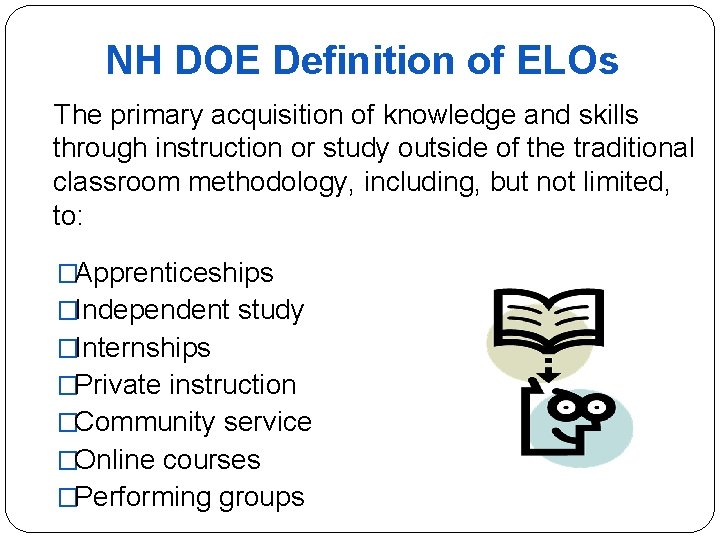
NH DOE Definition of ELOs The primary acquisition of knowledge and skills through instruction or study outside of the traditional classroom methodology, including, but not limited, to: �Apprenticeships �Independent study �Internships �Private instruction �Community service �Online courses �Performing groups
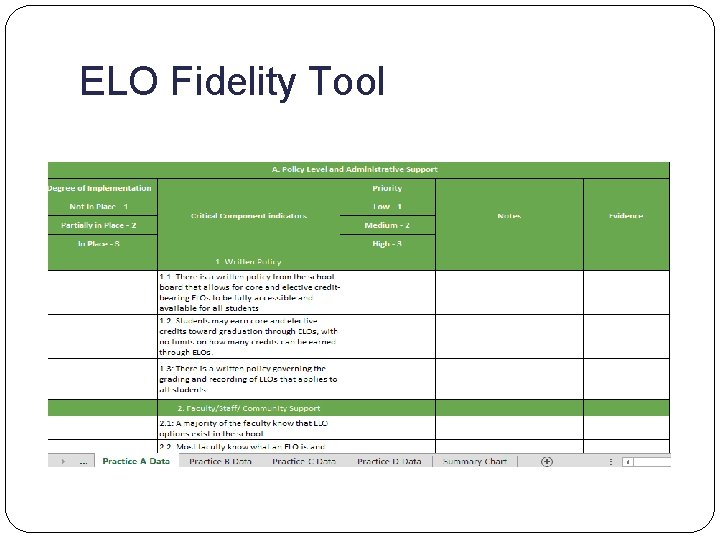
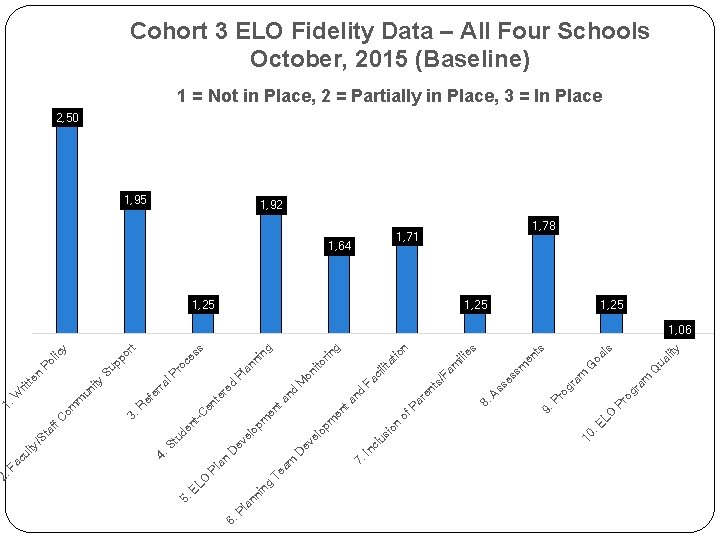
Where We Are Now: �The following data comes from the ELO Fidelity Tool that both cohort schools completed. �Lets think about this and how we use it as a starting place to expand the use and scope of ELOs.
ELO Fidelity Tool
6. g am gr Pr o G lit y ua s oa l 1, 25 Q m s en ts sm es gr a ro 9. P ss 8. A n ilie m Fa ts / ar en of P lit at io Fa ci 1, 25 EL O io n nd g rin 1, 64 1, 71 10. us cl In ta en m g an ni n on ito Pl M re d en ta nd op m op el D ev el ev D ss ce l. P ro rra ef e R y or t lic Po Su pp en rit t un ity m en te t-C de n St u 3. om f. C /S ta f 1. W 1, 95 7. am n Pl a 4. cu lty Fa Te EL O in an n Pl 5. 2. Cohort 3 ELO Fidelity Data – All Four Schools October, 2015 (Baseline) 1 = Not in Place, 2 = Partially in Place, 3 = In Place 2, 50 1, 92 1, 78 1, 25 1, 06
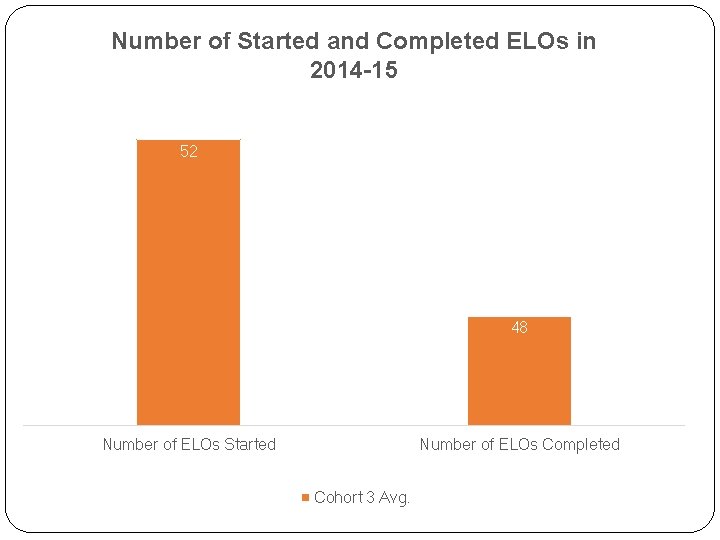
Number of Started and Completed ELOs in 2014 -15 52 48 Number of ELOs Started Number of ELOs Completed Cohort 3 Avg.
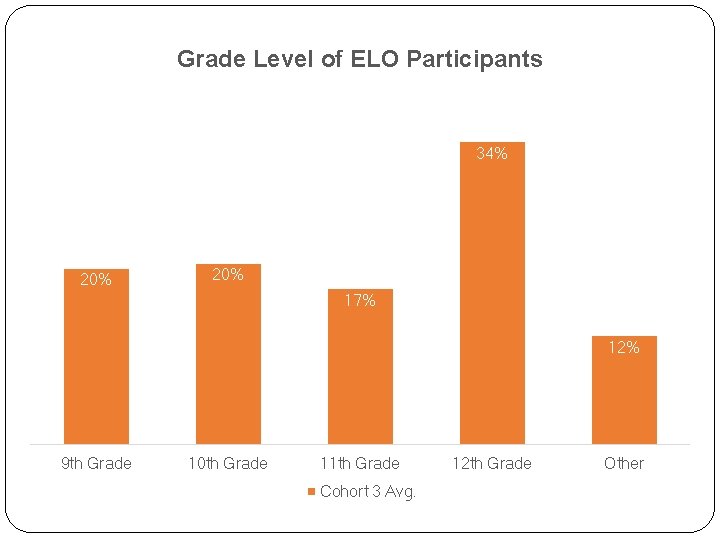
Grade Level of ELO Participants 34% 20% 17% 12% 9 th Grade 10 th Grade 11 th Grade Cohort 3 Avg. 12 th Grade Other