
EXTENDED IRREGULAR WORK HOURS SHIFT WORK HEALTH SAFETY
- Slides: 28
EXTENDED & IRREGULAR WORK HOURS, SHIFT WORK & HEALTH & SAFETY: PROBLEM AND SOLUTIONS UNITED STEELWORKERS HEALTH SAFETY & ENVIRONMENT CONFERENCE SEPTEMBER 13, 2016 PRESENTED BY UNIVERSITY OF IOWA LABOR CENTER
In order to have an “unsafe” or “at-risk” behavior, what must be present? A HAZARD
All injuries and illnesses on the job are the result of Exposure To Hazards. There are NO exceptions!
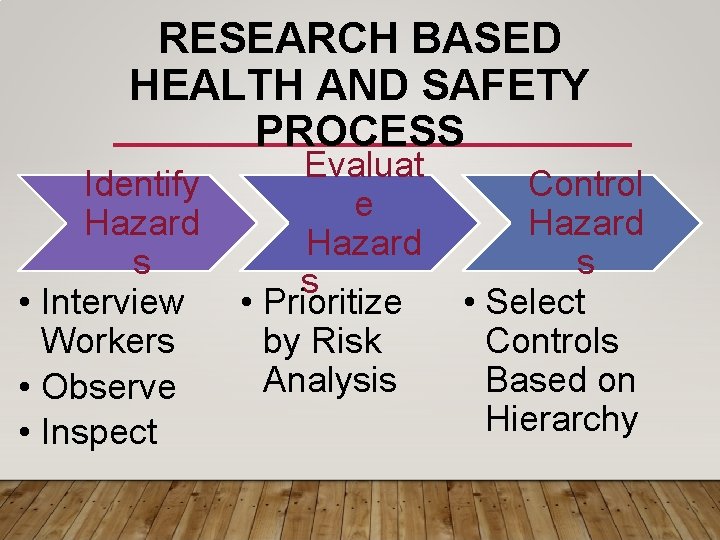
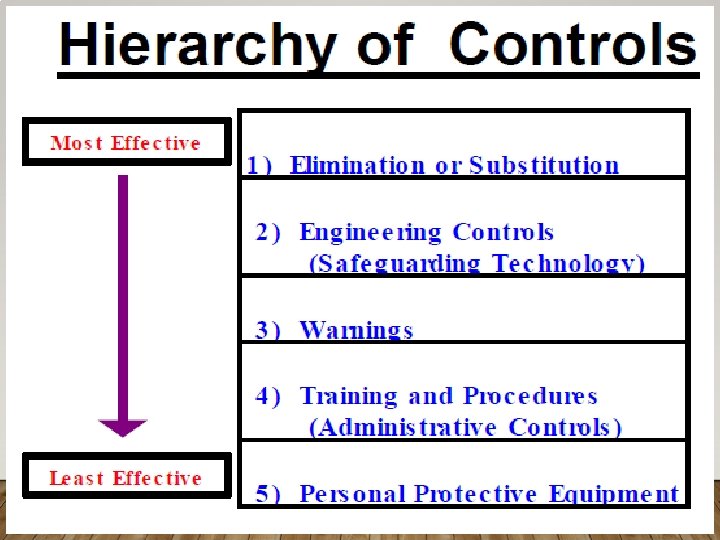
RESEARCH BASED HEALTH AND SAFETY PROCESS Identify Hazard s • Interview Workers • Observe • Inspect Evaluat e Hazard s • Prioritize by Risk Analysis Control Hazard s • Select Controls Based on Hierarchy
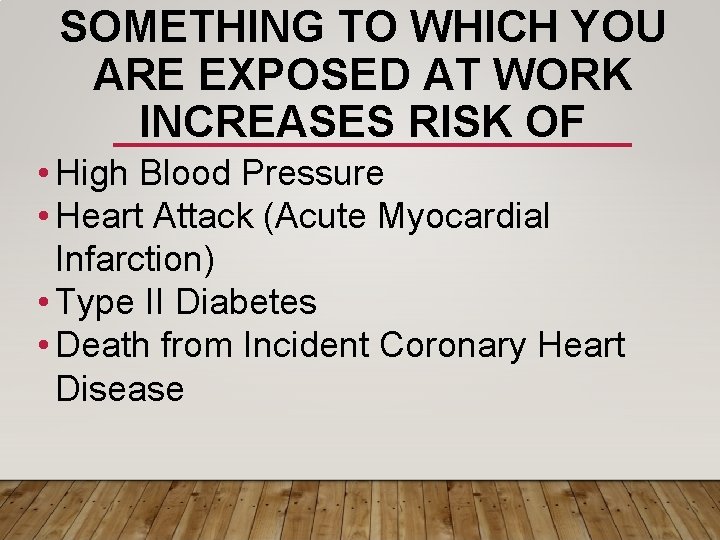
SOMETHING TO WHICH YOU ARE EXPOSED AT WORK INCREASES RISK OF • High Blood Pressure • Heart Attack (Acute Myocardial Infarction) • Type II Diabetes • Death from Incident Coronary Heart Disease
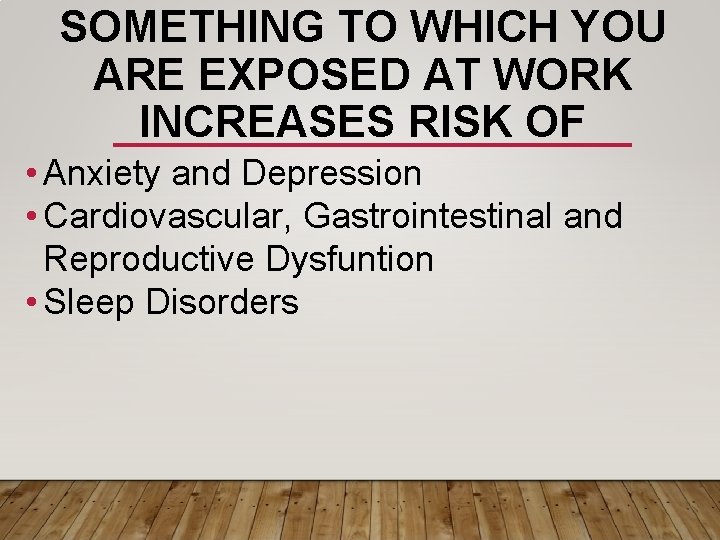
SOMETHING TO WHICH YOU ARE EXPOSED AT WORK INCREASES RISK OF • Anxiety and Depression • Cardiovascular, Gastrointestinal and Reproductive Dysfuntion • Sleep Disorders
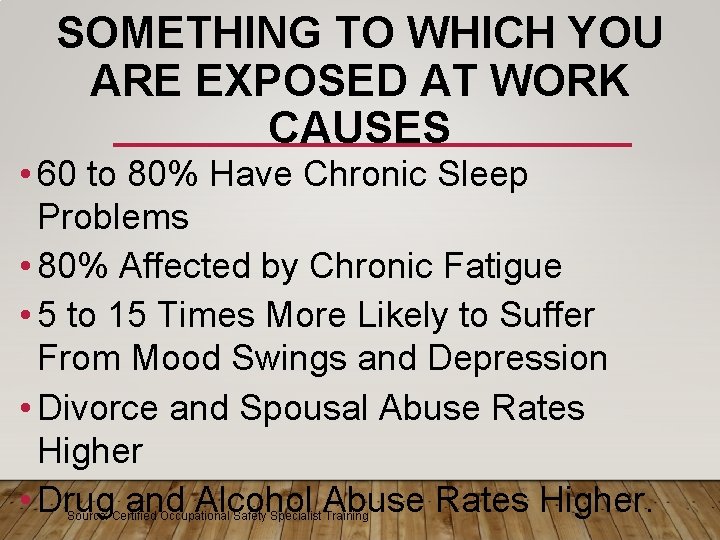
SOMETHING TO WHICH YOU ARE EXPOSED AT WORK CAUSES • 60 to 80% Have Chronic Sleep Problems • 80% Affected by Chronic Fatigue • 5 to 15 Times More Likely to Suffer From Mood Swings and Depression • Divorce and Spousal Abuse Rates Higher • Drug and Alcohol Abuse Rates Higher. Source: Certified Occupational Safety Specialist Training
What should be done about something causing these health risks?
FATIGUE IS A SAFETY HAZARD The Risks of Working Fatigued
WHEN DOES YOUR BODY WANT TO SLEEP?
THE BODY CLOCK • Known as circadian rhythms • Operates on a 24 -hour cycle • Makes you sleepy when it’s dark and awake when it’s light Source: Australia Civil Aviation Safety Authority
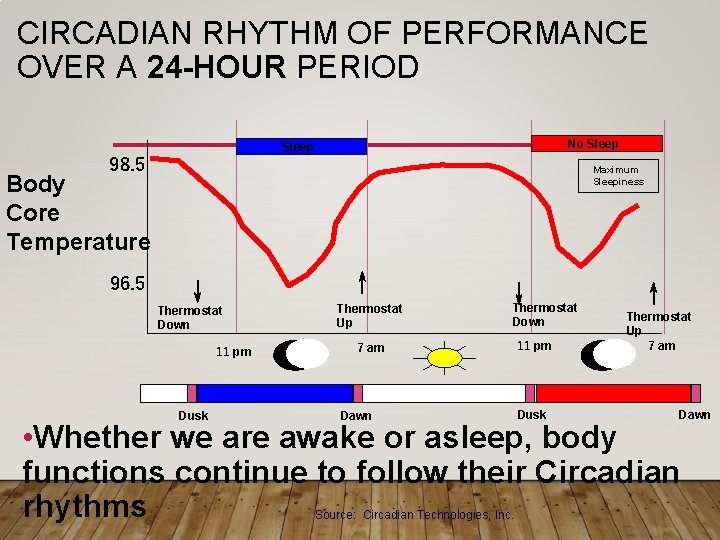
CIRCADIAN RHYTHM OF PERFORMANCE OVER A 24 -HOUR PERIOD No Sleep 98. 5 Maximum Sleepiness Body Core Temperature 96. 5 Thermostat Down 11 pm Dusk Thermostat Up Thermostat Down 7 am Dawn 11 pm Dusk Thermostat Up 7 am Dawn • Whether we are awake or asleep, body functions continue to follow their Circadian rhythms Source: Circadian Technologies, Inc.
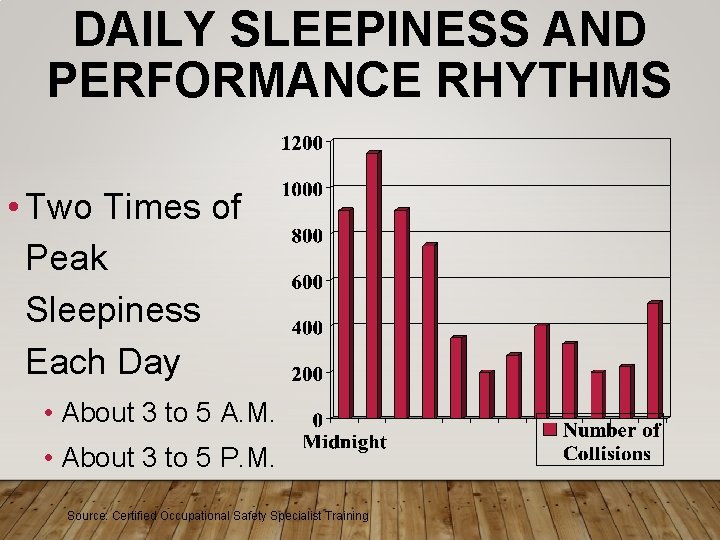
DAILY SLEEPINESS AND PERFORMANCE RHYTHMS • Two Times of Peak Sleepiness Each Day • About 3 to 5 A. M. • About 3 to 5 P. M. Source: Certified Occupational Safety Specialist Training
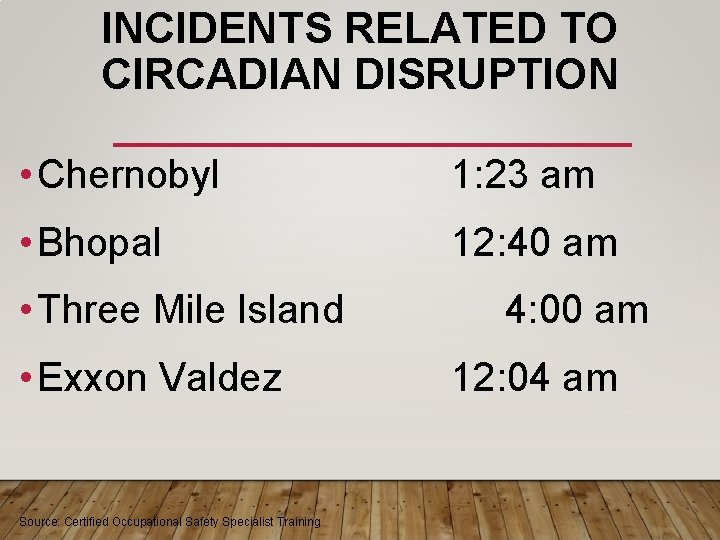
INCIDENTS RELATED TO CIRCADIAN DISRUPTION • Chernobyl 1: 23 am • Bhopal 12: 40 am • Three Mile Island • Exxon Valdez Source: Certified Occupational Safety Specialist Training 4: 00 am 12: 04 am
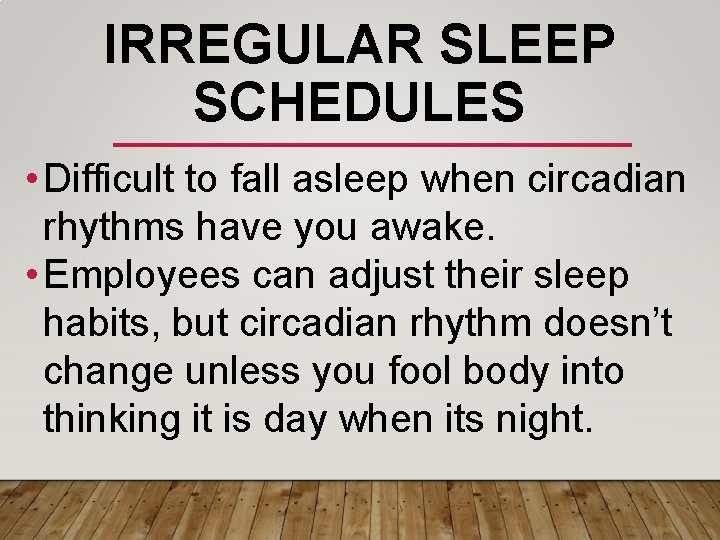
IRREGULAR SLEEP SCHEDULES • Difficult to fall asleep when circadian rhythms have you awake. • Employees can adjust their sleep habits, but circadian rhythm doesn’t change unless you fool body into thinking it is day when its night.
SHIFT-WORK SLEEP DISORDER (SWSD) • A sleep disorder that affects workers who frequently rotate shifts or work at night. • Schedules go against body’s natural Circadian rhythm • Difficult to adjust to the different sleep and wake schedule. Source: United States Mine Rescue Association
SHIFT-WORK SLEEP DISORDER (SWSD) • SWSD consists of a constant or recurrent pattern of sleep interruption that results in insomnia or excessive sleepiness. • This disorder is common in people who work non-traditional hours – usually between the hours of 10: 00 p. m. and 6: 00 a. m. Source: United States Mine Rescue Association
ACCUMULATING A SLEEP DEBT • Sleep Loss Is Cumulative and Builds a Debt • People whose sleep was restricted to 4 to 5 hours per night for one week needed two full nights sleep to recover vigilance, performance, and normal mood • How Do You Get Out of Sleep Debt? SLEEP! Source: Certified Occupational Safety Specialist Training
FACTS ABOUT SLEEP DEBT • When you are sleepy • You tend to over-estimate your own alertness • Your judgment isn’t as good • When you are very sleepy, motivation can’t stop you from falling asleep • You can sleep to make up a sleep debt, but you can’t bank extra sleep • It is harder to cope with fatigue as you get older Source: British Petroleum Fatigue Safety Training
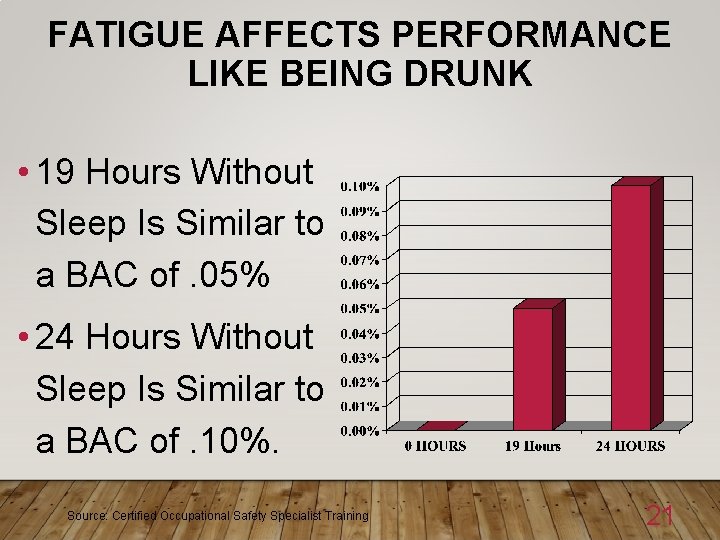
FATIGUE AFFECTS PERFORMANCE LIKE BEING DRUNK • 19 Hours Without Sleep Is Similar to a BAC of. 05% • 24 Hours Without Sleep Is Similar to a BAC of. 10%. Source: Certified Occupational Safety Specialist Training 21
MICRO-SLEEP • Short bursts of sleep waves • Seconds or minutes long • Eyelid blinking slows down • Often precedes nodding off • Loss of awareness • Fatigue/monotony induced Source: Circadian Technologies, Inc.
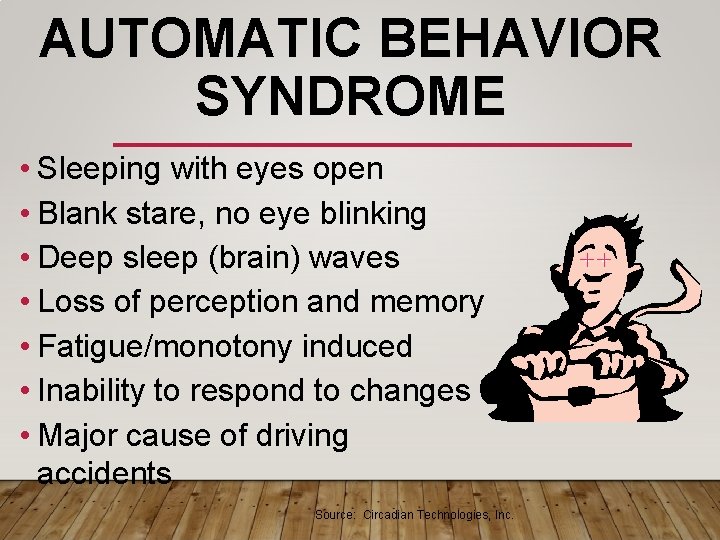
AUTOMATIC BEHAVIOR SYNDROME • Sleeping with eyes open • Blank stare, no eye blinking • Deep sleep (brain) waves • Loss of perception and memory • Fatigue/monotony induced • Inability to respond to changes • Major cause of driving accidents Source: Circadian Technologies, Inc.
DECISION FATIGUE • Research shows that the human brain has a limit to how many decisions it can make before it starts to shut down • When decision fatigue sets in people naturally have less impulse control, make impulsive (often bad) decisions • Need to be early in decision fatigue cycle to make tough decision; default to easiest decision when fatigue sets in. • Decision Fatigue reset by break with food or sleep.
WHAT KIND OF SCHEDULE MIGHT WORK? Limiting Fatigue Through Bio. Compatible Scheduling
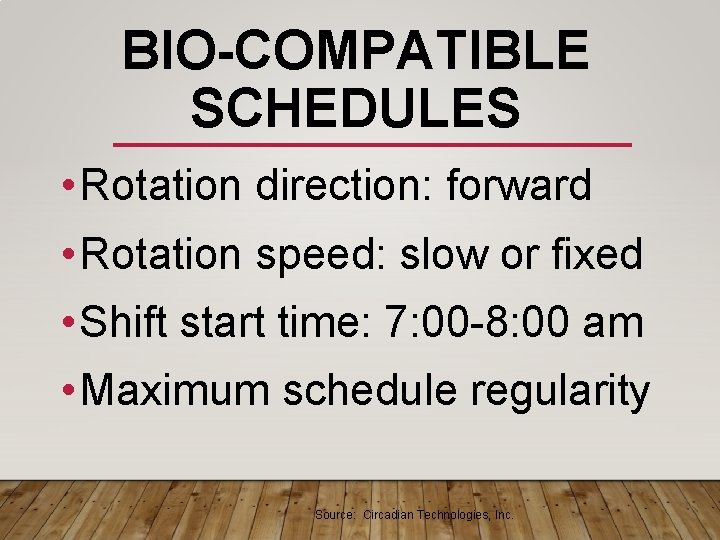
BIO-COMPATIBLE SCHEDULES • Rotation direction: forward • Rotation speed: slow or fixed • Shift start time: 7: 00 -8: 00 am • Maximum schedule regularity Source: Circadian Technologies, Inc.
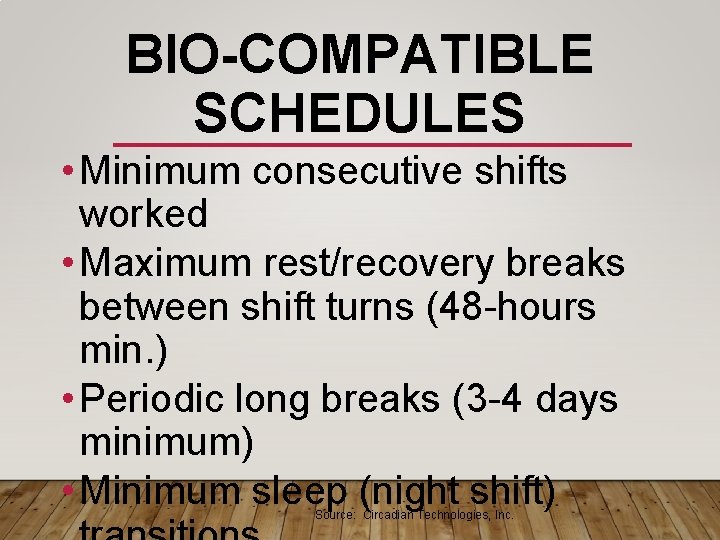
BIO-COMPATIBLE SCHEDULES • Minimum consecutive shifts worked • Maximum rest/recovery breaks between shift turns (48 -hours min. ) • Periodic long breaks (3 -4 days minimum) • Minimum sleep (night shift) Source: Circadian Technologies, Inc.
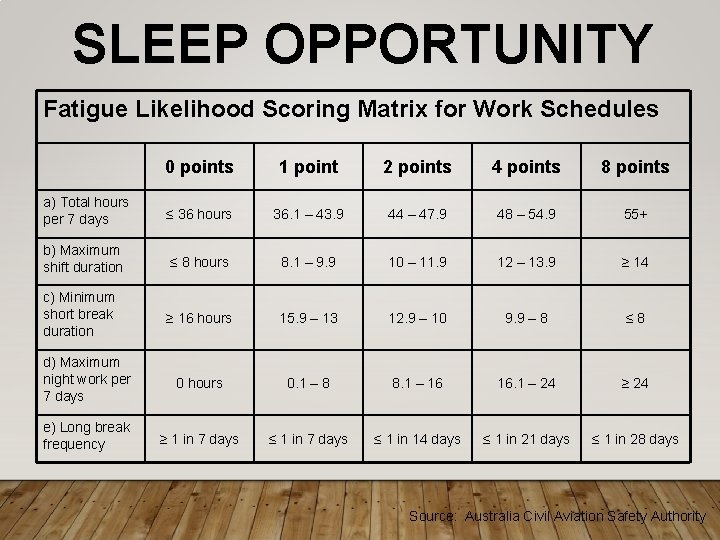
SLEEP OPPORTUNITY Fatigue Likelihood Scoring Matrix for Work Schedules 0 points 1 point 2 points 4 points 8 points a) Total hours per 7 days ≤ 36 hours 36. 1 – 43. 9 44 – 47. 9 48 – 54. 9 55+ b) Maximum shift duration ≤ 8 hours 8. 1 – 9. 9 10 – 11. 9 12 – 13. 9 ≥ 14 c) Minimum short break duration ≥ 16 hours 15. 9 – 13 12. 9 – 10 9. 9 – 8 ≤ 8 d) Maximum night work per 7 days 0 hours 0. 1 – 8 8. 1 – 16 16. 1 – 24 ≥ 24 e) Long break frequency ≥ 1 in 7 days ≤ 1 in 14 days ≤ 1 in 21 days ≤ 1 in 28 days Source: Australia Civil Aviation Safety Authority