
Extended Foster Care and Supervised Independent Living Services
- Slides: 11
Extended Foster Care and Supervised Independent Living Services Debra Emerson, LMSW-AP CPS Director, Transitional Living Services
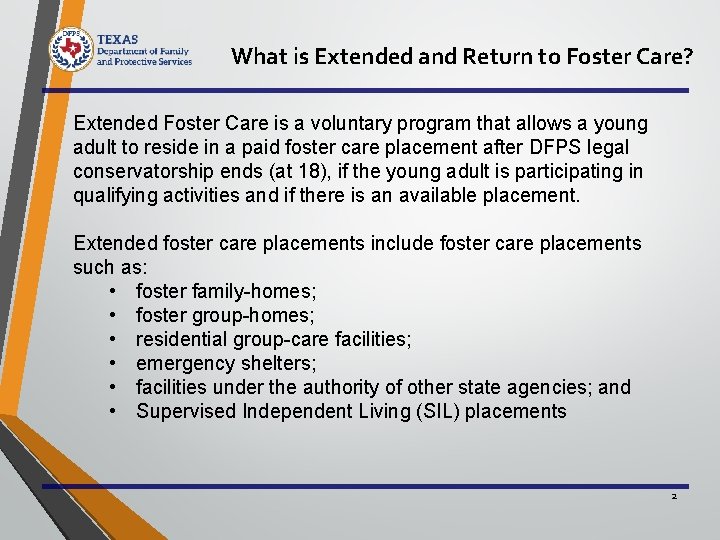
What is Extended and Return to Foster Care? Extended Foster Care is a voluntary program that allows a young adult to reside in a paid foster care placement after DFPS legal conservatorship ends (at 18), if the young adult is participating in qualifying activities and if there is an available placement. Extended foster care placements include foster care placements such as: • foster family-homes; • foster group-homes; • residential group-care facilities; • emergency shelters; • facilities under the authority of other state agencies; and • Supervised Independent Living (SIL) placements 2
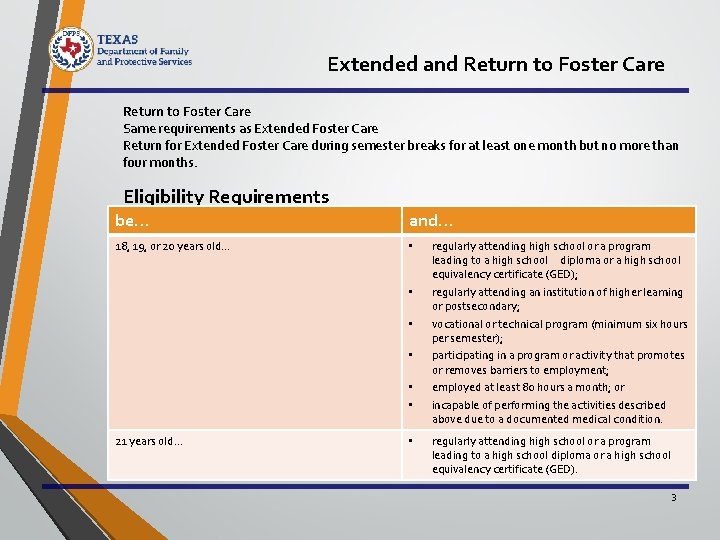
Extended and Return to Foster Care Same requirements as Extended Foster Care Return for Extended Foster Care during semester breaks for at least one month but no more than four months. Eligibility Requirements be… and… 18, 19, or 20 years old… • • • 21 years old… • regularly attending high school or a program leading to a high school diploma or a high school equivalency certificate (GED); regularly attending an institution of higher learning or postsecondary; vocational or technical program (minimum six hours per semester); participating in a program or activity that promotes or removes barriers to employment; employed at least 80 hours a month; or incapable of performing the activities described above due to a documented medical condition. regularly attending high school or a program leading to a high school diploma or a high school equivalency certificate (GED). 3
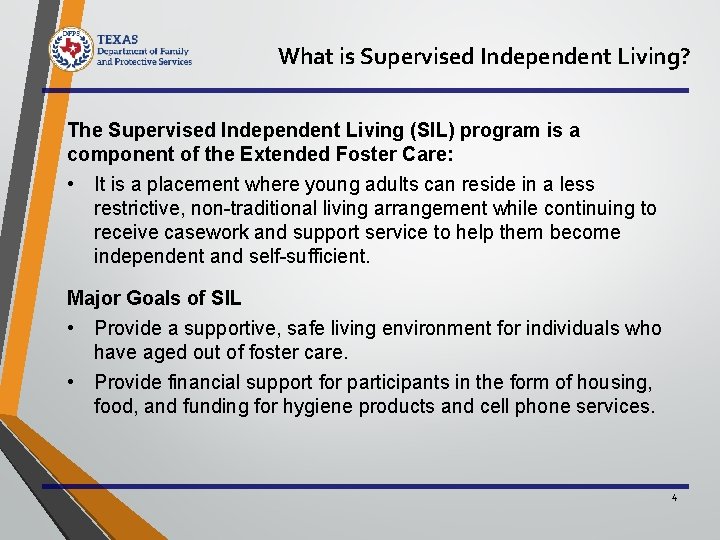
What is Supervised Independent Living? The Supervised Independent Living (SIL) program is a component of the Extended Foster Care: • It is a placement where young adults can reside in a less restrictive, non-traditional living arrangement while continuing to receive casework and support service to help them become independent and self-sufficient. Major Goals of SIL • Provide a supportive, safe living environment for individuals who have aged out of foster care. • Provide financial support for participants in the form of housing, food, and funding for hygiene products and cell phone services. 4
What is Supervised Independent Living • Through SIL a young adult is: • Allowed increased responsibilities with minimal supervision • Manage their own finances • Buying groceries/personal items • Working with a Landlord • Assisted with the transition to independent living • Achieving identified education and employment goals • Accessing community resources • Engaging in needed life skills training • Establishing important relationships 5
What is Supervised Independent Living SIL settings can include: • Apartments; • Non-College Dorms; • Shared Housing; and • Host Homes 6
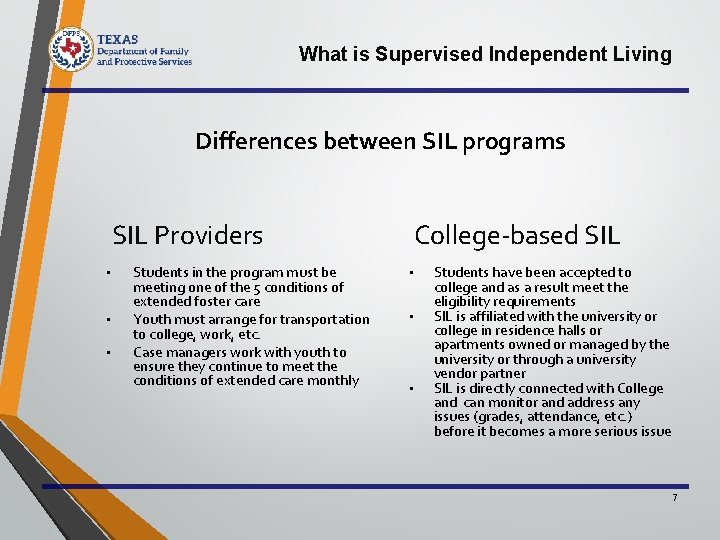
What is Supervised Independent Living Differences between SIL programs SIL Providers • • • Students in the program must be meeting one of the 5 conditions of extended foster care Youth must arrange for transportation to college, work, etc. Case managers work with youth to ensure they continue to meet the conditions of extended care monthly College-based SIL • • • Students have been accepted to college and as a result meet the eligibility requirements SIL is affiliated with the university or college in residence halls or apartments owned or managed by the university or through a university vendor partner SIL is directly connected with College and can monitor and address any issues (grades, attendance, etc. ) before it becomes a more serious issue 7
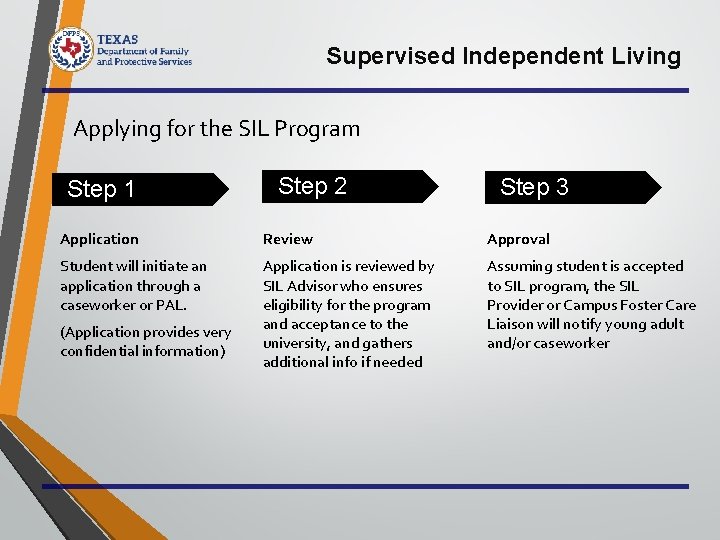
Supervised Independent Living Applying for the SIL Program Step 1 Step 2 Step 3 Application Review Approval Student will initiate an application through a caseworker or PAL. Application is reviewed by SIL Advisor who ensures eligibility for the program and acceptance to the university, and gathers additional info if needed Assuming student is accepted to SIL program, the SIL Provider or Campus Foster Care Liaison will notify young adult and/or caseworker (Application provides very confidential information)
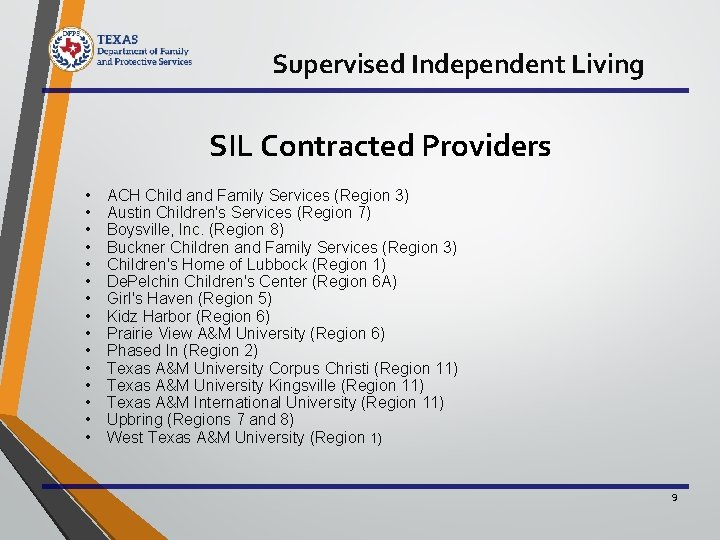
Supervised Independent Living SIL Contracted Providers • • • • ACH Child and Family Services (Region 3) Austin Children's Services (Region 7) Boysville, Inc. (Region 8) Buckner Children and Family Services (Region 3) Children's Home of Lubbock (Region 1) De. Pelchin Children's Center (Region 6 A) Girl's Haven (Region 5) Kidz Harbor (Region 6) Prairie View A&M University (Region 6) Phased In (Region 2) Texas A&M University Corpus Christi (Region 11) Texas A&M University Kingsville (Region 11) Texas A&M International University (Region 11) Upbring (Regions 7 and 8) West Texas A&M University (Region 1) 9
Questions? 10
Contacts Debra Emerson Director, Transitional Living Services Debra. Emerson@dfps. state. tx. us 512 -438 -4760 Gaye Vopat, TLS Lead Director, Transitional Living Services Gaye. Vopat@dfps. state. tx. us 512 -438 -5442 11