
Extended Entity Relationship Modelling and Mappings to the

- Slides: 58
(Extended) Entity Relationship Modelling and Mappings to the Relational Data Model
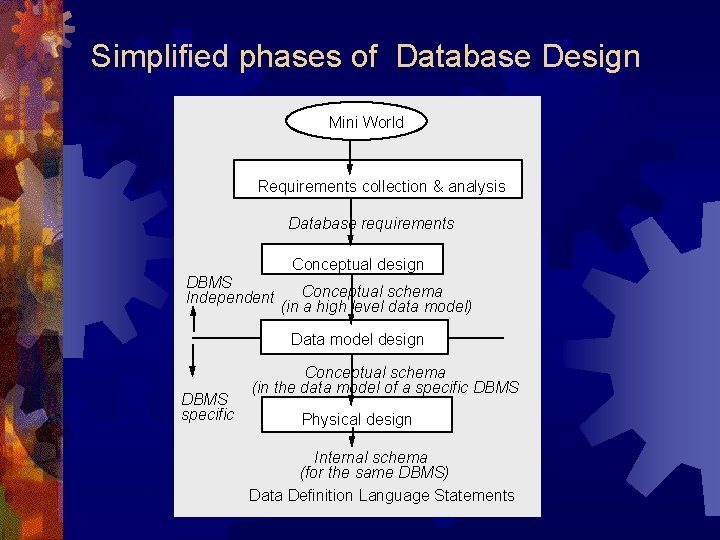
Simplified phases of Database Design Mini World Requirements collection & analysis Database requirements Conceptual design DBMS Independent Conceptual schema (in a high level data model) Data model design DBMS specific Conceptual schema (in the data model of a specific DBMS Physical design Internal schema (for the same DBMS) Data Definition Language Statements
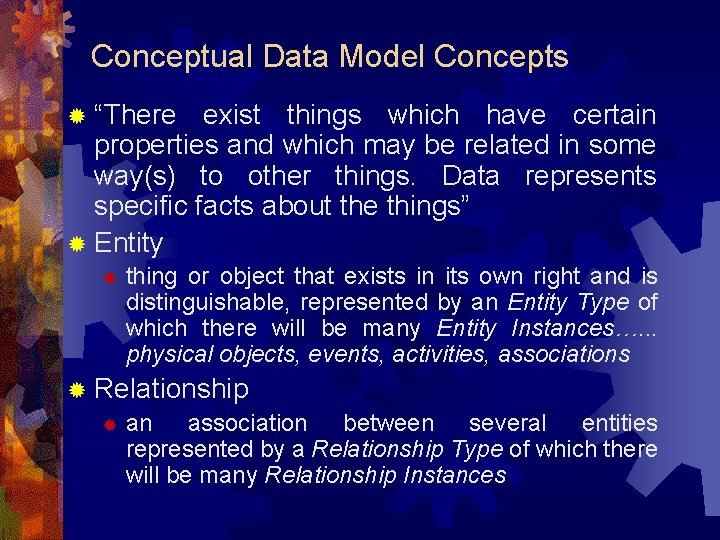
Conceptual Data Model Concepts ® “There exist things which have certain properties and which may be related in some way(s) to other things. Data represents specific facts about the things” ® Entity ® thing or object that exists in its own right and is distinguishable, represented by an Entity Type of which there will be many Entity Instances…. . . physical objects, events, activities, associations ® Relationship ® an association between several entities represented by a Relationship Type of which there will be many Relationship Instances
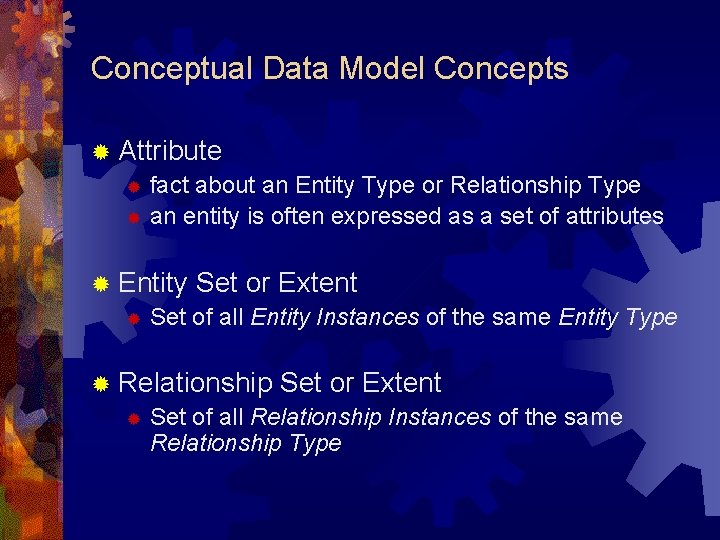
Conceptual Data Model Concepts ® Attribute ® fact about an Entity Type or Relationship Type ® an entity is often expressed as a set of attributes ® Entity Set or Extent ® Set of all Entity Instances of the same Entity Type ® Relationship Set or Extent ® Set of all Relationship Instances of the same Relationship Type
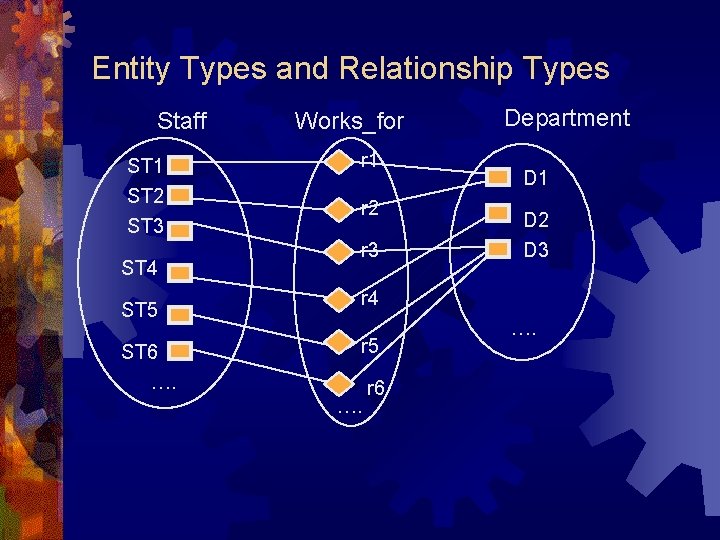
Entity Types and Relationship Types Staff ST 1 ST 2 ST 3 ST 4 ST 5 ST 6 …. Works_for r 1 r 2 r 3 Department D 1 D 2 D 3 r 4 r 5 …. r 6 ….
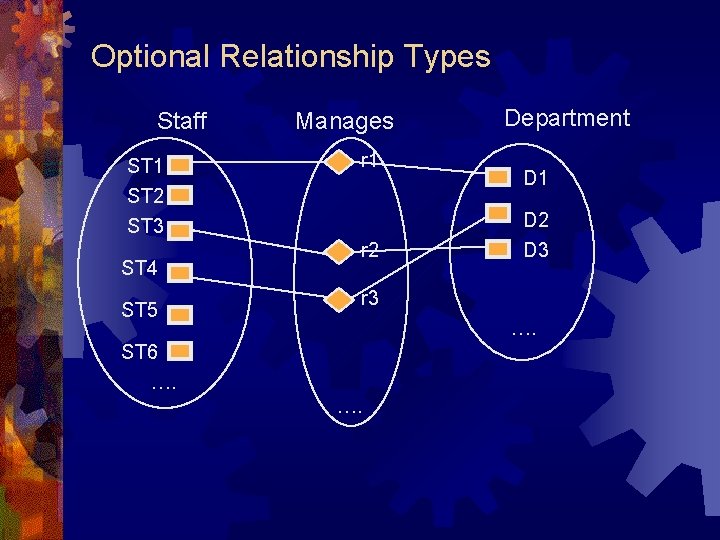
Optional Relationship Types Staff ST 1 ST 2 ST 3 ST 4 ST 5 Manages r 1 r 2 Department D 1 D 2 D 3 r 3 …. ST 6 …. ….
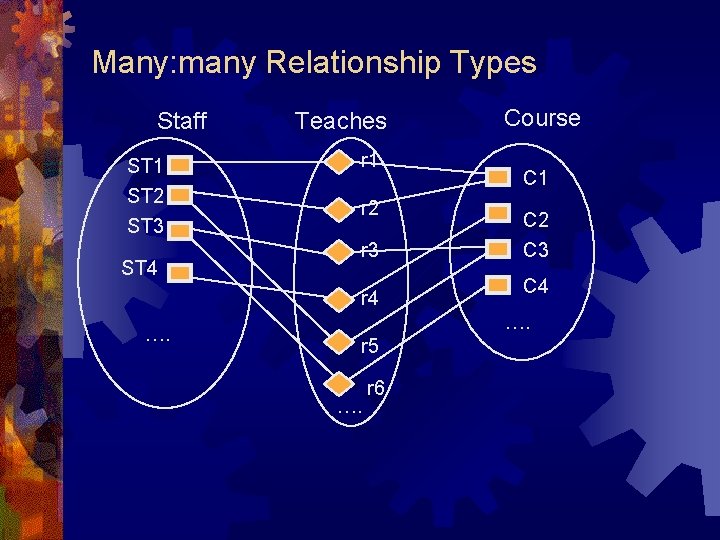
Many: many Relationship Types Staff ST 1 ST 2 ST 3 ST 4 Teaches r 1 r 2 r 3 r 4 …. Course C 1 C 2 C 3 C 4 …. r 5 …. r 6
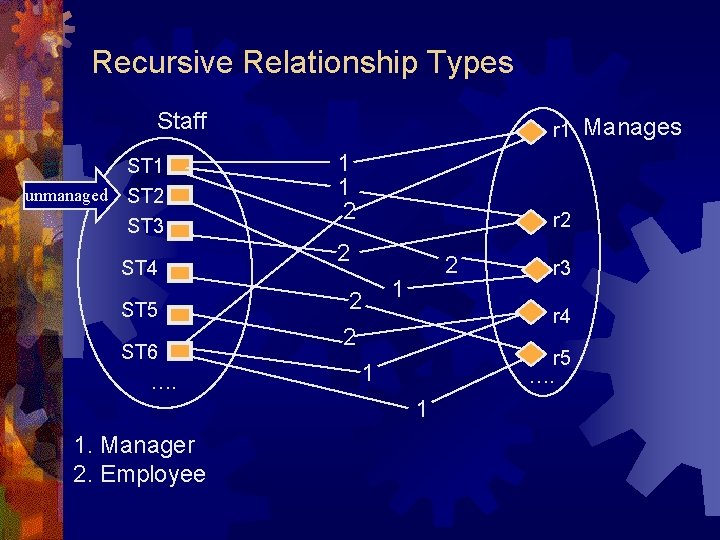
Recursive Relationship Types Staff ST 1 unmanaged ST 2 ST 3 ST 4 ST 5 ST 6 …. r 1 1 1 2 r 2 2 1 2 1 r 4 r 5 …. 1 1. Manager 2. Employee r 3 Manages
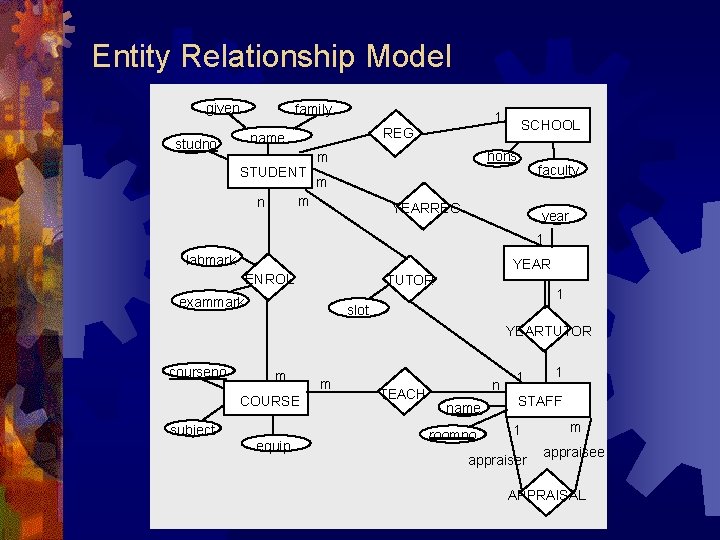
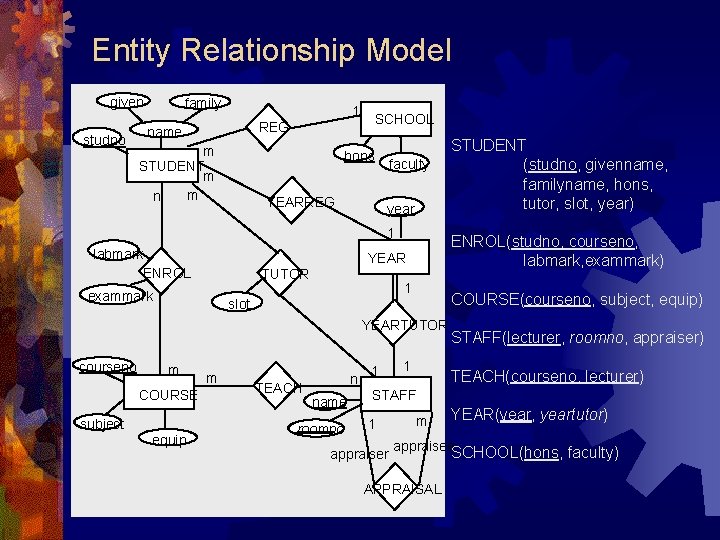
Entity Relationship Model given family 1 studno STUDENT hons m faculty m m n SCHOOL REG name YEARREG year 1 labmark YEAR ENROL TUTOR exammark 1 slot YEARTUTOR courseno m COURSE subject equip m TEACH n name roomno 1 1 STAFF 1 appraiser m appraisee APPRAISAL
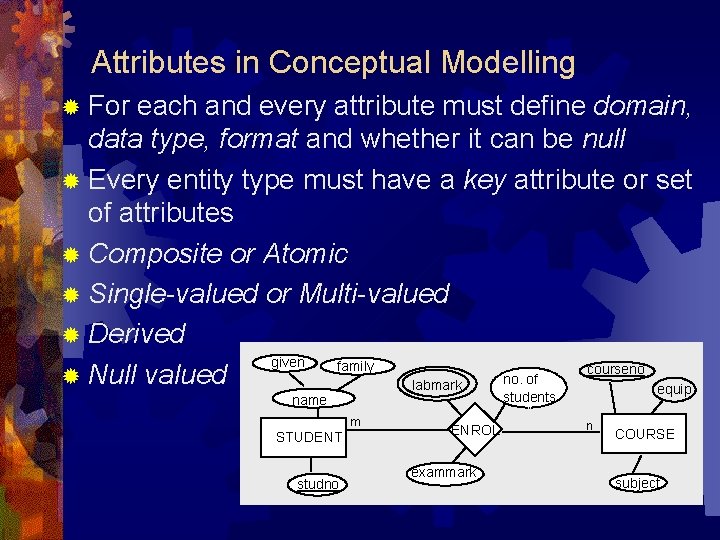
Attributes in Conceptual Modelling ® For each and every attribute must define domain, data type, format and whether it can be null ® Every entity type must have a key attribute or set of attributes ® Composite or Atomic ® Single-valued or Multi-valued ® Derived given family courseno ® Null valued no. of labmark equip students name m STUDENT studno ENROL exammark n COURSE subject
Properties of Relationship Types ® Degree ® The number of participating entity types ® Cardinality ratios ® The number of instances of each of the participating entity types which can partake in a single instance of the relationship type 1: 1, 1: many, many: 1, many: many ® Participation (optionality) ® The relationship instance doesn’t have to exist ® Whether an entity instance has to participate in a relationship instance ® Role ® The function that a particular entity type plays in a relationship type
Semantic Data Models Extended-Entity-Relationship Modelling Entity Attribute Relationship Modelling Entity Relationship Attribute Modelling Entity Modelling Object Modelling IFO, NIAM etc. … Extensions for temporal, constraints, rules etc Chen 1976 Entity Relationship Modelling
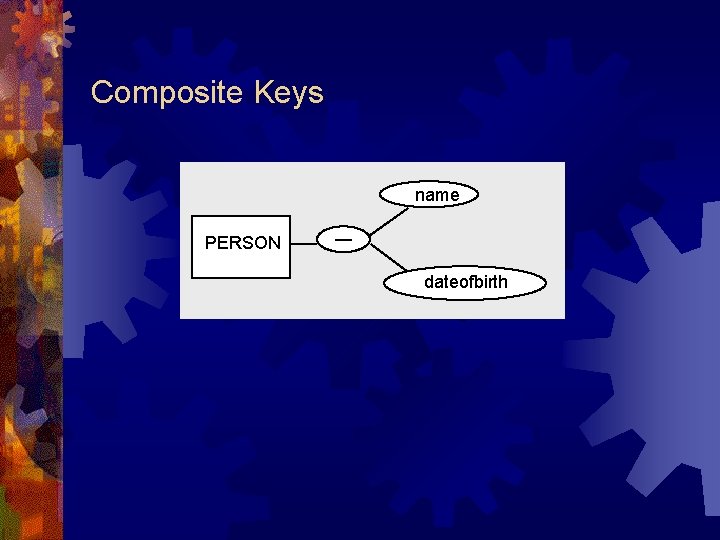
Composite Keys name PERSON dateofbirth
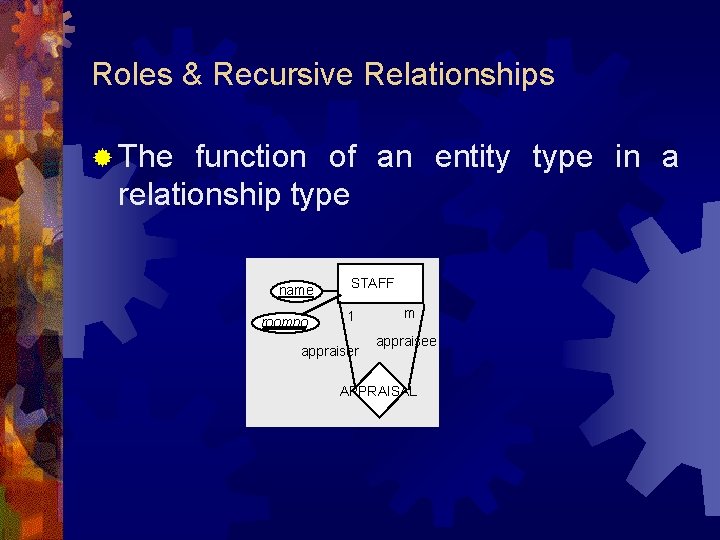
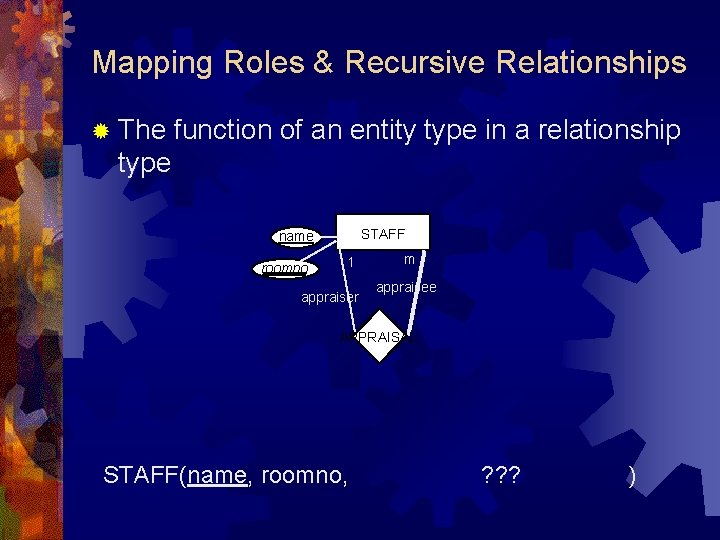
Roles & Recursive Relationships ® The function of an entity type in a relationship type name roomno STAFF 1 appraiser m appraisee APPRAISAL
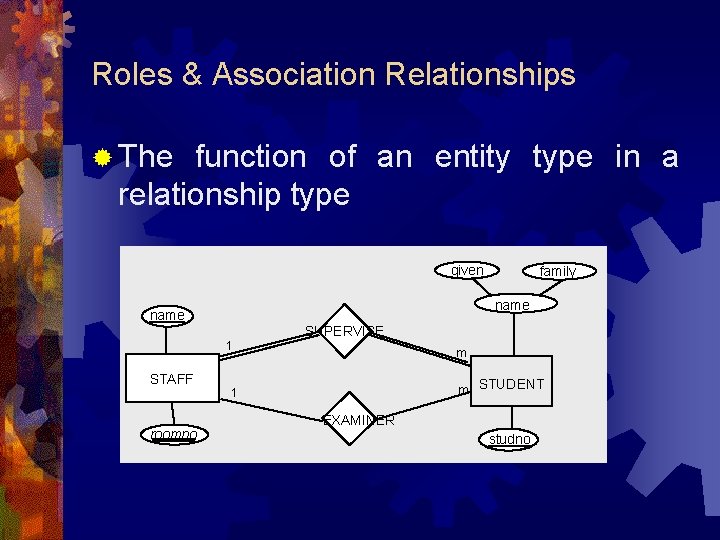
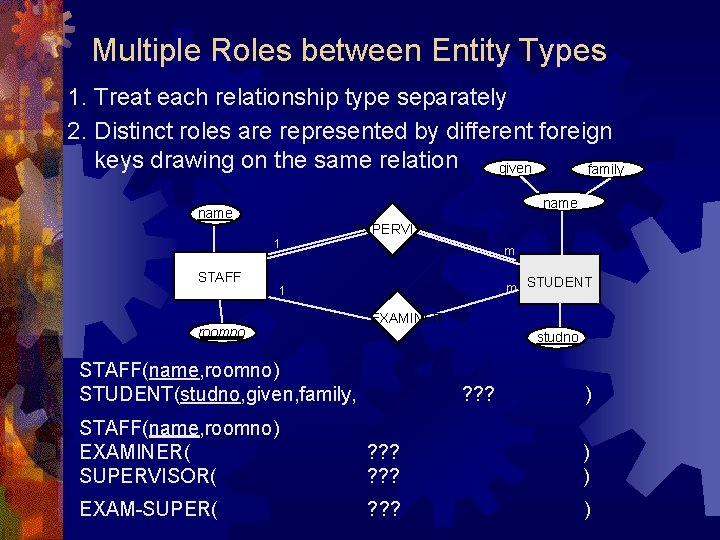
Roles & Association Relationships ® The function of an entity type in a relationship type given family name SUPERVISE 1 STAFF roomno m m STUDENT 1 EXAMINER studno
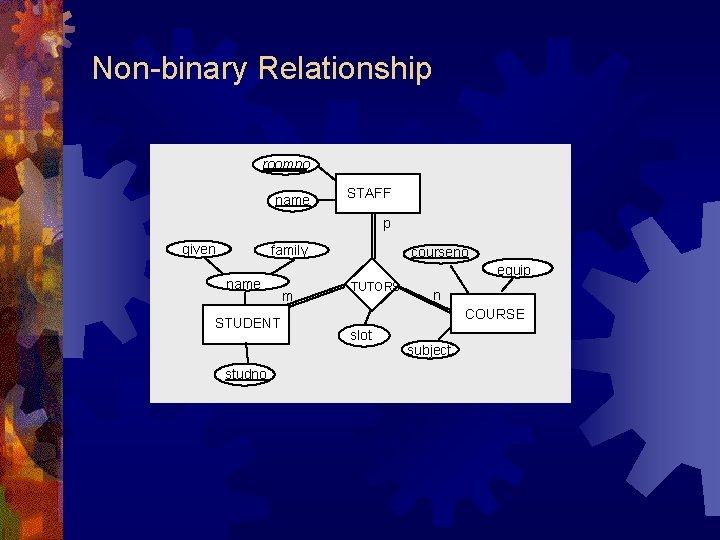
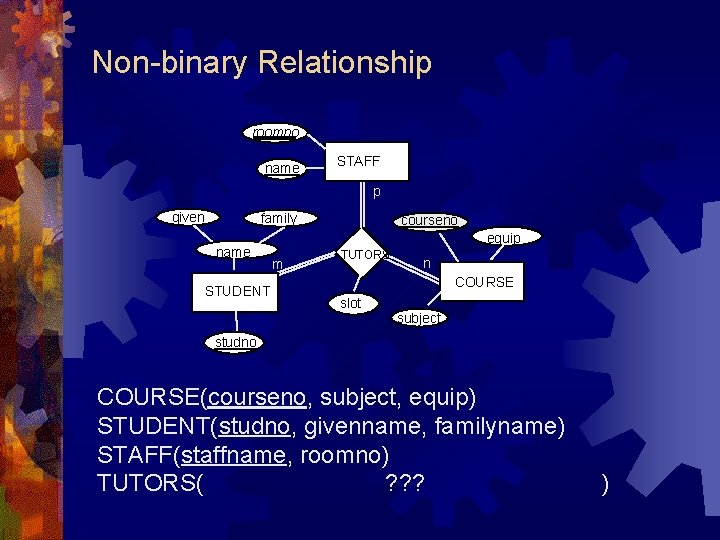
Non-binary Relationship roomno name STAFF p given family name STUDENT studno courseno equip m TUTORS n COURSE slot subject
Entity Relationship Model given studno family 1 REG name m STUDENT m m n SCHOOL hons YEARREG faculty year 1 labmark ENROL(studno, courseno, labmark, exammark) YEAR TUTOR exammark 1 slot COURSE(courseno, subject, equip) YEARTUTOR courseno m COURSE subject equip m TEACH n name roomno 1 STUDENT (studno, givenname, familyname, hons, tutor, slot, year) 1 STAFF(lecturer, roomno, appraiser) TEACH(courseno, lecturer) STAFF 1 appraiser m YEAR(year, yeartutor) appraisee APPRAISAL SCHOOL(hons, faculty)
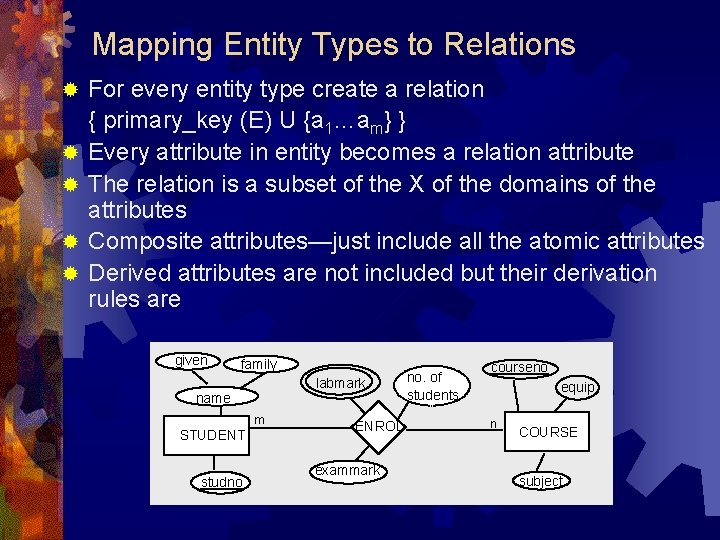
Mapping Entity Types to Relations ® ® ® For every entity type create a relation { primary_key (E) U {a 1…am} } Every attribute in entity becomes a relation attribute The relation is a subset of the X of the domains of the attributes Composite attributes—just include all the atomic attributes Derived attributes are not included but their derivation rules are given family labmark name m STUDENT studno ENROL exammark no. of students courseno equip n COURSE subject
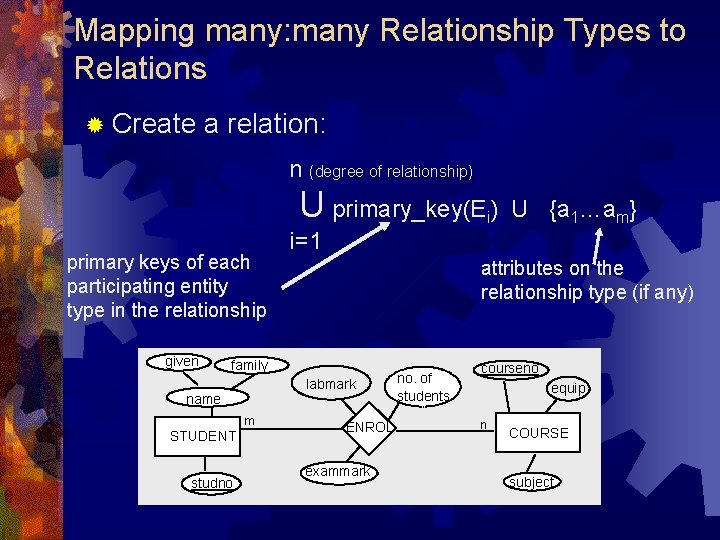
Mapping many: many Relationship Types to Relations ® Create a relation: n (degree of relationship) U primary_key(Ei) primary keys of each participating entity type in the relationship given i=1 attributes on the relationship type (if any) family labmark name m STUDENT studno U {a 1…am} ENROL exammark no. of students courseno equip n COURSE subject
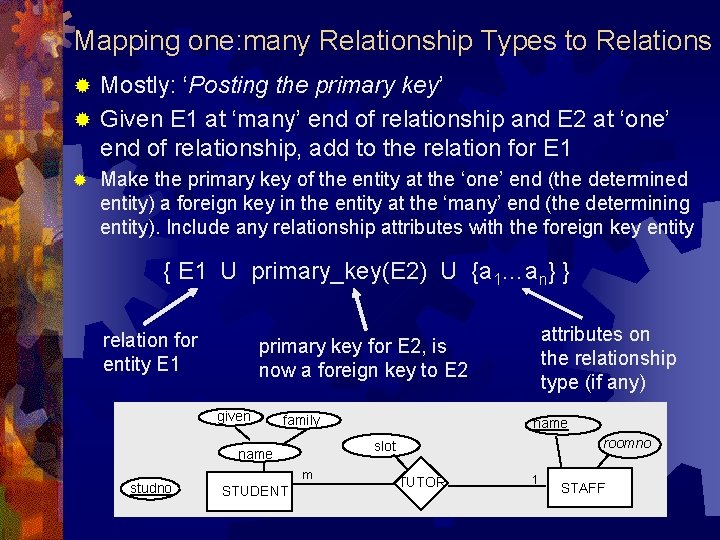
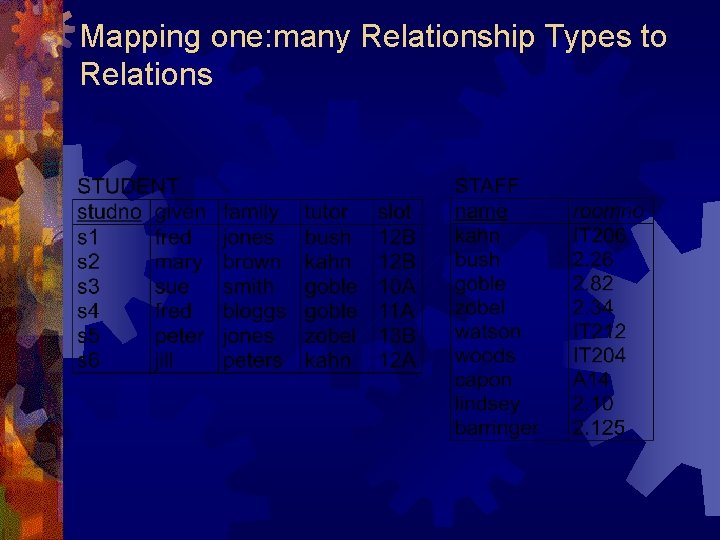
Mapping one: many Relationship Types to Relations Mostly: ‘Posting the primary key’ ® Given E 1 at ‘many’ end of relationship and E 2 at ‘one’ end of relationship, add to the relation for E 1 ® ® Make the primary key of the entity at the ‘one’ end (the determined entity) a foreign key in the entity at the ‘many’ end (the determining entity). Include any relationship attributes with the foreign key entity { E 1 U primary_key(E 2) U {a 1…an} } relation for entity E 1 given family m STUDENT name roomno slot name studno attributes on the relationship type (if any) primary key for E 2, is now a foreign key to E 2 TUTOR 1 STAFF
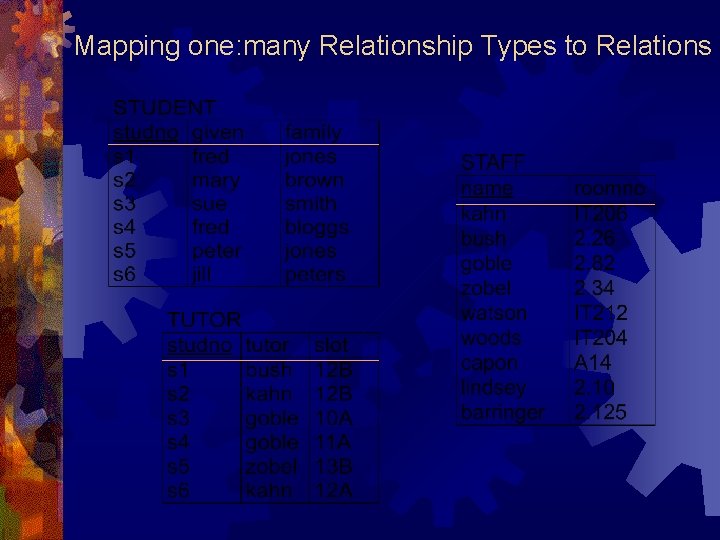
Mapping one: many Relationship Types to Relations
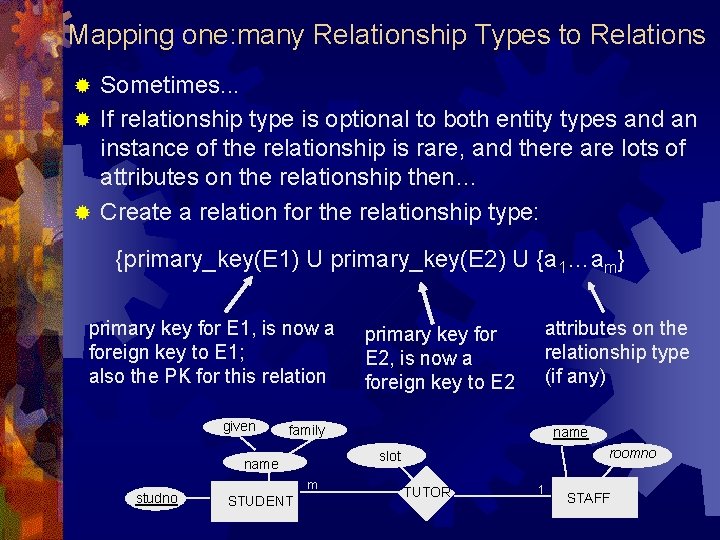
Mapping one: many Relationship Types to Relations Sometimes. . . ® If relationship type is optional to both entity types and an instance of the relationship is rare, and there are lots of attributes on the relationship then… ® Create a relation for the relationship type: ® {primary_key(E 1) U primary_key(E 2) U {a 1…am} primary key for E 1, is now a foreign key to E 1; also the PK for this relation given family m STUDENT name roomno slot name studno attributes on the relationship type (if any) primary key for E 2, is now a foreign key to E 2 TUTOR 1 STAFF
Mapping one: many Relationship Types to Relations
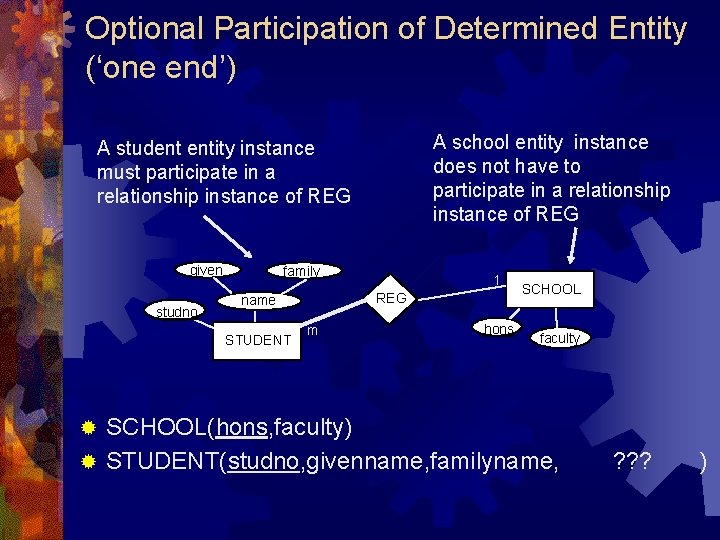
Optional Participation of Determined Entity (‘one end’) A school entity instance does not have to participate in a relationship instance of REG A student entity instance must participate in a relationship instance of REG given studno family REG name STUDENT 1 m hons SCHOOL faculty SCHOOL(hons, faculty) ® STUDENT(studno, givenname, familyname, ® ? ? ? )
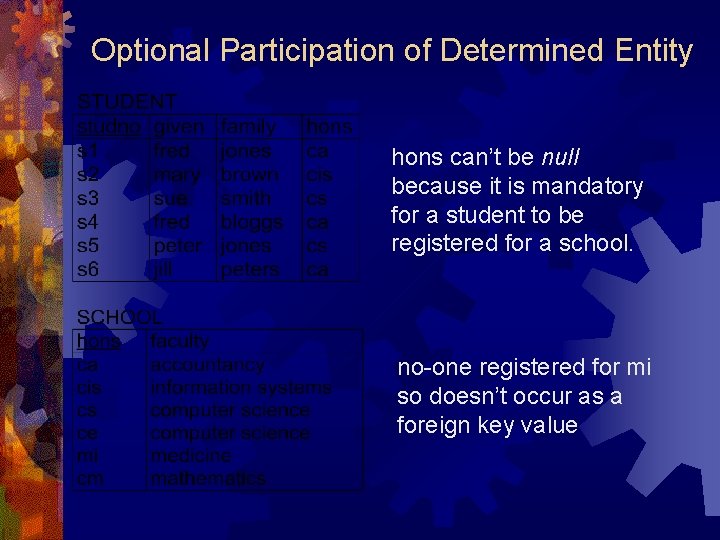
Optional Participation of Determined Entity hons can’t be null because it is mandatory for a student to be registered for a school. no-one registered for mi so doesn’t occur as a foreign key value
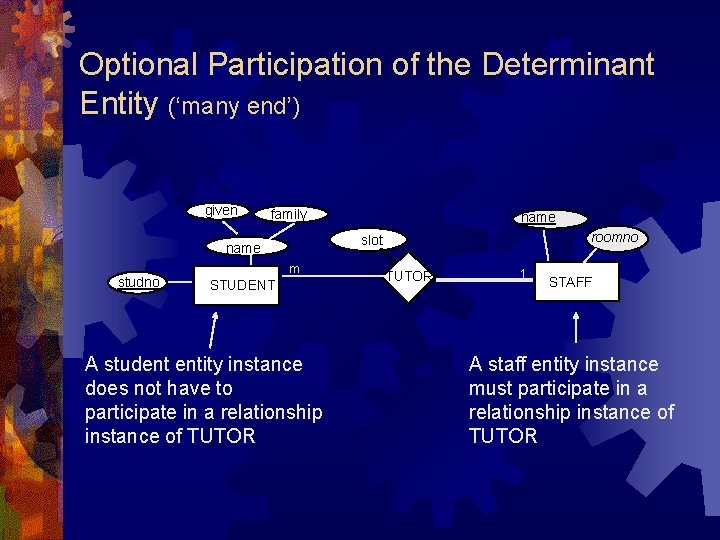
Optional Participation of the Determinant Entity (‘many end’) given family roomno slot name studno name m STUDENT A student entity instance does not have to participate in a relationship instance of TUTOR 1 STAFF A staff entity instance must participate in a relationship instance of TUTOR
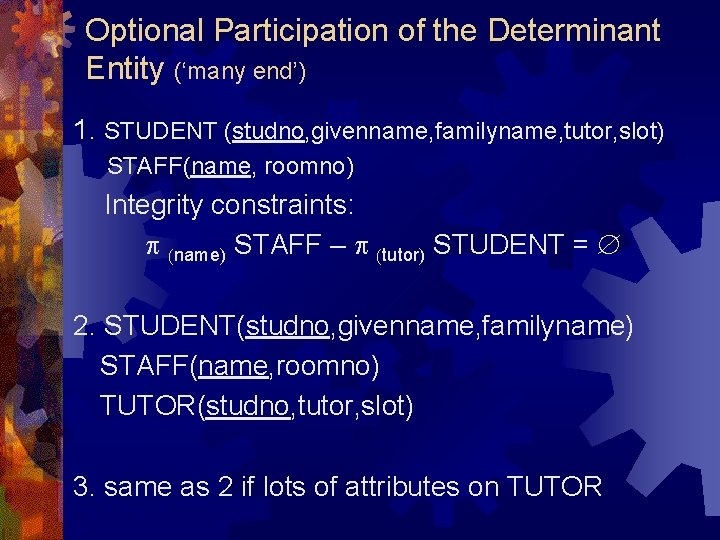
Optional Participation of the Determinant Entity (‘many end’) 1. STUDENT (studno, givenname, familyname, tutor, slot) STAFF(name, roomno) Integrity constraints: p (name) STAFF – p (tutor) STUDENT = 2. STUDENT(studno, givenname, familyname) STAFF(name, roomno) TUTOR(studno, tutor, slot) 3. same as 2 if lots of attributes on TUTOR
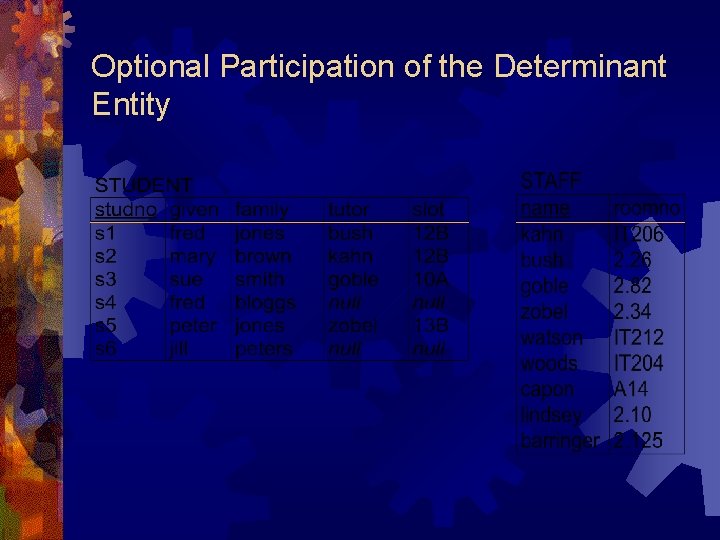
Optional Participation of the Determinant Entity
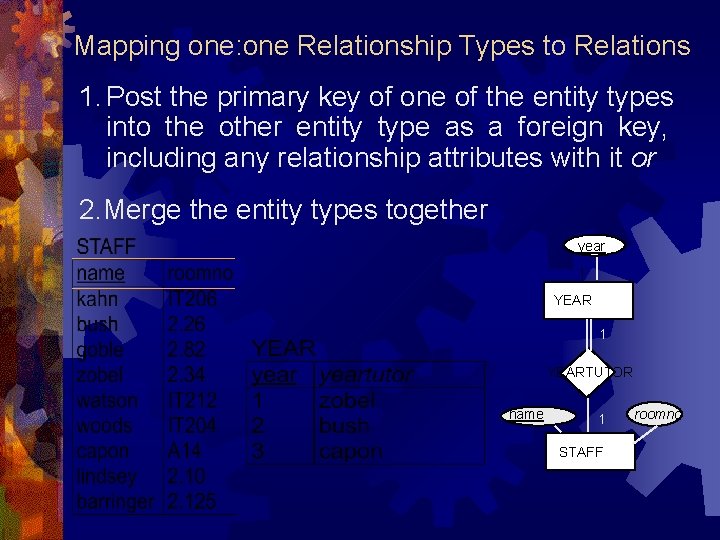
Mapping one: one Relationship Types to Relations 1. Post the primary key of one of the entity types into the other entity type as a foreign key, including any relationship attributes with it or 2. Merge the entity types together year 1 YEARTUTOR name 1 STAFF roomno
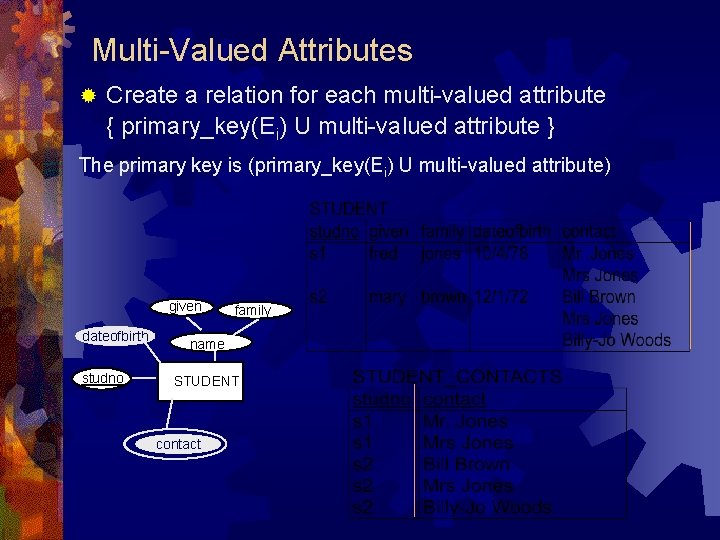
Multi-Valued Attributes ® Create a relation for each multi-valued attribute { primary_key(Ei) U multi-valued attribute } The primary key is (primary_key(Ei) U multi-valued attribute) given dateofbirth studno family name STUDENT contact
Mapping Roles & Recursive Relationships ® The function of an entity type in a relationship type STAFF name roomno 1 appraiser m appraisee APPRAISAL STAFF(name, roomno, ? ? ? )
Multiple Roles between Entity Types 1. Treat each relationship type separately 2. Distinct roles are represented by different foreign keys drawing on the same relation given family name SUPERVISE 1 STAFF m m STUDENT 1 roomno EXAMINER studno STAFF(name, roomno) STUDENT(studno, given, family, ? ? ? ) STAFF(name, roomno) EXAMINER( SUPERVISOR( ? ? ? ) ) EXAM-SUPER( ? ? ? )
Non-binary Relationship roomno name STAFF p given family name STUDENT courseno equip m TUTORS n COURSE slot subject studno COURSE(courseno, subject, equip) STUDENT(studno, givenname, familyname) STAFF(staffname, roomno) TUTORS( ? ? ? )
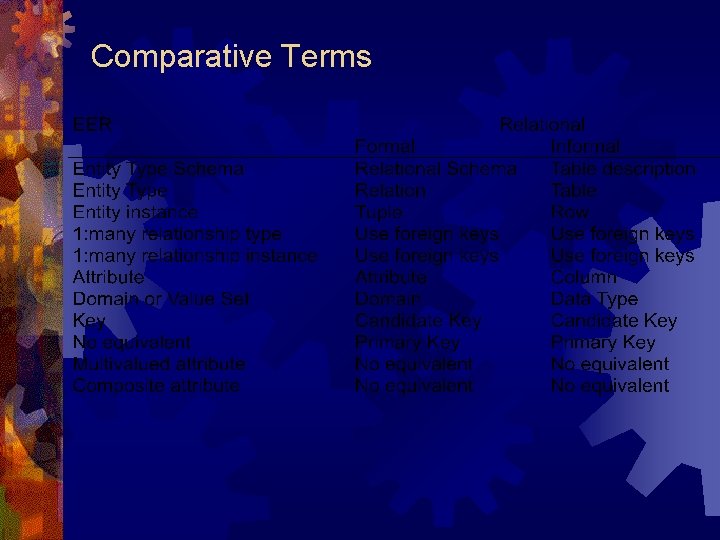
Comparative Terms
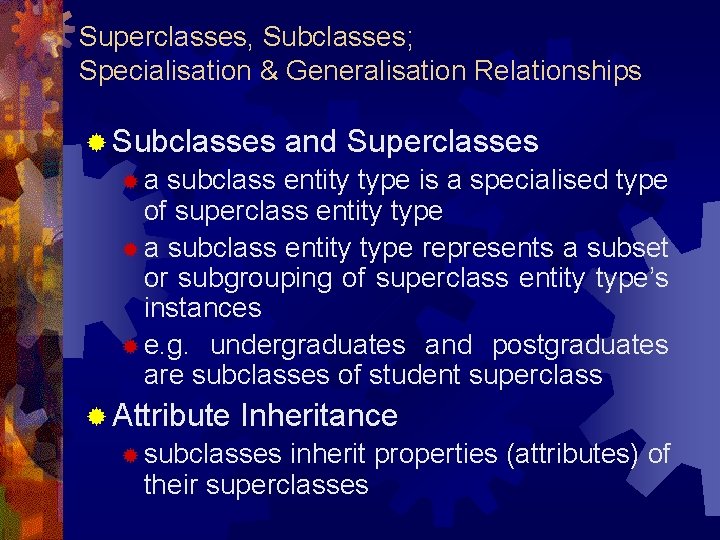
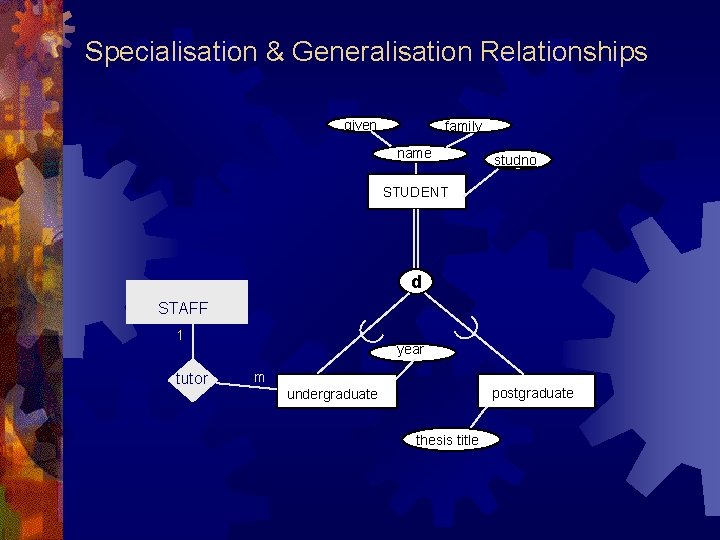
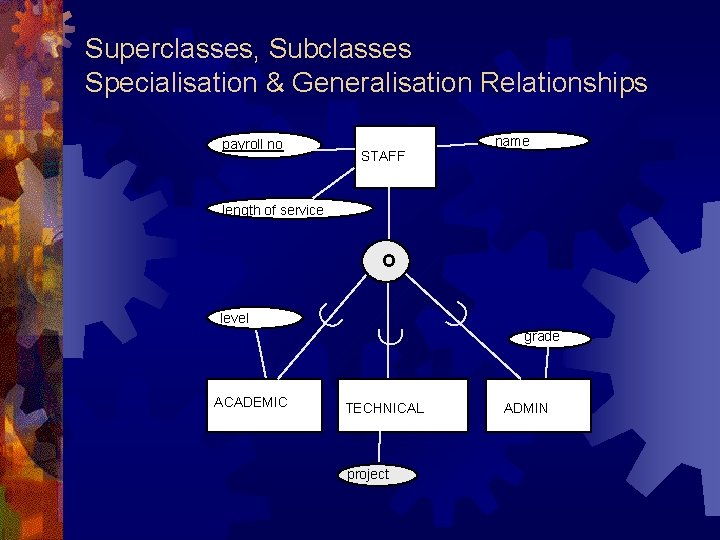
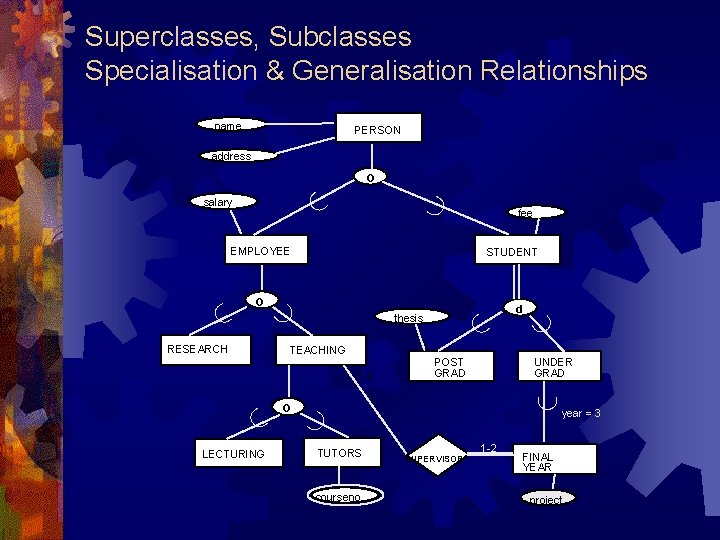
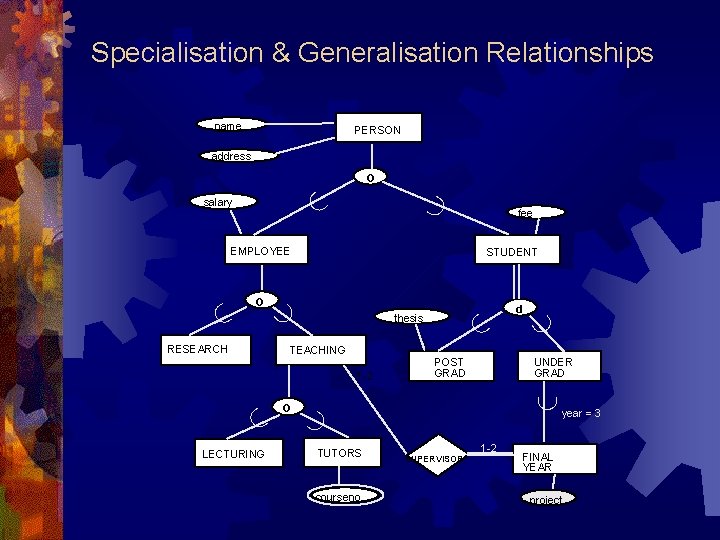
Superclasses, Subclasses; Specialisation & Generalisation Relationships ® Subclasses and Superclasses ®a subclass entity type is a specialised type of superclass entity type ® a subclass entity type represents a subset or subgrouping of superclass entity type’s instances ® e. g. undergraduates and postgraduates are subclasses of student superclass ® Attribute Inheritance ® subclasses inherit properties (attributes) of their superclasses
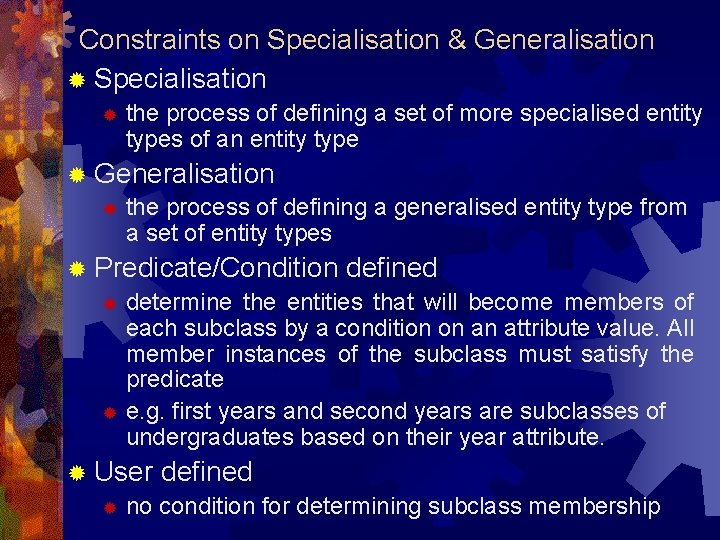
Constraints on Specialisation & Generalisation ® Specialisation ® the process of defining a set of more specialised entity types of an entity type ® Generalisation ® the process of defining a generalised entity type from a set of entity types ® Predicate/Condition defined ® determine the entities that will become members of each subclass by a condition on an attribute value. All member instances of the subclass must satisfy the predicate ® e. g. first years and second years are subclasses of undergraduates based on their year attribute. ® User defined ® no condition for determining subclass membership
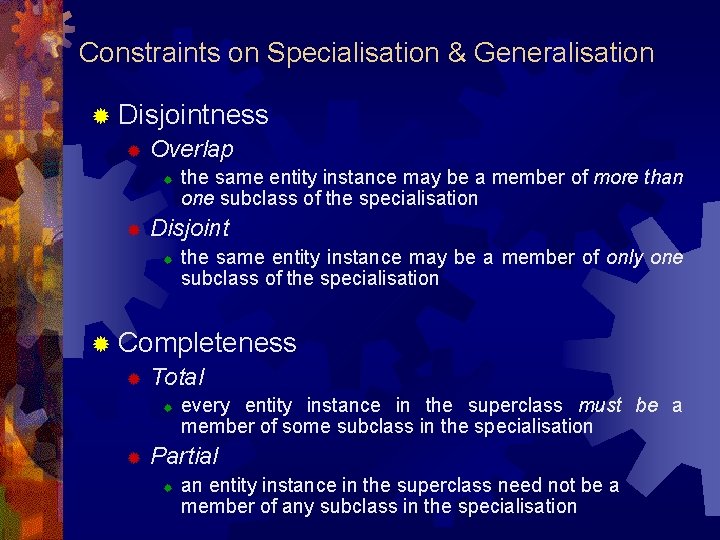
Constraints on Specialisation & Generalisation ® Disjointness ® Overlap ® ® the same entity instance may be a member of more than one subclass of the specialisation Disjoint ® the same entity instance may be a member of only one subclass of the specialisation ® Completeness ® Total ® ® every entity instance in the superclass must be a member of some subclass in the specialisation Partial ® an entity instance in the superclass need not be a member of any subclass in the specialisation
Specialisation & Generalisation Relationships given family name studno STUDENT d tutor m 1 year STAFF postgraduate undergraduate thesis title
Superclasses, Subclasses Specialisation & Generalisation Relationships payroll no name STAFF length of service ACADEMIC TECHNICAL project level O grade ADMIN
Superclasses, Subclasses Specialisation & Generalisation Relationships name PERSON address RESEARCH thesis O STUDENT d TEACHING LECTURING O UNDER GRAD 1 -2 POST GRAD EMPLOYEE fee salary O TUTORS courseno SUPERVISOR 1 -2 year = 3 FINAL YEAR project
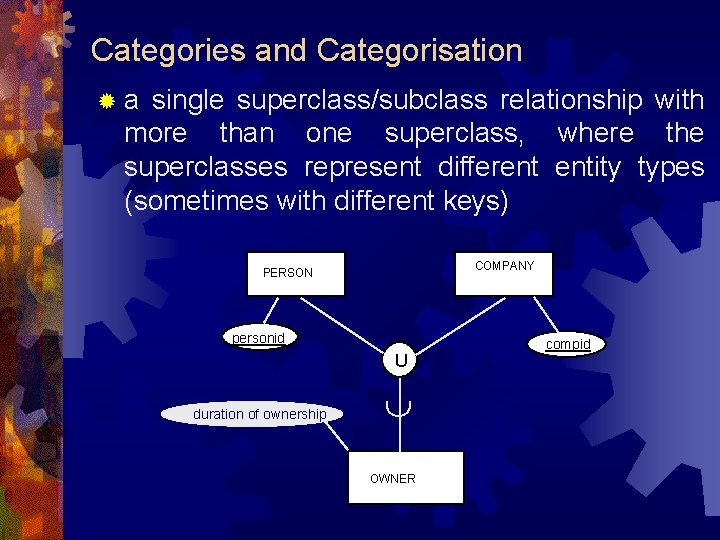
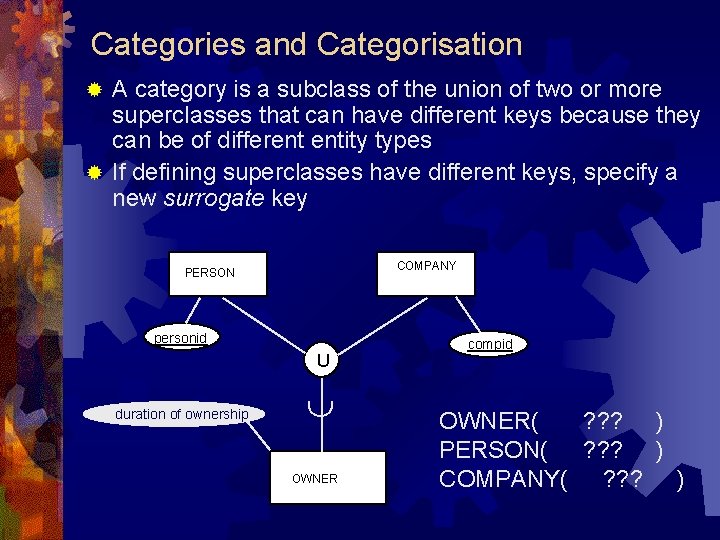
Categories and Categorisation ®a single superclass/subclass relationship with more than one superclass, where the superclasses represent different entity types (sometimes with different keys) COMPANY PERSON personid U duration of ownership OWNER compid
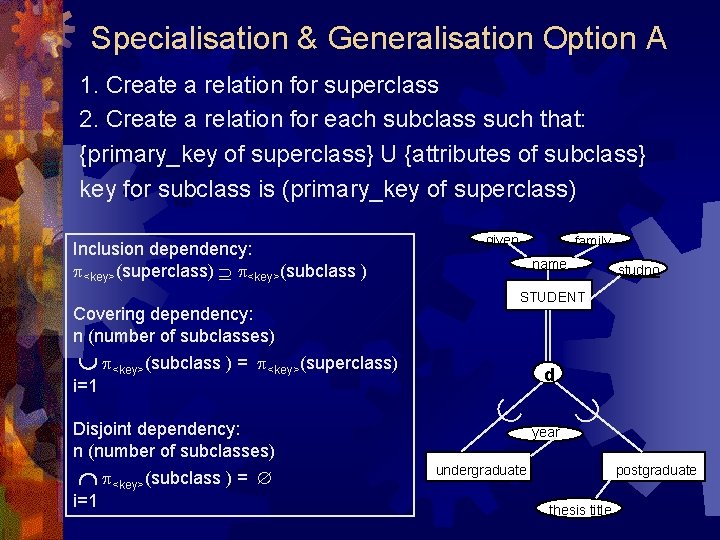
Specialisation & Generalisation Option A 1. Create a relation for superclass 2. Create a relation for each subclass such that: {primary_key of superclass} U {attributes of subclass} key for subclass is (primary_key of superclass) Covering dependency: n (number of subclasses) i=1 name studno STUDENT p<key>(superclass) Disjoint dependency: n (number of subclasses) p<key>(subclass ) = family d p<key>(subclass ) = given year Inclusion dependency: p<key>(superclass) p<key>(subclass ) postgraduate undergraduate thesis title
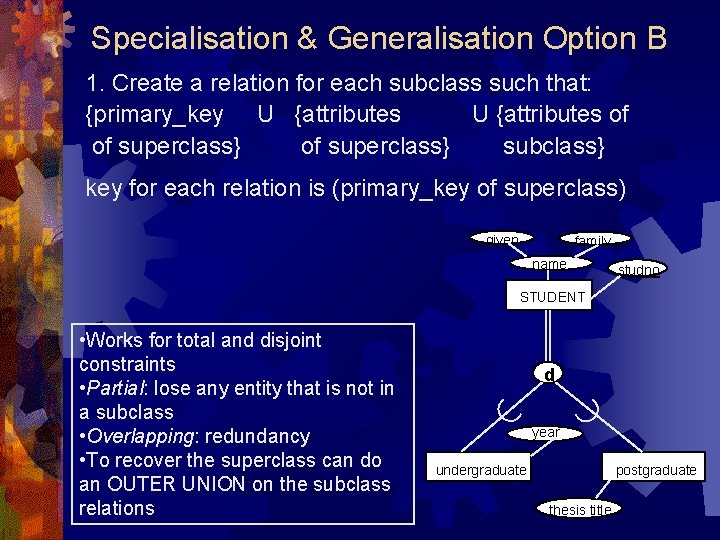
Specialisation & Generalisation Option B 1. Create a relation for each subclass such that: {primary_key U {attributes of of superclass} subclass} key for each relation is (primary_key of superclass) given family name studno STUDENT d year • Works for total and disjoint constraints • Partial: lose any entity that is not in a subclass • Overlapping: redundancy • To recover the superclass can do an OUTER UNION on the subclass relations postgraduate undergraduate thesis title
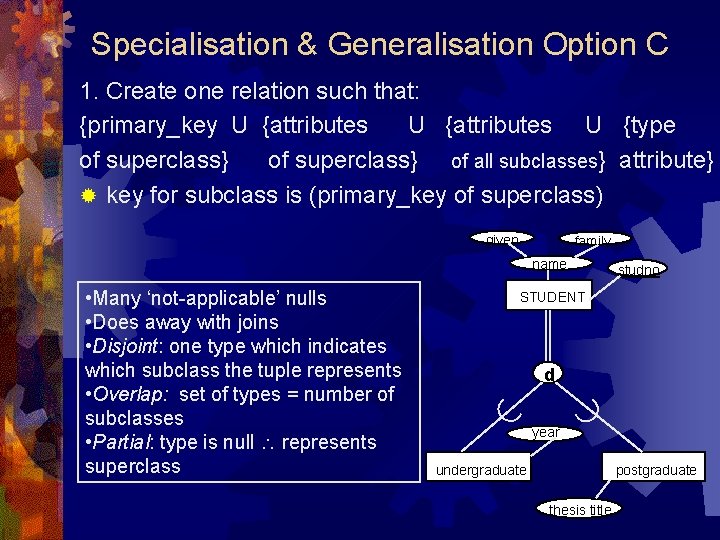
Specialisation & Generalisation Option C 1. Create one relation such that: {primary_key U {attributes U {type of superclass} of all subclasses} attribute} ® key for subclass is (primary_key of superclass) given family name STUDENT d year • Many ‘not-applicable’ nulls • Does away with joins • Disjoint: one type which indicates which subclass the tuple represents • Overlap: set of types = number of subclasses • Partial: type is null represents superclass studno postgraduate undergraduate thesis title
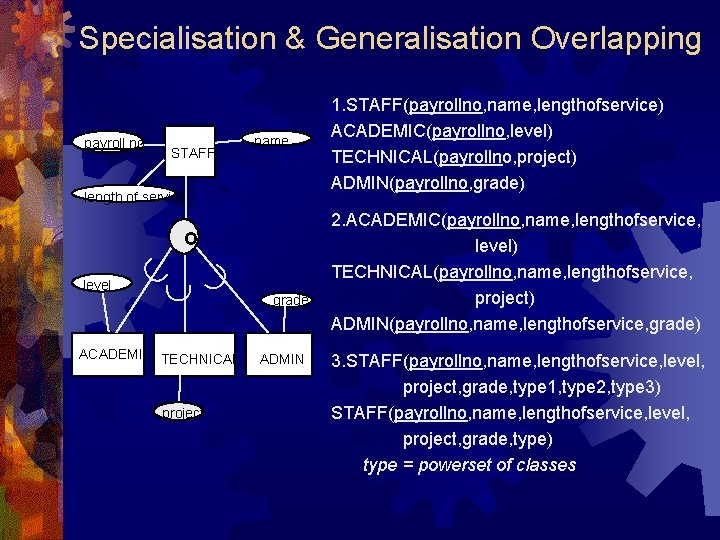
Specialisation & Generalisation Overlapping payroll no STAFF name length of service level O ACADEMIC TECHNICAL project grade ADMIN 1. STAFF(payrollno, name, lengthofservice) ACADEMIC(payrollno, level) TECHNICAL(payrollno, project) ADMIN(payrollno, grade) 2. ACADEMIC(payrollno, name, lengthofservice, level) TECHNICAL(payrollno, name, lengthofservice, project) ADMIN(payrollno, name, lengthofservice, grade) 3. STAFF(payrollno, name, lengthofservice, level, project, grade, type 1, type 2, type 3) STAFF(payrollno, name, lengthofservice, level, project, grade, type) type = powerset of classes
Specialisation & Generalisation Relationships name PERSON address RESEARCH thesis O STUDENT d TEACHING LECTURING O UNDER GRAD 1 -2 POST GRAD EMPLOYEE fee salary O TUTORS courseno SUPERVISOR 1 -2 year = 3 FINAL YEAR project
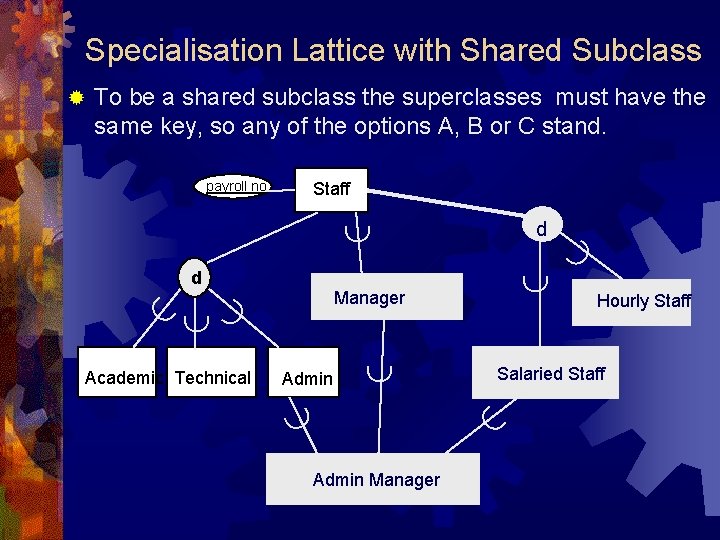
Specialisation Lattice with Shared Subclass To be a shared subclass the superclasses must have the same key, so any of the options A, B or C stand. Staff payroll no Admin Manager Hourly Staff Salaried Staff Admin Manager Academic Technical d d ®
Categories and Categorisation A category is a subclass of the union of two or more superclasses that can have different keys because they can be of different entity types ® If defining superclasses have different keys, specify a new surrogate key ® COMPANY PERSON personid U duration of ownership OWNER compid OWNER( ? ? ? ) PERSON( ? ? ? ) COMPANY( ? ? ? )
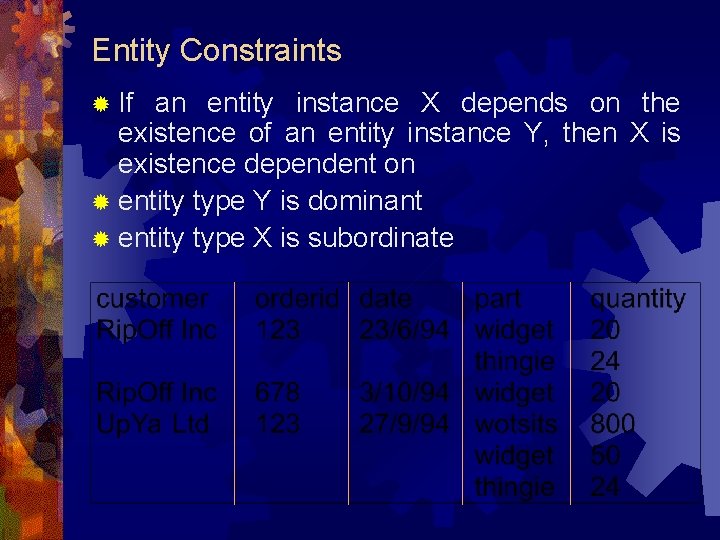
Entity Constraints ® If an entity instance X depends on the existence of an entity instance Y, then X is existence dependent on ® entity type Y is dominant ® entity type X is subordinate
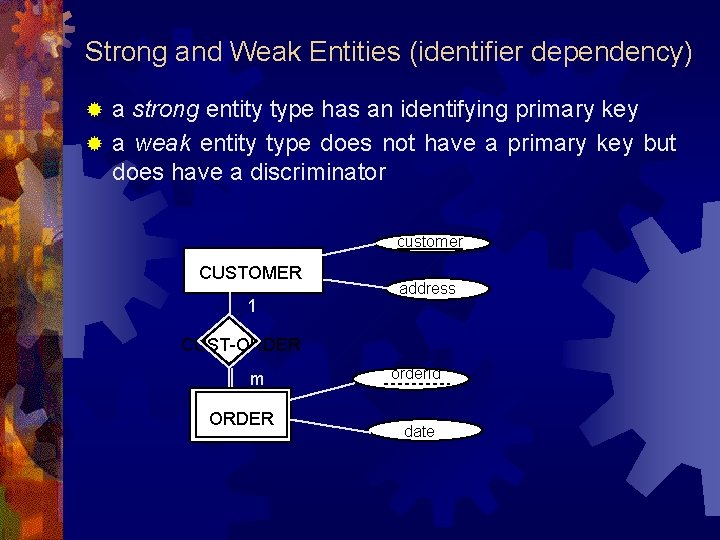
Strong and Weak Entities (identifier dependency) a strong entity type has an identifying primary key ® a weak entity type does not have a primary key but does have a discriminator ® customer CUSTOMER 1 address CUST-ORDER m ORDER orderid date
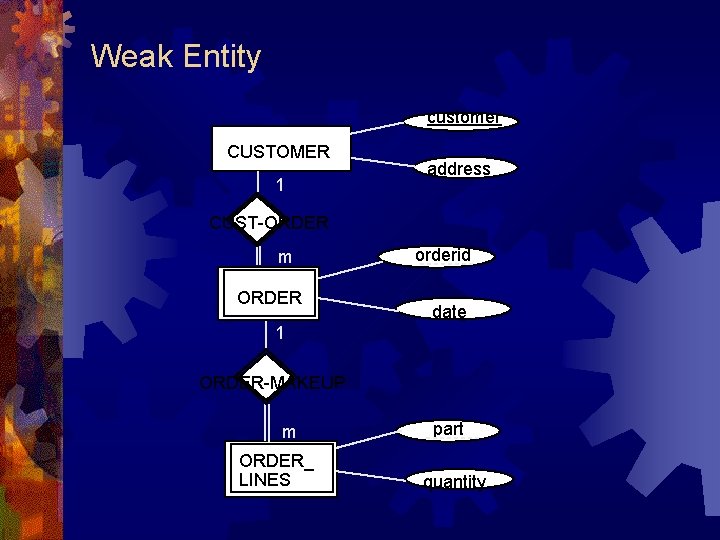
Weak Entity customer CUSTOMER 1 address CUST-ORDER m ORDER orderid date 1 ORDER-MAKEUP m ORDER_ ORDER LINES part quantity
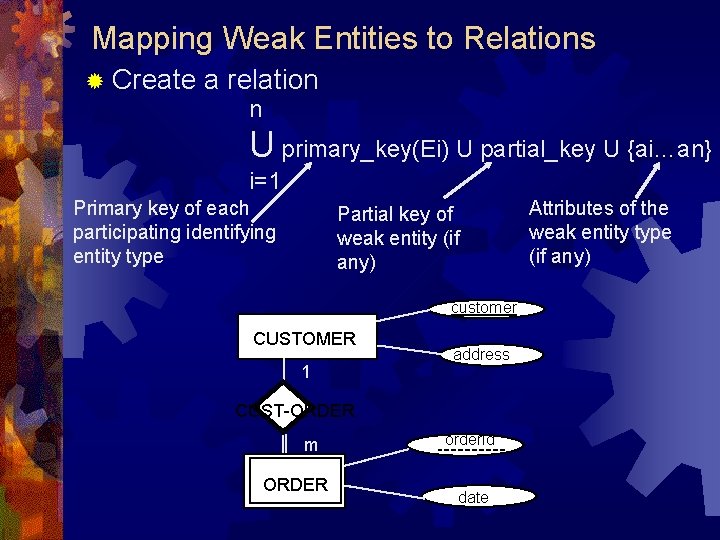
Mapping Weak Entities to Relations ® Create a relation n U primary_key(Ei) U partial_key U {ai…an} i=1 Primary key of each participating identifying entity type Partial key of weak entity (if any) customer CUSTOMER 1 address CUST-ORDER m ORDER orderid date Attributes of the weak entity type (if any)
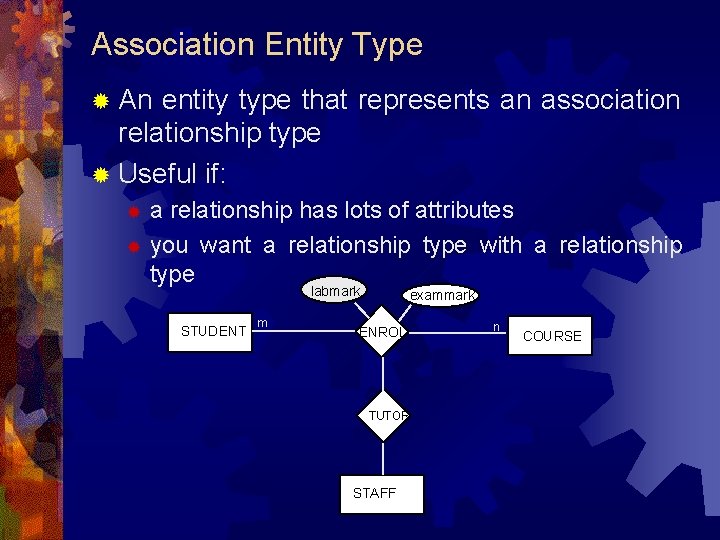
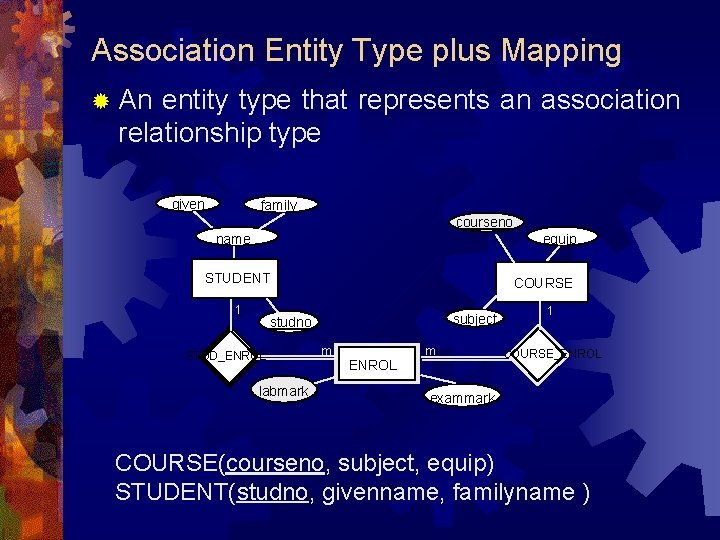
Association Entity Type ® An entity type that represents an association relationship type ® Useful if: a relationship has lots of attributes ® you want a relationship type with a relationship type ® labmark STUDENT m exammark ENROL TUTOR STAFF n COURSE
Association Entity Type plus Mapping ® An entity type that represents an association relationship type given family courseno name equip m STUDENT 1 COURSE subject studno STUD_ENROL labmark m ENROL m 1 COURSE_ENROL exammark COURSE(courseno, subject, equip) STUDENT(studno, givenname, familyname )
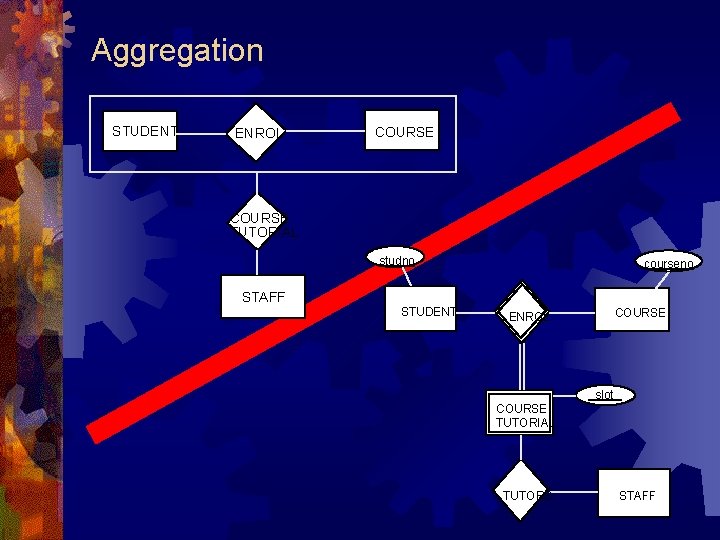
Aggregation ® Aggregation is an abstraction concept for building composite entities from their components 1. aggregate attribute values to form a whole entity 2. combining entities that are related by an association relationship into higher-level aggregate entity ® IS-A-PART-OF ® IS-A-COMPONENT-OF ® Sadly, not catered for in EER modelling.
Aggregation STUDENT ENROL COURSE TUTORIAL studno STAFF STUDENT courseno COURSE ENROL slot COURSE TUTORIAL TUTORS STAFF
Hints for EER Modelling ® ® ® ® identify entity types by searching for nouns and noun phrases assume all entities are strong and check for weak ones on a later pass need an identifier for each strong entity assume all relationships are partial participation (optional) and check for total (mandatory) ones on a later pass expect to keep changing your mind about whether things are entities, relationships or attributes keep level of detail relevant and consistent (for example leave out attributes at first) approach diagram through different views and merge them
Lets Practice! A record company wishes to use a computer database to help with its operations regarding its performers, recordings and song catalogue. ® Songs have a unique song number, a non-unique title and a composition date. A song can be written by a number of composers; the composer’s full name is required. Songs are recorded by recording artists (bands or solo performers). A song is recorded as a track of a CD. A CD has many songs on it, called tracks. CDs have a unique record catalogue number, a title and must have a producer (the full name of the producer is required). Each track must have the recording date and the track number of the CD. ® A song can appear on many (or no) CDs, and be recorded by many different recording artists. The same recording artist might re-record the same song on different CDs. A CD must have only 1 recording artist appearing on it. CDs can be released a number of times, and each time the release date and associated number of sales is required. ®