
extend previous knowledge of sets and subsets using
extend previous knowledge of sets and subsets using a visual representation to describe relationships between sets of rational numbers. [7. 2 A] October 2014 Math Grade PAP 7 th
![add, subtract, multiply, and divide rational numbers fluently. [7. 3 A] October 2014 Math](http://slidetodoc.com/presentation_image_h/2ad070a90dceb838abec8f70af6f295c/image-2.jpg "add, subtract, multiply, and divide rational numbers fluently. [7. 3 A] October 2014 Math")
add, subtract, multiply, and divide rational numbers fluently. [7. 3 A] October 2014 Math Grade PAP 7 th
apply and extend previous understandings of operations to solve problems using addition, subtraction, multiplication, and division of rational numbers. [7. 3 B] October 2014 Math Grade PAP 7 th
represent constant rates of change in mathematical and real-world problems given pictorial, tabular, verbal, numeric, graphical, and algebraic representations, including d = rt. [7. 4 A] October 2014 Math Grade PAP 7 th
![calculate unit rates from rates in mathematical and real-world problems. [7. 4 B] October](http://slidetodoc.com/presentation_image_h/2ad070a90dceb838abec8f70af6f295c/image-5.jpg "calculate unit rates from rates in mathematical and real-world problems. [7. 4 B] October")
calculate unit rates from rates in mathematical and real-world problems. [7. 4 B] October 2014 Math Grade PAP 7 th
determine the constant of proportionality (k = y / x) within mathematical and real-world problems. [7. 4 C] October 2014 Math Grade PAP 7 th

solve problems involving ratios, rates, and percents, including multi-step problems involving percent increase and percent decrease, and financial literacy problems. [7. 4 D] October 2014 Math Grade PAP 7 th
convert between measurement systems, including the use of proportions and the use of unit rates. [7. 4 E] October 2014 Math Grade PAP 7 th
generalize the critical attributes of similarity, including ratios within and between similar shapes. [7. 5 A] October 2014 Math Grade PAP 7 th
describe π as the ratio of the circumference of a circle to its diameter. [7. 5 B] October 2014 Math Grade PAP 7 th
![solve mathematical and real-world problems involving similar shape and scale drawings. [7. 5 C]](http://slidetodoc.com/presentation_image_h/2ad070a90dceb838abec8f70af6f295c/image-11.jpg "solve mathematical and real-world problems involving similar shape and scale drawings. [7. 5 C]")
solve mathematical and real-world problems involving similar shape and scale drawings. [7. 5 C] October 2014 Math Grade PAP 7 th
represent sample spaces for simple and compound events using lists and tree diagrams. [7. 6 A] October 2014 Math Grade PAP 7 th
select and use different simulations to represent simple and compound events with and without technology. [7. 6 B] October 2014 Math Grade PAP 7 th
make predictions and determine solutions using experimental data for simple and compound events. [7. 6 C] October 2014 Math Grade PAP 7 th

make predictions and determine solutions using theoretical probability for simple and compound events. [7. 6 D] October 2014 Math Grade PAP 7 th
find the probabilities of a simple event and its complement and describe the relationship between the two. [7. 6 E] October 2014 Math Grade PAP 7 th
use data from a random sample to make inferences about a population. [7. 6 F] October 2014 Math Grade PAP 7 th
use data from a random sample to make inferences about a population. [7. 6 F] October 2014 Math Grade PAP 7 th
solve problems using data represented in bar graphs, dot plots, and circle graphs, including part-to-whole and part-to-part comparisons and equivalents. [7. 6 G] October 2014 Math Grade PAP 7 th
solve problems using qualitative and quantitative predictions and comparisons from simple experiments. [7. 6 H] October 2014 Math Grade PAP 7 th
determine experimental and theoretical probabilities related to simple and compound events using data and sample spaces. [7. 6 I] October 2014 Math Grade PAP 7 th
represent linear relationships using verbal descriptions, tables, graphs, and equations that simplify to the form y = mx + b. [7. 7 A] October 2014 Math Grade PAP 7 th
model the relationship between the volume of a rectangular prism and a rectangular pyramid having both congruent bases and heights and connect that relationship to the formulas. [7. 8 A] October 2014 Math Grade PAP 7 th
explain verbally and symbolically the relationship between the volume of a triangular prism and a triangular pyramid having both congruent bases and heights and connect that relationship to the formulas. [7. 8 B] October 2014 Math Grade PAP 7 th
use models to determine the approximate formulas for the circumference and area of a circle and connect the models to the actual formulas. [7. 8 C] October 2014 Math Grade PAP 7 th
solve problems involving the volume of rectangular prisms, triangular prisms, rectangular pyramids, and triangular pyramids. [7. 9 A] October 2014 Math Grade PAP 7 th
![determine the circumference and area of circles. [7. 9 B] October 2014 Math Grade](http://slidetodoc.com/presentation_image_h/2ad070a90dceb838abec8f70af6f295c/image-27.jpg "determine the circumference and area of circles. [7. 9 B] October 2014 Math Grade")
determine the circumference and area of circles. [7. 9 B] October 2014 Math Grade PAP 7 th
determine the area of composite figures containing combinations of rectangles, squares, parallelograms, trapezoids, triangles, semicircles, and quarter circles. [7. 9 C] October 2014 Math Grade PAP 7 th
solve problems involving the lateral and total surface area of a rectangular prism, rectangular pyramid, triangular prism, and triangular pyramid by determining the area of the shape's net. [7. 9 D] October 2014 Math Grade PAP 7 th
write one-variable, two-step equations and inequalities to represent constraints or conditions within problems. [7. 10 A] October 2014 Math Grade PAP 7 th
![represent solutions for onevariable, two-step equations and inequalities on number lines. [7. 10 B]](http://slidetodoc.com/presentation_image_h/2ad070a90dceb838abec8f70af6f295c/image-31.jpg "represent solutions for onevariable, two-step equations and inequalities on number lines. [7. 10 B]")
represent solutions for onevariable, two-step equations and inequalities on number lines. [7. 10 B] October 2014 Math Grade PAP 7 th
write a corresponding real-world problem given a one-variable, two-step equation or inequality. [7. 10 C] October 2014 Math Grade PAP 7 th
![model and solve one-variable, two-step equations and inequalities. [7. 11 A] October 2014 Math](http://slidetodoc.com/presentation_image_h/2ad070a90dceb838abec8f70af6f295c/image-33.jpg "model and solve one-variable, two-step equations and inequalities. [7. 11 A] October 2014 Math")
model and solve one-variable, two-step equations and inequalities. [7. 11 A] October 2014 Math Grade PAP 7 th
determine if the given value(s) make(s) one-variable, two-step equations and inequalities true. [7. 11 B] October 2014 Math Grade PAP 7 th
write and solve equations using geometry concepts, including the sum of the angles in a triangle, and angle relationships. [7. 11 C] October 2014 Math Grade PAP 7 th
compare two groups of numeric data using comparative dot plots or box plots by comparing their shapes, centers, and spreads. [7. 12 A] October 2014 Math Grade PAP 7 th
use data from a random sample to make inferences about a population. [7. 12 B] October 2014 Math Grade PAP 7 th
compare two populations based on data in random samples from these populations, including informal comparative inferences about differences between the two populations. [7. 12 C] October 2014 Math Grade PAP 7 th
calculate the sales tax for a given purchase and calculate income tax for earned wages. [7. 13 A] October 2014 Math Grade PAP 7 th
identify the components of a personal budget, including income; planned savings for college, retirement, and emergencies; taxes; and fixed and variable expenses, and calculate what percentage each category comprises of the total budget. [7. 13 B] October 2014 Math Grade PAP 7 th

create and organize a financial assets and liabilities record and construct a net worth statement. [7. 13 C] October 2014 Math Grade PAP 7 th
use a family budget estimator to determine the minimum household budget and average hourly wage needed for a family to meet its basic needs in the student's city or another large city nearby. [7. 13 D] October 2014 Math Grade PAP 7 th
![calculate and compare simple interest and compound interest earnings. [7. 13 E] October 2014](http://slidetodoc.com/presentation_image_h/2ad070a90dceb838abec8f70af6f295c/image-43.jpg "calculate and compare simple interest and compound interest earnings. [7. 13 E] October 2014")
calculate and compare simple interest and compound interest earnings. [7. 13 E] October 2014 Math Grade PAP 7 th
![analyze and compare monetary incentives, including sales, rebates, and coupons. [7. 13 F] October](http://slidetodoc.com/presentation_image_h/2ad070a90dceb838abec8f70af6f295c/image-44.jpg "analyze and compare monetary incentives, including sales, rebates, and coupons. [7. 13 F] October")
analyze and compare monetary incentives, including sales, rebates, and coupons. [7. 13 F] October 2014 Math Grade PAP 7 th
extend previous knowledge of sets and subsets using a visual representation to describe relationships between sets of real numbers. [8. 2 A] October 2014 Math 8 th Grade
approximate the value of an irrational number, including π and square roots of numbers less than 225, and locate that rational number approximation on a number line. [8. 2 B] October 2014 Math 8 th Grade
![convert between standard decimal notation and scientific notation. [8. 2 C] October 2014 Math](http://slidetodoc.com/presentation_image_h/2ad070a90dceb838abec8f70af6f295c/image-47.jpg "convert between standard decimal notation and scientific notation. [8. 2 C] October 2014 Math")
convert between standard decimal notation and scientific notation. [8. 2 C] October 2014 Math 8 th Grade
order a set of real numbers arising from mathematical and real-world contexts. [8. 2 D] October 2014 Math 8 th Grade
generalize that the ratio of corresponding sides of similar shapes are proportional, including a shape and its dilation. [8. 3 A] October 2014 Math 8 th Grade
compare and contrast the attributes of a shape and its dilation(s) on a coordinate plane. [8. 3 B] October 2014 Math 8 th Grade
use an algebraic representation to explain the effect of a given positive rational scale factor applied to two-dimensional figures on a coordinate plane with the origin as the center of dilation. [8. 3 C] October 2014 Math 8 th Grade
use similar right triangles to develop an understanding that slope, m, given as the rate comparing the change in y-values to the change in x -values, (y₂ - y₁) / (x₂ - x₁), is the same for any two points (x₁, y₁) and (x₂, y₂) on the same line. [8. 4 A] October 2014 Math 8 th Grade
graph proportional relationships, interpreting the unit rate as the slope of the line that models the relationship. [8. 4 B] October 2014 Math 8 th Grade
use data from a table or graph to determine the rate of change or slope and y-intercept in mathematical and real-world problems. [8. 4 C] October 2014 Math 8 th Grade
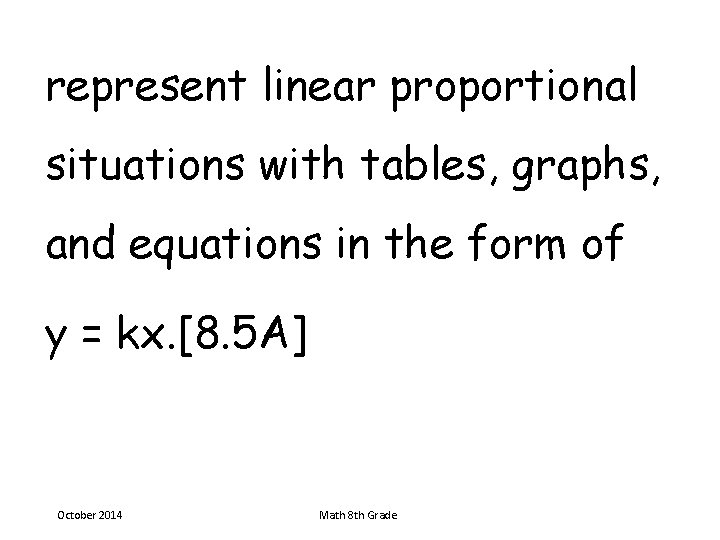
represent linear proportional situations with tables, graphs, and equations in the form of y = kx. [8. 5 A] October 2014 Math 8 th Grade
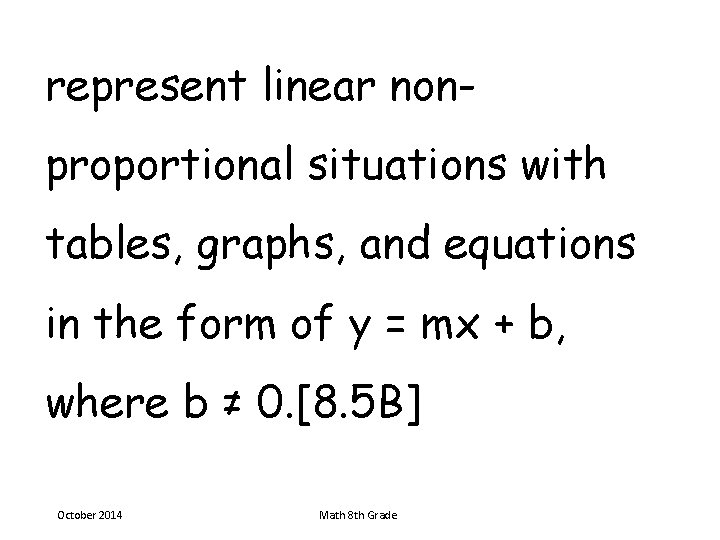
represent linear nonproportional situations with tables, graphs, and equations in the form of y = mx + b, where b ≠ 0. [8. 5 B] October 2014 Math 8 th Grade
contrast bivariate sets of data that suggest a linear relationship with bivariate sets of data that do not suggest a linear relationship from a graphical representation. [8. 5 C] October 2014 Math 8 th Grade
use a trend line that approximates the linear relationship between bivariate sets of data to make predictions. [8. 5 D] October 2014 Math 8 th Grade
![solve problems involving direct variation. [8. 5 E] October 2014 Math 8 th Grade](http://slidetodoc.com/presentation_image_h/2ad070a90dceb838abec8f70af6f295c/image-59.jpg "solve problems involving direct variation. [8. 5 E] October 2014 Math 8 th Grade")
solve problems involving direct variation. [8. 5 E] October 2014 Math 8 th Grade
distinguish between proportional and non-proportional situations using tables, graphs, and equations in the form y = kx or y = mx + b, where b ≠ 0. [8. 5 F] October 2014 Math 8 th Grade
![identify functions using sets of ordered pairs, tables, mappings, and graphs. [8. 5 G]](http://slidetodoc.com/presentation_image_h/2ad070a90dceb838abec8f70af6f295c/image-61.jpg "identify functions using sets of ordered pairs, tables, mappings, and graphs. [8. 5 G]")
identify functions using sets of ordered pairs, tables, mappings, and graphs. [8. 5 G] October 2014 Math 8 th Grade
identify examples of proportional and non-proportional functions that arise from mathematical and real -world problems. [8. 5 H] October 2014 Math 8 th Grade
write an equation in the form y = mx + b to model a linear relationship between two quantities using verbal, numerical, tabular, and graphical representations. [8. 5 I] October 2014 Math 8 th Grade
describe the volume formula V = Bh of a cylinder in terms of its base area and its height. [8. 6 A] October 2014 Math 8 th Grade
model the relationship between the volume of a cylinder and a cone having both congruent bases and heights and connect that relationship to the formulas. [8. 6 B] October 2014 Math 8 th Grade
![use models and diagrams to explain the Pythagorean Theorem. [8. 6 C] October 2014](http://slidetodoc.com/presentation_image_h/2ad070a90dceb838abec8f70af6f295c/image-66.jpg "use models and diagrams to explain the Pythagorean Theorem. [8. 6 C] October 2014")
use models and diagrams to explain the Pythagorean Theorem. [8. 6 C] October 2014 Math 8 th Grade
![solve problems involving the volume of cylinders, cones, and spheres. [8. 7 A] October](http://slidetodoc.com/presentation_image_h/2ad070a90dceb838abec8f70af6f295c/image-67.jpg "solve problems involving the volume of cylinders, cones, and spheres. [8. 7 A] October")
solve problems involving the volume of cylinders, cones, and spheres. [8. 7 A] October 2014 Math 8 th Grade
use previous knowledge of surface area to make connections to the formulas for lateral and total surface area and determine solutions for problems involving rectangular prisms, triangular prisms, and cylinders. [8. 7 B] October 2014 Math 8 th Grade
![use the Pythagorean Theorem and its converse to solve problems. [8. 7 C] October](http://slidetodoc.com/presentation_image_h/2ad070a90dceb838abec8f70af6f295c/image-69.jpg "use the Pythagorean Theorem and its converse to solve problems. [8. 7 C] October")
use the Pythagorean Theorem and its converse to solve problems. [8. 7 C] October 2014 Math 8 th Grade
determine the distance between two points on a coordinate plane using the Pythagorean Theorem. [8. 7 D] October 2014 Math 8 th Grade
write one-variable equations or inequalities with variables on both sides that represent problems using rational number coefficients and constants. [8. 8 A] October 2014 Math 8 th Grade
write a corresponding real-world problem when given a one-variable equation or inequality with variables on both sides of the equal sign using rational number coefficients and constants. [8. 8 B] October 2014 Math 8 th Grade
model and solve one-variable equations with variables on both sides of the equal sign that represent mathematical and real-world problems using rational number coefficients and constants. [8. 8 C] October 2014 Math 8 th Grade
use informal arguments to establish facts about the angle sum and exterior angle of triangles, the angles created when parallel lines are cut by a transversal, and the angle-angle criterion for similarity of triangles. [8. 8 D] October 2014 Math 8 th Grade
identify and verify the values of x and y that simultaneously satisfy two linear equations in the form y = mx + b from the intersections of the graphed equations. [8. 9 A] October 2014 Math 8 th Grade
generalize the properties of orientation and congruence of rotations, reflections, translations, and dilations of two-dimensional shapes on a coordinate plane. [8. 10 A] October 2014 Math 8 th Grade
![differentiate between transformations that preserve congruence and those that do not. [8. 10 B]](http://slidetodoc.com/presentation_image_h/2ad070a90dceb838abec8f70af6f295c/image-77.jpg "differentiate between transformations that preserve congruence and those that do not. [8. 10 B]")
differentiate between transformations that preserve congruence and those that do not. [8. 10 B] October 2014 Math 8 th Grade
explain the effect of translations, reflections over the x- or y-axis, and rotations limited to 90°, 180°, 270°, and 360° as applied to twodimensional shapes on a coordinate plane using an algebraic representation. [8. 10 C] October 2014 Math 8 th Grade
model the effect on linear and area measurements of dilated two-dimensional shapes. [8. 10 D] October 2014 Math 8 th Grade
construct a scatterplot and describe the observed data to address questions of association such as linear, non-linear, and no association between bivariate data. [8. 11 A] October 2014 Math 8 th Grade
determine the mean absolute deviation and use this quantity as a measure of the average distance data are from the mean using a data set of no more than 10 data points. [8. 11 B] October 2014 Math 8 th Grade
simulate generating random samples of the same size from a population with known characteristics to develop the notion of a random sample being representative of the population from which it was selected. [8. 11 C] October 2014 Math 8 th Grade
solve real-world problems comparing how interest rate and loan length affect the cost of credit. [8. 12 A] October 2014 Math 8 th Grade
calculate the total cost of repaying a loan, including credit cards and easy access loans, under various rates of interest and over different periods using an online calculator. [8. 12 B] October 2014 Math 8 th Grade
explain how small amounts of money invested regularly, including money saved for college and retirement, grow over time. [8. 12 C] October 2014 Math 8 th Grade
![calculate and compare simple interest and compound interest earnings. [8. 12 D] October 2014](http://slidetodoc.com/presentation_image_h/2ad070a90dceb838abec8f70af6f295c/image-86.jpg "calculate and compare simple interest and compound interest earnings. [8. 12 D] October 2014")
calculate and compare simple interest and compound interest earnings. [8. 12 D] October 2014 Math 8 th Grade
![identify and explain the advantages and disadvantages of different payment methods. [8. 12 E]](http://slidetodoc.com/presentation_image_h/2ad070a90dceb838abec8f70af6f295c/image-87.jpg "identify and explain the advantages and disadvantages of different payment methods. [8. 12 E]")
identify and explain the advantages and disadvantages of different payment methods. [8. 12 E] October 2014 Math 8 th Grade
analyze situations to determine if they represent financially responsible decisions and identify the benefits of financial responsibility and the costs of financial irresponsibility. [8. 12 F] October 2014 Math 8 th Grade
estimate the cost of a two-year and four-year college education, including family contribution, and devise a periodic savings plan for accumulating the money needed to contribute to the total cost of attendance for at least the first year of college. [8. 12 G] October 2014 Math 8 th Grade
- Slides: 89