
EXPRESSIVE BEHAVIOUR Body gestures posture facial expressions and
EXPRESSIVE BEHAVIOUR

Body gestures, posture, facial expressions, and our tone of voice display what emotions we are feeling, and many of our facial expressions are universal.
Universality of Expressive Behaviour If someone has a mad look on their face, it doesn’t matter what language they speak or where they are from, there is a high chance that they are mad.
However, expressions are influenced by our cultures and society’s rules for displaying emotions. e. g. the guards outside Buckingham Palace are not allowed to display any emotion on their face – this could cause people from other cultures to describe them as looking mad, when in reality they are not.

Are the outward expressions of emotion the same in all humans? Charles Darwin (1872) recognised that animals, especially mammals, use facial expressions to communicate emotions. E. g. apes bare their teeth and grimace to display aggression
Universality of Expressive Behaviour Darwin believed that there are universal expressions of emotion among humans - These are innate (inborn) - Acquired through our evolutionary links with the apes

Universality of Expressive Behaviour Darwin believed that people, like apes, use particular facial expressions to communicate different emotions such as fear and happiness, and that these expressions can be recognised by other people.
Universality of Expressive Behaviour Darwin’s views are supported by studies of blind and deaf children who could not have learned how to communicate emotions through observation or hearing descriptions of facial expressions. E. g. happiness consisted of raised mouth corners and tightened lower eyelids.

However, as these children became older, their facial movements associated with emotions tend to become less expressive. Woodsworth (1954): suggests that learning through observation of behaviour has an important role to play in how we express emotions e. g. receiving a smile from someone when we smile at them encourages us to smile at others in the future
In summary: • Expressive behaviour may have a biological component e. g. anger is similar on faces of animals and humans, blind children still smile • Must also be learned e. g. blind children becoming less expressive as they get older
Cultural Influences on the Expression of Emotion

Cultural Influences on Facial Expression of Emotion Research shows that culture influences the ways in which we express emotions. Culture is believed to influence emotional expressions by establishing social norms or ‘rules’ in a society for when it is acceptable to show certain emotions and which types of emotional expressions are appropriate in different situations.
Cultural Influences on Facial Expression of Emotion Regardless of cultural differences, Zimbardo (1992) has found that people all over the world generally express basic emotions through facial expressions in the same way and are able to identify the basic emotions of others from facial expressions. A prominent researcher on types of facial expression and their relationship to basic emotions is American psychologist Paul Ekman.
Paul Ekman - Used cross-cultural studies to investigate whether facial expressions are universal, irrespective of social background - Concluded that ‘all people speak and understand the same facial language’

Paul Ekman Displayed photographs of facial expressions including disgust, fear, happiness, anger, sadness and surprise to people from Brazil, China, Japan, Argentina and USA. - Participants were asked to say what the person in each photograph was feeling. - Regardless of cultural background, great majority of participants were able to identify the emotions .
Paul Ekman Confounding Variable: any variable whose unwanted effect on the DV might be confused with the effect of the IV. In this experiment, a possible confounding variable may have been that participants not from Western cultures may have had some exposure to Western people e. g. through the media, and therefore learned to ‘read’ Western facial expressions. This means the researchers could not be confident whether participants’ ability to identify the emotions occurred due to universal recognition or whether they were learned.
Paul Ekman Display rules: patterns of emotional expression considered appropriate within a culture or subculture. For example: -Western Cultures: emotional displays are often intense and prolonged -Eastern/Asian Cultures: much more reserved in their emotional expression
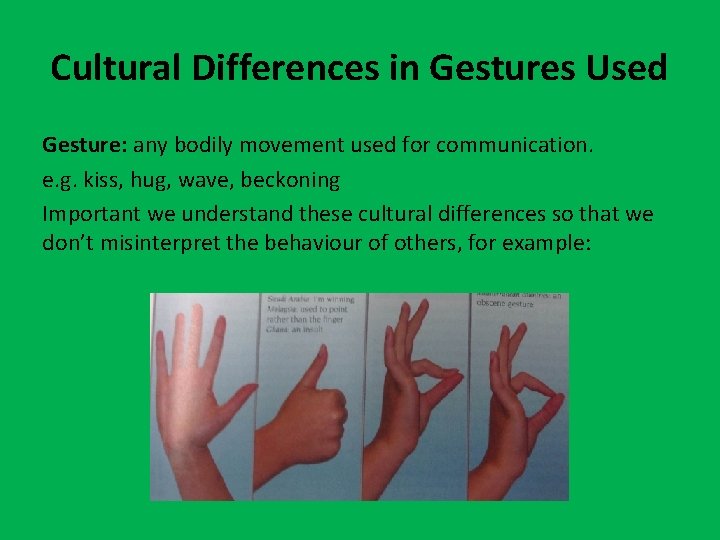
Cultural Differences in Gestures Used Gesture: any bodily movement used for communication. e. g. kiss, hug, wave, beckoning Important we understand these cultural differences so that we don’t misinterpret the behaviour of others, for example:
Examples of differences in Cultural Gestures used to express emotion: In Australia, thumbs up can have different meanings –downward movement can be negative while upward movement can be positive: - In Saudi Arabia it means ‘I’m winning’ - In Ghana it is an insult
Examples of differences in Cultural Gestures used to express emotion: In Middle-Eastern and Latin-American cultures, holding hands, walking with arms around each other and kissing on greeting between same sex acquaintances is the norm: - In Asia and North America, only very close friends or family might hug or kiss as a greeting or farewell - In these cultures, same-sex kissing may be seen as a sign of homosexuality
Two potential uses for an awareness and understanding of cultural variation in expression: 1. An awareness of the different expressions of emotion across the various cultures is important in ensuring international harmony. 2. This information is useful for people who are involved with or work with people from different cultures.
Gender Differences in Behavioural Expressions of Emotion
Gender Differences in Behavioural Expressions of Emotion • There are obvious similarities in behavioural expressions of emotions by males/females • There also differences Research suggests that females are ‘better’ at expressing some emotions than males and vice versa.
Study one: Students were videotaped individually – asked to talk about times when they were happy, sad or angry. - Research participants were shown the five second video clips (without sound) and asked to identify which of the three emotions was being expressed: • 66% of the time, participants were able to correctly identify happy emotions from expressive behaviour by females • Less than 50% were able to correctly identify happy emotions from expressive behaviour by males Participants were able to correctly identify angry emotions from expressive behaviour displayed by males slightly more frequently than when females expressed anger
Study two: Researchers observed and recorded the facial expressions of boys and girls as they watched a video-tape showing an emotional interaction between people. - Generally the facial expressions displayed by girls as they watched the video more accurately reflected the facial expressions of the people on screen compared with the boys • As a result, it was suggested that girls have greater empathy with others • It was also found that the girls provided more accurate descriptions of the emotions shown on the videotape than the boys
Reasons for Gender Differences: Some psychologists believe the differences reflect different approaches to socialisation between girls and boys (how they are brought up) - Many families encourage girls to talk about their feelings and to express emotions - Many families encourage boys to be ‘strong’ and not let others see that they are hurt, sad or scared because it may be ‘weak’ or ‘unmanly’ These socialisation patterns tend to be universal across cultures.
Reasons for Gender Differences Also suggested by psychologists is an evolutionary background: - e. g. nurturing, caring role of bringing up children has been predominantly female, requiring attention to feelings - Females have therefore evolved in a way that makes them more open to expressive feelings and more attuned to feelings of others
Reasons for Gender Differences - Evolutionary: greater awareness of feelings has been described as potentially harmful to males in their role of defending their ‘group’, ‘territory’ and their fight for a mate - Vulnerability = easier target However, it is males who are attuned to the feelings of others that are more likely to be socially successful.
- Slides: 28