
Exposures Health Effects of Mercury for Humans Board
Exposures & Health Effects of Mercury for Humans Board of Scientific Counselors February 23, 2005 Rita Schoeny, Ph. D. Senior Science Advisor, Office of Water U. S. Environmental Protection Agency schoeny. rita@epa. gov 1
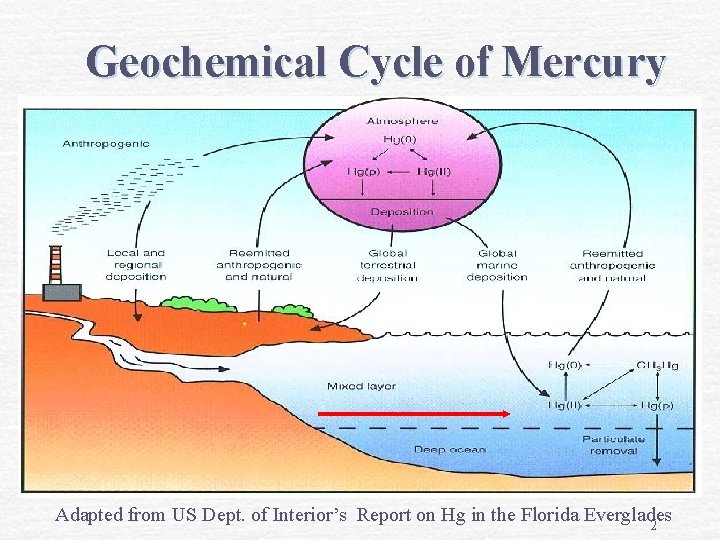
Geochemical Cycle of Mercury Adapted from US Dept. of Interior’s Report on Hg in the Florida Everglades 2
Major Exposure Pathways Elemental mercury (Hg 0) vapours: Dental amalgams for most people Occupations (such as artisanal mining and chloralkali plants) for some populations Use of mercury in religious/cultural practices Other incidents (children playing with mercury) Spills (broken thermometers, thermostats, etc. . ) Methylmercury (Me. Hg): Consumption of fish and marine mammals (certain whales, seals) 3
4
Humans are also exposed to other mercury forms including Inorganic mercury salts, mainly through ingestion Low levels in some foods (e. g. wild mushrooms) Some traditional Asian medicines: Cinnabaris (mercury sulfide) Calomelas (mercuric chloride) Skin lightening creams Ethylmercury from preservative (thimerosal, ethylmercury thiosalicylate) in some vaccines and other medical products Use of thimerosal is being eliminated or significantly reduced in many countries 5
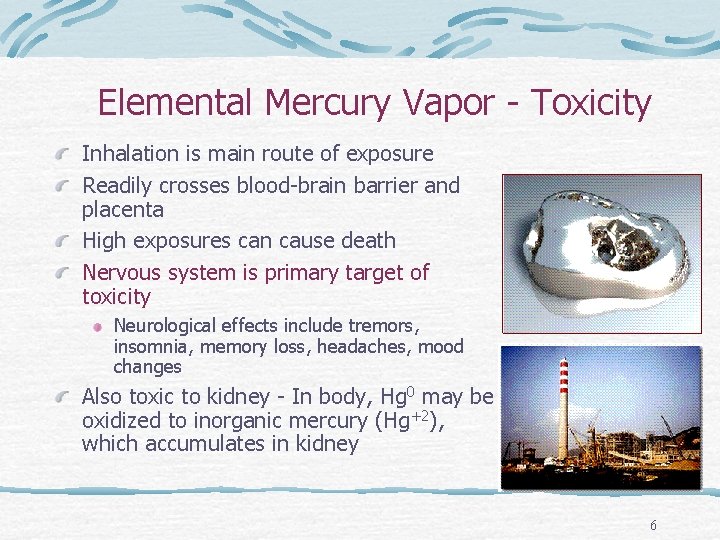
Elemental Mercury Vapor - Toxicity Inhalation is main route of exposure Readily crosses blood-brain barrier and placenta High exposures can cause death Nervous system is primary target of toxicity Neurological effects include tremors, insomnia, memory loss, headaches, mood changes Also toxic to kidney - In body, Hg 0 may be oxidized to inorganic mercury (Hg+2), which accumulates in kidney 6
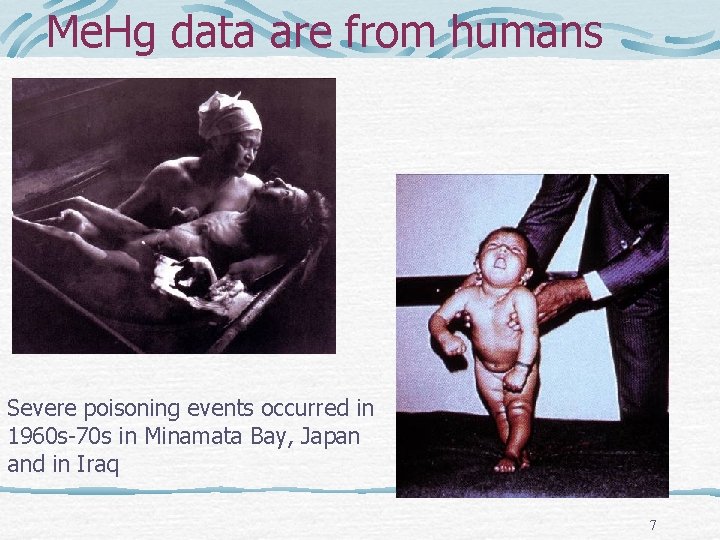
Me. Hg data are from humans Severe poisoning events occurred in 1960 s-70 s in Minamata Bay, Japan and in Iraq 7
Me. Hg Health Effects Spectrum of effects from adult exposure or during development – mortality through subtle effects on ability to learn Developing nervous system is a sensitive target for low dose Me. Hg exposure Evidence from human and animals of adverse effect on developing and adult cardiovascular system Animal evidence of immune and reproductive effects Mechanism is unknown Not likely to be a human carcinogen 8
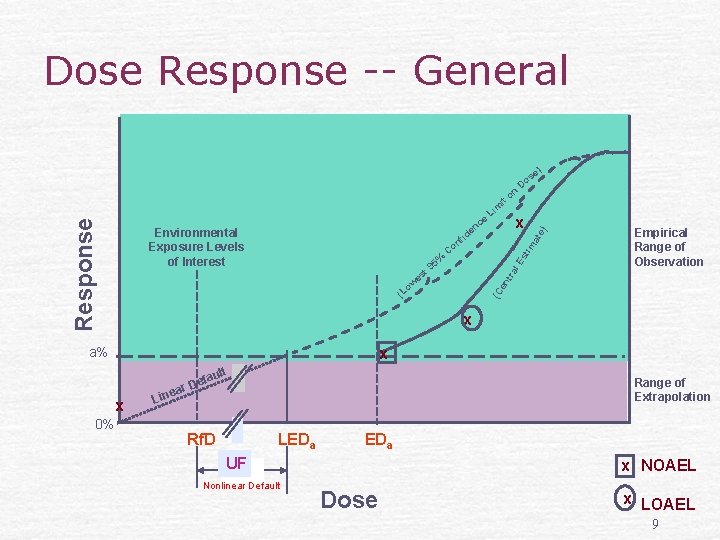
Dose Response -- General ) on it se Do x im st Empirical Range of Observation tra 9 st en e w o (L n Co l. E 5% at fid e) en Environmental Exposure Levels of Interest Li (C Response m ce x a% x ult x 0% efa ar D Range of Extrapolation L ine Rf. D LEDa UF Nonlinear Default x NOAEL Dose x LOAEL 9
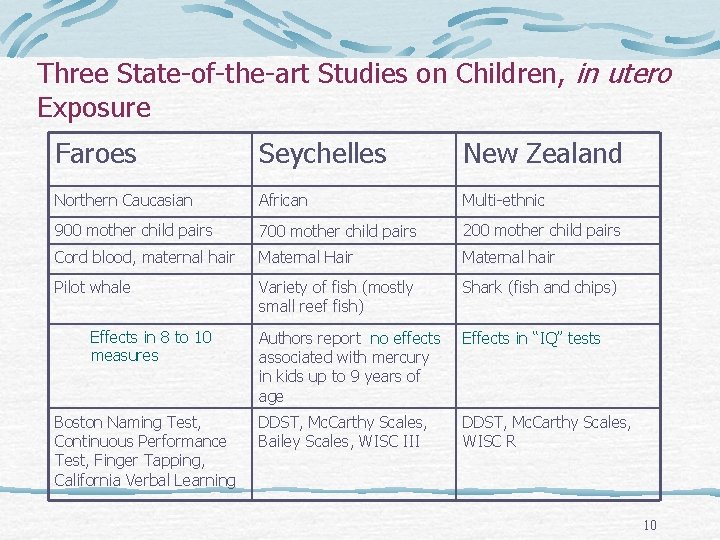
Three State-of-the-art Studies on Children, in utero Exposure Faroes Seychelles New Zealand Northern Caucasian African Multi-ethnic 900 mother child pairs 700 mother child pairs 200 mother child pairs Cord blood, maternal hair Maternal Hair Maternal hair Pilot whale Variety of fish (mostly small reef fish) Shark (fish and chips) Authors report no effects associated with mercury in kids up to 9 years of age Effects in “IQ” tests DDST, Mc. Carthy Scales, Bailey Scales, WISC III DDST, Mc. Carthy Scales, WISC R Effects in 8 to 10 measures Boston Naming Test, Continuous Performance Test, Finger Tapping, California Verbal Learning 10
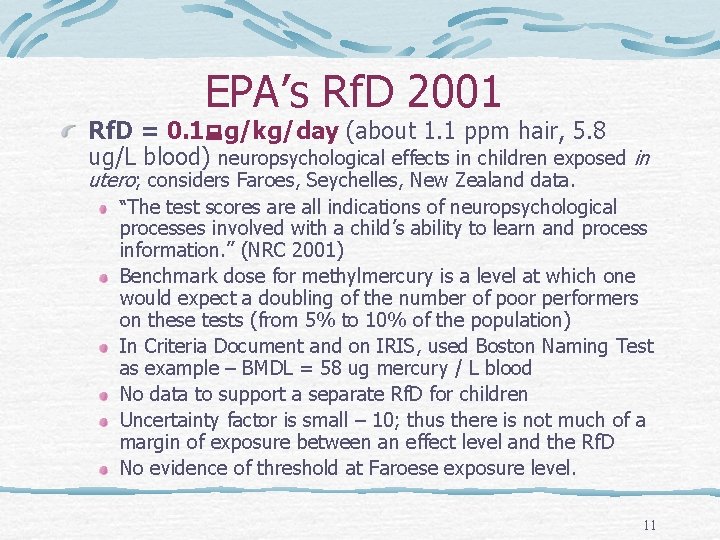
EPA’s Rf. D 2001 Rf. D = 0. 1 g/kg/day (about 1. 1 ppm hair, 5. 8 ug/L blood) neuropsychological effects in children exposed in utero; considers Faroes, Seychelles, New Zealand data. “The test scores are all indications of neuropsychological processes involved with a child’s ability to learn and process information. ” (NRC 2001) Benchmark dose for methylmercury is a level at which one would expect a doubling of the number of poor performers on these tests (from 5% to 10% of the population) In Criteria Document and on IRIS, used Boston Naming Test as example – BMDL = 58 ug mercury / L blood No data to support a separate Rf. D for children Uncertainty factor is small – 10; thus there is not much of a margin of exposure between an effect level and the Rf. D No evidence of threshold at Faroese exposure level. 11
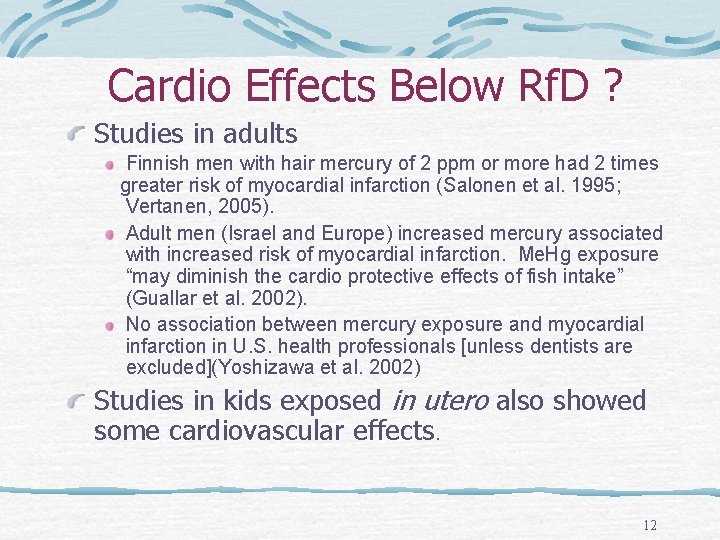
Cardio Effects Below Rf. D ? Studies in adults Finnish men with hair mercury of 2 ppm or more had 2 times greater risk of myocardial infarction (Salonen et al. 1995; Vertanen, 2005). Adult men (Israel and Europe) increased mercury associated with increased risk of myocardial infarction. Me. Hg exposure “may diminish the cardio protective effects of fish intake” (Guallar et al. 2002). No association between mercury exposure and myocardial infarction in U. S. health professionals [unless dentists are excluded](Yoshizawa et al. 2002) Studies in kids exposed in utero also showed some cardiovascular effects. 12
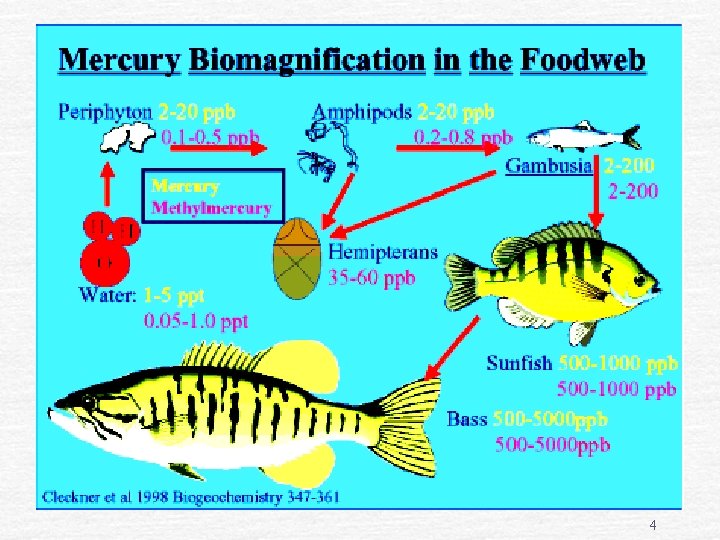
Exposures to Methylmercury Eating fish – an important part of a healthy diet -- is the main source of exposure to Me. Hg Typically about 0. 05 to 1. 4 ppm (or mg/kg) in fish Levels vary by species, size, and age of fish Also, vary by characteristics of waterbody (p. H, redox potential, local contamination, and other factors) Highest in large predatory marine species, such as shark, swordfish, large tuna, some whales, seals Levels can also be high in predatory freshwater fish, such as pike, perch, tilapia 13
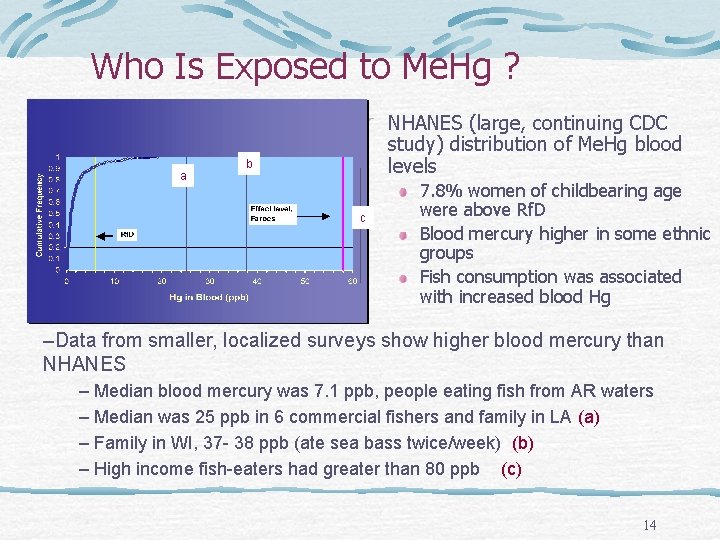
Who Is Exposed to Me. Hg ? a NHANES (large, continuing CDC study) distribution of Me. Hg blood levels b c Fishers, LA 7. 8% women of childbearing age were above Rf. D Blood mercury higher in some ethnic groups Fish consumption was associated with increased blood Hg –Data from smaller, localized surveys show higher blood mercury than NHANES – Median blood mercury was 7. 1 ppb, people eating fish from AR waters – Median was 25 ppb in 6 commercial fishers and family in LA (a) – Family in WI, 37 - 38 ppb (ate sea bass twice/week) (b) – High income fish-eaters had greater than 80 ppb (c) 14
Who Is at Risk for Hg Toxicity? Fish is good, nutritious food, consumed in moderation; however, people who consume substantial amounts of contaminated fish and/or marine mammals are “at risk” Women of childbearing have potential to expose developing fetus. Children eat more food on body weight basis than adults and are still developing, so may be at higher risk than adults What about middle aged men? ? ? Some occupations Artisanal miners, some chloralkali plant workers…. People living near spills, especially indoor spills Possibly some other subgroups using traditional medicines, cosmetics, ritual uses… 15
Additional Information 16
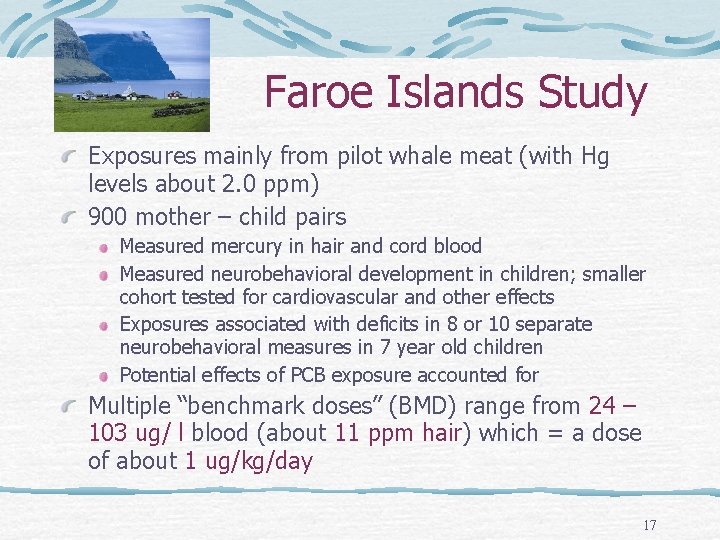
Faroe Islands Study Exposures mainly from pilot whale meat (with Hg levels about 2. 0 ppm) 900 mother – child pairs Measured mercury in hair and cord blood Measured neurobehavioral development in children; smaller cohort tested for cardiovascular and other effects Exposures associated with deficits in 8 or 10 separate neurobehavioral measures in 7 year old children Potential effects of PCB exposure accounted for Multiple “benchmark doses” (BMD) range from 24 – 103 ug/ l blood (about 11 ppm hair) which = a dose of about 1 ug/kg/day 17
Other Major Studies of Me. Hg Effects New Zealand Study: 200 mother – child pairs (fish and chips) Effects noted on several measures in “standard IQ” tests. Median BMD = 24 ug/ l blood (9 ppm hair) or about 1 ug/kg/day Seychelles. 700 mother – child pairs Exposures from fish diet (with Hg levels 0. 2 -0. 3 ppm) High exposure group had mean mercury hair level = 15 ppm No adverse effects identified in children tested at various ages up to 66 months NOAEL = 15 ppm hair (1. 5 ug/kg/day) NOAEL = no observed adverse effect level 18
Reference Levels, Estimated to Be Safe, Including Fetal Exposure FAO/WHO Expert Committee 2003 Provisional Tolerable Weekly Intake (PTWI) = 1. 6 ug/kg bw = 0. 23 ug/kg/day Derived from BMD of 1. 5 ug/kg/day divided by 6. 4 to account for uncertainty and variability U. S. EPA Reference Dose = 0. 1 ug/kg/day BMD of 1 ug/kg/day divided by 10 to account for uncertainty and variability U. S. ATSDR Minimal Risk Level = 0. 3 ug/kg/day Canada reference level = 0. 2 ug/kg/day European Union level = 0. 1 ug/kg/day FAO/WHO = United Nations Food and Agricultural Organization (FAO) and World Health Organization (WHO) 19
Mercury Exposures for Wildlife species that rely on fish as a large part of their diet can have elevated mercury levels Examples include: otter, mink, raptors, eagles, osprey, seals, some whales For example, mercury levels in arctic ringed seals and beluga whales have increased by 2 to 4 times over the past 25 years (based on studies in Canada) 20
Effects in wildlife Fish-eating animals and those that prey on fish-eaters are the most exposed population. But effects have been measured in insect-eating songbirds Mercury affects the nervous system and causes reproductive abnormalities. Birds in Minamata had difficulty flying, and exhibited other severe abnormal behavior. Waltzing cats. Mating behaviors may be impaired. Laboratory studies have shown impairment in mink, cats, mallards and wading birds Field data strongly suggest that adverse effects in common loons are due to accumulation of mercury originating from air emissions. Field data also suggest adverse effects due to mercury in the Florida panther, but the origin of this mercury may be from both air and other types of sources. 21
Effects in wildlife -- 2 Adverse effects of Me. Hg on reproduction can occur at egg concentrations as low as 0. 05 to 2. 0 mg/kg. Eggs of certain Canadian species are in this range Concentrations in several other species are approaching these levels Effects on fish are beginning to be demonstrated Mercury may also harm soil communities by decreasing microbiological activity 22
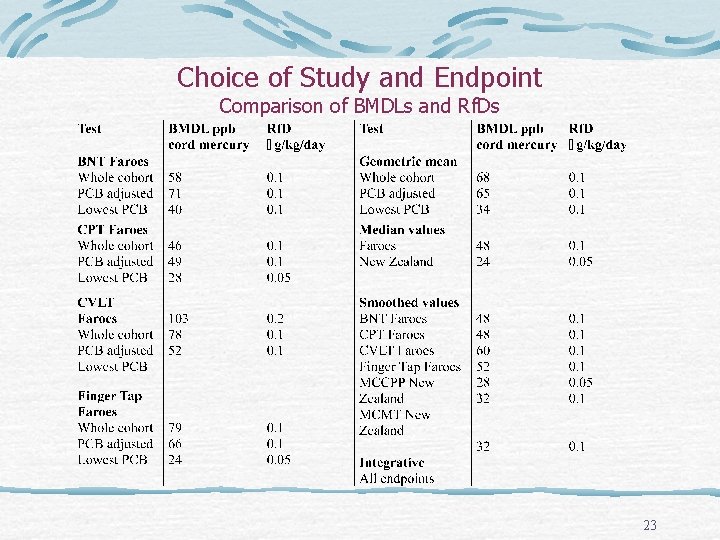
Choice of Study and Endpoint Comparison of BMDLs and Rf. Ds 23
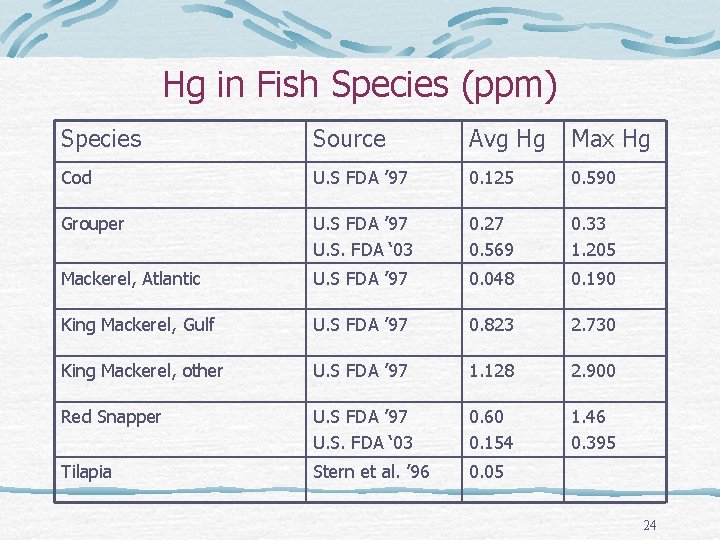
Hg in Fish Species (ppm) Species Source Avg Hg Max Hg Cod U. S FDA ’ 97 0. 125 0. 590 Grouper U. S FDA ’ 97 U. S. FDA ‘ 03 0. 27 0. 569 0. 33 1. 205 Mackerel, Atlantic U. S FDA ’ 97 0. 048 0. 190 King Mackerel, Gulf U. S FDA ’ 97 0. 823 2. 730 King Mackerel, other U. S FDA ’ 97 1. 128 2. 900 Red Snapper U. S FDA ’ 97 U. S. FDA ‘ 03 0. 60 0. 154 1. 46 0. 395 Tilapia Stern et al. ’ 96 0. 05 24
- Slides: 24