
Exposure Therapy Aversive Therapy Lecture 18 Exposure Therapies
- Slides: 16
Exposure Therapy & Aversive Therapy Lecture 18
Exposure Therapies For fear/anxiety & other negative CERs l Intense, maladaptive, or inappropriate l Some strong fears adaptive n Based on Extinction l Fear-provoking events (CS+) l Safe environment (no US) ~ n
Exposure Therapies Models Brief/graduated exposure therapy l Short exposure periods l Gadually increase intensity of CS n Prolonged/intense l Lengthy exposure periods l Immediate exposure to intense CS n Mode of exposure on continuum l Imaginal ----------- in vivo ~ n
Exposure Therapies: Techniques Direction of therapy l Therapist directed l Self-managed n Additional procedures l Competing responses l Response prevention l Exaggerated scenes ~ n
Systematic Desensitization Brief/Graduated Exposure Therapy l Fear & relaxation incompatible l Developed by Wolpe n 3 components l Relaxation Training l Fear Hierarchy l Graded Pairing ~ n
Systematic Desensitization Relaxation Training l Identify & tense muscle groups l Relaxing the muscle groups n Fear Hierarchy l List of fear-provoking situations l Rank from least to most intense n Graded Pairing l CS for fear with muscle relaxation l Thru hierarchy: lowest highest l In vivo vs. Covert desensitization ~ n
Systematic Desensitization: Other competing responses Emotive imagery l Pleasant thoughts replace fear n Humor/laughter l No learning required l Coping with disease ~ n
Systematic Desensitization: Other Target Behaviors n n n Anger Asthmatic attacks Insomnia Motion sickness Nightmares Problem drinking n n Sleepwalking Speech disorders Body image disturbances Racial Prejudice
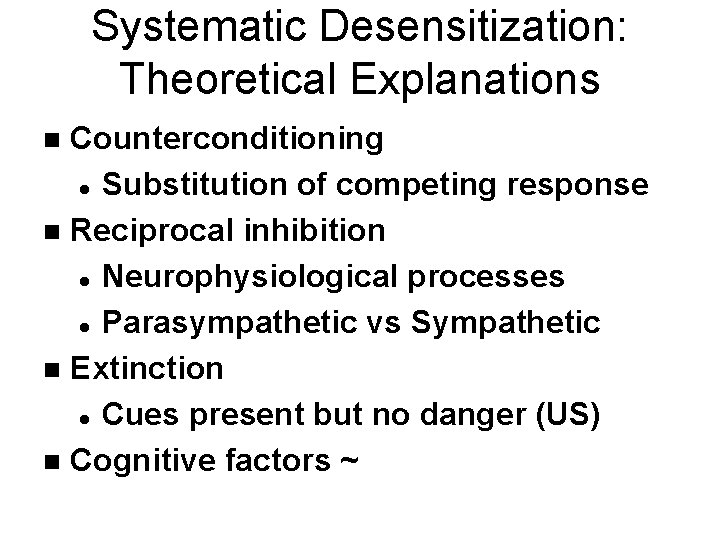
Systematic Desensitization: Theoretical Explanations Counterconditioning l Substitution of competing response n Reciprocal inhibition l Neurophysiological processes l Parasympathetic vs Sympathetic n Extinction l Cues present but no danger (US) n Cognitive factors ~ n
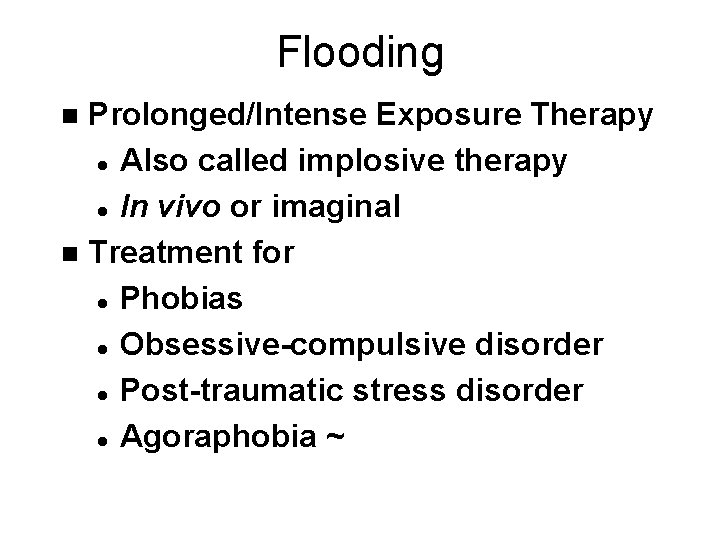
Flooding Prolonged/Intense Exposure Therapy l Also called implosive therapy l In vivo or imaginal n Treatment for l Phobias l Obsessive-compulsive disorder l Post-traumatic stress disorder l Agoraphobia ~ n
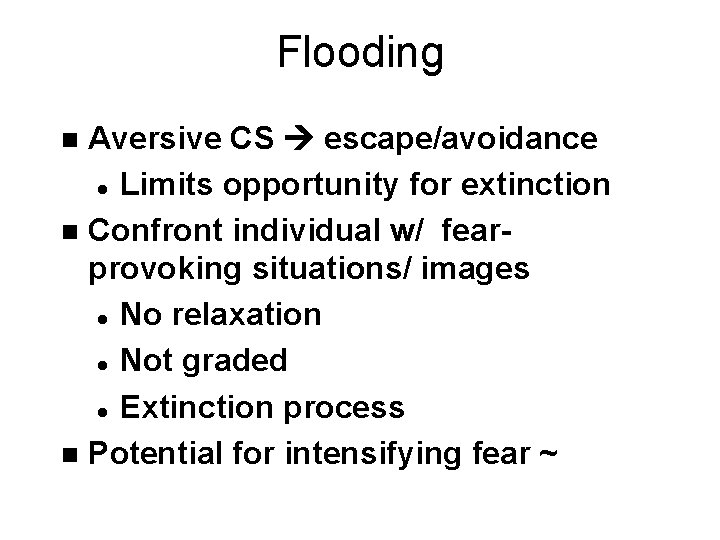
Flooding Aversive CS escape/avoidance l Limits opportunity for extinction n Confront individual w/ fearprovoking situations/ images l No relaxation l Not graded l Extinction process n Potential for intensifying fear ~ n
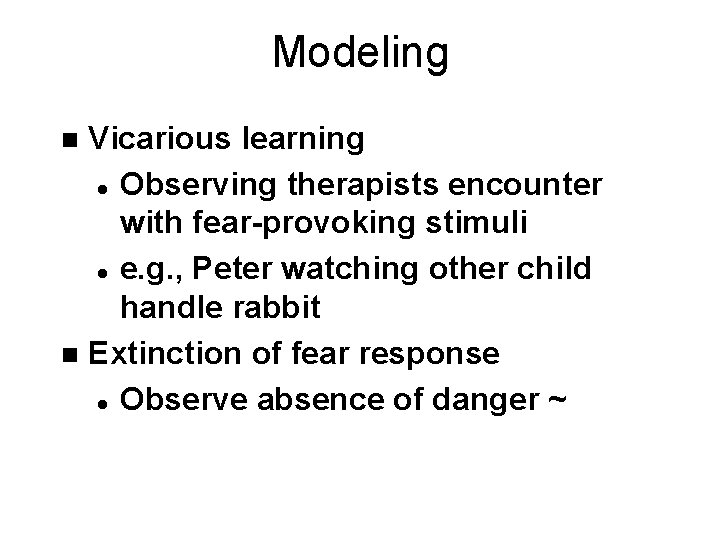
Modeling Vicarious learning l Observing therapists encounter with fear-provoking stimuli l e. g. , Peter watching other child handle rabbit n Extinction of fear response l Observe absence of danger ~ n
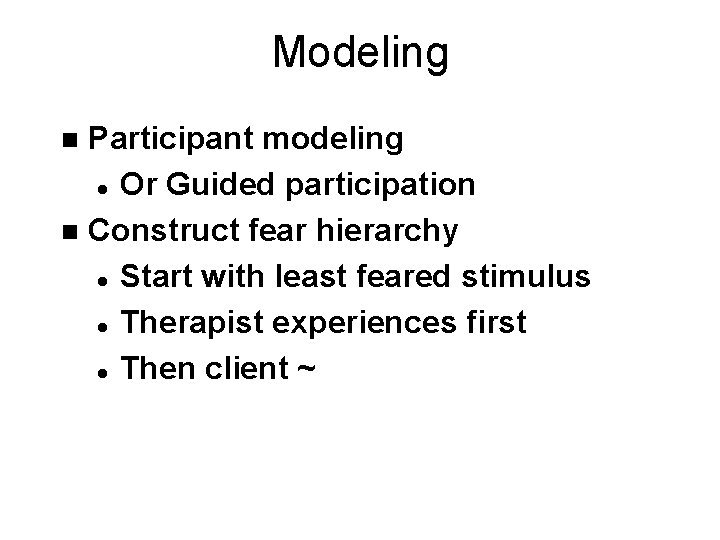
Modeling Participant modeling l Or Guided participation n Construct fear hierarchy l Start with least feared stimulus l Therapist experiences first l Then client ~ n
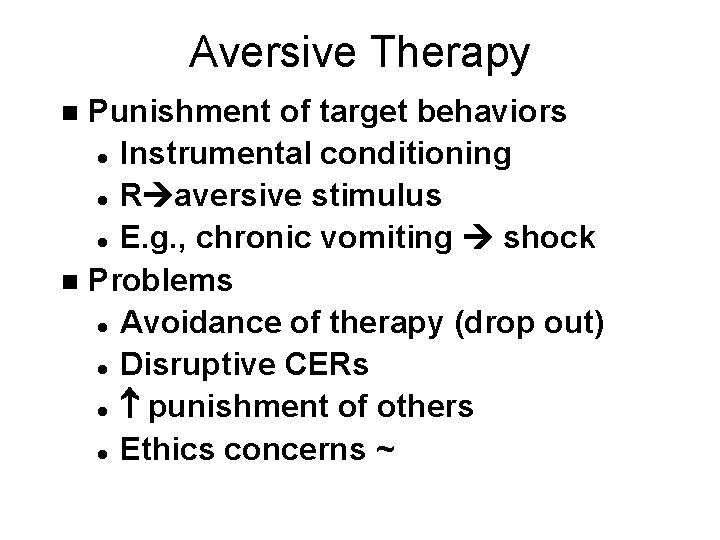
Aversive Therapy Punishment of target behaviors l Instrumental conditioning l R aversive stimulus l E. g. , chronic vomiting shock n Problems l Avoidance of therapy (drop out) l Disruptive CERs l punishment of others l Ethics concerns ~ n
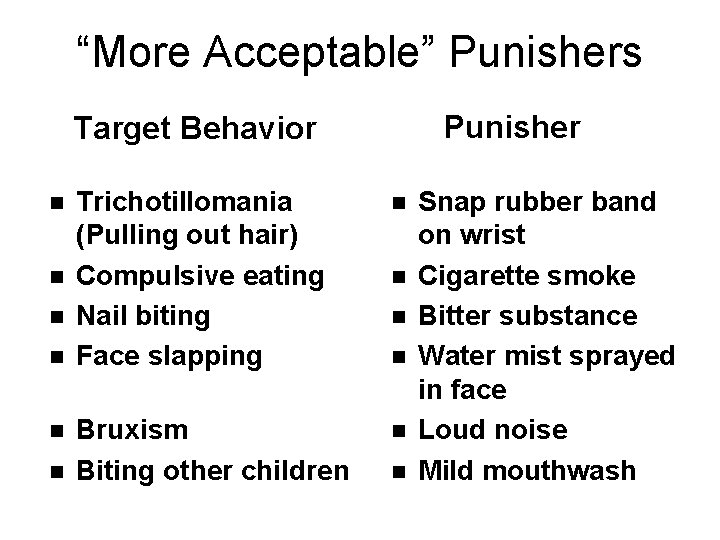
“More Acceptable” Punishers Punisher Target Behavior n n n Trichotillomania (Pulling out hair) Compulsive eating Nail biting Face slapping n Bruxism Biting other children n n Snap rubber band on wrist Cigarette smoke Bitter substance Water mist sprayed in face Loud noise Mild mouthwash
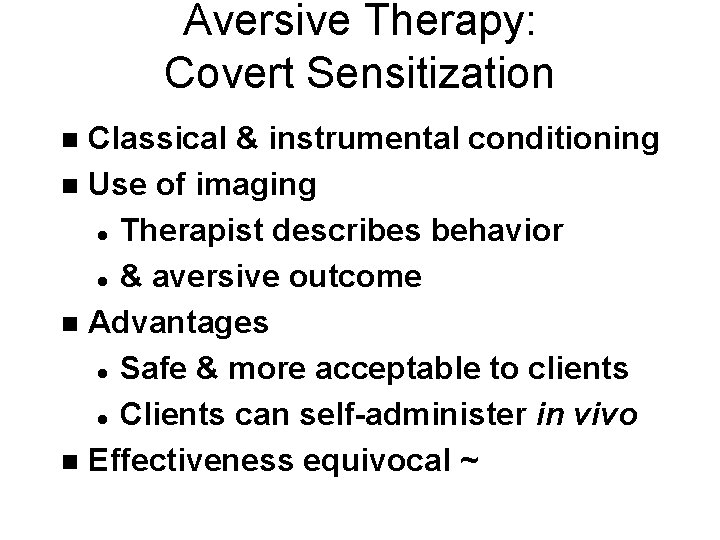
Aversive Therapy: Covert Sensitization Classical & instrumental conditioning n Use of imaging l Therapist describes behavior l & aversive outcome n Advantages l Safe & more acceptable to clients l Clients can self-administer in vivo n Effectiveness equivocal ~ n