
Exposure revision Look at the word youve been
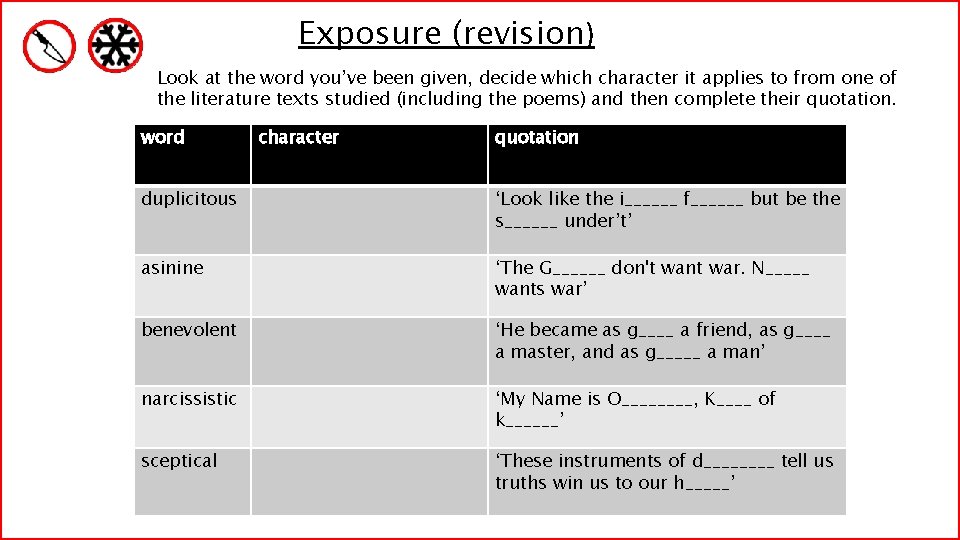
Exposure (revision) Look at the word you’ve been given, decide which character it applies to from one of the literature texts studied (including the poems) and then complete their quotation. word character quotation duplicitous ‘Look like the i______ f______ but be the s______ under’t’ asinine ‘The G______ don't want war. N_____ wants war’ benevolent ‘He became as g____ a friend, as g____ a master, and as g_____ a man’ narcissistic ‘My Name is O____, K____ of k______’ sceptical ‘These instruments of d____ tell us truths win us to our h_____’
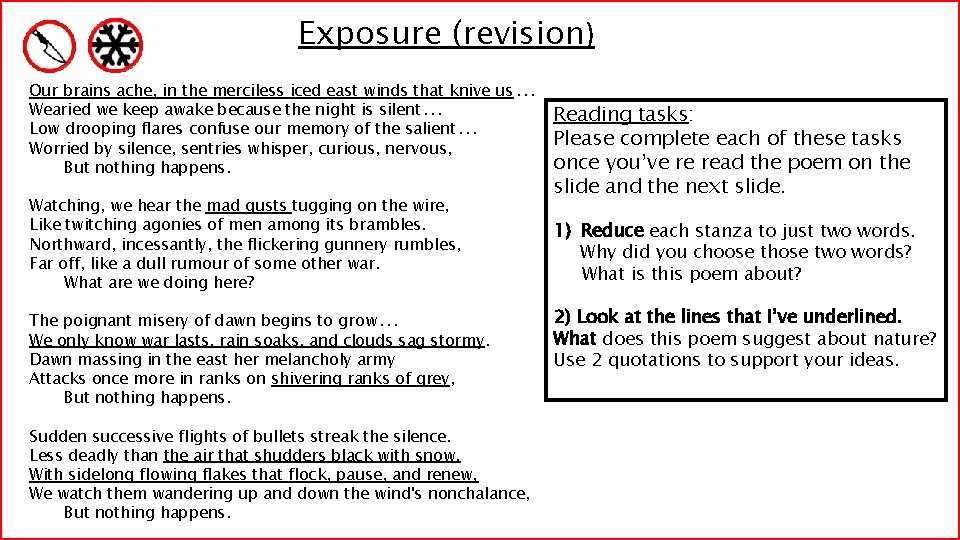
Exposure (revision) Our brains ache, in the merciless iced east winds that knive us. . . Wearied we keep awake because the night is silent. . . Low drooping flares confuse our memory of the salient. . . Worried by silence, sentries whisper, curious, nervous, But nothing happens. Watching, we hear the mad gusts tugging on the wire, Like twitching agonies of men among its brambles. Northward, incessantly, the flickering gunnery rumbles, Far off, like a dull rumour of some other war. What are we doing here? The poignant misery of dawn begins to grow. . . We only know war lasts, rain soaks, and clouds sag stormy. Dawn massing in the east her melancholy army Attacks once more in ranks on shivering ranks of grey, But nothing happens. Sudden successive flights of bullets streak the silence. Less deadly than the air that shudders black with snow, With sidelong flowing flakes that flock, pause, and renew, We watch them wandering up and down the wind's nonchalance, But nothing happens. Reading tasks: Please complete each of these tasks once you’ve re read the poem on the slide and the next slide. 1) Reduce each stanza to just two words. Why did you choose those two words? What is this poem about? 2) Look at the lines that I’ve underlined. What does this poem suggest about nature? Use 2 quotations to support your ideas.
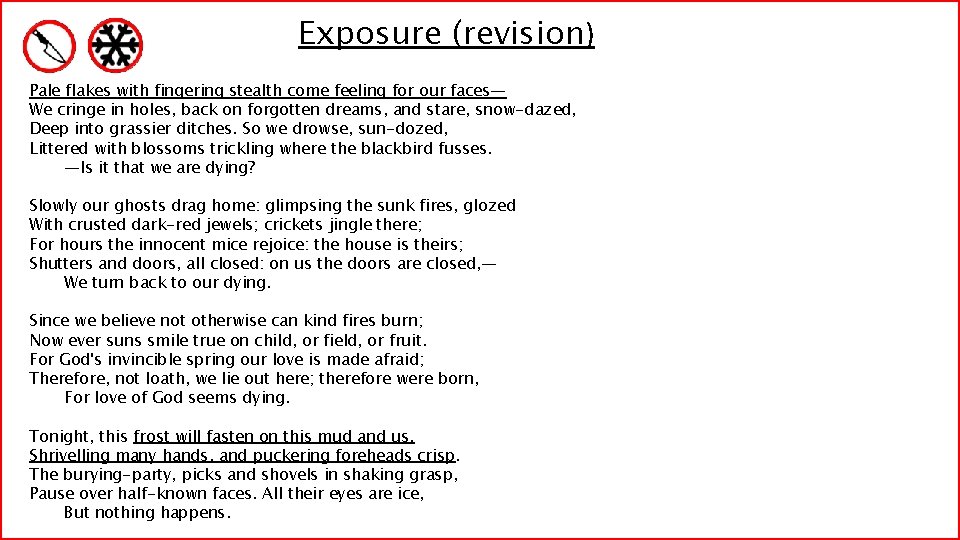
Exposure (revision) Pale flakes with fingering stealth come feeling for our faces— We cringe in holes, back on forgotten dreams, and stare, snow-dazed, Deep into grassier ditches. So we drowse, sun-dozed, Littered with blossoms trickling where the blackbird fusses. —Is it that we are dying? Slowly our ghosts drag home: glimpsing the sunk fires, glozed With crusted dark-red jewels; crickets jingle there; For hours the innocent mice rejoice: the house is theirs; Shutters and doors, all closed: on us the doors are closed, — We turn back to our dying. Since we believe not otherwise can kind fires burn; Now ever suns smile true on child, or field, or fruit. For God's invincible spring our love is made afraid; Therefore, not loath, we lie out here; therefore were born, For love of God seems dying. Tonight, this frost will fasten on this mud and us, Shrivelling many hands, and puckering foreheads crisp. The burying-party, picks and shovels in shaking grasp, Pause over half-known faces. All their eyes are ice, But nothing happens.

Exposure (revision) Choose any two tasks below to complete. 1. Find examples of 2. There is a semantic 4. 5. Compare this poem to 6. How does the poem Extract from the Prelude link to this image: by making a Venn Explain your Diagram – make sure you connections. personification. Why has Owen used this to describe the weather? Why has he use this technique? Create a diary entry as if you were one of the soldiers that was with Wilfred Owen. field of monotony within the poem – which words make this semantic field and what does this highlight or emphasise? Use quotations to help you have looked at describe the conditions of the trenches and the weather. similarities and 200 words. differences. 3. How does Wilfred Owen build suspense/tense in the poem? Write a what – how – why paragraph.

Exposure (revision) Vocabulary: incessant: (adjective) continuing without pause or interruption. expose: (verb) make something visible by uncovering it. 2) reveal the true nature of someone or something. monotonous: (adjective) dull, tedious, and repetitious; lacking in variety Complete the following by using the three words opposite correctly to close the gap: Wilfred Owen’s main intention with Exposure was to ____ the harsh reality and conditions that many men experienced during WW 1. Whilst it is clear that gunfire was ____ throughout his time in the trenches, Owen is also commenting on the idea that war itself is ____, and that unfortunately for man, this will not change. Owen successfully presents the _____ tone and mood that he would have experienced in the trenches by using pathetic fallacy: he uses colours such as ‘grey’ and ‘black’ to describe the weather.
- Slides: 5