
EXPOSURE FACTORS 1 Contrast Density Image Quality technique





- Slides: 57
EXPOSURE FACTORS: 1 Contrast, Density, Image Quality, technique math
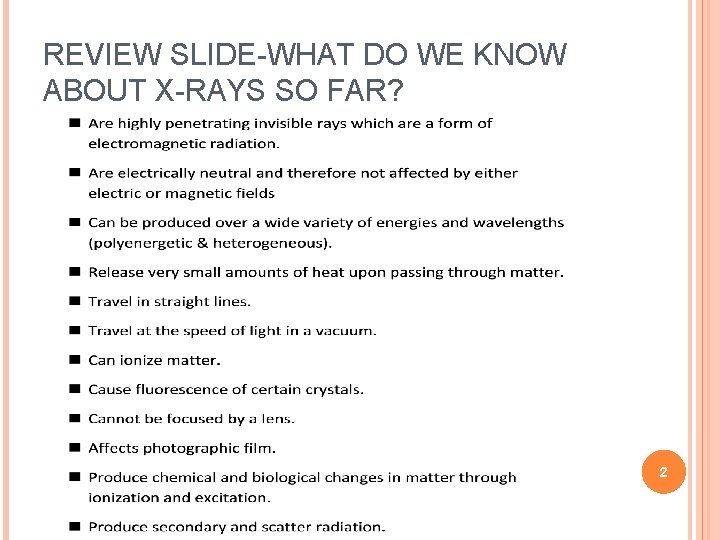
REVIEW SLIDE-WHAT DO WE KNOW ABOUT X-RAYS SO FAR? 2
UNITS OF MEASURE-REVIEW Measure of current, amount of electron charges passing through a point Volt Measure of potential difference, value of potential electrical difference as one unit of current passes 3
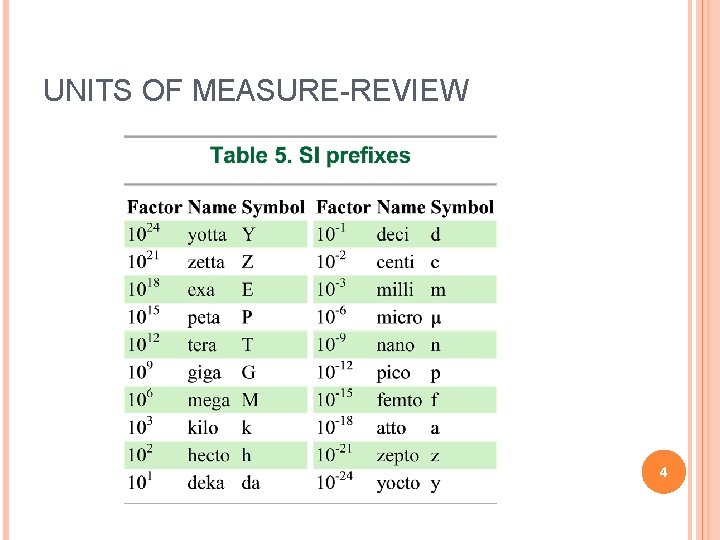
UNITS OF MEASURE-REVIEW 4
EXPOSURE FACTORS m. A, time m. As Milliamps-Amount of electrons burned off filament Time-measured in seconds, fractions of seconds, determines how long the electrons will flow across to anode(another amount) k. Vp, k. V Kilovoltage Determines the strength of the x-ray Determines the wavelength of the x-ray Determines the power of the x-ray Determines the penetrating ability of xray 5
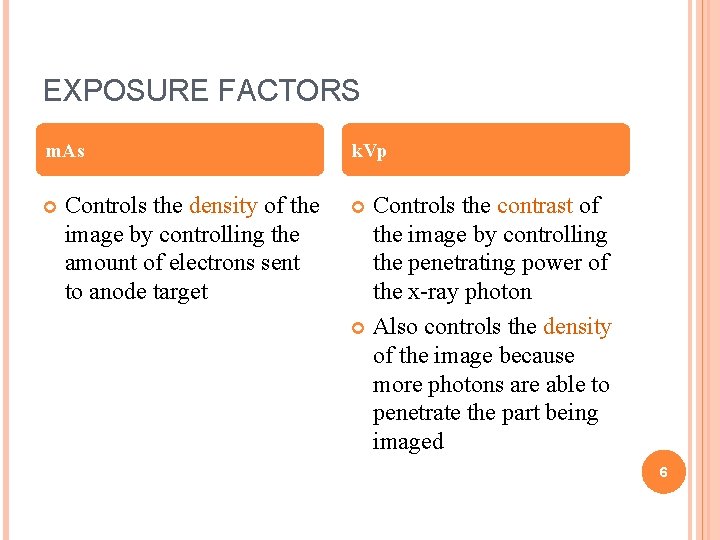
EXPOSURE FACTORS m. As Controls the density of the image by controlling the amount of electrons sent to anode target k. Vp Controls the contrast of the image by controlling the penetrating power of the x-ray photon Also controls the density of the image because more photons are able to penetrate the part being imaged 6
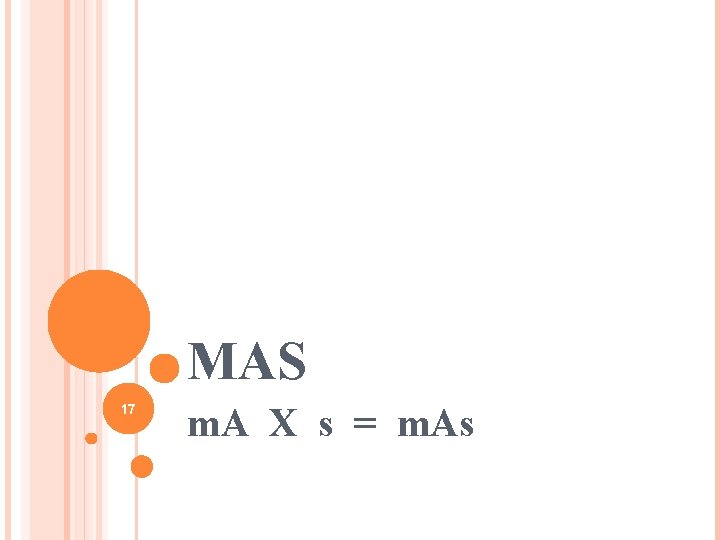
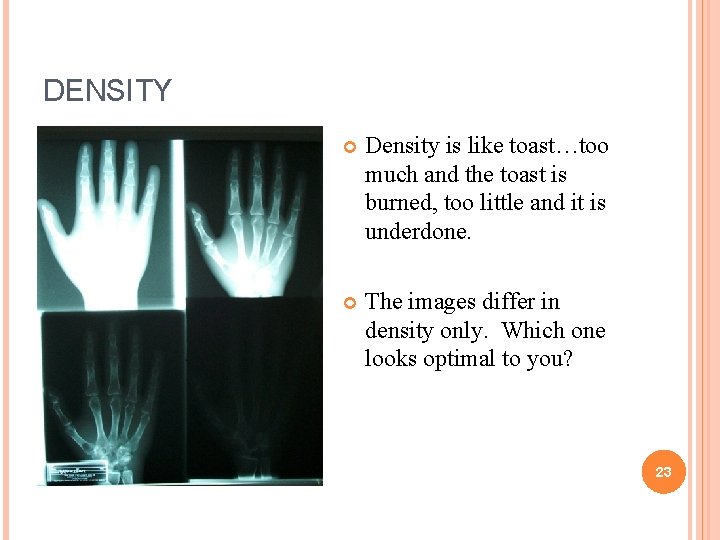
DENSITY Density • The overall darkening of the image • Viewing the overall, general image darkness (or lightness), a general term, referred to as optical density Density • Controlled by the amount of electrons sent to the target anode Density • Formula for m. As • m. A x seconds = m. As • 200 m. A x. 25 seconds= 50 m. As 7
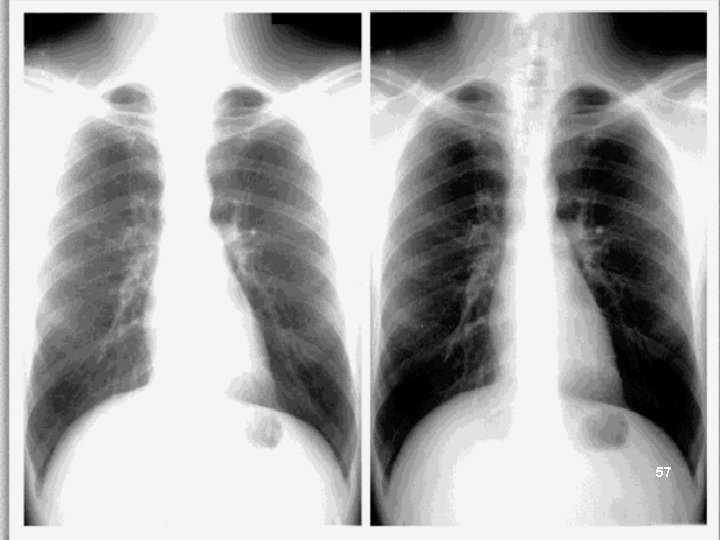
CONTRAST Contrast The differences between the light and dark areas on the image Since x-rays are only black, white and gray, we tend to say the difference between the black and the white areas Contrast The Scale of Contrast can range from completely black to stark white and various shades of gray in between. The scale of contrast is referred to as a long scale or a short scale. Contrast When the t difference between the grays is large, it is considered High Contrast. When the difference between the grays is small, it is considered Low Contrast. 8
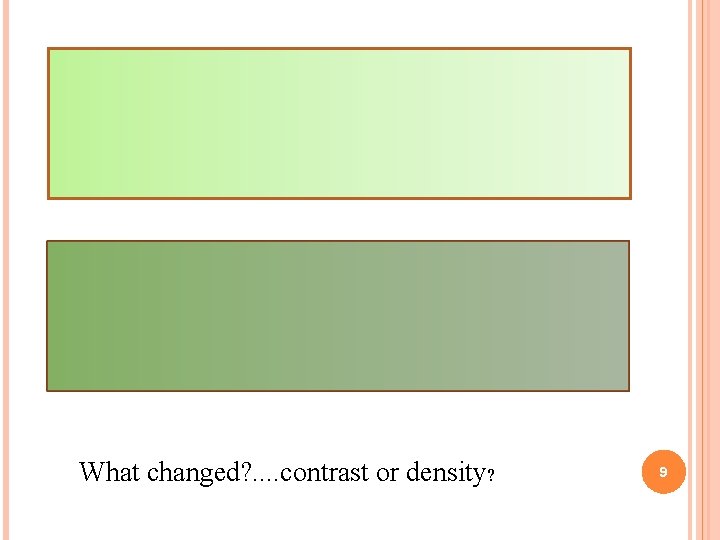
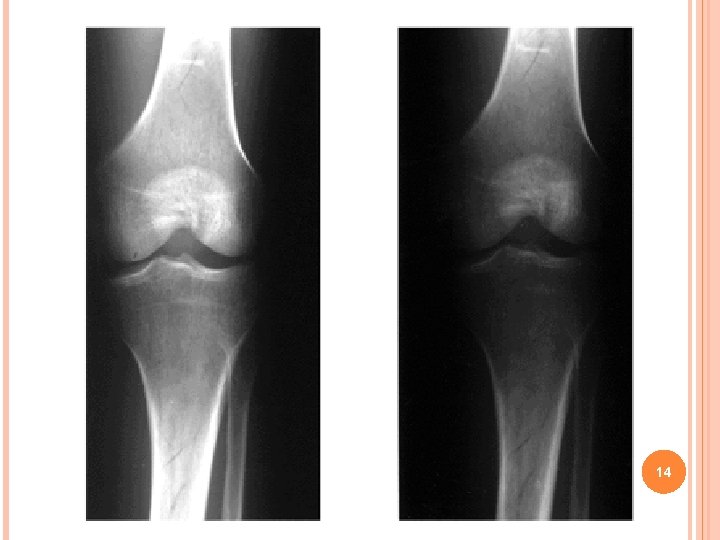
What changed? . . contrast or density? 9
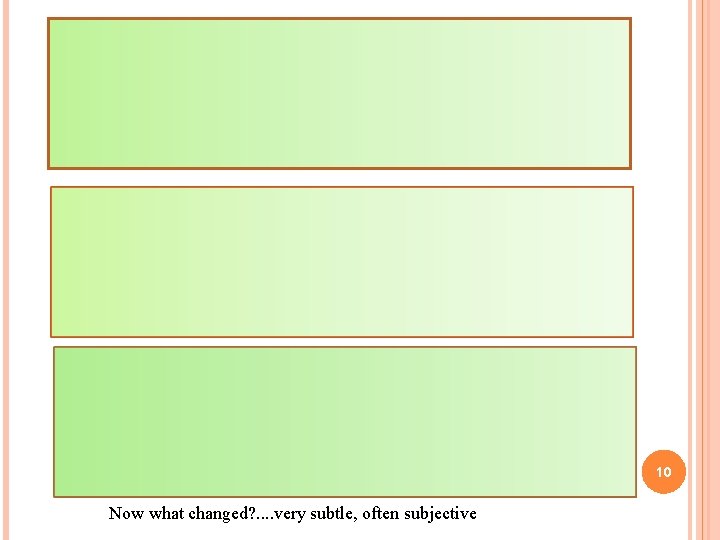
10 Now what changed? . . very subtle, often subjective
2 4 3 1 11
4 5 3 2 1 12
DENSITY v Anatomic Density v Body part/object being x-rayed v Atomic # v Thickness of part v Optical Density v Amount of x-ray photons reaching the image receptor v The m. A applied v The time applied v Also referred to as x-ray output 13
14
MILLIAMPERAGE m. A One milliampere is equal to one thousandth of an ampere. The amount of current supplied to the x-ray tube Range 10 to 1200 m. A 15
TIME In seconds How long x-rays will be produced 0. 001 to 6 seconds 16
MAS 17 m. A X s = m. As
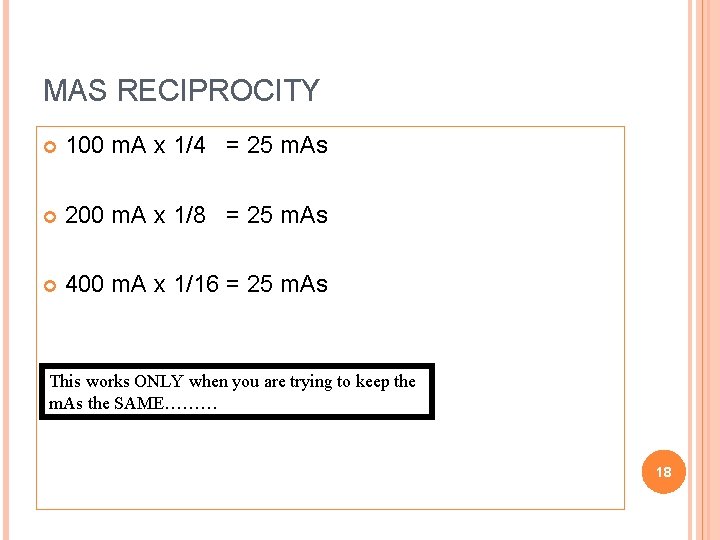
MAS RECIPROCITY 100 m. A x 1/4 = 25 m. As 200 m. A x 1/8 = 25 m. As 400 m. A x 1/16 = 25 m. As This works ONLY when you are trying to keep the m. As the SAME……… 18
WHAT CHANGES TO MAS ARE NEEDED FOR HUMAN EYE TO DETECT? 19
TO CHANGE DENSITY The human eye needs a 20 -30% change in density on an image in order to visibly see it. Most frequently radiographers will change the density by doubling or by halving the density. What do you do in order to double density on an image? 20
DENSITY DIRECTLY PROPORTIONAL TO MAS 100 m. As + 25%m. AS = 25% increase in density 21 +50% m. As = 50% increase in density
22
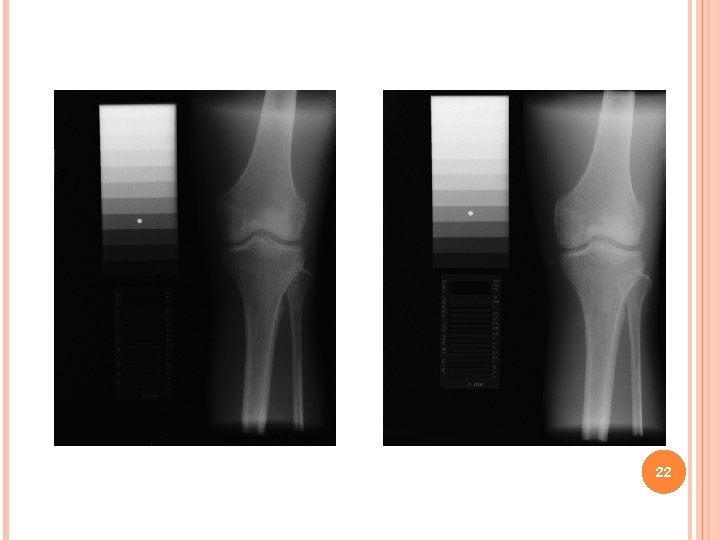
DENSITY Density is like toast…too much and the toast is burned, too little and it is underdone. The images differ in density only. Which one looks optimal to you? 23
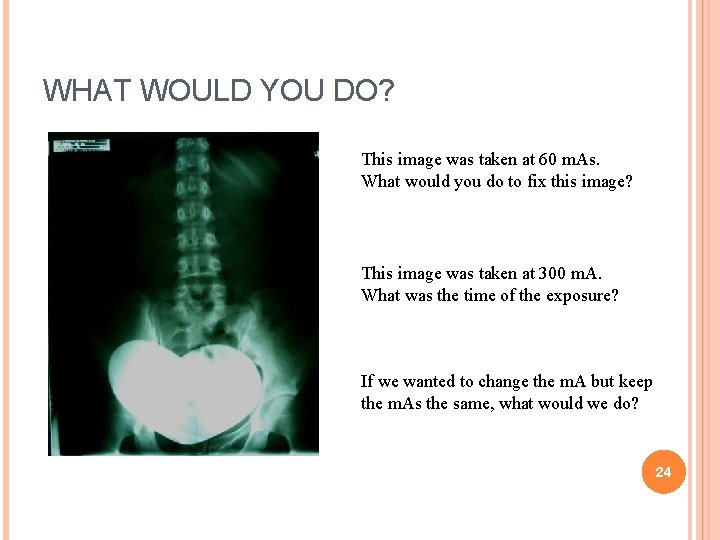
WHAT WOULD YOU DO? This image was taken at 60 m. As. What would you do to fix this image? This image was taken at 300 m. A. What was the time of the exposure? If we wanted to change the m. A but keep the m. As the same, what would we do? 24
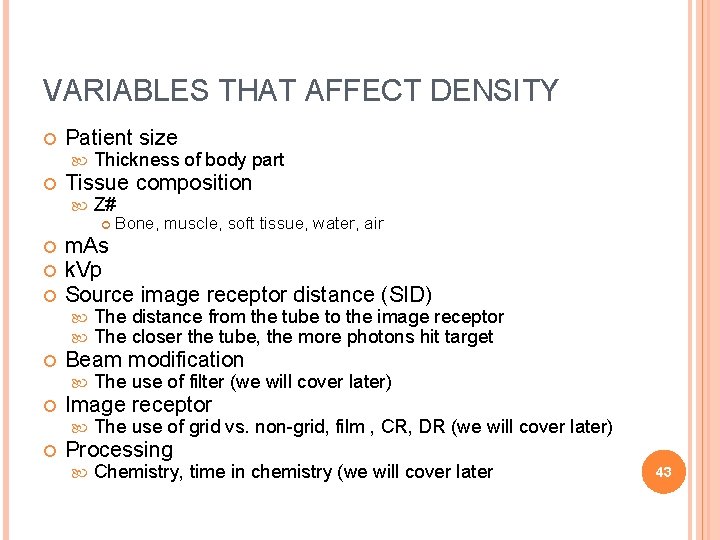
VARIABLES THAT AFFECT DENSITY Patient size Thickness of body part Tissue composition Z# m. As k. Vp Source image receptor distance (SID) The use of filter (we will cover later) Image receptor The distance from the tube to the image receptor The closer the tube, the more photons hit target Beam modification Bone, muscle, soft tissue, water, air The use of grid vs. non-grid, film , CR, DR (we will cover later) Processing Chemistry, time in chemistry (we will cover later 25
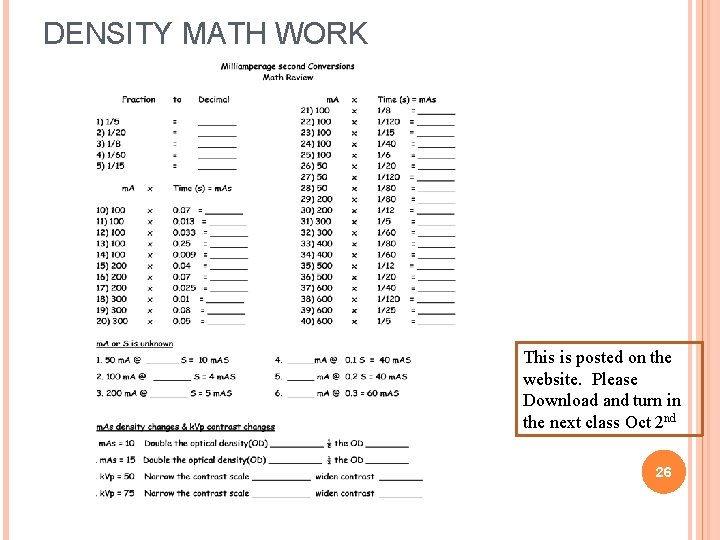
DENSITY MATH WORK This is posted on the website. Please Download and turn in the next class Oct 2 nd 26
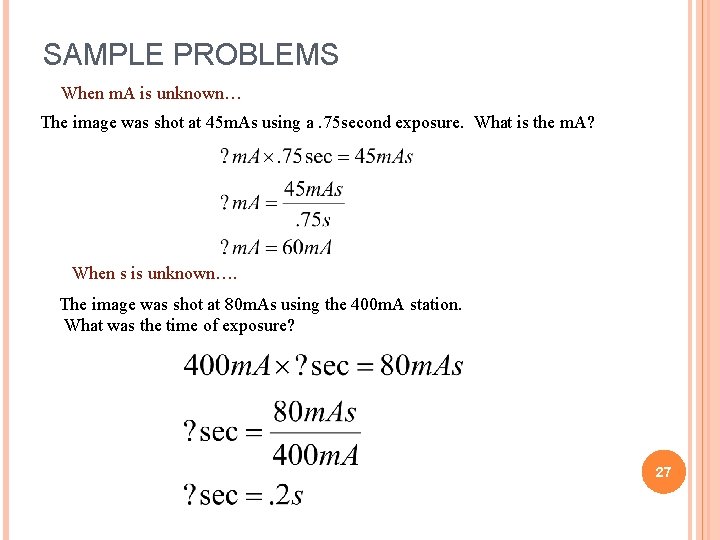
SAMPLE PROBLEMS When m. A is unknown… The image was shot at 45 m. As using a. 75 second exposure. What is the m. A? When s is unknown…. The image was shot at 80 m. As using the 400 m. A station. What was the time of exposure? 27
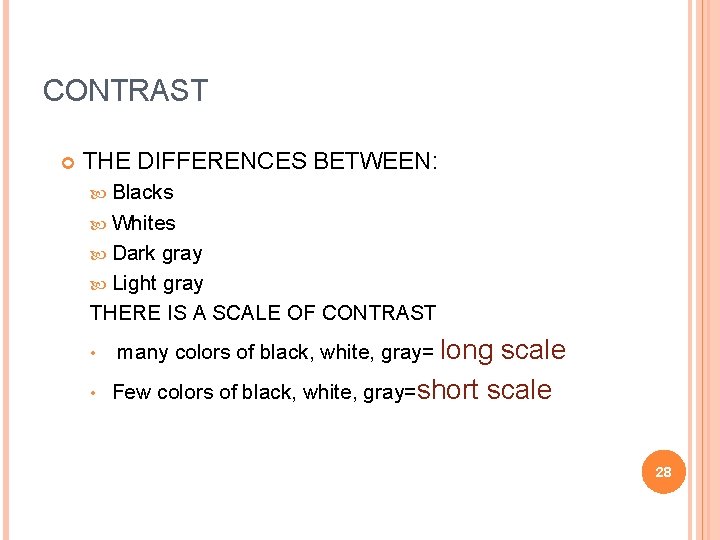
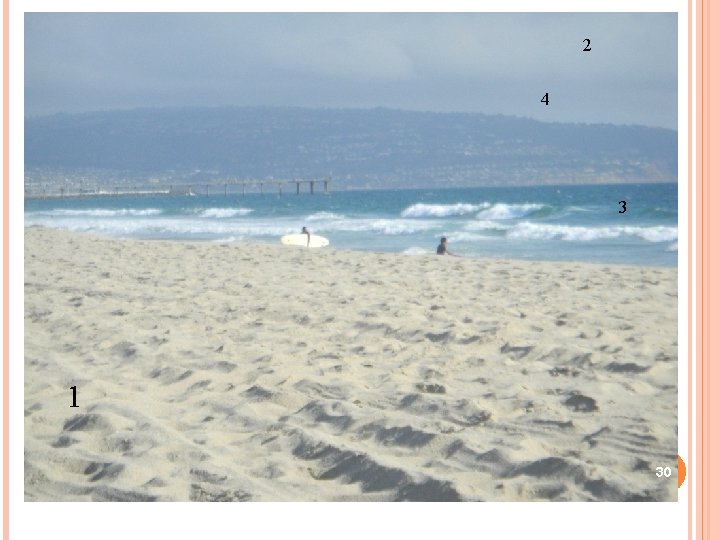
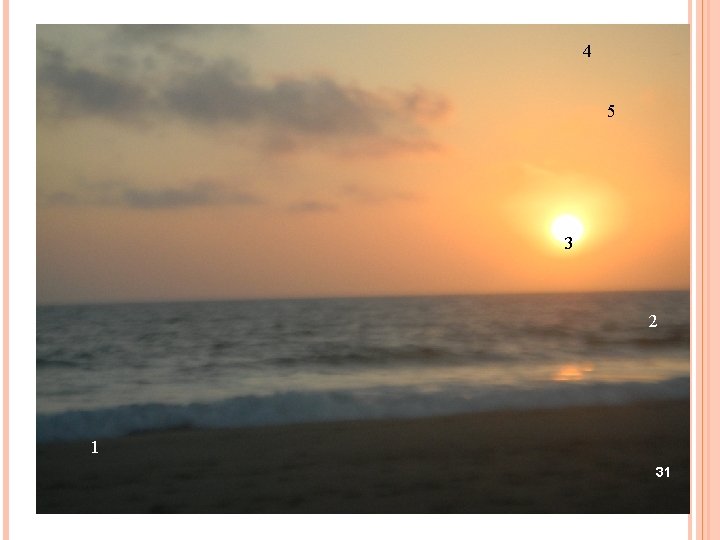
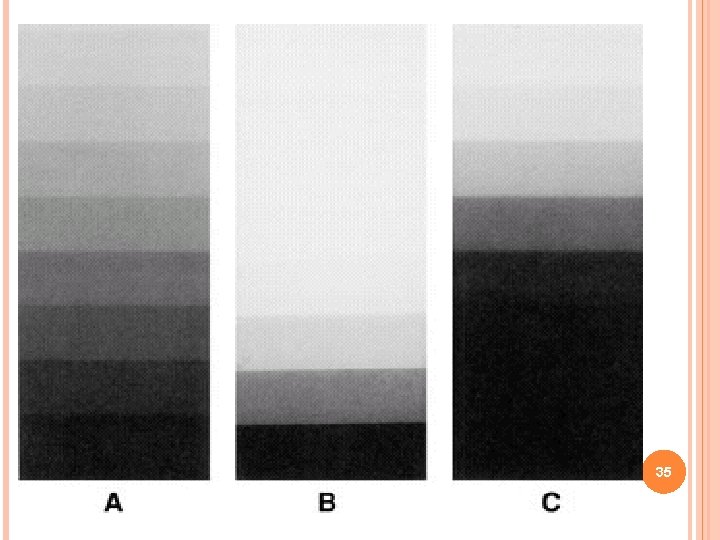
CONTRAST THE DIFFERENCES BETWEEN: Blacks Whites Dark gray Light gray THERE IS A SCALE OF CONTRAST • • many colors of black, white, gray= long scale Few colors of black, white, gray=short scale 28
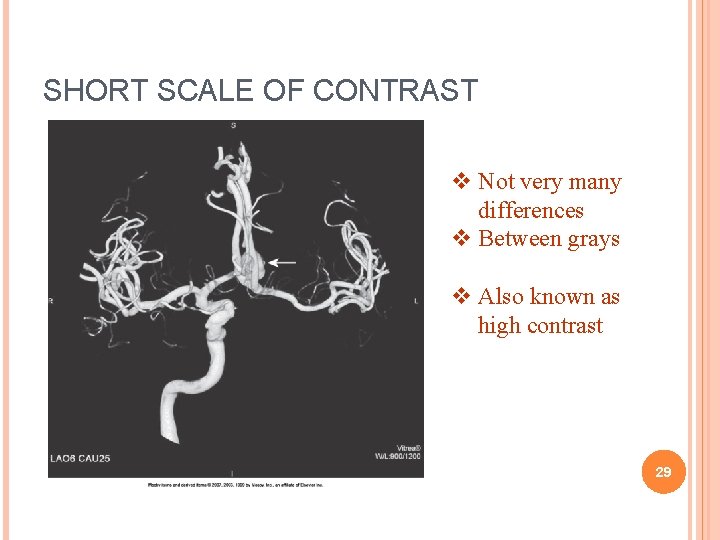
SHORT SCALE OF CONTRAST v Not very many differences v Between grays v Also known as high contrast 29
2 4 3 1 30
4 5 3 2 1 31
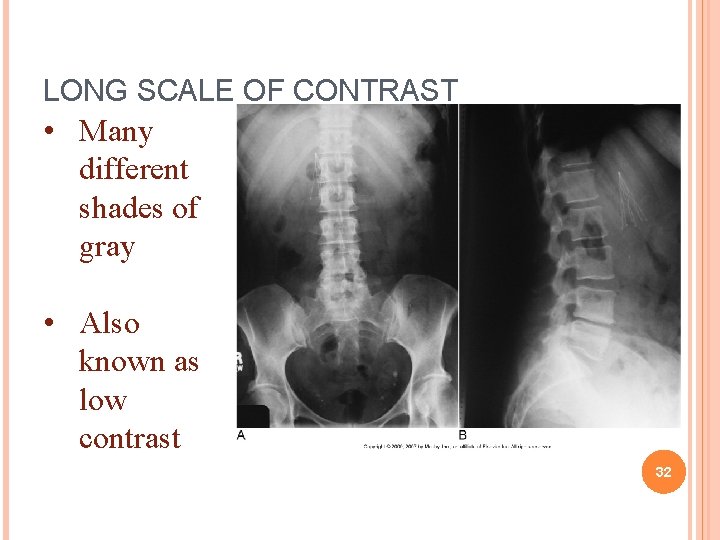
LONG SCALE OF CONTRAST • Many different shades of gray • Also known as low contrast 32
KILOVOLTAGE PEAK (KVP) Controls contrast Controls both Contrast and Density • Although m. As is considered the primary controlling factor of density, k. Vp also can affect density of the image. Penetrating Ability Determines the quality of the x-ray beam • The higher the k. Vp, the more penetrating the beam is, the denser tissue it can travel through. Referred to as the strength of the beam. Poly-energetic Beam The x-ray beam has multiple photons with many different energy levels. • Created by both Brems (multiple energy photons) and characteristic types of radiation, the x-ray beam quality is absolutely controlled by the k. Vp. The energy ranges from 0 to the peak k. V. It can also be termed heterogeneous beam energy. 33
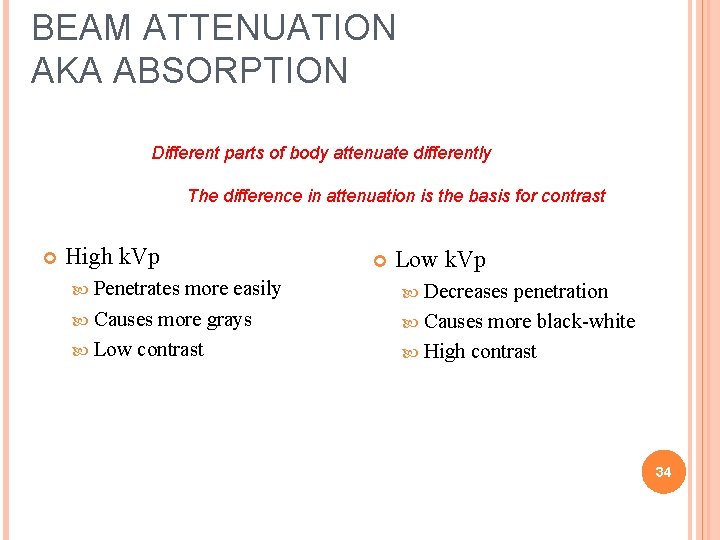
BEAM ATTENUATION AKA ABSORPTION Different parts of body attenuate differently The difference in attenuation is the basis for contrast High k. Vp Penetrates more easily Causes more grays Low contrast Low k. Vp Decreases penetration Causes more black-white High contrast 34
35
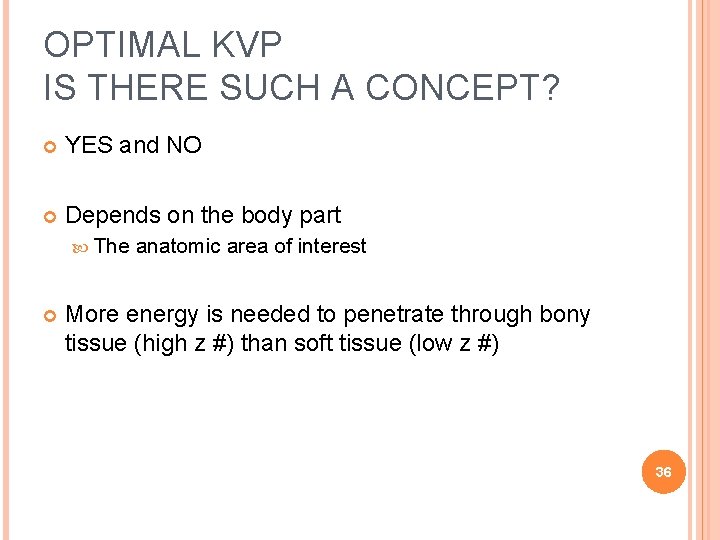
OPTIMAL KVP IS THERE SUCH A CONCEPT? YES and NO Depends on the body part The anatomic area of interest More energy is needed to penetrate through bony tissue (high z #) than soft tissue (low z #) 36
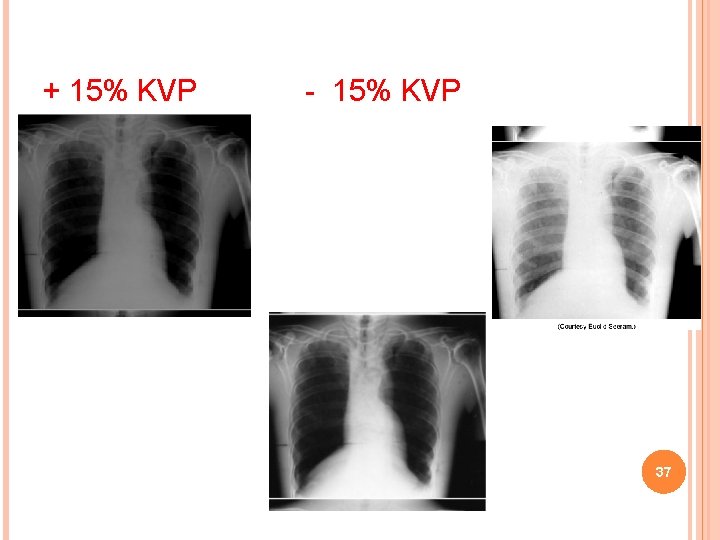
+ 15% KVP - 15% KVP 37
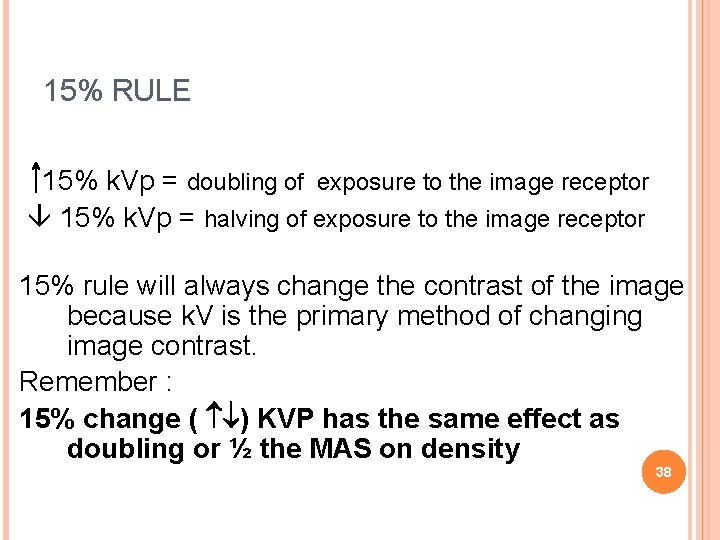
15% RULE 15% k. Vp = doubling of exposure to the image receptor 15% k. Vp = halving of exposure to the image receptor 15% rule will always change the contrast of the image because k. V is the primary method of changing image contrast. Remember : 15% change ( ) KVP has the same effect as doubling or ½ the MAS on density 38
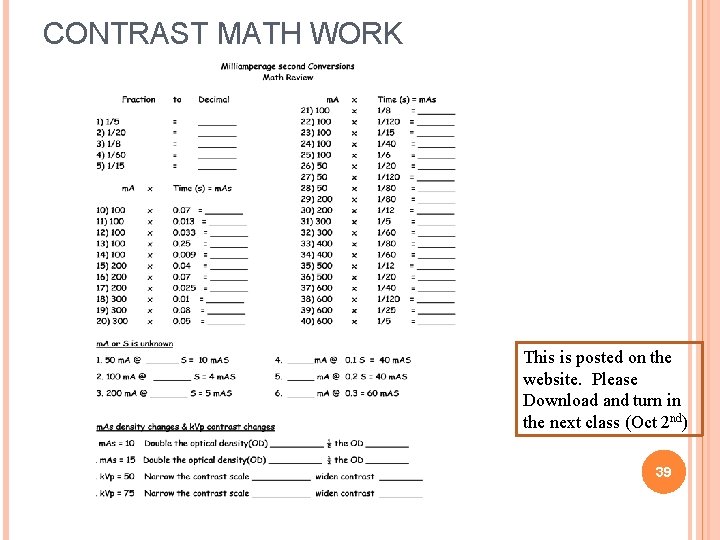
CONTRAST MATH WORK This is posted on the website. Please Download and turn in the next class (Oct 2 nd) 39
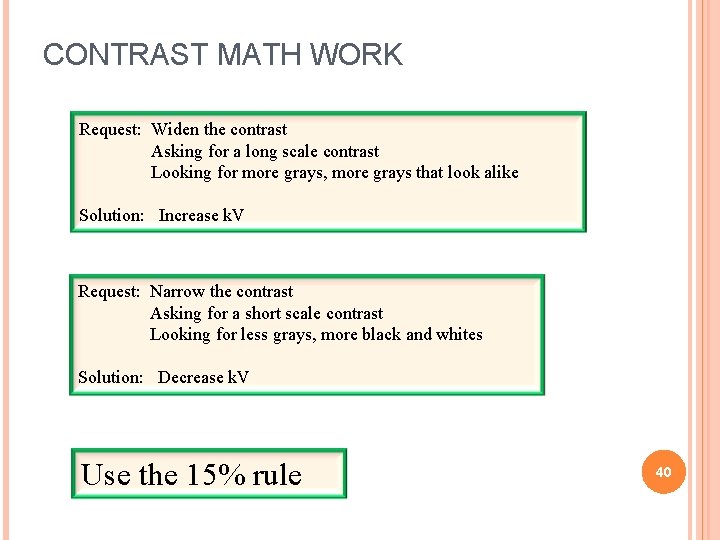
CONTRAST MATH WORK Request: Widen the contrast Asking for a long scale contrast Looking for more grays, more grays that look alike Solution: Increase k. V Request: Narrow the contrast Asking for a short scale contrast Looking for less grays, more black and whites Solution: Decrease k. V Use the 15% rule 40
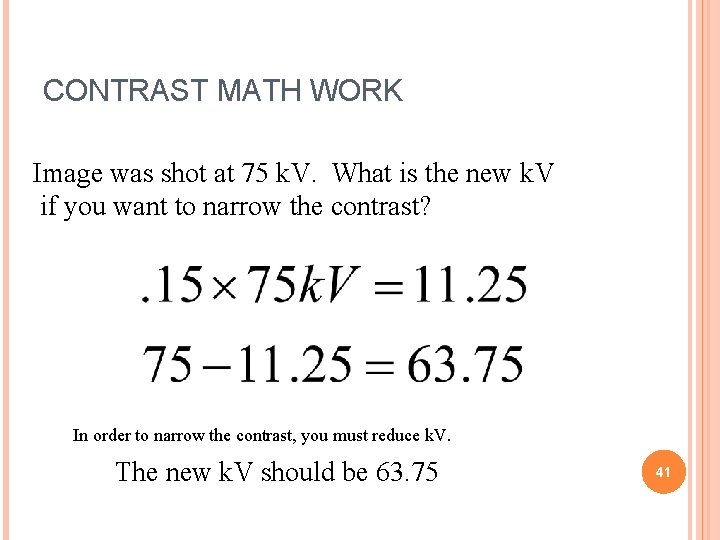
CONTRAST MATH WORK Image was shot at 75 k. V. What is the new k. V if you want to narrow the contrast? In order to narrow the contrast, you must reduce k. V. The new k. V should be 63. 75 41
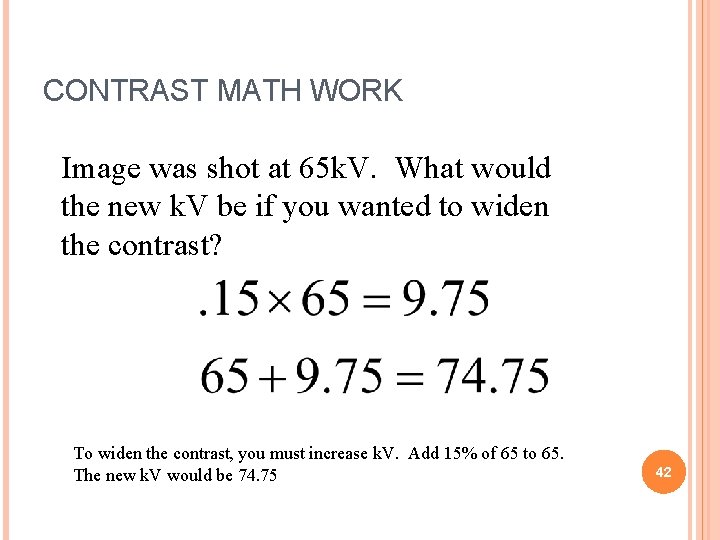
CONTRAST MATH WORK Image was shot at 65 k. V. What would the new k. V be if you wanted to widen the contrast? To widen the contrast, you must increase k. V. Add 15% of 65 to 65. The new k. V would be 74. 75 42
VARIABLES THAT AFFECT DENSITY Patient size Thickness of body part Tissue composition Z# m. As k. Vp Source image receptor distance (SID) The use of filter (we will cover later) Image receptor The distance from the tube to the image receptor The closer the tube, the more photons hit target Beam modification Bone, muscle, soft tissue, water, air The use of grid vs. non-grid, film , CR, DR (we will cover later) Processing Chemistry, time in chemistry (we will cover later 43
SOURCE TO IMAGE RECEPTOR DISTANCE 44 SID -controlled and manipulated in the x-ray room
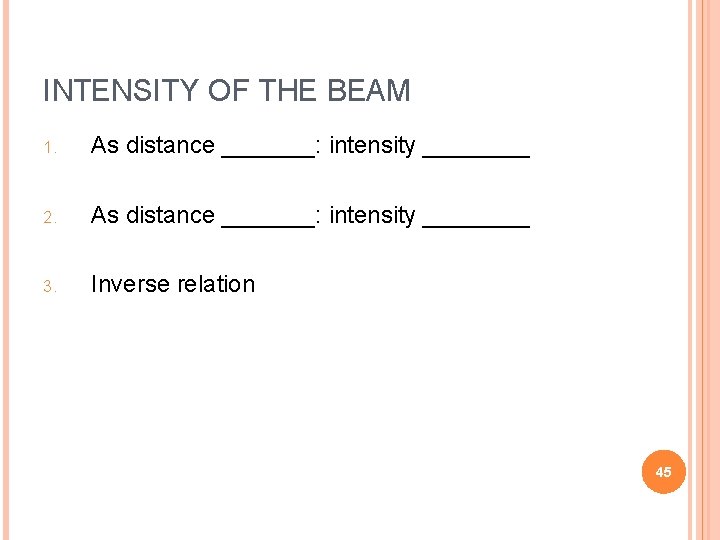
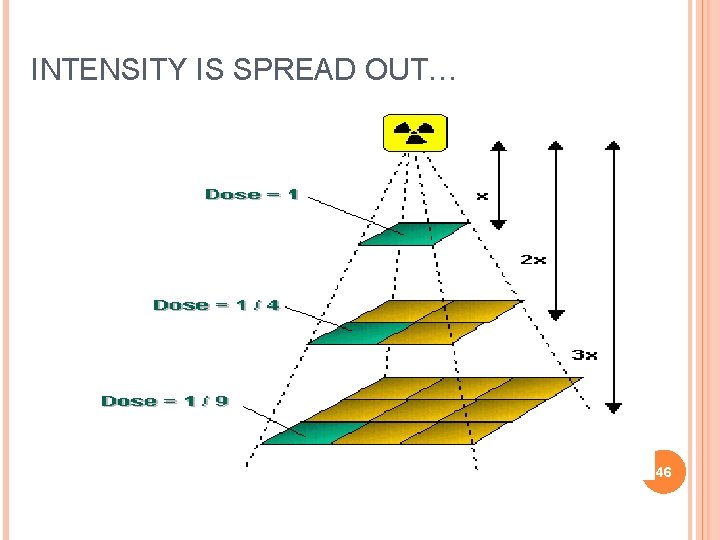
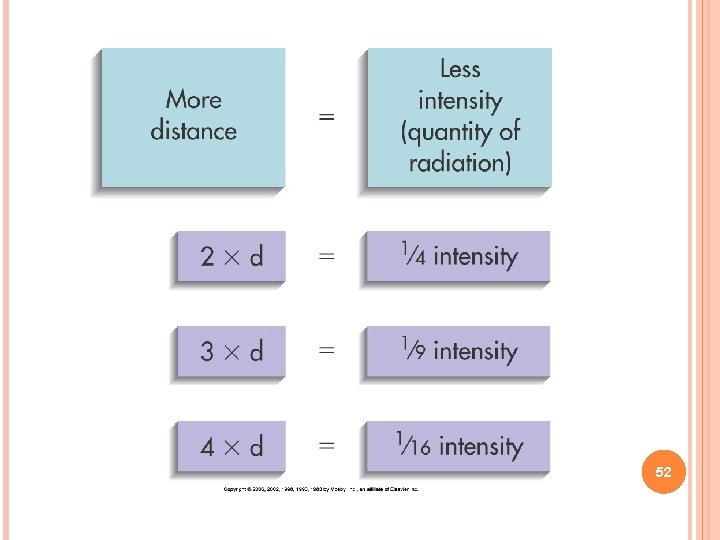
INTENSITY OF THE BEAM 1. As distance _______: intensity ____ 2. As distance _______: intensity ____ 3. Inverse relation 45
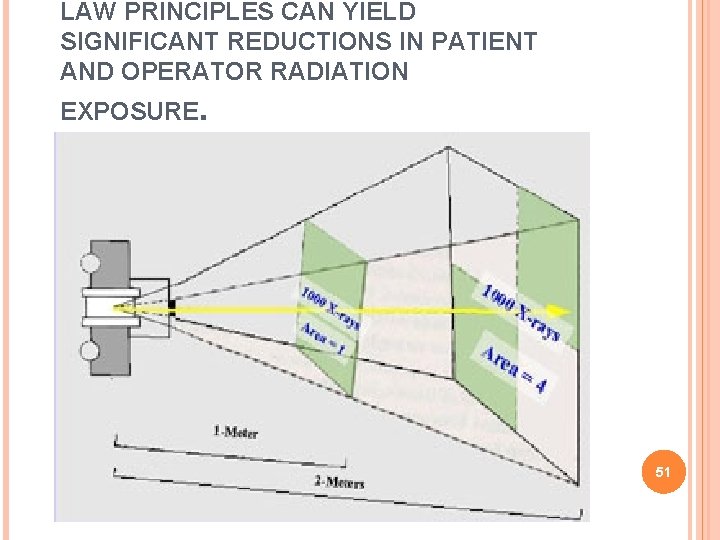
INTENSITY IS SPREAD OUT… 46
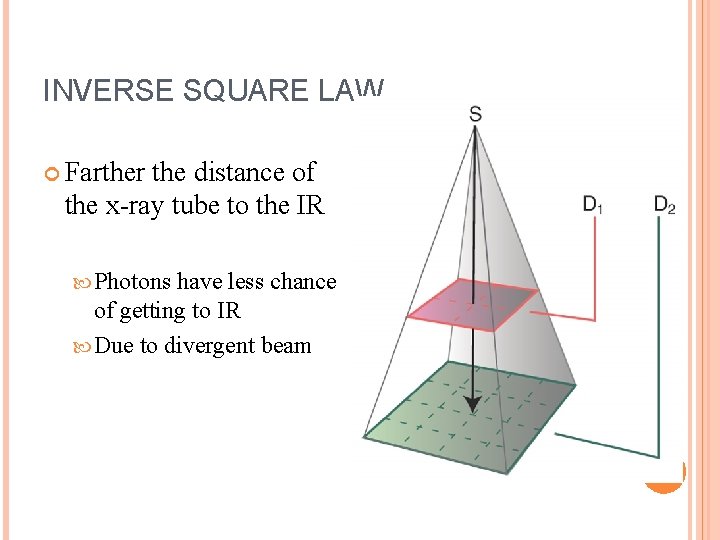
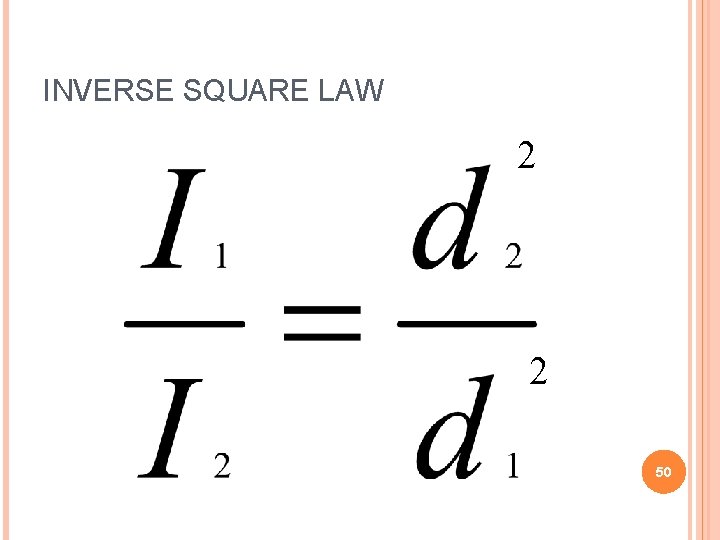
INVERSE SQUARE LAW Farther the distance of the x-ray tube to the IR Photons have less chance of getting to IR Due to divergent beam 47
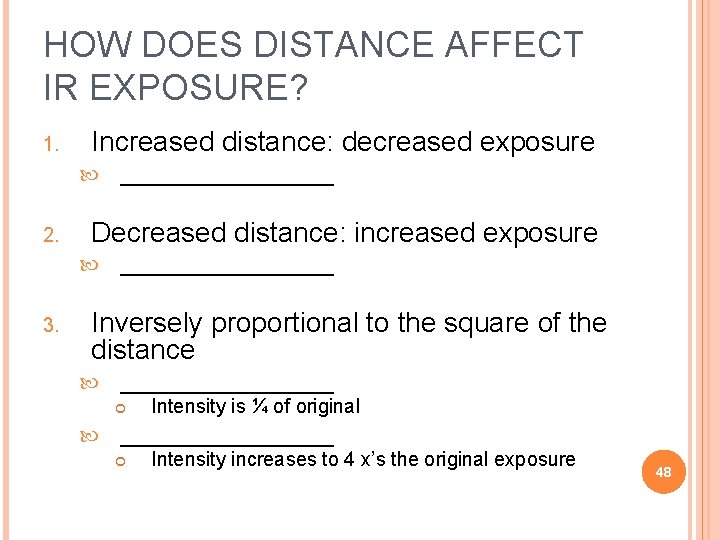
HOW DOES DISTANCE AFFECT IR EXPOSURE? 1. Increased distance: decreased exposure 2. Decreased distance: increased exposure 3. ________________ Inversely proportional to the square of the distance ________ Intensity is ¼ of original ________ Intensity increases to 4 x’s the original exposure 48
INVERSE SQUARE LAW Used for RADIATION PROTECTION When you change your distance from the “radiation source” The intensity of radiation will be reduced by a square of the distance MOVING AWAY FROM THE SOURCE INCREASED – CLOSER TO SOURCE 49
INVERSE SQUARE LAW 2 2 50
LAW PRINCIPLES CAN YIELD SIGNIFICANT REDUCTIONS IN PATIENT AND OPERATOR RADIATION EXPOSURE. 51
52
53
54
55
56
57