
ExpositoryInformational Writing The How and Why of Writing
- Slides: 17
Expository/Informational Writing The “How and Why” of Writing
What is Expository Writing? • Expository writing is defined as presenting reasons, explanations, or steps in a process • Informational writing • An expository essay should follow a logical sequence and have three different main points • Logic and coherence is the main focus of an expository essay
How is it different ? • Expository writing does not tell a story • Expository writing does not persuade a reader but only gives facts and reasons • Expository writing can also give the steps of a process
Expository Writing • Introduction of an expository should include the main idea and what the essay is about • The three main reasons supporting this main idea should also be included in the introduction
Expository writing contd. • Paragraph two should introduce the first reason and give details to support the first reason • Paragraph three should introduce the second reason and give details to support the second reason • Paragraph four should introduce third reason and give details to support the third reason • The conclusion should re-state all the reasons
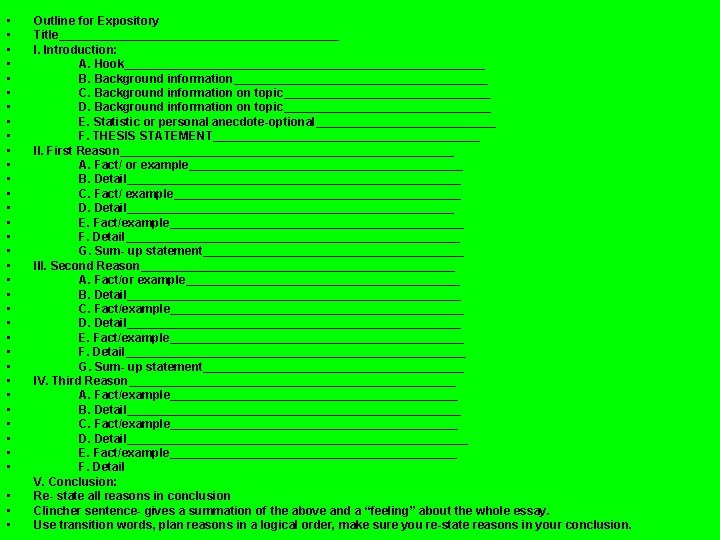
• • • • • • • • • Outline for Expository Title_____________________ I. Introduction: A. Hook___________________________ B. Background information___________________ C. Background information on topic________________ D. Background information on topic________________ E. Statistic or personal anecdote-optional______________ F. THESIS STATEMENT____________________ II. First Reason_________________________ A. Fact/ or example_____________________ B. Detail_________________________ C. Fact/ example______________________ D. Detail_________________________ E. Fact/example______________________ F. Detail_________________________ G. Sum- up statement____________________ III. Second Reason________________________ A. Fact/or example_____________________ B. Detail_________________________ C. Fact/example______________________ D. Detail_________________________ E. Fact/example______________________ F. Detail__________________________ G. Sum- up statement____________________ IV. Third Reason_________________________ A. Fact/example______________________ B. Detail_________________________ C. Fact/example______________________ D. Detail__________________________ E. Fact/example______________________ F. Detail V. Conclusion: Re- state all reasons in conclusion Clincher sentence- gives a summation of the above and a “feeling” about the whole essay. Use transition words, plan reasons in a logical order, make sure you re-state reasons in your conclusion.
Definition of Terms • Thesis Statement: The main idea of the whole essay • Transition words: Words such as first, second, as a result, which make transitions easy in the essay. • Main Ideas: Each paragraph should have a main point or idea • Supporting Details: Details support the main ideas
Re-Cap: Expository writing needs: • • • One topic Reasons supporting that topic Details supporting the reasons A conclusion re-stating the reasons Transition words Clear, concise, logical and informative language
Details • • Can be descriptive Can be factual Can be from personal experience Can be anecdotes
Paragraph One • Thesis statement • Background information on your three topics • I admire friends with great qualities. Three qualities I admire are: loyalty, honesty, a good sense of humor.
Paragraph 2 • Put main idea for paragraph 2 on the outline • Add your details • Personal experiences • Descriptive details-describe experience • Facts about the topic • Short anecdotes
Paragraph 3 • • Put your main idea on the outline Add your details Personal experiences Description of how the topic works itself out • Examples of the topic
Paragraph 4 • Add your main idea onto your outline • Add your details • Personal examples of how the idea has been experienced by you in your life • Describe how the idea “ looks” or what the person does • Facts
Conclusion • Re-state all of your ideas in your conclusion
Transition words • • • Add your transition words First Second Third Finally, or In Conclusion
Introduction • Now let’s write the introduction together, now that we know what we are writing about. • 1. Hook- Hook your reader with a question, quote, short anecdote, or personal experience statement
Thesis Statement • The thesis statement can be first in the paragraph, last in the paragraph or implied throughout the paragraph • Example: I would like to change the world by improving the poverty situation in our world, alleviating crime, and helping the homeless.