
Expository vs Persuasive Expository writing w has a
- Slides: 25
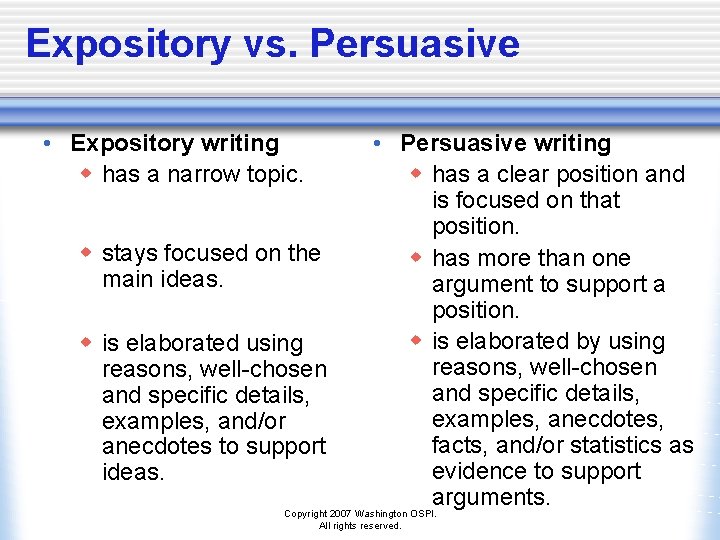
Expository vs. Persuasive • Expository writing w has a narrow topic. w stays focused on the main ideas. w is elaborated using reasons, well-chosen and specific details, examples, and/or anecdotes to support ideas. • Persuasive writing w has a clear position and is focused on that position. w has more than one argument to support a position. w is elaborated by using reasons, well-chosen and specific details, examples, anecdotes, facts, and/or statistics as evidence to support arguments. Copyright 2007 Washington OSPI. All rights reserved.
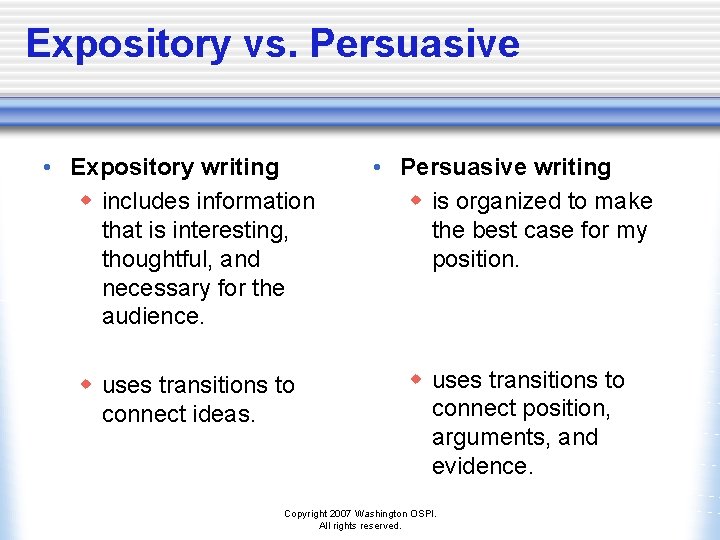
Expository vs. Persuasive • Expository writing w includes information that is interesting, thoughtful, and necessary for the audience. w uses transitions to connect ideas. • Persuasive writing w is organized to make the best case for my position. w uses transitions to connect position, arguments, and evidence. Copyright 2007 Washington OSPI. All rights reserved.
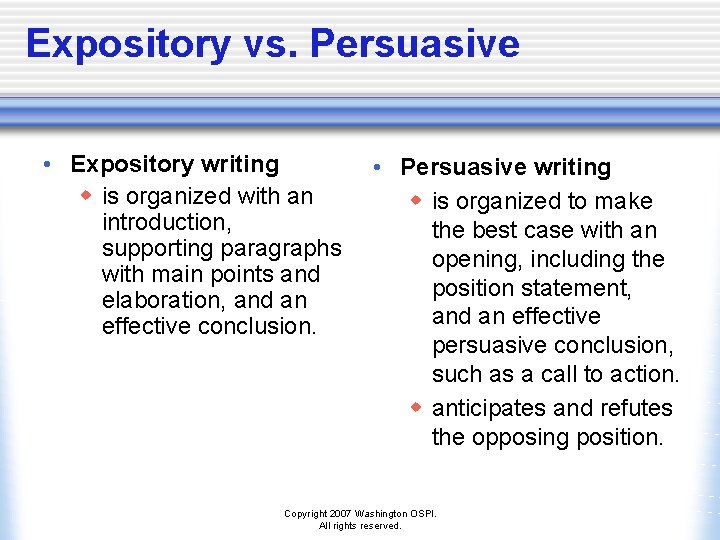
Expository vs. Persuasive • Expository writing w is organized with an introduction, supporting paragraphs with main points and elaboration, and an effective conclusion. • Persuasive writing w is organized to make the best case with an opening, including the position statement, and an effective persuasive conclusion, such as a call to action. w anticipates and refutes the opposing position. Copyright 2007 Washington OSPI. All rights reserved.
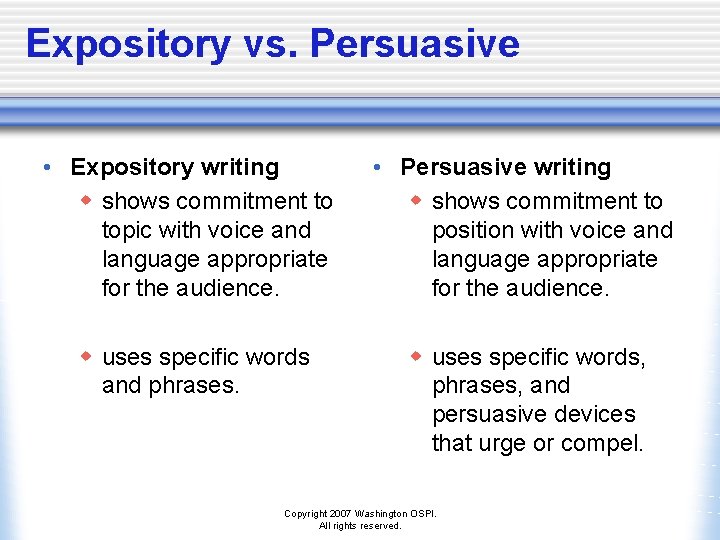
Expository vs. Persuasive • Expository writing w shows commitment to topic with voice and language appropriate for the audience. • Persuasive writing w shows commitment to position with voice and language appropriate for the audience. w uses specific words and phrases. w uses specific words, phrases, and persuasive devices that urge or compel. Copyright 2007 Washington OSPI. All rights reserved.
Persuasive Example The purpose of persuasive writing is to persuade. Some late work counts as 70% credit, giving kids a Cwhich is passing. Some kids are happy because they think a C- is a good grade. How can we allow students to turn in all of their work late but still have a passing grade? The kids that have C-’s don’t care about their work because even if they turn it in late, they can still get a passing grade. These kids have sort of twisted the grading system to benefit themselves. This can no longer be allowed. Copyright 2007 Washington OSPI. All rights reserved.
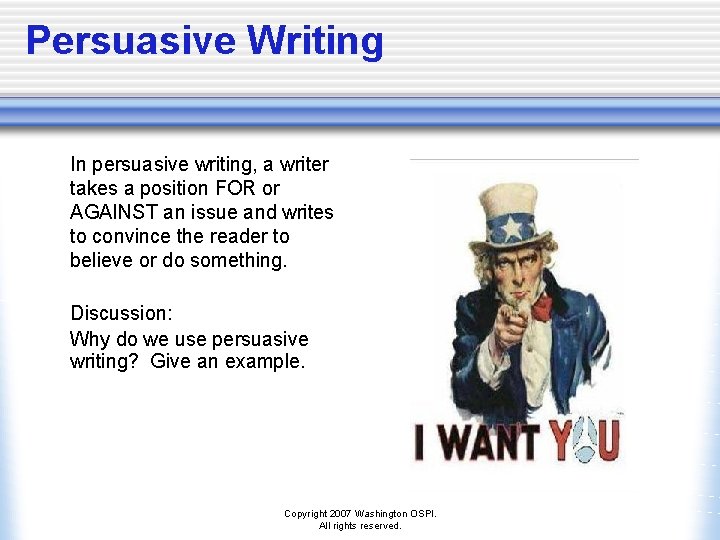
Persuasive Writing In persuasive writing, a writer takes a position FOR or AGAINST an issue and writes to convince the reader to believe or do something. Discussion: Why do we use persuasive writing? Give an example. Copyright 2007 Washington OSPI. All rights reserved.
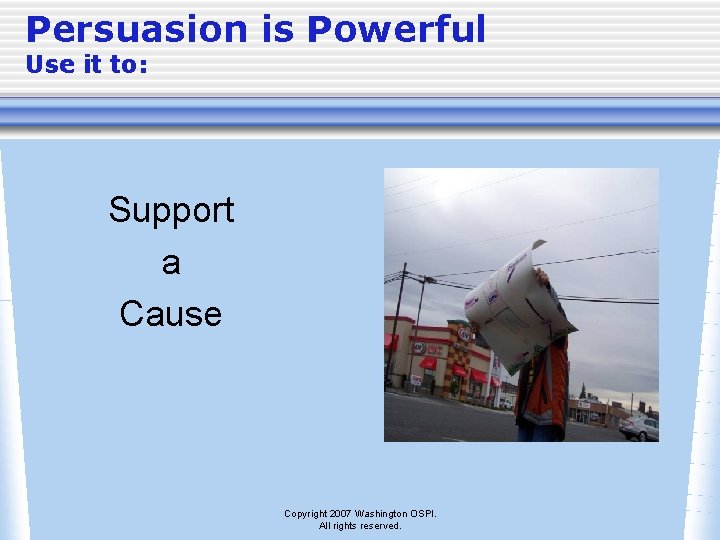
Persuasion is Powerful Use it to: Support a Cause Copyright 2007 Washington OSPI. All rights reserved.
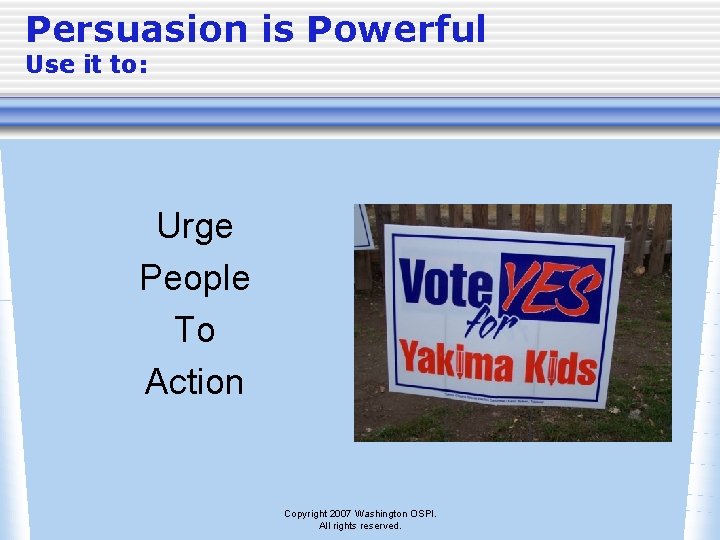
Persuasion is Powerful Use it to: Urge People To Action Copyright 2007 Washington OSPI. All rights reserved.
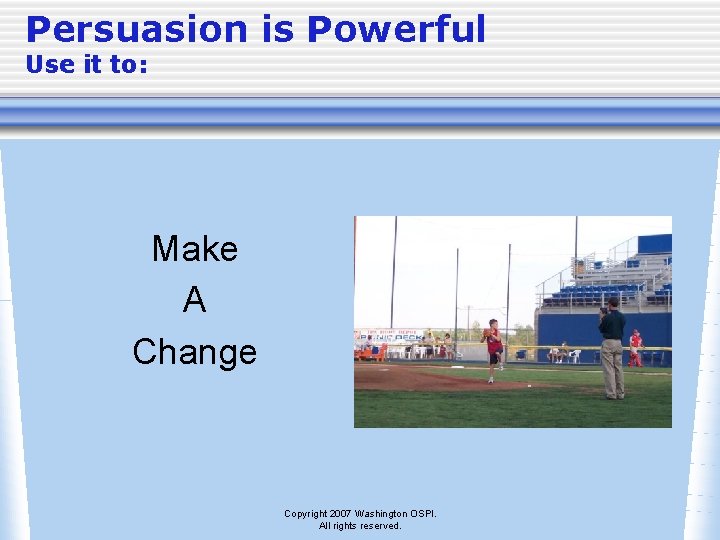
Persuasion is Powerful Use it to: Make A Change Copyright 2007 Washington OSPI. All rights reserved.
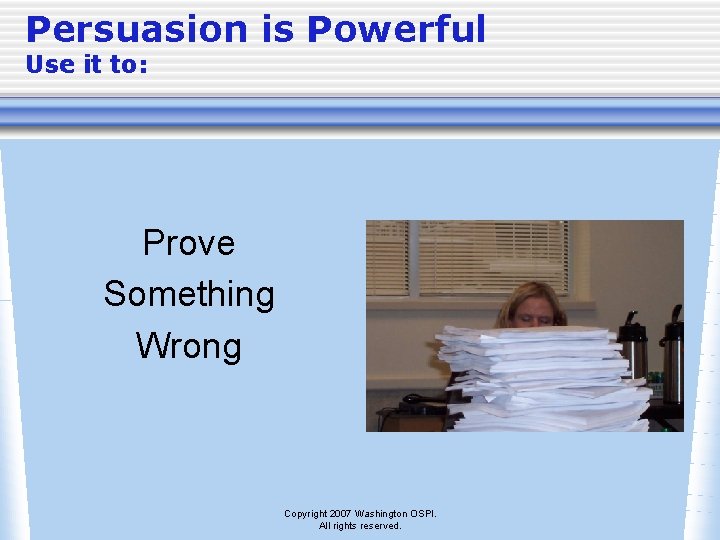
Persuasion is Powerful Use it to: Prove Something Wrong Copyright 2007 Washington OSPI. All rights reserved.
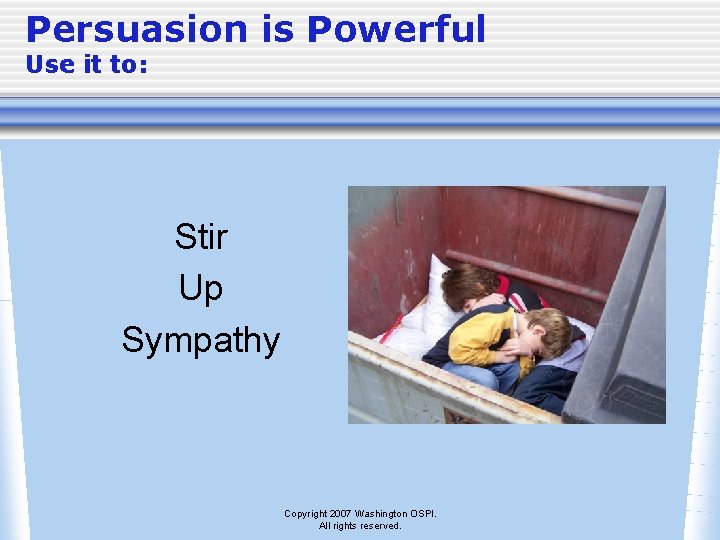
Persuasion is Powerful Use it to: Stir Up Sympathy Copyright 2007 Washington OSPI. All rights reserved.
Persuasion is Powerful Use it to: Create Interest Copyright 2007 Washington OSPI. All rights reserved.
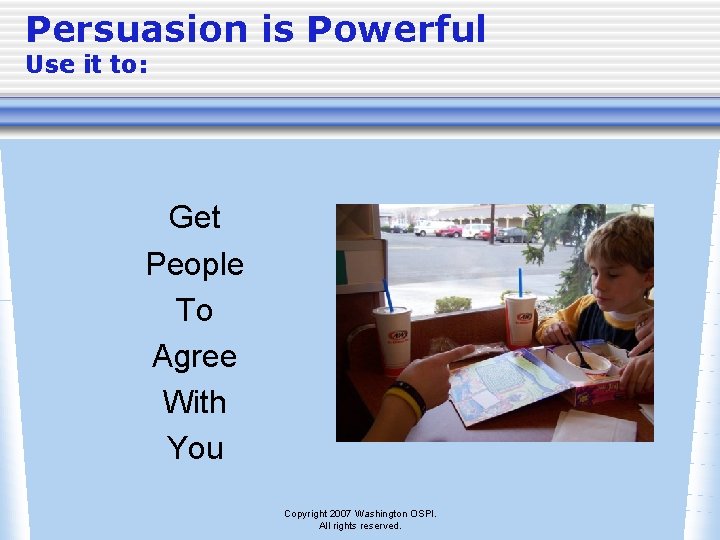
Persuasion is Powerful Use it to: Get People To Agree With You Copyright 2007 Washington OSPI. All rights reserved.
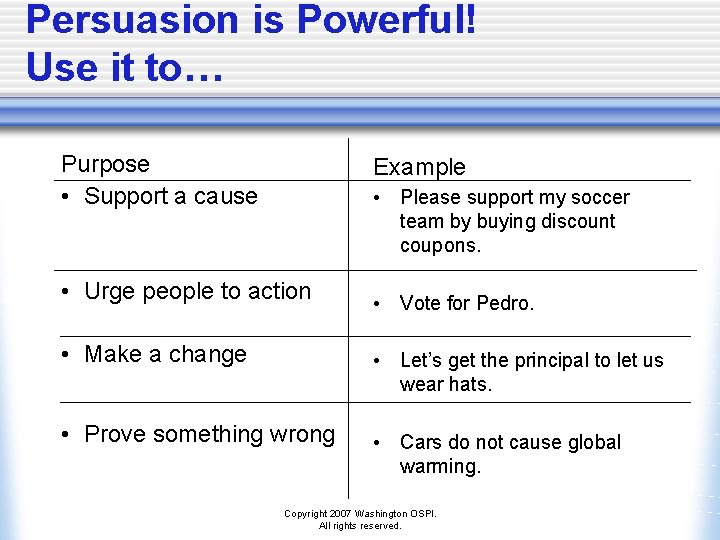
Persuasion is Powerful! Use it to… Purpose • Support a cause Example • Please support my soccer team by buying discount coupons. • Urge people to action • Make a change • Vote for Pedro. • Let’s get the principal to let us wear hats. • Prove something wrong • Cars do not cause global warming. Copyright 2007 Washington OSPI. All rights reserved.
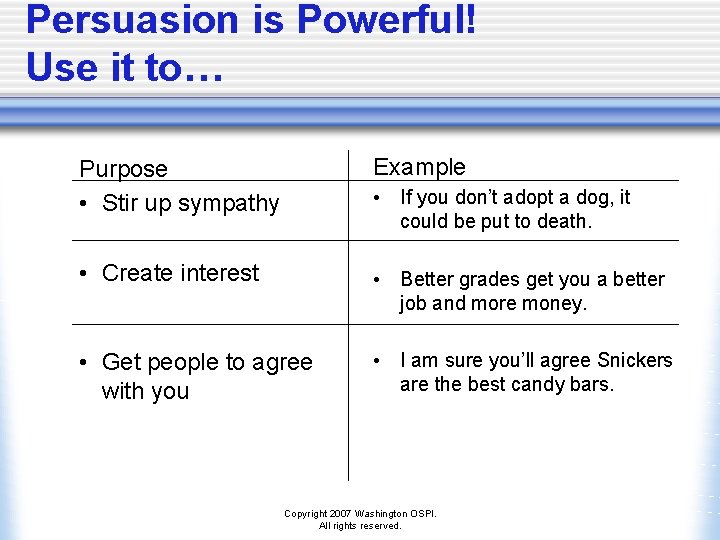
Persuasion is Powerful! Use it to… Purpose • Stir up sympathy Example • Create interest • Better grades get you a better job and more money. • Get people to agree with you • I am sure you’ll agree Snickers are the best candy bars. • If you don’t adopt a dog, it could be put to death. Copyright 2007 Washington OSPI. All rights reserved.
Audience Awareness • Know your audience before you start writing. w The audience is who will read your writing. w The audience may include your teacher, your parents, your friends, or the President of the United States. • Think about the needs of your reader (audience) so you can give reasons that will persuade him/her. Copyright 2007 Washington OSPI. All rights reserved.
Audience Awareness • Knowing your audience helps you to decide w How to connect with the ideas, knowledge, or beliefs of the person or group w What information to include w How informal or formal the language should be Copyright 2007 Washington OSPI. All rights reserved.
Clear Position The writer must have a clear position and stay focused on that position. Generally, the position is stated in the opening paragraph or introduction. Copyright 2007 Washington OSPI. All rights reserved.
Clear Position — example Anxiety creases the brows of many students trying to finish their homework on time. If they don’t finish on time they won’t get any credit. Having a no late homework rule is a very bad idea. Students’ grades will drop, their work will be of lesser quality, and school won’t feel as welcoming. Students won’t be able to do work worth a lot of merit. Copyright 2007 Washington OSPI. All rights reserved.
Persuasive Language Persuasive language is choosing just the right words or phrases to use at just the right time with just the right audience. w Strong words trigger strong feelings. § Snatches § Snarls § Dumbstruck w Repeated words or phrases for emphasis § I have a dream…(Martin Luther King, Jr. ) w Effective choice of connotations § Mean or strict § Died or passed away § Used or pre-owned Copyright 2007 Washington OSPI. All rights reserved.
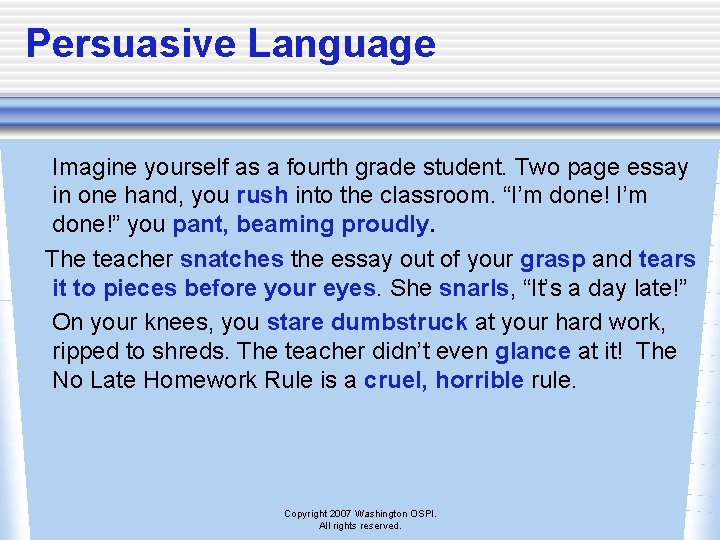
Persuasive Language Imagine yourself as a fourth grade student. Two page essay in one hand, you rush into the classroom. “I’m done!” you pant, beaming proudly. The teacher snatches the essay out of your grasp and tears it to pieces before your eyes. She snarls, “It’s a day late!” On your knees, you stare dumbstruck at your hard work, ripped to shreds. The teacher didn’t even glance at it! The No Late Homework Rule is a cruel, horrible rule. Copyright 2007 Washington OSPI. All rights reserved.
Organizational Structure Argument / Counter Argument Concession / Rebuttal Copyright 2007 Washington OSPI. All rights reserved.
Organizational Structure • Strategies that you choose to use for persuasion dictate how the paper is organized. • Persuasive organization frequently looks very different from expository organization. • As we look at different strategies, we will see what that means regarding the organization of the paper. Copyright 2007 Washington OSPI. All rights reserved.
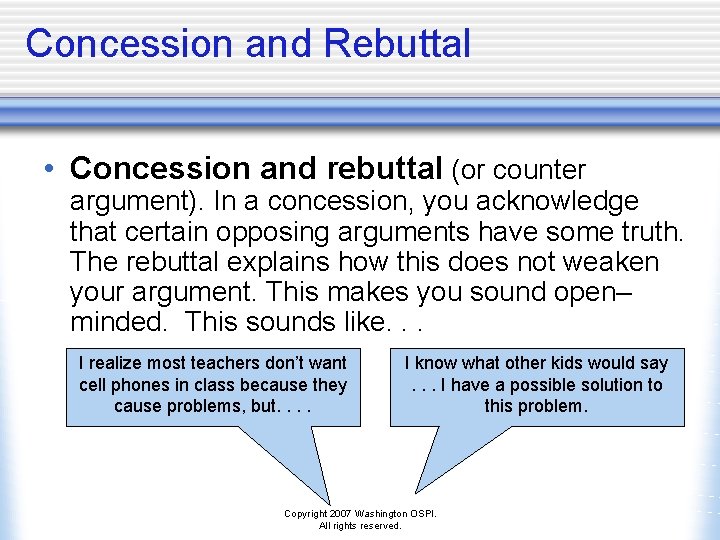
Concession and Rebuttal • Concession and rebuttal (or counter argument). In a concession, you acknowledge that certain opposing arguments have some truth. The rebuttal explains how this does not weaken your argument. This makes you sound open– minded. This sounds like. . . I realize most teachers don’t want cell phones in class because they cause problems, but. . I know what other kids would say. . . I have a possible solution to this problem. Copyright 2007 Washington OSPI. All rights reserved.
Concession and Rebuttal • Concession and rebuttal happens frequently. How many of you have been in a discussion with someone and you remember saying, “Yeah, that’s true, but…” This is concession and rebuttal. • Let’s list several situations when you have actually said something similar. Copyright 2007 Washington OSPI. All rights reserved.