
Export Control Reform Lesson Objectives Integrate PolMil principles
Export Control Reform
Lesson Objectives Integrate Pol-Mil principles into customer/partner relationships; and select and evaluate international acquisition management and technology transfer processes – Contrast prior U. S. Government and non-government export control activity and results – Relate any prior activities to personal/workplace experiences, including results and actions – Hypothesize between Do. D, Do. S, industry, and “think tank” perspectives
Export “Headlines” • Difficulties in getting U. S. Export Licenses make supply “unreliable” • Directive to select European-made components • Future designs must not be dependent on U. S. origin components • “The process is too long and unpredictable” • Desire for ‘harmonization of export rules’ • No assurance that U. S. export licenses would be approved • High probability of costly export delays … too great a risk
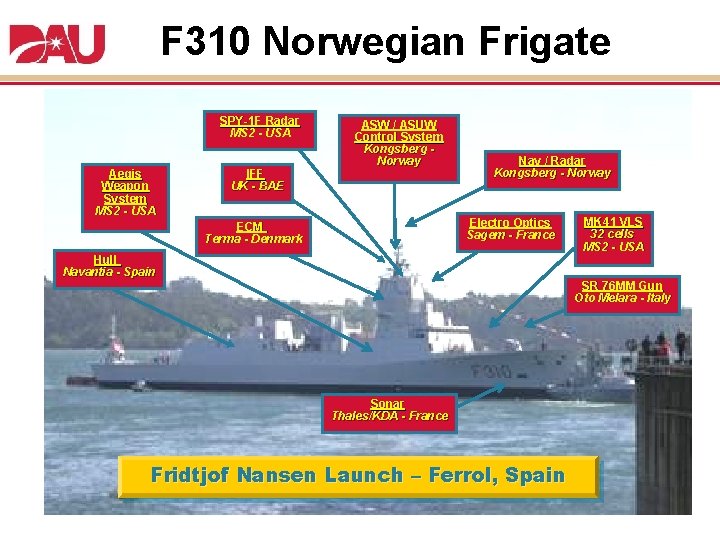
F 310 Norwegian Frigate SPY-1 F Radar MS 2 - USA Aegis Weapon System MS 2 - USA IFF UK - BAE ASW / ASUW Control System Kongsberg Norway Nav / Radar Kongsberg - Norway Electro Optics Sagem - France ECM Terma - Denmark Hull Navantia - Spain MK 41 VLS 32 cells MS 2 - USA SR 76 MM Gun Oto Melara - Italy Sonar Thales/KDA - France Fridtjof Nansen Launch – Ferrol, Spain
Have We Been Here Before? • Attempt to redraft the Export Administration Act (EAA) • Defense Trade Security Initiatives (DTSI) • National Security Decision Policy (NSDP) 19 (still classified) • Canadian exemptions to ITAR • Treaties with the UK and Australia (ratified on September 29, 2010) • National Security Presidential Directives (NSPDs) 55 & 56 (also still classified)
What Has Changed? • Geopolitical landscape has changed – Bipolar to Multipolar – Non-traditional ‘partners’ – NGOs and non-state actors • High Technology landscape has changed – Joint Strike Fighter – Nanotechnology (Japan and Korea) – Hydro, Nuclear, Solar, and Wind Power • Global economic landscape has changed – Global corporations – Quasi-government defense base
Current System and Shortcomings • U. S. has a robust export control system, but it is rooted in the Cold War – must be updated for currency • Current system may not allow for timely or flexible cooperation with allies or partners • Prolonged U. S. interagency deliberations – Commodity Jurisdiction clashes … Do. S or Do. C issue license (? ) • Past reform efforts have “nibbled around the edges” for too long – short term reform efforts at the detriment of fundamental reform • We may have squeezed all efficiencies out of current system
“Nuts and Bolts” of Technology Transfer • Andrew J. Shapiro, Assistant Secretary of State, in a recent speech (July 17, 2012) … “As the defense trade expands, the strain put on our aging export system has only increased. The USML protects too much and tries to control everything – from the weapon system, itself, to every nut, bolt, and screw that may be used on that system. The current rules were written before the Internet and smartphone age. It generally treats all items the same and applies the same controls across the board … the system doesn’t distinguish between a generic bolt on the F-16 and the F-16 itself. This, to say the least, is nuts!”
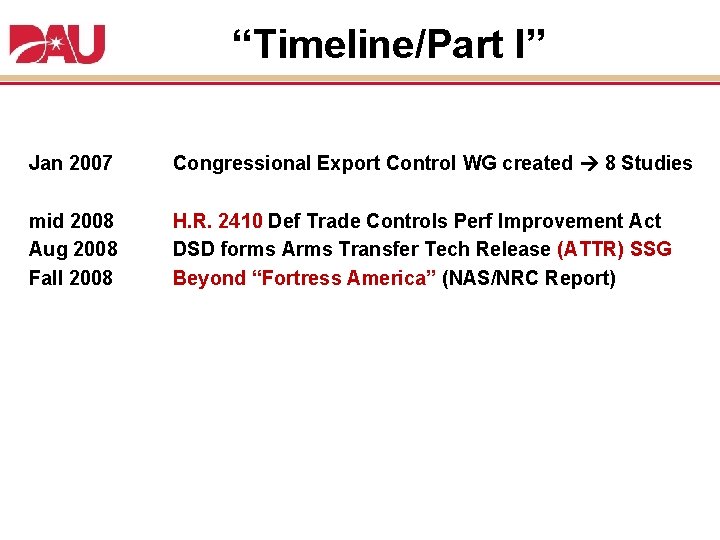
“Timeline/Part I” Jan 2007 Congressional Export Control WG created 8 Studies mid 2008 Aug 2008 Fall 2008 H. R. 2410 Def Trade Controls Perf Improvement Act DSD forms Arms Transfer Tech Release (ATTR) SSG Beyond “Fortress America” (NAS/NRC Report)
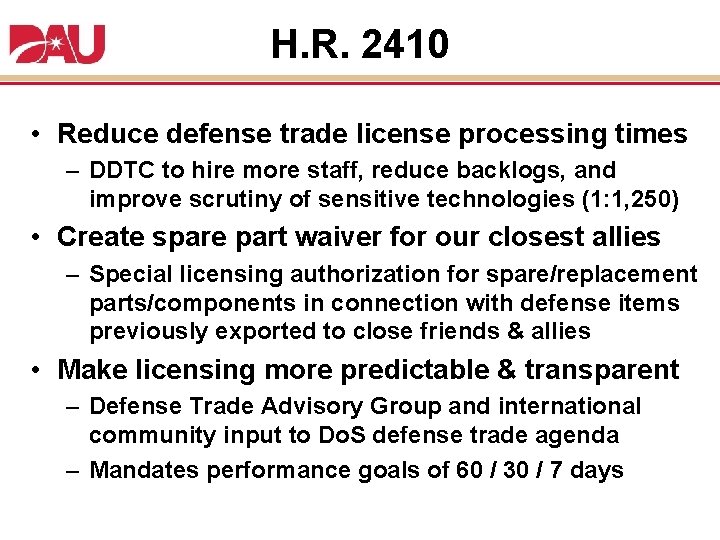
H. R. 2410 • Reduce defense trade license processing times – DDTC to hire more staff, reduce backlogs, and improve scrutiny of sensitive technologies (1: 1, 250) • Create spare part waiver for our closest allies – Special licensing authorization for spare/replacement parts/components in connection with defense items previously exported to close friends & allies • Make licensing more predictable & transparent – Defense Trade Advisory Group and international community input to Do. S defense trade agenda – Mandates performance goals of 60 / 30 / 7 days
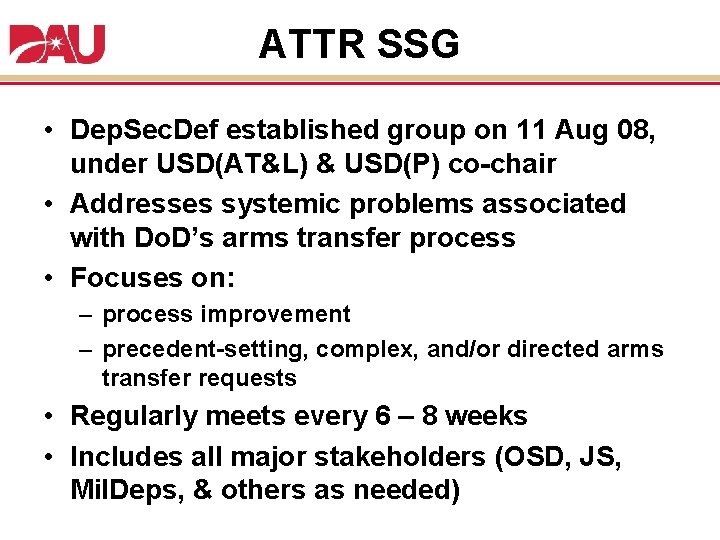
ATTR SSG • Dep. Sec. Def established group on 11 Aug 08, under USD(AT&L) & USD(P) co-chair • Addresses systemic problems associated with Do. D’s arms transfer process • Focuses on: – process improvement – precedent-setting, complex, and/or directed arms transfer requests • Regularly meets every 6 – 8 weeks • Includes all major stakeholders (OSD, JS, Mil. Deps, & others as needed)
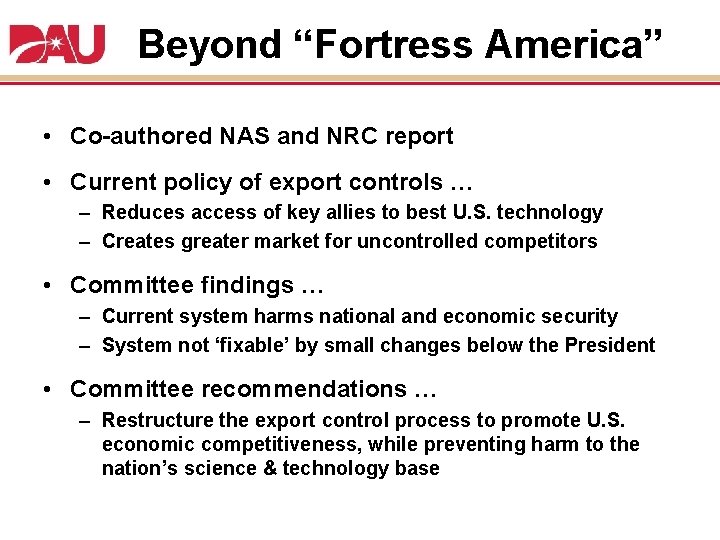
Beyond “Fortress America” • Co-authored NAS and NRC report • Current policy of export controls … – Reduces access of key allies to best U. S. technology – Creates greater market for uncontrolled competitors • Committee findings … – Current system harms national and economic security – System not ‘fixable’ by small changes below the President • Committee recommendations … – Restructure the export control process to promote U. S. economic competitiveness, while preventing harm to the nation’s science & technology base
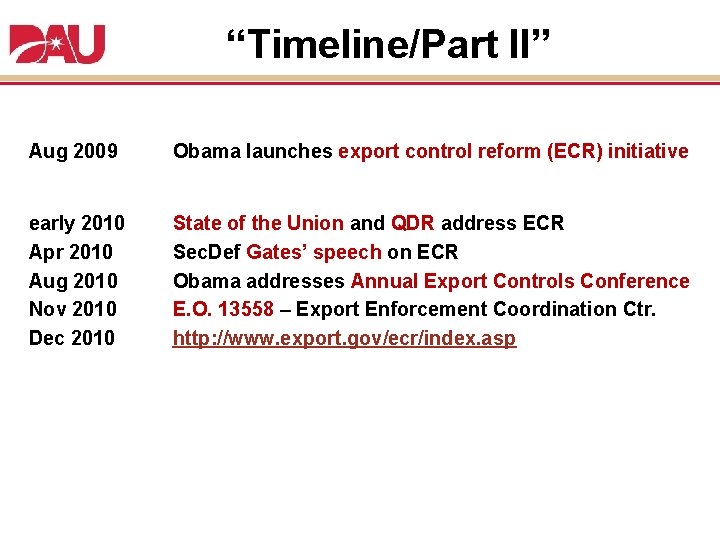
“Timeline/Part II” Aug 2009 Obama launches export control reform (ECR) initiative early 2010 Apr 2010 Aug 2010 Nov 2010 Dec 2010 State of the Union and QDR address ECR Sec. Def Gates’ speech on ECR Obama addresses Annual Export Controls Conference E. O. 13558 – Export Enforcement Coordination Ctr. http: //www. export. gov/ecr/index. asp
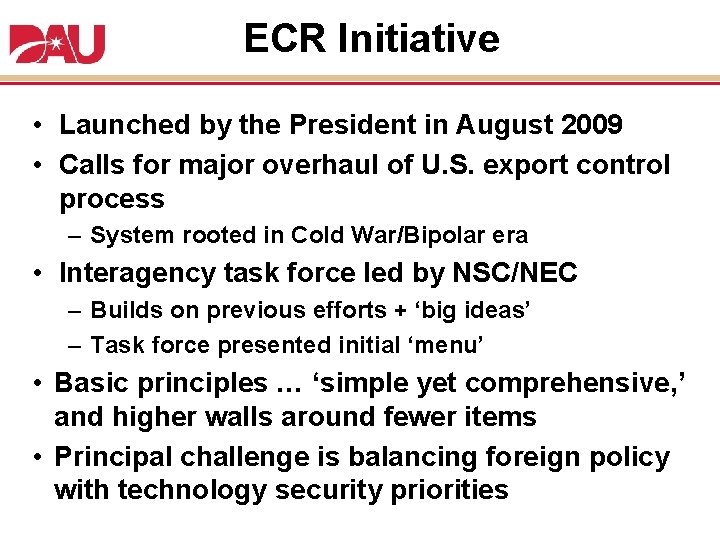
ECR Initiative • Launched by the President in August 2009 • Calls for major overhaul of U. S. export control process – System rooted in Cold War/Bipolar era • Interagency task force led by NSC/NEC – Builds on previous efforts + ‘big ideas’ – Task force presented initial ‘menu’ • Basic principles … ‘simple yet comprehensive, ’ and higher walls around fewer items • Principal challenge is balancing foreign policy with technology security priorities
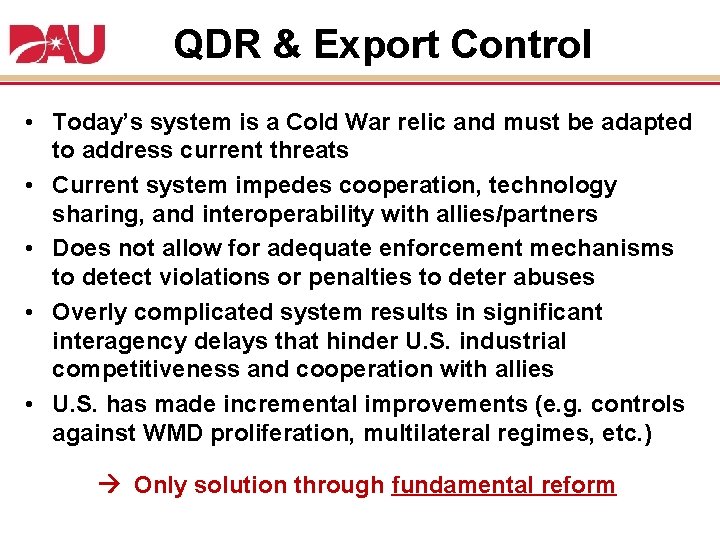
QDR & Export Control • Today’s system is a Cold War relic and must be adapted to address current threats • Current system impedes cooperation, technology sharing, and interoperability with allies/partners • Does not allow for adequate enforcement mechanisms to detect violations or penalties to deter abuses • Overly complicated system results in significant interagency delays that hinder U. S. industrial competitiveness and cooperation with allies • U. S. has made incremental improvements (e. g. controls against WMD proliferation, multilateral regimes, etc. ) Only solution through fundamental reform
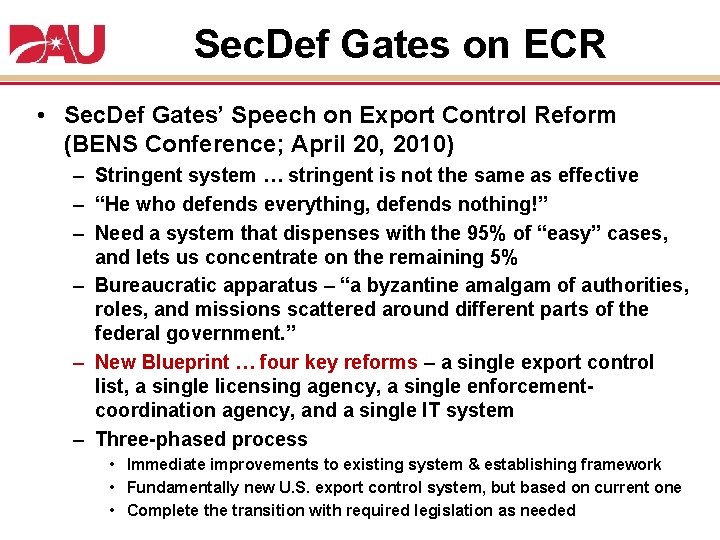
Sec. Def Gates on ECR • Sec. Def Gates’ Speech on Export Control Reform (BENS Conference; April 20, 2010) – Stringent system … stringent is not the same as effective – “He who defends everything, defends nothing!” – Need a system that dispenses with the 95% of “easy” cases, and lets us concentrate on the remaining 5% – Bureaucratic apparatus – “a byzantine amalgam of authorities, roles, and missions scattered around different parts of the federal government. ” – New Blueprint … four key reforms – a single export control list, a single licensing agency, a single enforcementcoordination agency, and a single IT system – Three-phased process • Immediate improvements to existing system & establishing framework • Fundamentally new U. S. export control system, but based on current one • Complete the transition with required legislation as needed
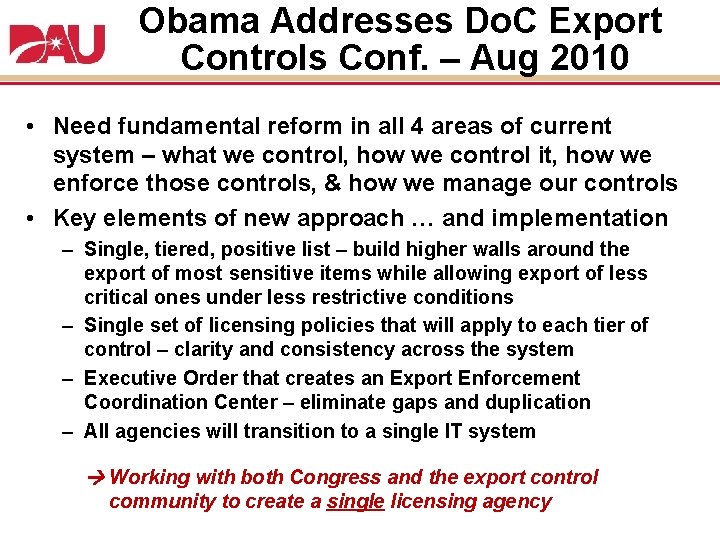
Obama Addresses Do. C Export Controls Conf. – Aug 2010 • Need fundamental reform in all 4 areas of current system – what we control, how we control it, how we enforce those controls, & how we manage our controls • Key elements of new approach … and implementation – Single, tiered, positive list – build higher walls around the export of most sensitive items while allowing export of less critical ones under less restrictive conditions – Single set of licensing policies that will apply to each tier of control – clarity and consistency across the system – Executive Order that creates an Export Enforcement Coordination Center – eliminate gaps and duplication – All agencies will transition to a single IT system Working with both Congress and the export control community to create a single licensing agency
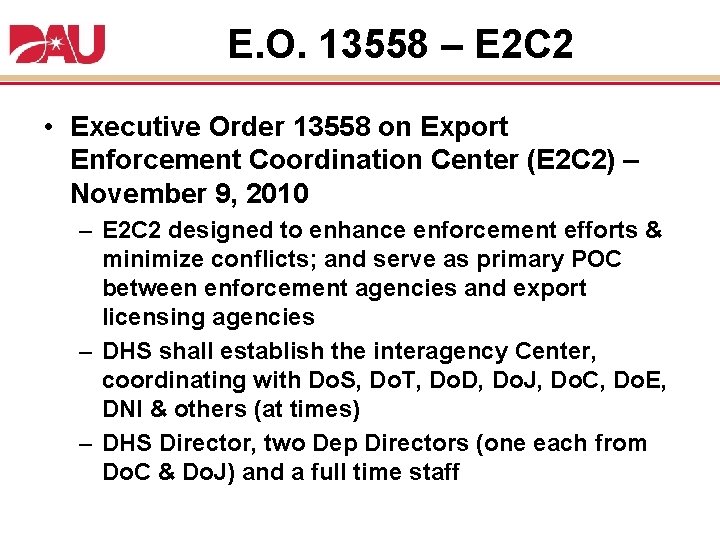
E. O. 13558 – E 2 C 2 • Executive Order 13558 on Export Enforcement Coordination Center (E 2 C 2) – November 9, 2010 – E 2 C 2 designed to enhance enforcement efforts & minimize conflicts; and serve as primary POC between enforcement agencies and export licensing agencies – DHS shall establish the interagency Center, coordinating with Do. S, Do. T, Do. D, Do. J, Do. C, Do. E, DNI & others (at times) – DHS Director, two Dep Directors (one each from Do. C & Do. J) and a full time staff
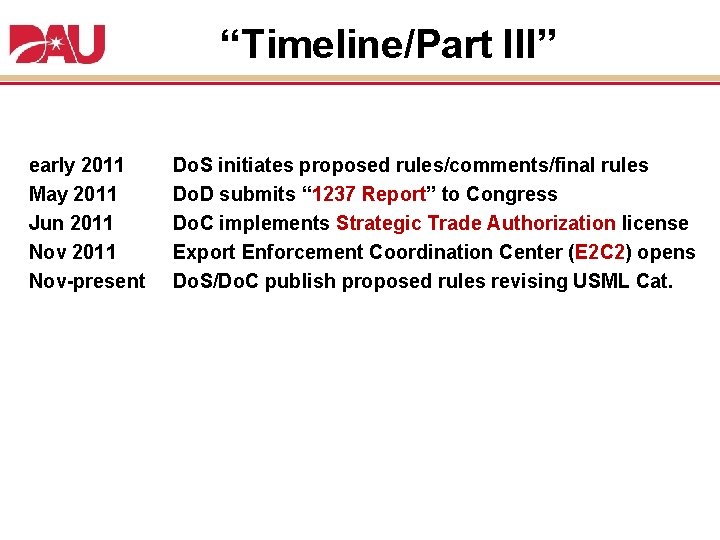
“Timeline/Part III” early 2011 May 2011 Jun 2011 Nov-present Do. S initiates proposed rules/comments/final rules Do. D submits “ 1237 Report” to Congress Do. C implements Strategic Trade Authorization license Export Enforcement Coordination Center (E 2 C 2) opens Do. S/Do. C publish proposed rules revising USML Cat.
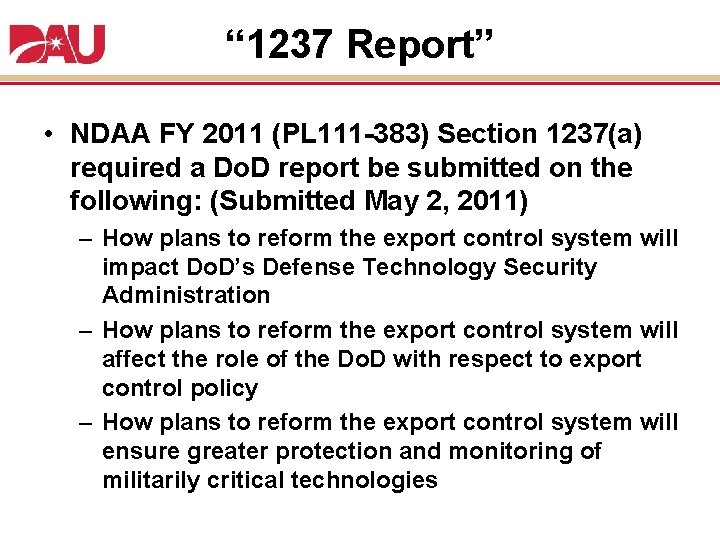
“ 1237 Report” • NDAA FY 2011 (PL 111 -383) Section 1237(a) required a Do. D report be submitted on the following: (Submitted May 2, 2011) – How plans to reform the export control system will impact Do. D’s Defense Technology Security Administration – How plans to reform the export control system will affect the role of the Do. D with respect to export control policy – How plans to reform the export control system will ensure greater protection and monitoring of militarily critical technologies
Strategic Trade Auth. • Do. C implemented a new license exception, Strategic Trade Authorization, on 6/16/2011 • Eliminates licenses for approx. 3, 000 types of transactions annually (valued at $1. 4 B) • Makes U. S. exporters more competitive • STA streamlines exports to and among our 36 closest NATO and multilateral regime partners by removing license requirements for items currently on the CCL • Items must be for the ultimate end use by the government of one of those 36 countries • No free lunch – STA has compliance obligations
E 2 C 2 • Export Enforcement Coordination Center opened on November 9, 2011 • Pursuant to E. O. 13558, the E 2 C 2 has: – Identified and established its management team • • Director – Craig Healy (DHS) Chief of Staff – Linda Dere (DHS) Dep. Director for Operations – Mary Thompson (FBI) Dep. Director for Programs – Edward Holland (Do. C) – Working toward functions assigned by the President • The E 2 C 2 is: – Utilizing interagency deconfliction and coordination protocols – Planning an expanded, more robust process for governmentwide coordination, information sharing and public outreach
ECR Perspectives • Relationship between regional security and defense trade • Decisions have to be consistent • ATTR SSG enhancement • Extensive dialogue and compliance measures • Outreach by U. S. Government “very” positive
Basic Principles for a New Export System • Protect the “crown jewels” of U. S. technology – Maintain important technological advantage • Expedited technology sharing and cooperation with allies and partners Build Partnership Capacity • Certain countries and entities should not receive U. S. exports – Deny all resources possible to terrorists, adversary states, and proliferators – Retain the legal authority to impose unilateral sanctions • Fulfill international export control and nonproliferation obligations – Wassenaar Arrangement, the Nuclear Suppliers Group, the Australia Group, and the Missile Technology Control Regime
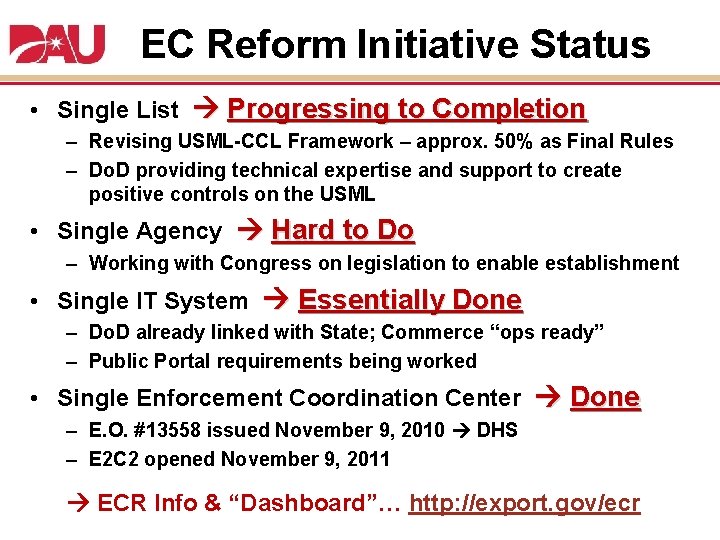
EC Reform Initiative Status • Single List Progressing to Completion – Revising USML-CCL Framework – approx. 50% as Final Rules – Do. D providing technical expertise and support to create positive controls on the USML • Single Agency Hard to Do – Working with Congress on legislation to enable establishment • Single IT System Essentially Done – Do. D already linked with State; Commerce “ops ready” – Public Portal requirements being worked • Single Enforcement Coordination Center Done – E. O. #13558 issued November 9, 2010 DHS – E 2 C 2 opened November 9, 2011 ECR Info & “Dashboard”… http: //export. gov/ecr
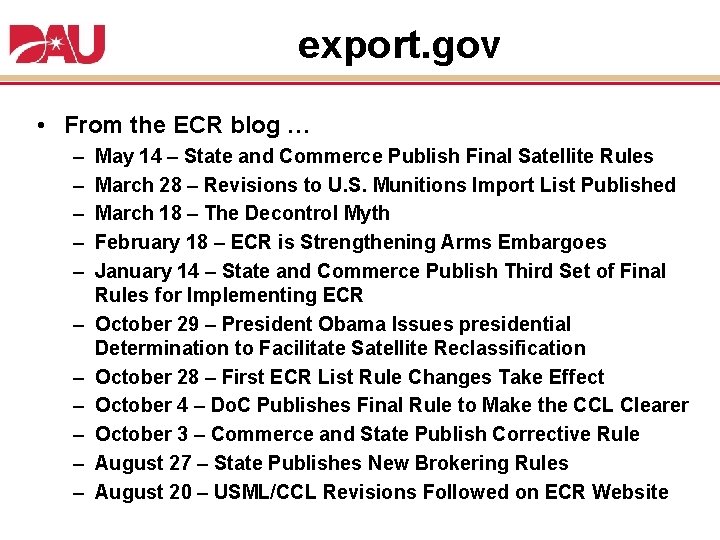
export. gov • From the ECR blog … – – – May 14 – State and Commerce Publish Final Satellite Rules March 28 – Revisions to U. S. Munitions Import List Published March 18 – The Decontrol Myth February 18 – ECR is Strengthening Arms Embargoes January 14 – State and Commerce Publish Third Set of Final Rules for Implementing ECR October 29 – President Obama Issues presidential Determination to Facilitate Satellite Reclassification October 28 – First ECR List Rule Changes Take Effect October 4 – Do. C Publishes Final Rule to Make the CCL Clearer October 3 – Commerce and State Publish Corrective Rule August 27 – State Publishes New Brokering Rules August 20 – USML/CCL Revisions Followed on ECR Website
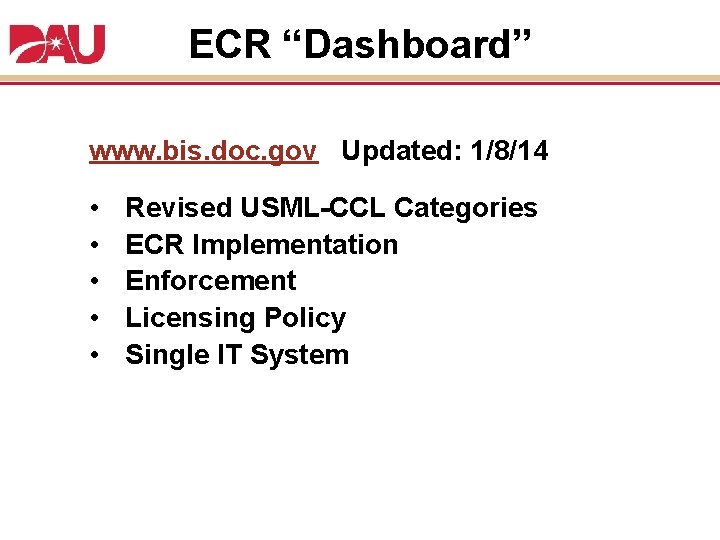
ECR “Dashboard” www. bis. doc. gov Updated: 1/8/14 • • • Revised USML-CCL Categories ECR Implementation Enforcement Licensing Policy Single IT System
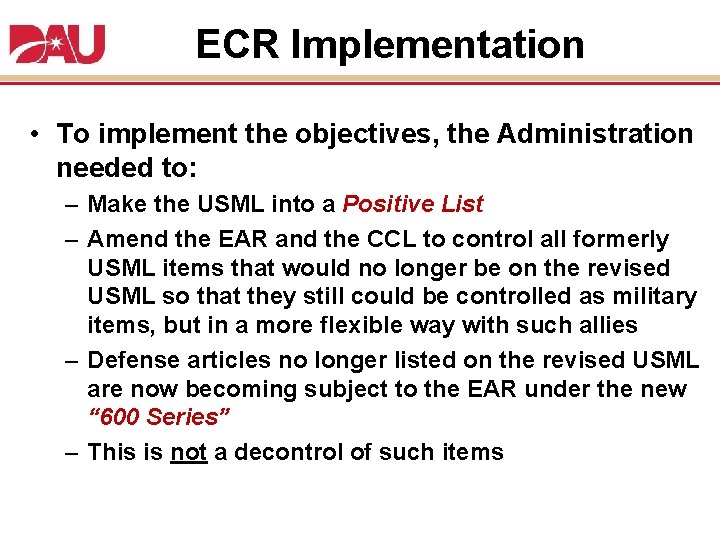
ECR Implementation • To implement the objectives, the Administration needed to: – Make the USML into a Positive List – Amend the EAR and the CCL to control all formerly USML items that would no longer be on the revised USML so that they still could be controlled as military items, but in a more flexible way with such allies – Defense articles no longer listed on the revised USML are now becoming subject to the EAR under the new “ 600 Series” – This is not a decontrol of such items
How Does ECR Help You? • Facilitate exports to key defense allies • Expand exports to lower Do. D acquisition and research costs • Integrate acquisition and export activities for major projects without licensing delays • Partner nation involvement in development, production and logistics enhances U. S. and partner nation affordability through life cycle • Under Commerce regulations, no longer need a purchase order to apply for a license
- Slides: 29