
Exponents and Polynomials Copyright Cengage Learning All rights
- Slides: 32
Exponents and Polynomials Copyright © Cengage Learning. All rights reserved. 5
SECTION 5. 2 Division with Exponents Copyright © Cengage Learning. All rights reserved.
Objectives A Apply the negative exponent property. B Use the quotient property for exponents. C Use the expanded distributive property for exponents. D Simplify expressions involving exponents of 0 and 1. E Simplify expressions using combinations of the properties of exponents. 3
Objectives F cont’d Use negative exponents when writing numbers in scientific notation and expanded form. 4
A Negative Exponents 5
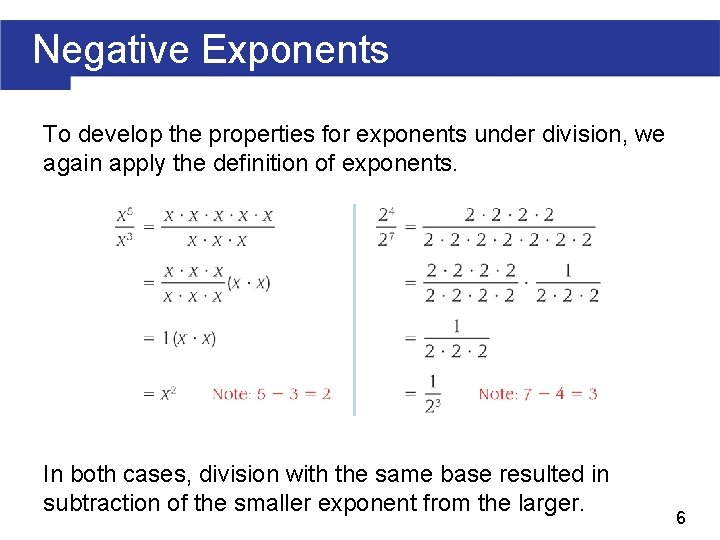
Negative Exponents To develop the properties for exponents under division, we again apply the definition of exponents. In both cases, division with the same base resulted in subtraction of the smaller exponent from the larger. 6
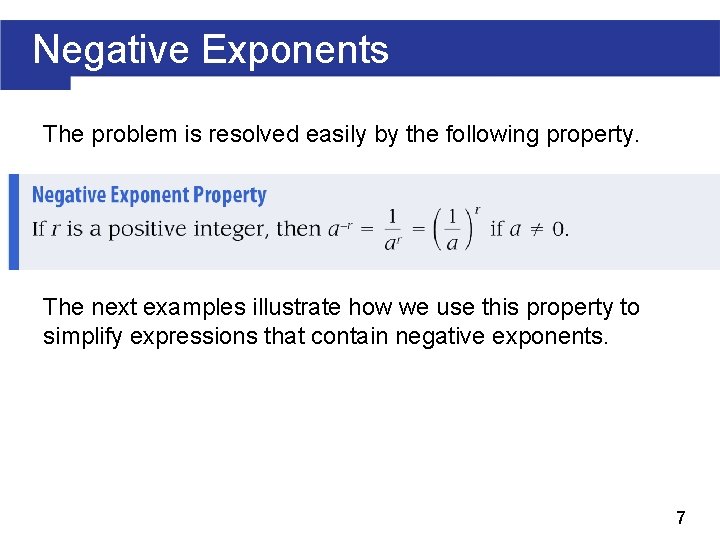
Negative Exponents The problem is resolved easily by the following property. The next examples illustrate how we use this property to simplify expressions that contain negative exponents. 7
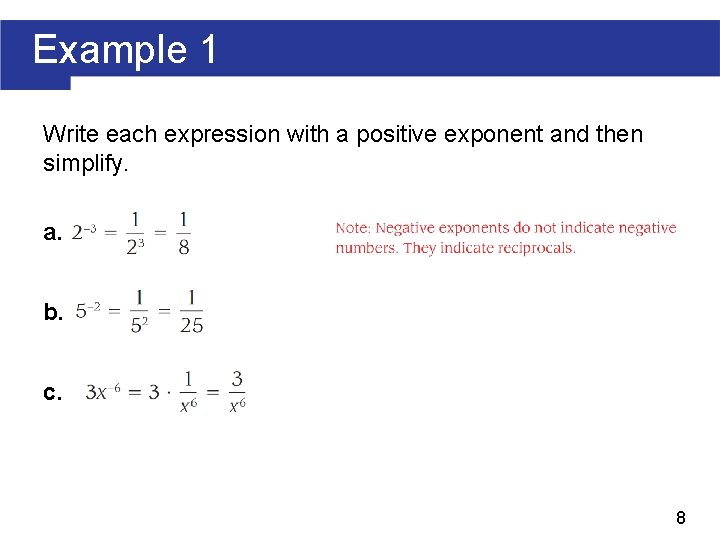
Example 1 Write each expression with a positive exponent and then simplify. a. b. c. 8
B Quotient Property for Exponents 9
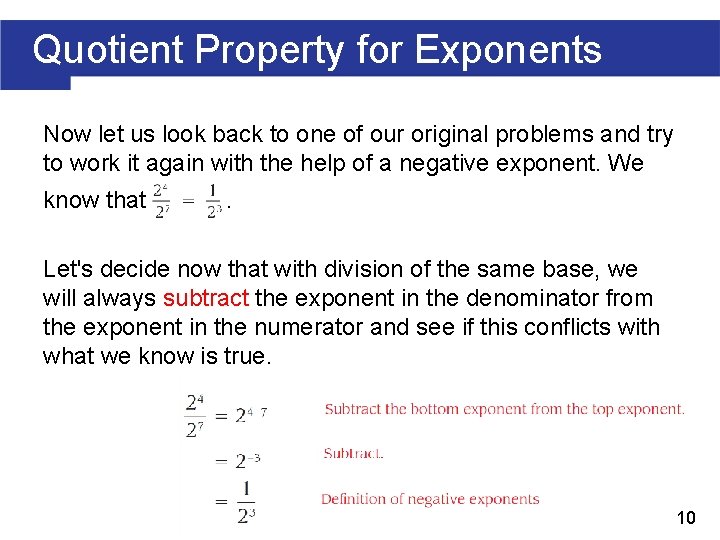
Quotient Property for Exponents Now let us look back to one of our original problems and try to work it again with the help of a negative exponent. We know that . Let's decide now that with division of the same base, we will always subtract the exponent in the denominator from the exponent in the numerator and see if this conflicts with what we know is true. 10
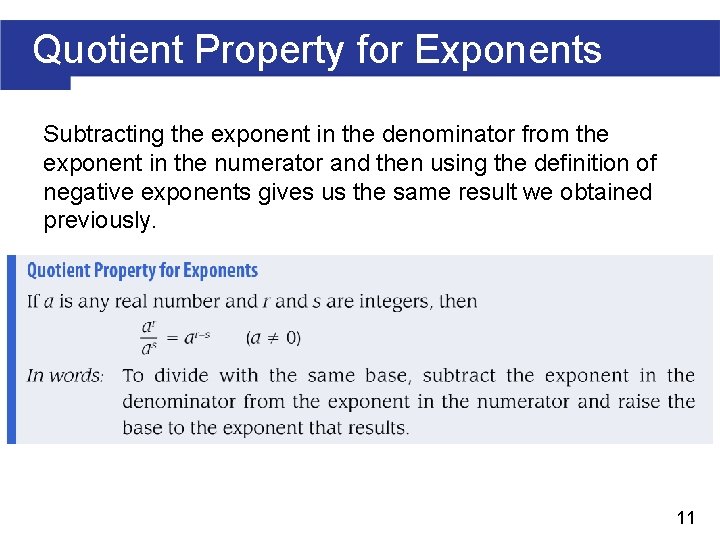
Quotient Property for Exponents Subtracting the exponent in the denominator from the exponent in the numerator and then using the definition of negative exponents gives us the same result we obtained previously. 11
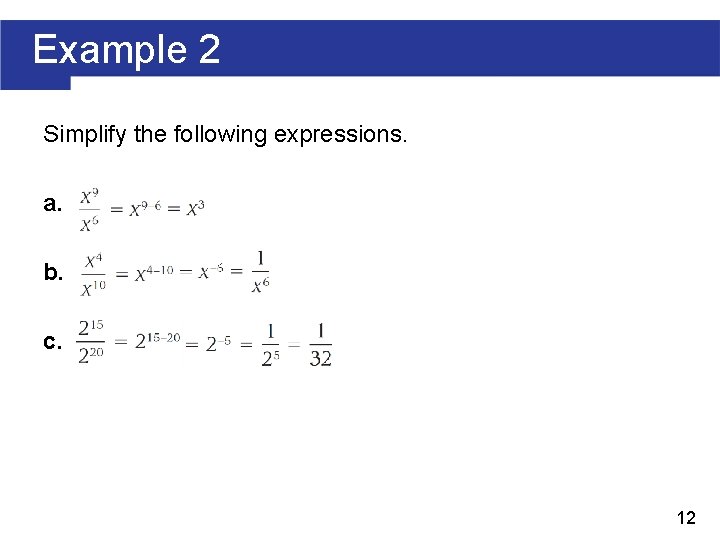
Example 2 Simplify the following expressions. a. b. c. 12
C Expanded Distributive Property for Exponents 13
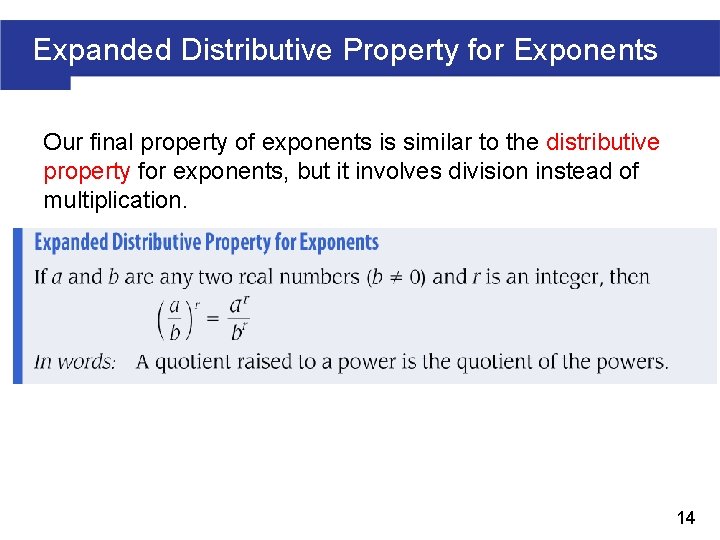
Expanded Distributive Property for Exponents Our final property of exponents is similar to the distributive property for exponents, but it involves division instead of multiplication. 14
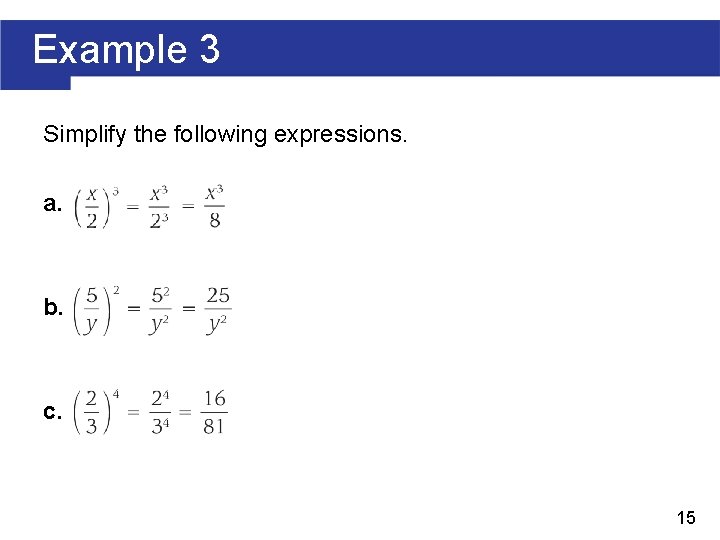
Example 3 Simplify the following expressions. a. b. c. 15
D Zero and One as Exponents 16
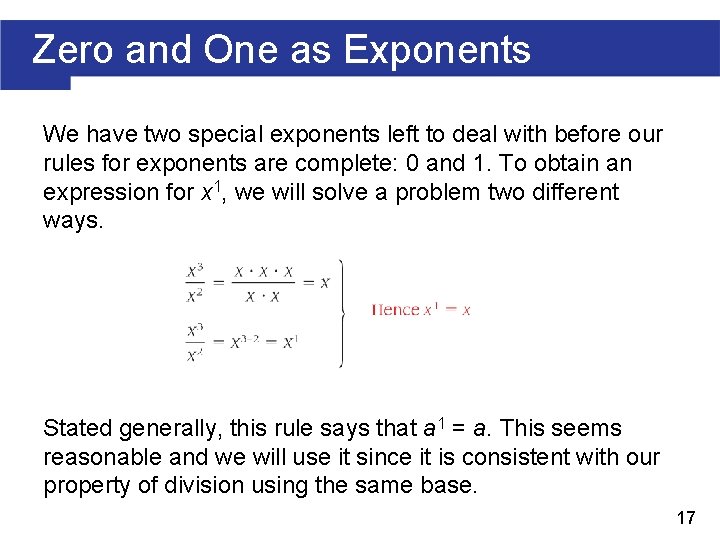
Zero and One as Exponents We have two special exponents left to deal with before our rules for exponents are complete: 0 and 1. To obtain an expression for x 1, we will solve a problem two different ways. Stated generally, this rule says that a 1 = a. This seems reasonable and we will use it since it is consistent with our property of division using the same base. 17
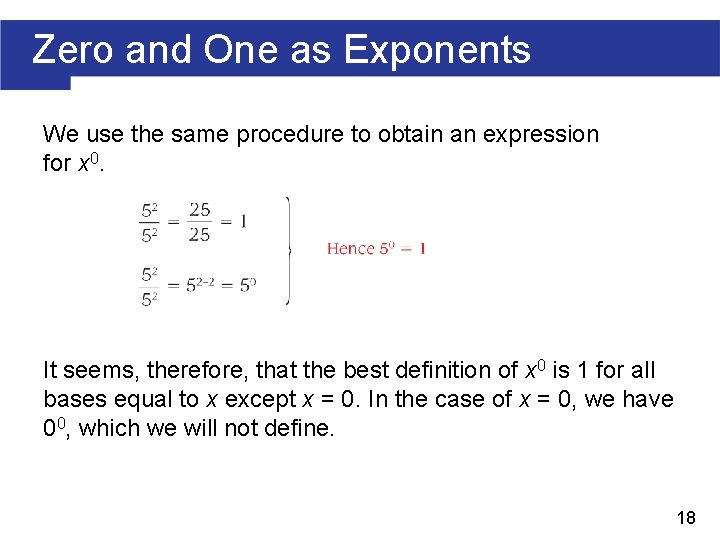
Zero and One as Exponents We use the same procedure to obtain an expression for x 0. It seems, therefore, that the best definition of x 0 is 1 for all bases equal to x except x = 0. In the case of x = 0, we have 00, which we will not define. 18
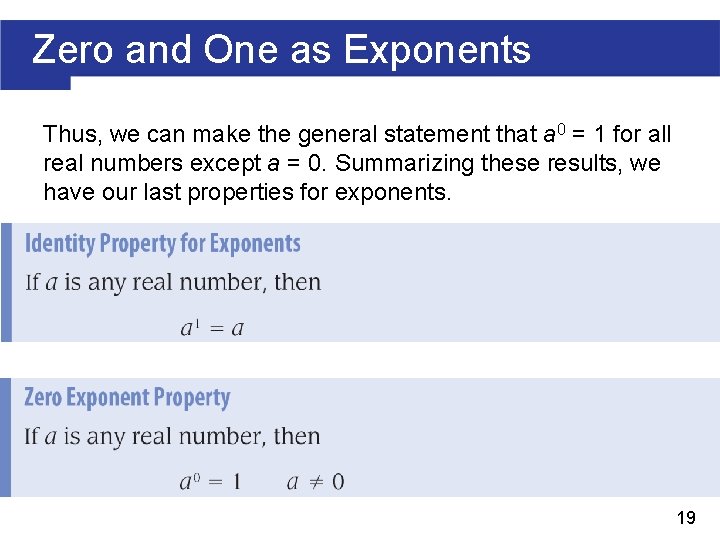
Zero and One as Exponents Thus, we can make the general statement that a 0 = 1 for all real numbers except a = 0. Summarizing these results, we have our last properties for exponents. 19
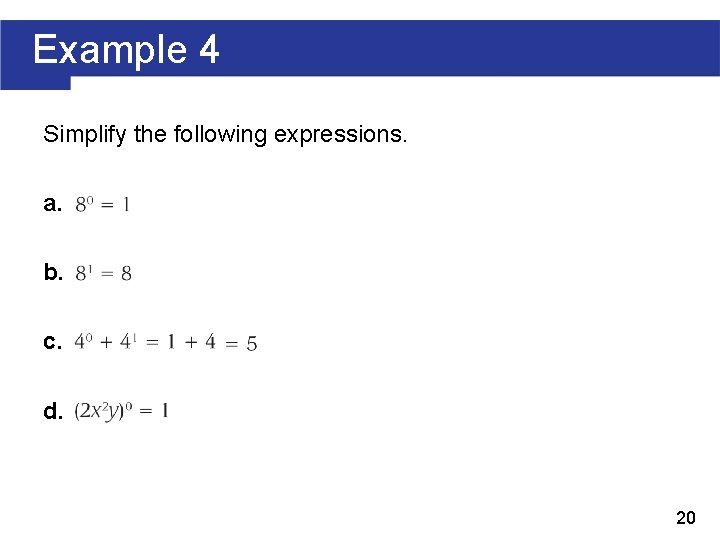
Example 4 Simplify the following expressions. a. b. c. d. 20
E Combinations of Properties 21
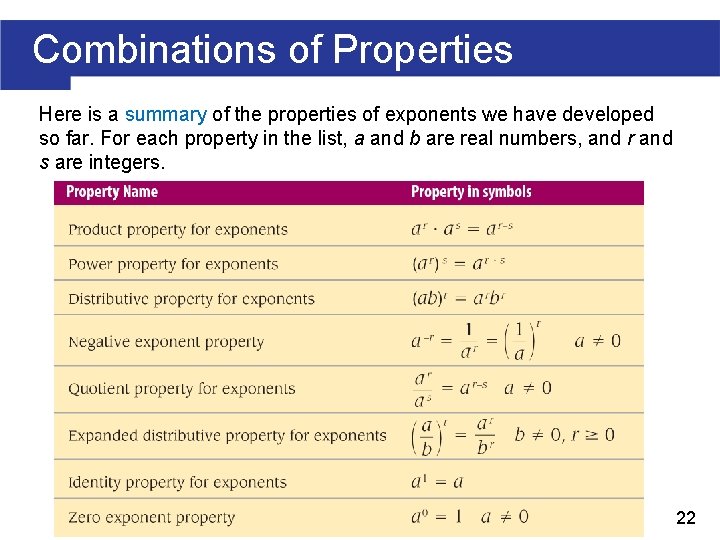
Combinations of Properties Here is a summary of the properties of exponents we have developed so far. For each property in the list, a and b are real numbers, and r and s are integers. 22
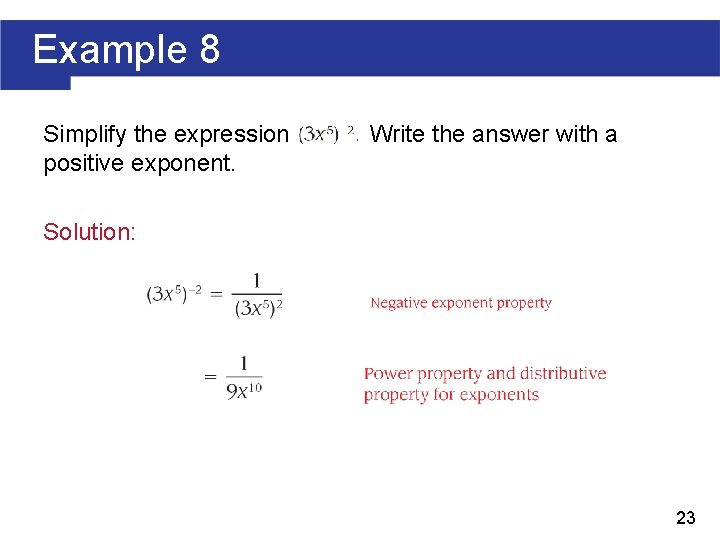
Example 8 Simplify the expression positive exponent. Write the answer with a Solution: 23
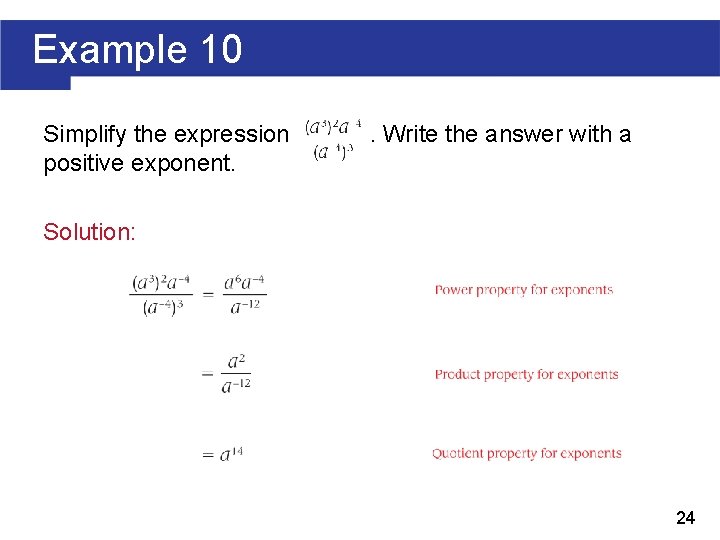
Example 10 Simplify the expression positive exponent. . Write the answer with a Solution: 24
Example 11 Suppose you have two squares, one of which is larger than the other. If the length of a side of the larger square is 3 times as long as the length of a side of the smaller square, how many of the smaller squares will it take to cover up the larger square? Solution: If we let x represent the length of a side of the smaller square, then the length of a side of the larger square is 3 x. 25
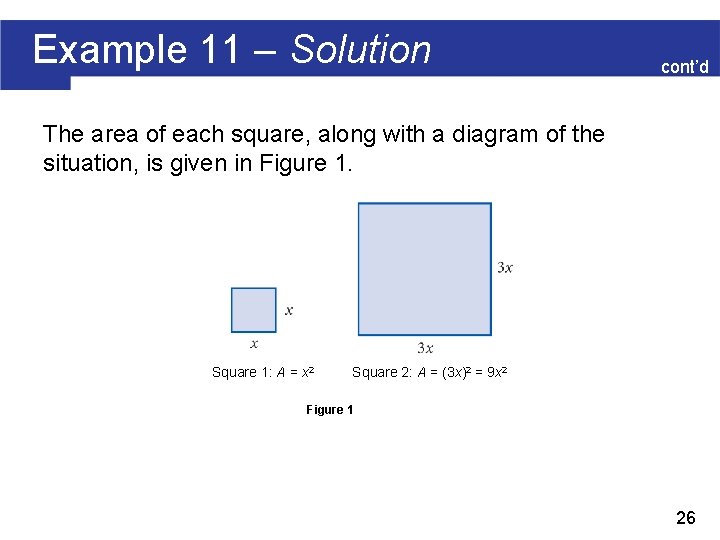
Example 11 – Solution cont’d The area of each square, along with a diagram of the situation, is given in Figure 1. Square 1: A = x 2 Square 2: A = (3 x)2 = 9 x 2 Figure 1 26
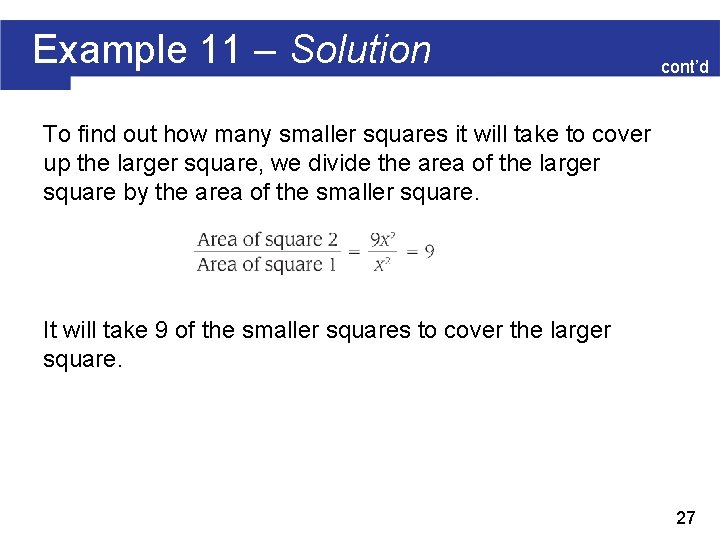
Example 11 – Solution cont’d To find out how many smaller squares it will take to cover up the larger square, we divide the area of the larger square by the area of the smaller square. It will take 9 of the smaller squares to cover the larger square. 27
F Scientific Notation and Negative Exponents 28
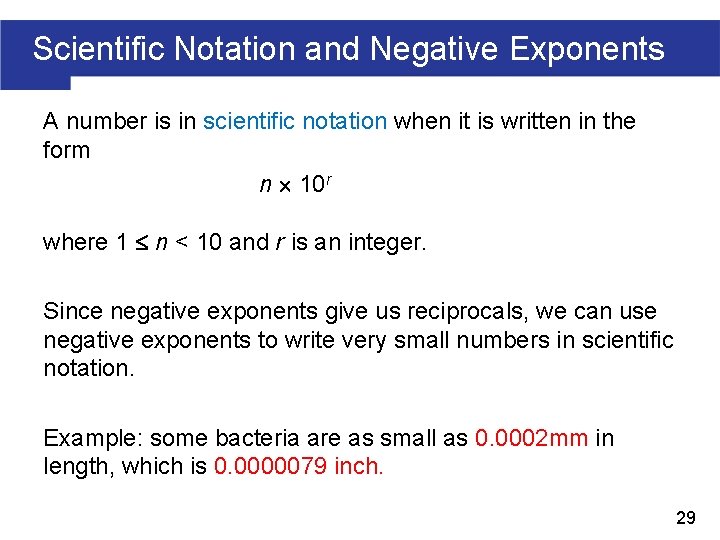
Scientific Notation and Negative Exponents A number is in scientific notation when it is written in the form n 10 r where 1 n < 10 and r is an integer. Since negative exponents give us reciprocals, we can use negative exponents to write very small numbers in scientific notation. Example: some bacteria are as small as 0. 0002 mm in length, which is 0. 0000079 inch. 29
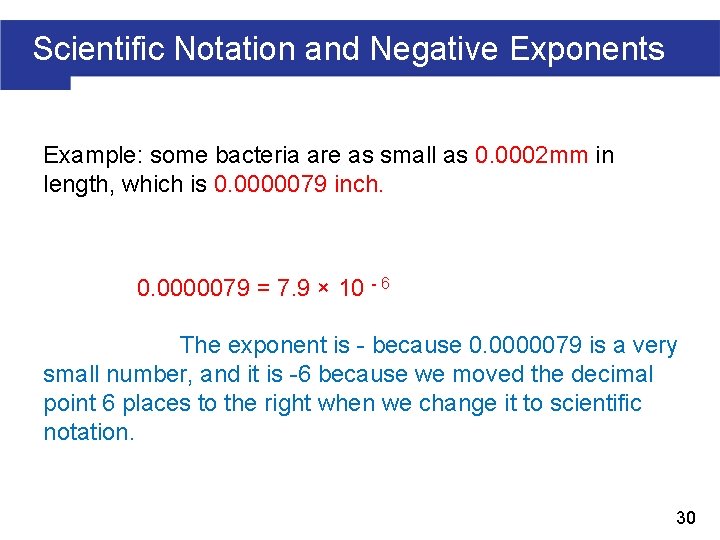
Scientific Notation and Negative Exponents Example: some bacteria are as small as 0. 0002 mm in length, which is 0. 0000079 inch. 0. 0000079 = 7. 9 × 10 - 6 The exponent is - because 0. 0000079 is a very small number, and it is -6 because we moved the decimal point 6 places to the right when we change it to scientific notation. 30
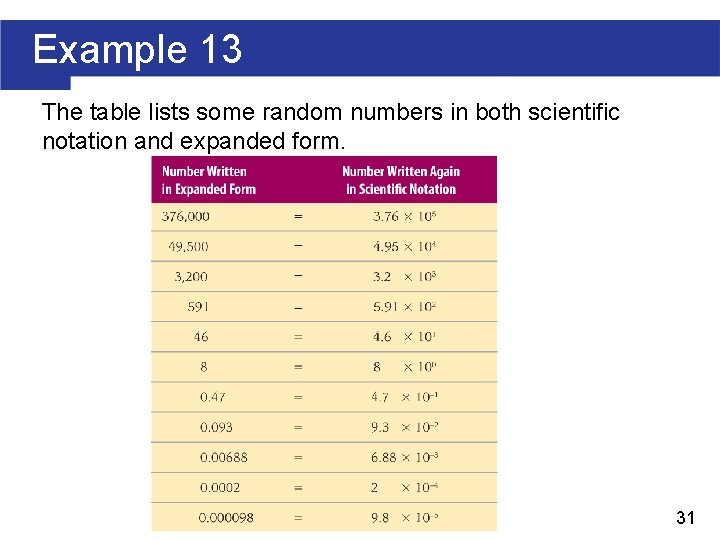
Example 13 The table lists some random numbers in both scientific notation and expanded form. 31
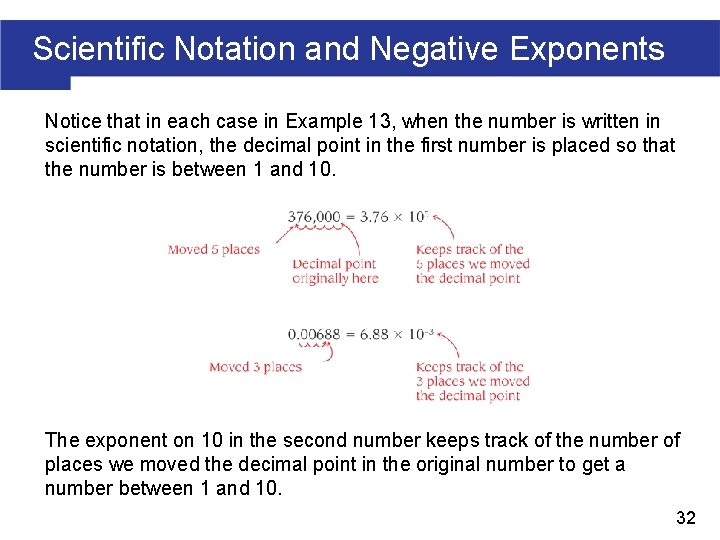
Scientific Notation and Negative Exponents Notice that in each case in Example 13, when the number is written in scientific notation, the decimal point in the first number is placed so that the number is between 1 and 10. The exponent on 10 in the second number keeps track of the number of places we moved the decimal point in the original number to get a number between 1 and 10. 32