
Exponential random graphs and dynamic graph algorithms David
- Slides: 17
Exponential random graphs and dynamic graph algorithms David Eppstein Comp. Sci. Dept. , UC Irvine
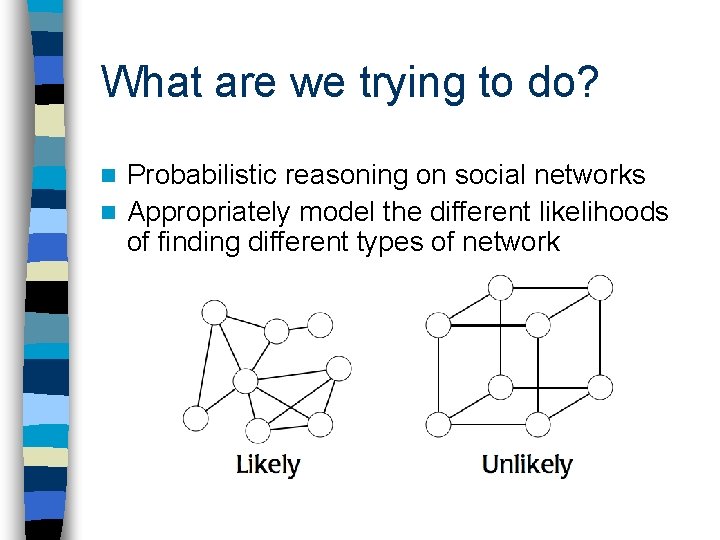
What are we trying to do? Probabilistic reasoning on social networks n Appropriately model the different likelihoods of finding different types of network n
Exponential Random Graphs n Family of graphs with fixed vertex set n Probability of a graph is proportional to exp(sum of weights of features) n Different choices of features give simpler or more powerful models
ERG models can be simple… n Easily subsumes many standard random graph models n E. g. G(n, p): – Edges are independent w/probability p – Feature = edge – Weight = log(p) - log(1 -p)
…but ERG models can also be very powerful n Powerful enough to represent any distribution over n-vertex graphs – Feature = isomorphism with one graph – Weight = log(probability of that graph) n More power requires a more complex set of features
Computational tasks for reasoning with ERGs n Compute normalizing factor (partition function) for graph probabilities n Generate random graphs from the model n Use the model as a prior for maxlikelihood data fitting, or modify the feature weights to fit the data
Monte Carlo methods for computing with ERGs n Start with an arbitrary graph n Repeatedly propose a small change (e. g. , insert or delete a single edge) n Compute log-likelihood of the modified graph and use it to accept or reject the proposed change
The Algorithmic Lens n Social scientists and statisticians determine the sorts of models that best describe their data n Algorithms researchers (e. g. me) figure out how to make the model run quickly n Faster algorithms lead to the ability to use more accurate models
Algorithmic rephrasing of the computational task n Maintain a dynamic graph subject to edge insertions and deletions n As the graph changes, keep track of its computational properties efficiently (faster than recomputing them from scratch) n The properties we track should be the ones needed for ERG feature vectors
A brief survey of dynamic graph algorithms n Sparsification (E. , Galil, Italiano, Nissenzweig, JACM ‘ 92): – Replace dense graphs by tree of sparse subgraphs – Applies to many problems including maintaining connected components – Replaces #edges by #vertices in running times of update algorithms
A brief survey of dynamic graph algorithms n Fast dynamic connectivity (Holm, de Lichtenberg, Thorup, JACM 2001): – Maintain connected components, number of connected components, or a spanning tree (so can use #components as ERG feature) – Update time O(log n) – Complicated, of interest to search for more easily implemented variants
A brief survey of dynamic graph algorithms n Distance and reachability in graphs – Of likely use in ERGs (e. g. to model smallworld properties of these graphs) – Some dynamic graph algorithms are known but more theoretical than practical
A brief survey of dynamic graph algorithms n Graphs in the plane and on surfaces – E. et al, J. Algorithms 1992 – E. et al, J. Comp. Sys. Sci. 1996 – E. , SODA 2002 n Of possible interest for integrating social networks with geographic data
Not-yet-dynamized graph algorithms useful for ERGs n Low-degree orientations of sparse graphs (Chrobak, E. , Theor. Comp. Sci. 1991) – Assign directions to the edges of the graph so that each vertex has O(1) outgoing edges – Enable fast search for small subgraphs (e. g. list all cliques in linear time) – May be found in linear time
Not-yet-dynamized graph algorithms useful for ERGs n Finding all maximal complete bipartite subgraphs in a sparse graph (E. , IPL 1994) – Allows concise representation of all fourvertex cycles (quadratically many cycles may be represented in linear space and time) – Based on low-degree orientation
Not-yet-dynamized graph algorithms useful for ERGs n Subgraph isomorphism: finding all copies of some small pattern graph in a larger graph (E. , J. Graph Th. 1993 and J. Graph Algorithms 1999) – Commonly used as ERG features – Known fast algorithms rely on special graph properties e. g. planarity
Conclusions n ERG are important model for social nets n ERG computation naturally involves dynamic graphs n Many existing dynamic graph algorithms known, not fully adapted to ERG problems n Much opportunity for further study of dynamic graph algorithms in ERG setting