
Exponential Functions Warm Up Lesson Presentation Lesson Quiz
- Slides: 21
Exponential Functions Warm Up Lesson Presentation Lesson Quiz Holt. Mc. Dougal Algebra 1
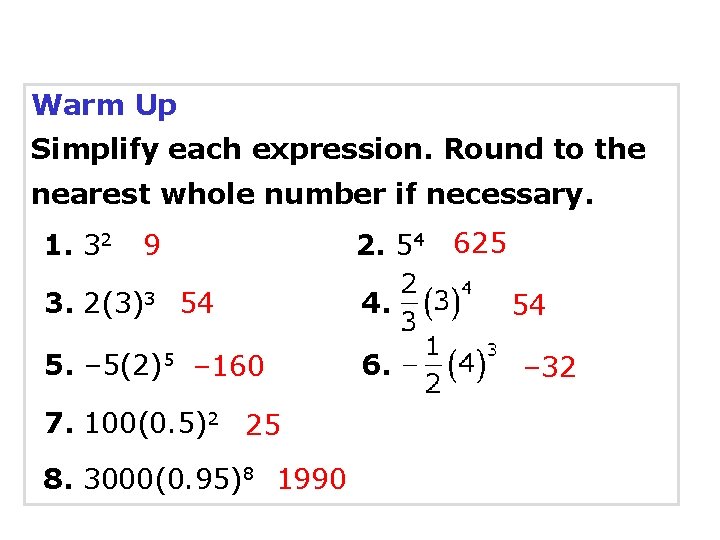
Warm Up Simplify each expression. Round to the nearest whole number if necessary. 1. 32 9 2. 54 3. 2(3)3 54 4. 5. – 5(2)5 – 160 6. 7. 100(0. 5)2 25 8. 3000(0. 95)8 1990 625 54 – 32
Objectives Evaluate exponential functions. Identify and graph exponential functions.
Vocabulary Exponential function
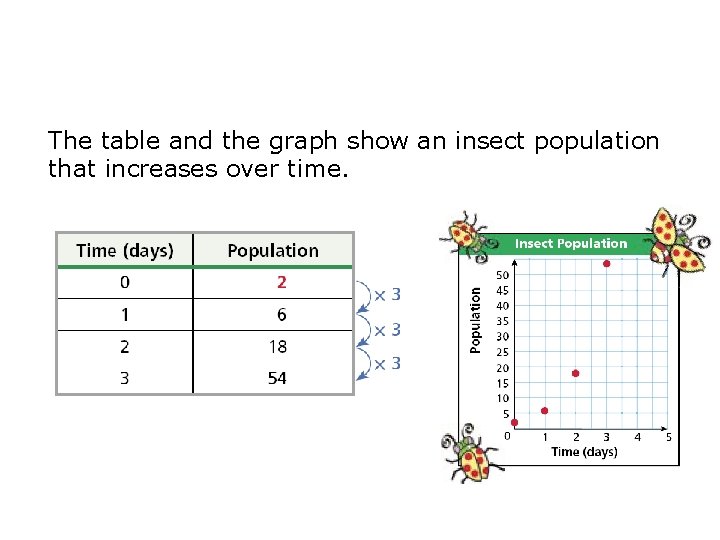
The table and the graph show an insect population that increases over time.
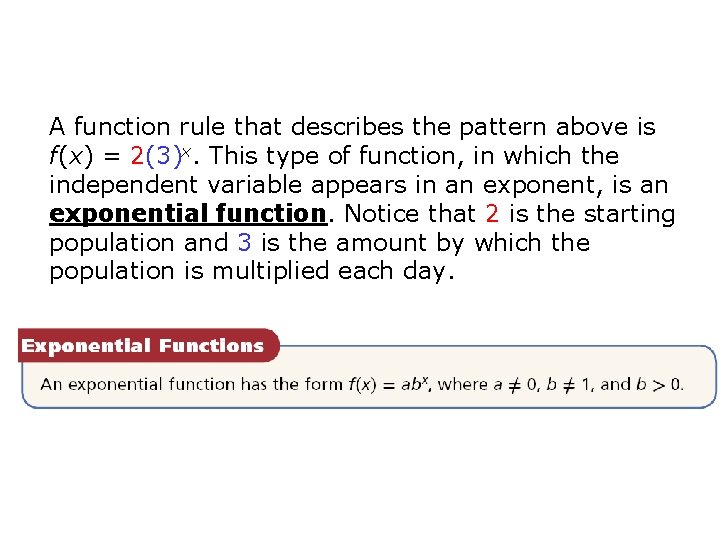
A function rule that describes the pattern above is f(x) = 2(3)x. This type of function, in which the independent variable appears in an exponent, is an exponential function. Notice that 2 is the starting population and 3 is the amount by which the population is multiplied each day.
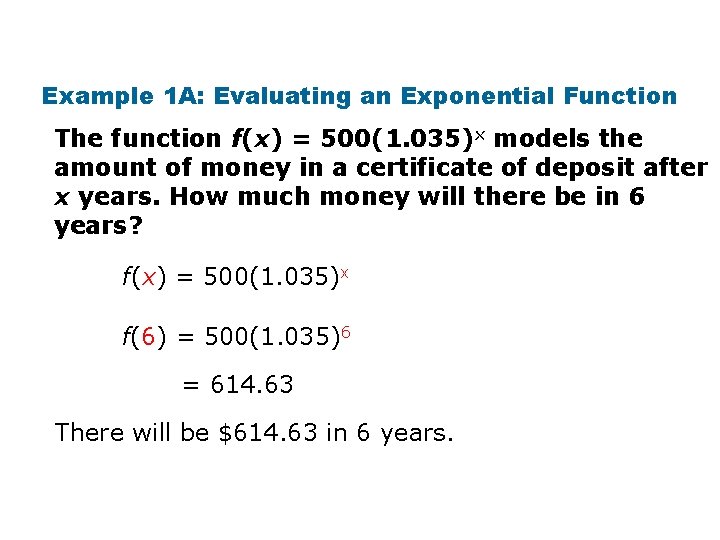
Example 1 A: Evaluating an Exponential Function The function f(x) = 500(1. 035)x models the amount of money in a certificate of deposit after x years. How much money will there be in 6 years? f(x) = 500(1. 035)x f(6) = 500(1. 035)6 = 614. 63 There will be $614. 63 in 6 years.
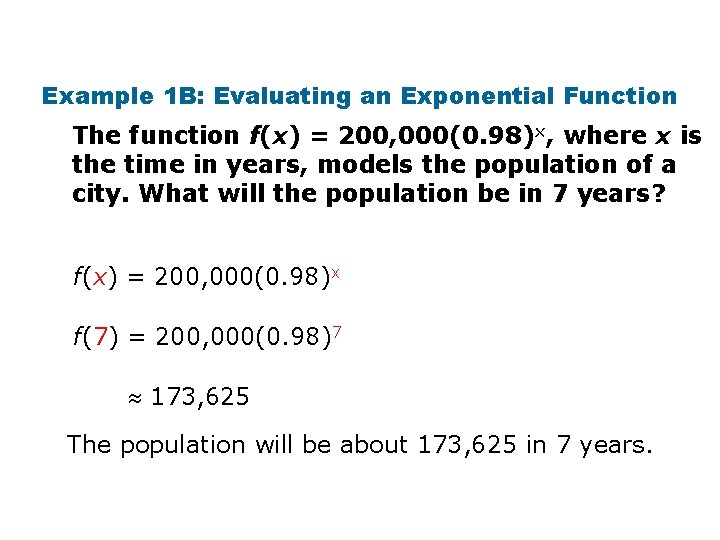
Example 1 B: Evaluating an Exponential Function The function f(x) = 200, 000(0. 98)x, where x is the time in years, models the population of a city. What will the population be in 7 years? f(x) = 200, 000(0. 98)x f(7) = 200, 000(0. 98)7 173, 625 The population will be about 173, 625 in 7 years.
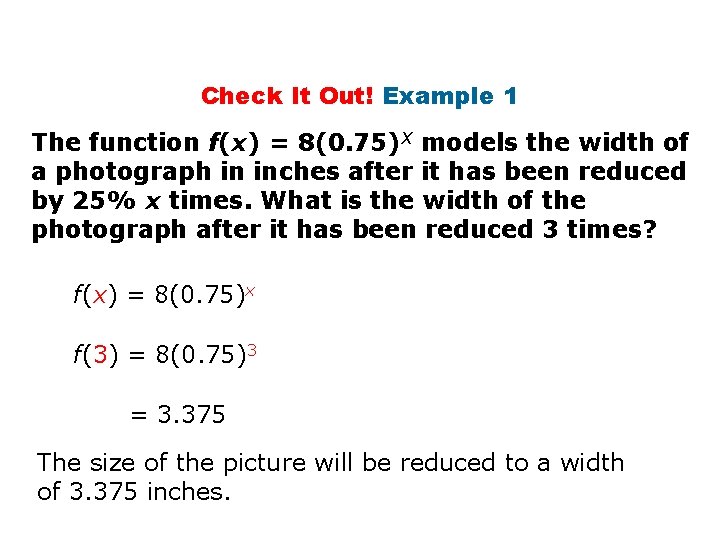
Check It Out! Example 1 The function f(x) = 8(0. 75)X models the width of a photograph in inches after it has been reduced by 25% x times. What is the width of the photograph after it has been reduced 3 times? f(x) = 8(0. 75)x f(3) = 8(0. 75)3 = 3. 375 The size of the picture will be reduced to a width of 3. 375 inches.
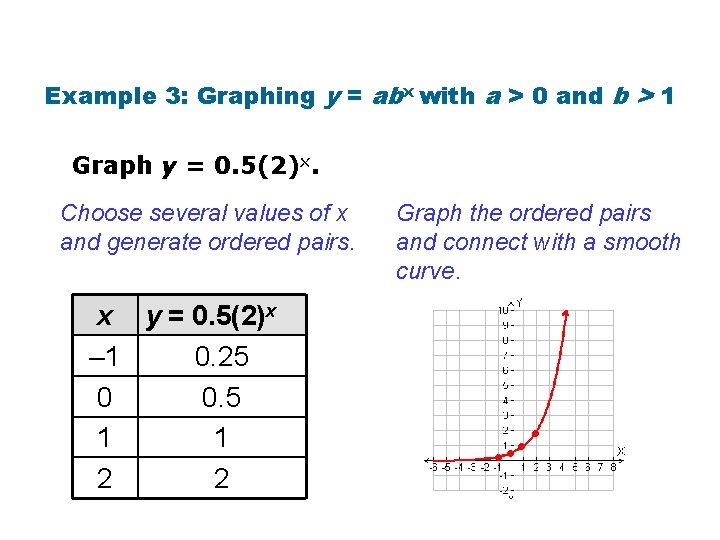
Example 3: Graphing y = abx with a > 0 and b > 1 Graph y = 0. 5(2)x. Choose several values of x and generate ordered pairs. x y = 0. 5(2)x – 1 0. 25 0 0. 5 1 1 2 2 Graph the ordered pairs and connect with a smooth curve. • •
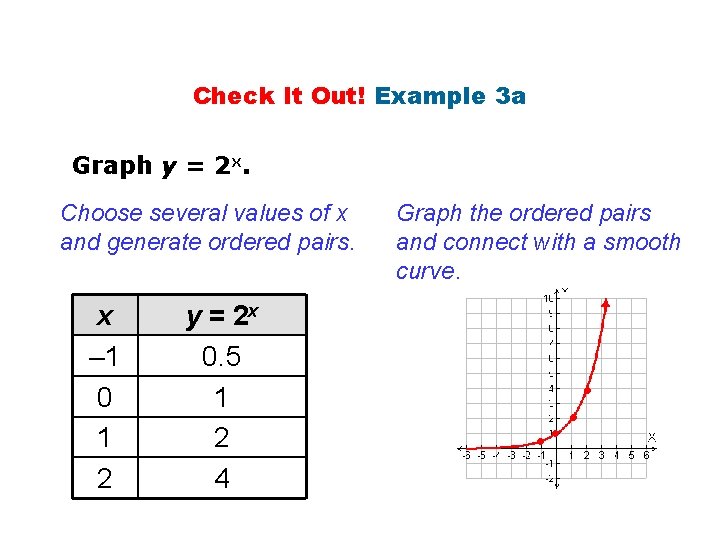
Check It Out! Example 3 a Graph y = 2 x. Choose several values of x and generate ordered pairs. x – 1 0 1 2 y = 2 x 0. 5 1 2 4 Graph the ordered pairs and connect with a smooth curve. • •
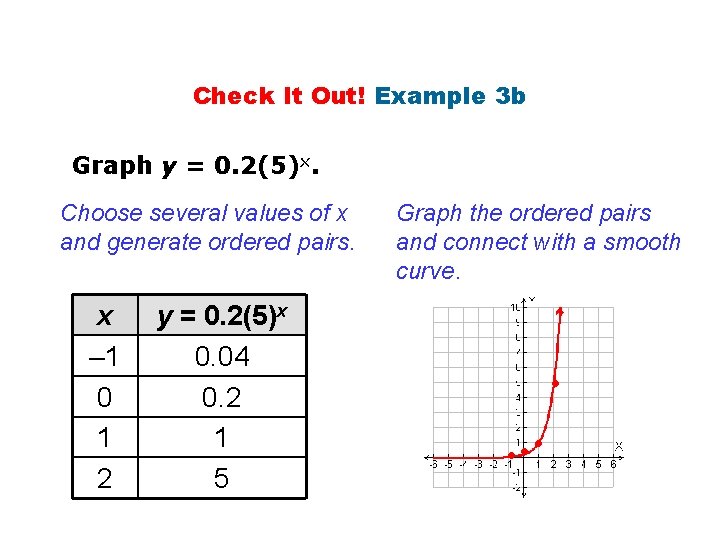
Check It Out! Example 3 b Graph y = 0. 2(5)x. Choose several values of x and generate ordered pairs. x – 1 0 1 2 y = 0. 2(5)x 0. 04 0. 2 1 5 Graph the ordered pairs and connect with a smooth curve. • •
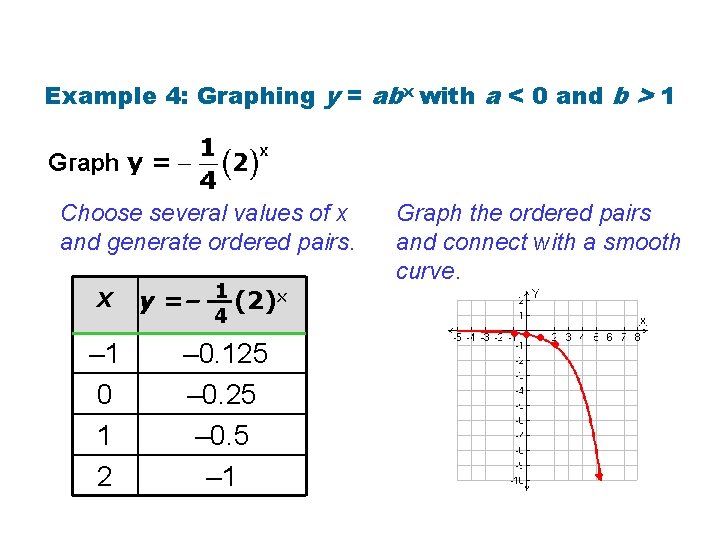
Example 4: Graphing y = abx with a < 0 and b > 1 Choose several values of x and generate ordered pairs. x y =– – 1 0 1 2 1 (2)x 4 – 0. 125 – 0. 5 – 1 Graph the ordered pairs and connect with a smooth curve. • • • •
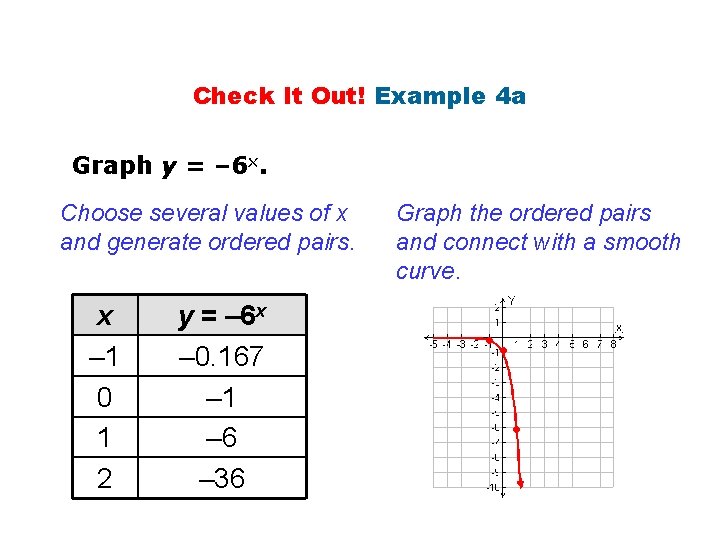
Check It Out! Example 4 a Graph y = – 6 x. Choose several values of x and generate ordered pairs. x – 1 0 1 2 y = – 6 x – 0. 167 – 1 – 6 – 36 Graph the ordered pairs and connect with a smooth curve. • • •
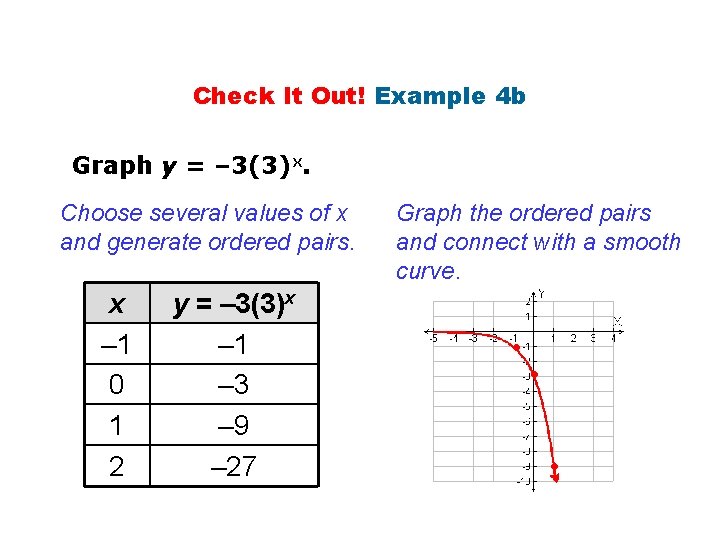
Check It Out! Example 4 b Graph y = – 3(3)x. Choose several values of x and generate ordered pairs. x – 1 0 1 2 y = – 3(3)x – 1 – 3 – 9 – 27 Graph the ordered pairs and connect with a smooth curve. • • •
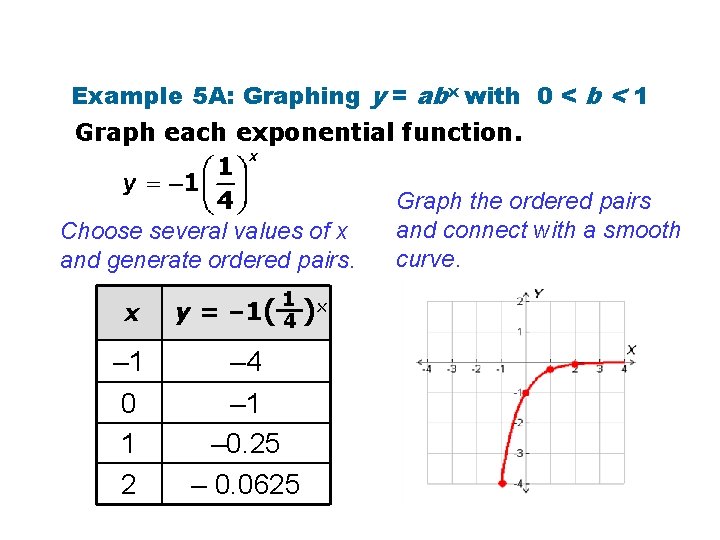
Example 5 A: Graphing y = abx with 0 < b < 1 Graph each exponential function. Choose several values of x and generate ordered pairs. 1 x y = – 1( 4 )x – 1 0 1 2 – 4 – 1 – 0. 25 – 0. 0625 Graph the ordered pairs and connect with a smooth curve.
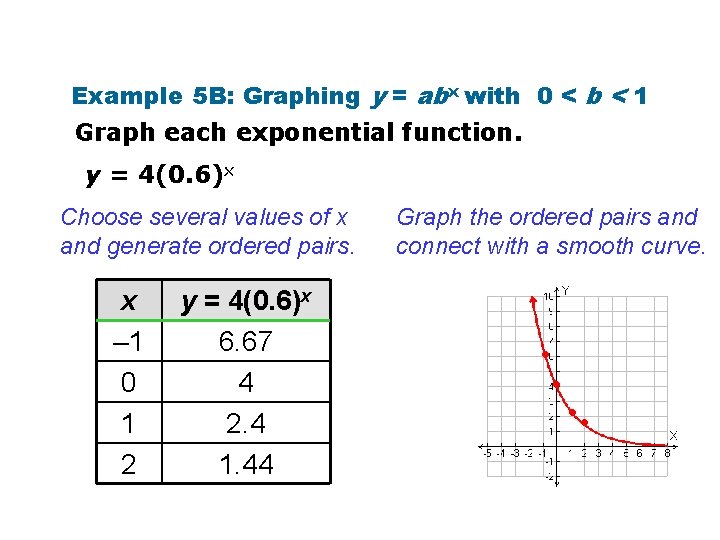
Example 5 B: Graphing y = abx with 0 < b < 1 Graph each exponential function. y = 4(0. 6)x Choose several values of x and generate ordered pairs. x – 1 0 1 2 y = 4(0. 6)x 6. 67 4 2. 4 1. 44 Graph the ordered pairs and connect with a smooth curve. • •
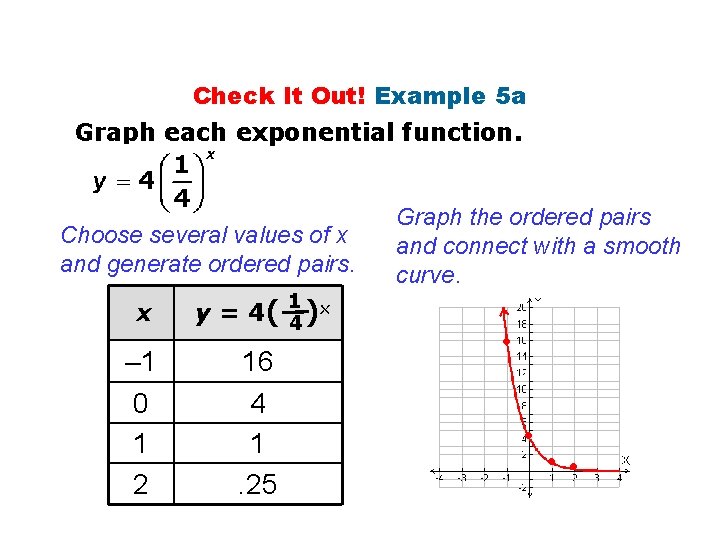
Check It Out! Example 5 a Graph each exponential function. Choose several values of x and generate ordered pairs. x – 1 0 1 2 y = 4( 16 4 1. 25 1 x 4) Graph the ordered pairs and connect with a smooth curve. • •
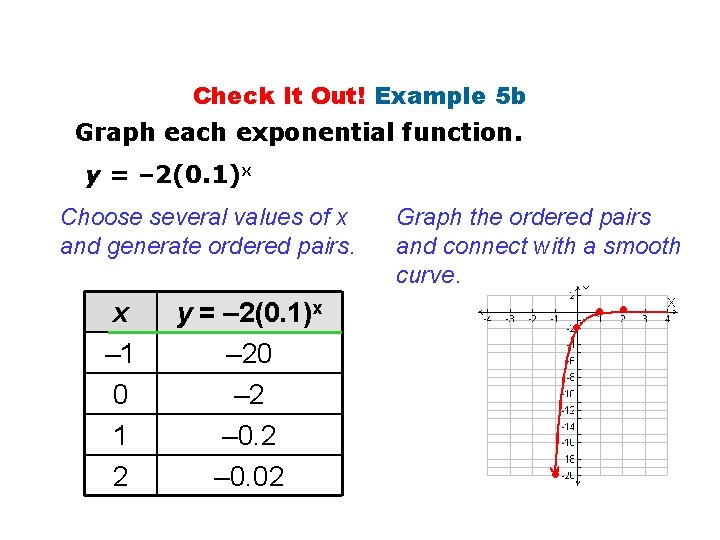
Check It Out! Example 5 b Graph each exponential function. y = – 2(0. 1)x Choose several values of x and generate ordered pairs. x – 1 0 1 2 y = – 2(0. 1)x – 20 – 2 – 0. 02 Graph the ordered pairs and connect with a smooth curve. • •
Example 6: Application In 2000, each person in India consumed an average of 13 kg of sugar. Sugar consumption in India is projected to increase by 3. 6% per year. At this growth rate the function f(x) = 13(1. 036)x gives the average yearly amount of sugar, in kilograms, consumed person x years after 2000. Using this model, in about what year will sugar consumption average about 18 kg person?
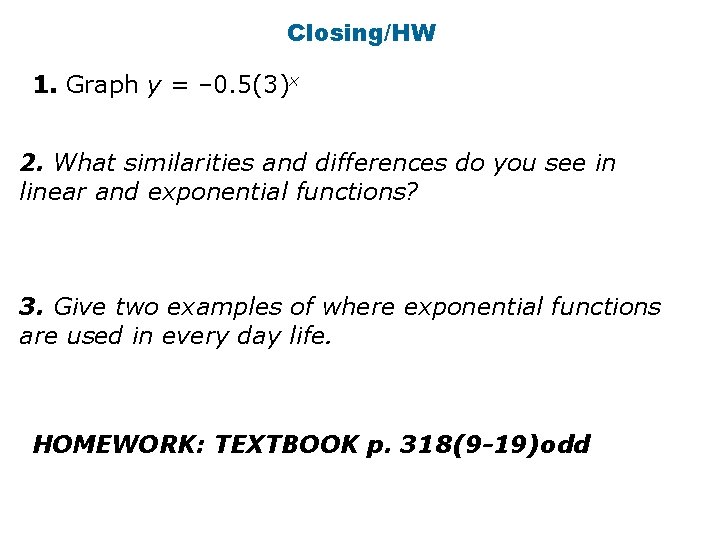
Closing/HW 1. Graph y = – 0. 5(3)x 2. What similarities and differences do you see in linear and exponential functions? 3. Give two examples of where exponential functions are used in every day life. HOMEWORK: TEXTBOOK p. 318(9 -19)odd