
Exponential and Logarithmic Equations Objectives Solve exponential and
Exponential and Logarithmic Equations Objectives Solve exponential and logarithmic equations and equalities. Solve problems involving exponential and logarithmic equations.
Vocabulary exponential equation logarithmic equation

An exponential equation is an equation containing one or more expressions that have a variable as an exponent. To solve exponential equations: Try writing them so that the bases are the same Take the logarithm of both sides

Solving Exponential Equations by Expressing Each Side as a Power of the Same Base Express each side as a power of the same base. Set the exponents equal to each other.
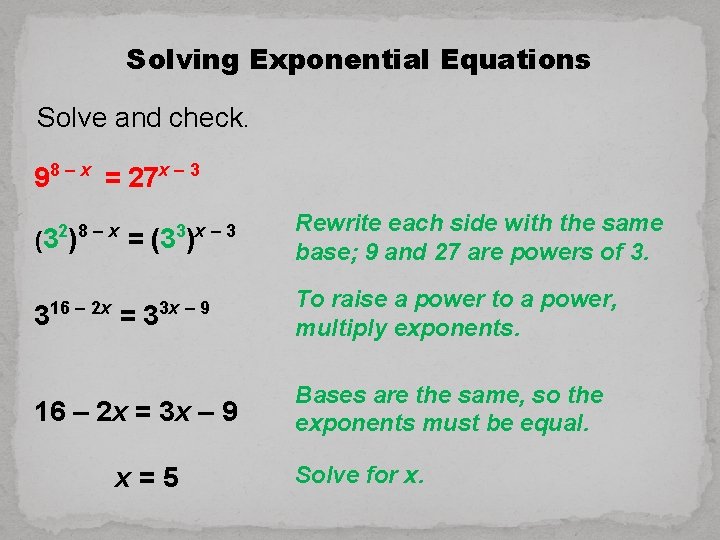
Solving Exponential Equations Solve and check. 98 – x = 27 x – 3 2 8–x (3 ) 3 16 – 2 x 3 x– 3 = (3 ) =3 3 x – 9 16 – 2 x = 3 x – 9 x=5 Rewrite each side with the same base; 9 and 27 are powers of 3. To raise a power to a power, multiply exponents. Bases are the same, so the exponents must be equal. Solve for x.
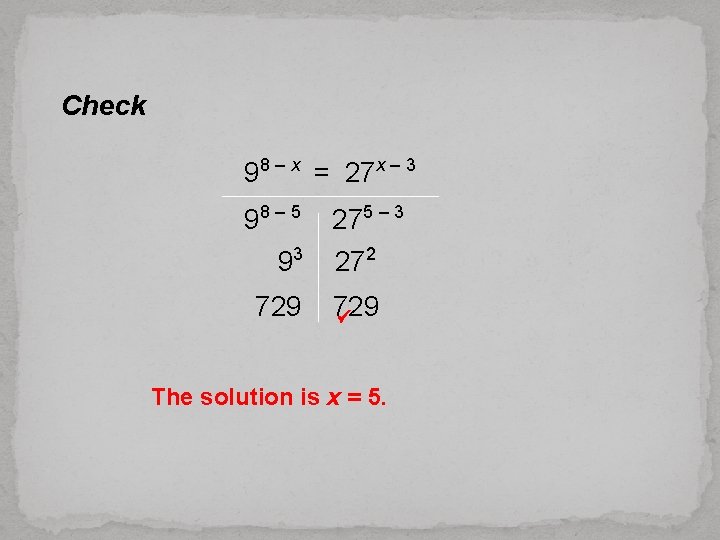
Check 98 – x = 27 x – 3 98 – 5 93 729 275 – 3 272 729 The solution is x = 5.
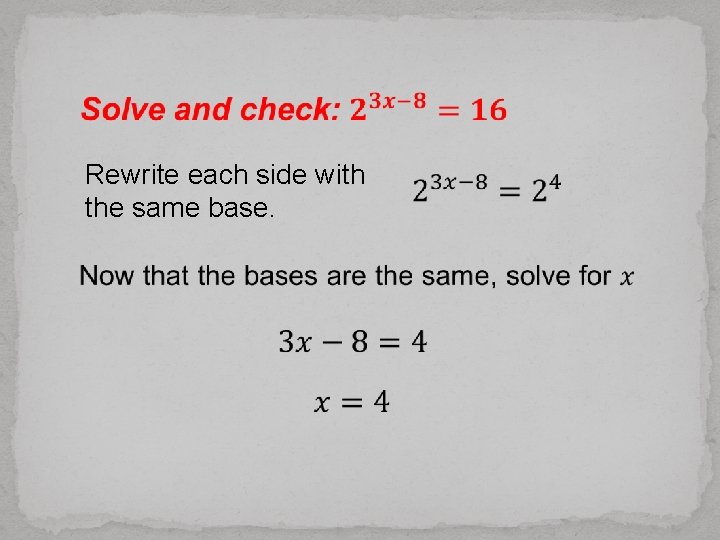
Rewrite each side with the same base.
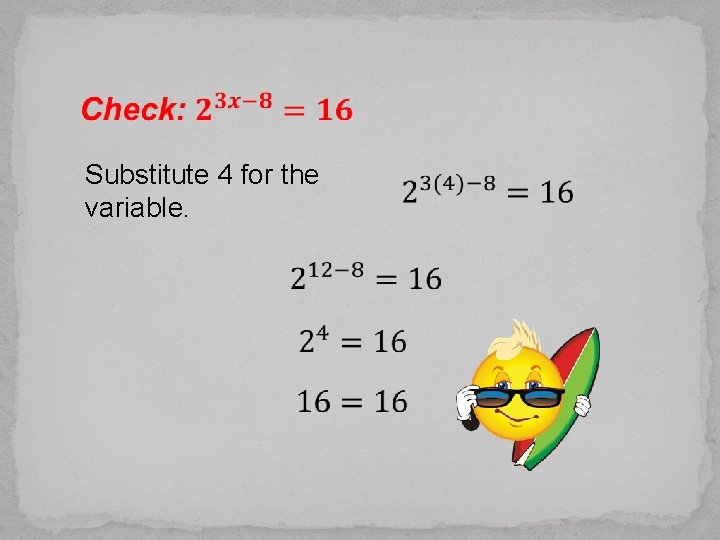
Substitute 4 for the variable.
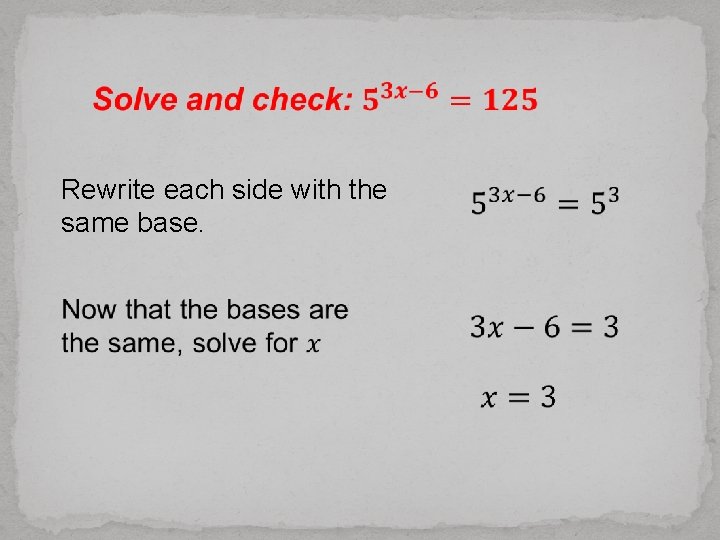
Rewrite each side with the same base.
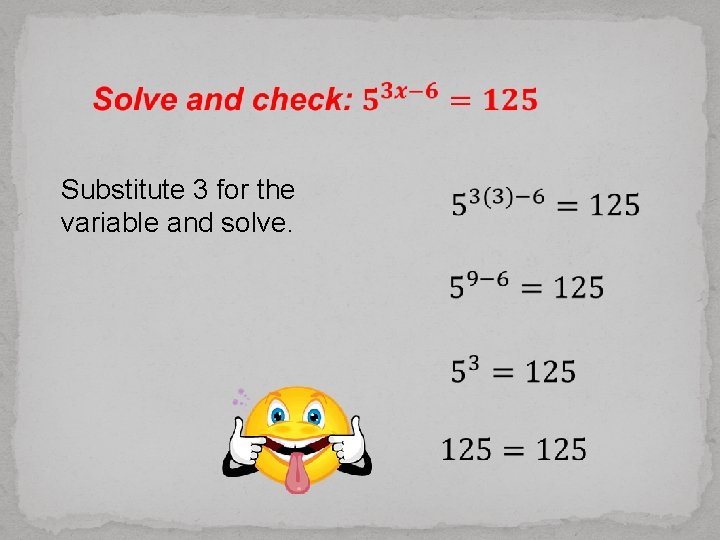
Substitute 3 for the variable and solve.
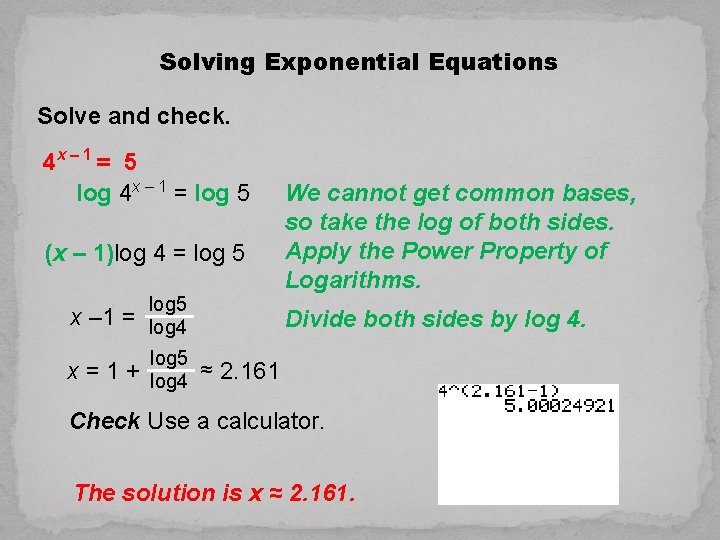
Solving Exponential Equations Solve and check. 4 x – 1 = 5 log 4 x – 1 = log 5 (x – 1)log 4 = log 5 x – 1 = log 5 log 4 We cannot get common bases, so take the log of both sides. Apply the Power Property of Logarithms. Divide both sides by log 4. log 5 x = 1 + log 4 ≈ 2. 161 Check Use a calculator. The solution is x ≈ 2. 161.

Using Logarithms to Solve Exponential Equations

Take the natural logarithm on both sides Use the power rule Use calculator. Check.

Take the natural logarithm of both sides. Check your answer.
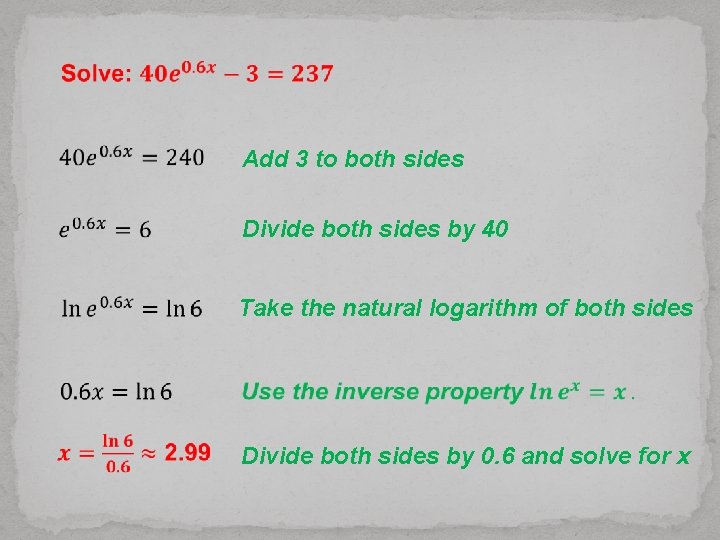
Add 3 to both sides Divide both sides by 40 Take the natural logarithm of both sides Divide both sides by 0. 6 and solve for x
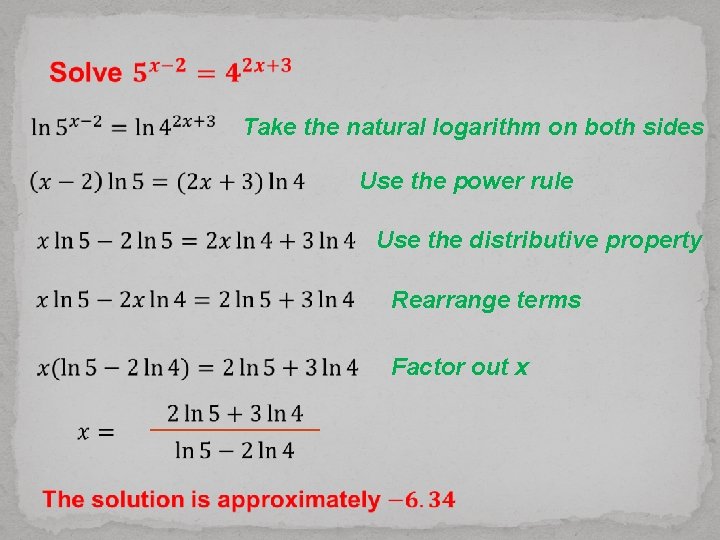
Take the natural logarithm on both sides Use the power rule Use the distributive property Rearrange terms Factor out x
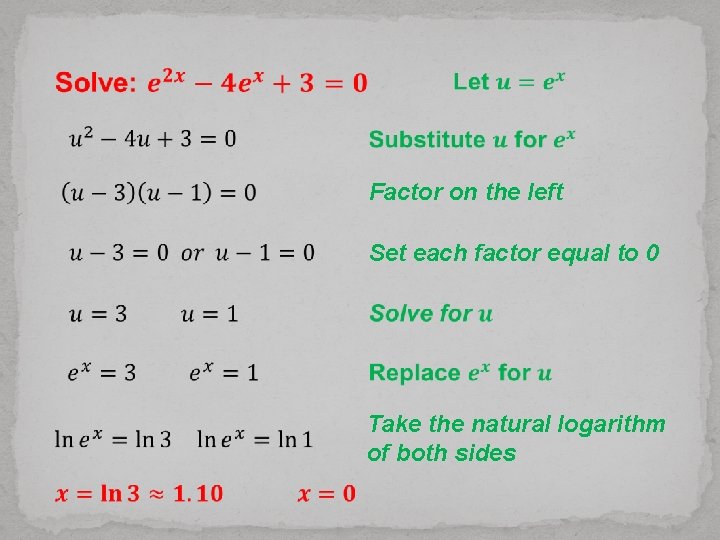
Factor on the left Set each factor equal to 0 Take the natural logarithm of both sides

Using the Definition of a Logarithm to Solve Logarithmic Equations
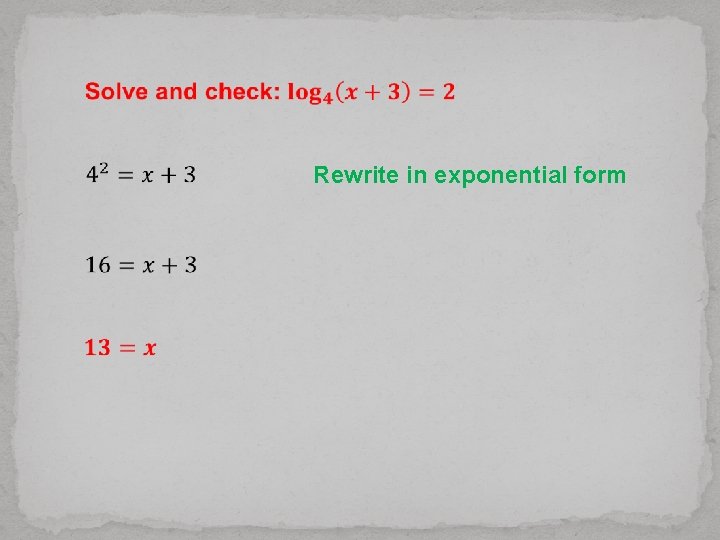
Rewrite in exponential form
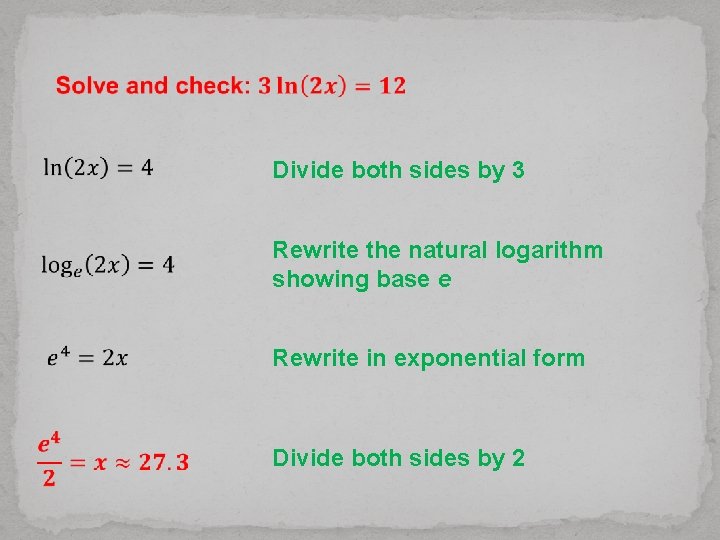
Divide both sides by 3 Rewrite the natural logarithm showing base e Rewrite in exponential form Divide both sides by 2
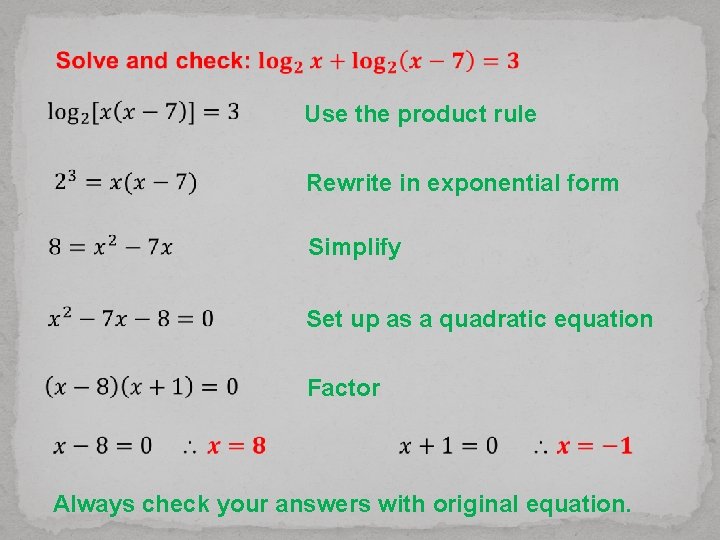
Use the product rule Rewrite in exponential form Simplify Set up as a quadratic equation Factor Always check your answers with original equation.

Using the One-to-One Property of Logarithms to Solve Logarithmic Equations
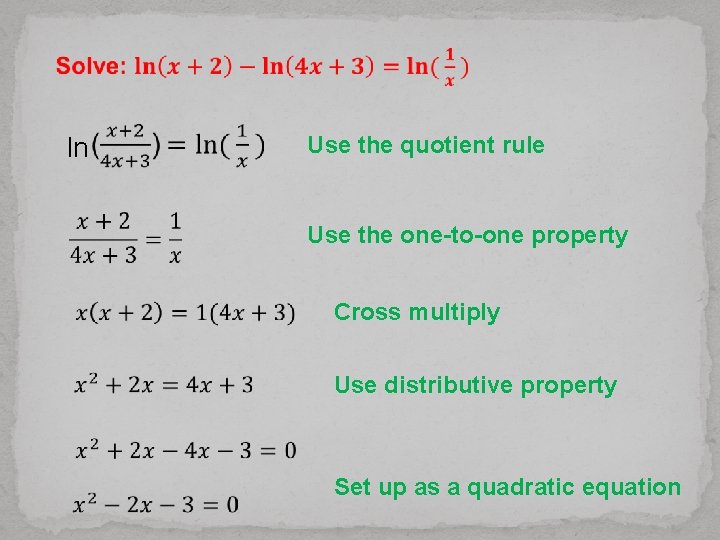
ln Use the quotient rule Use the one-to-one property Cross multiply Use distributive property Set up as a quadratic equation
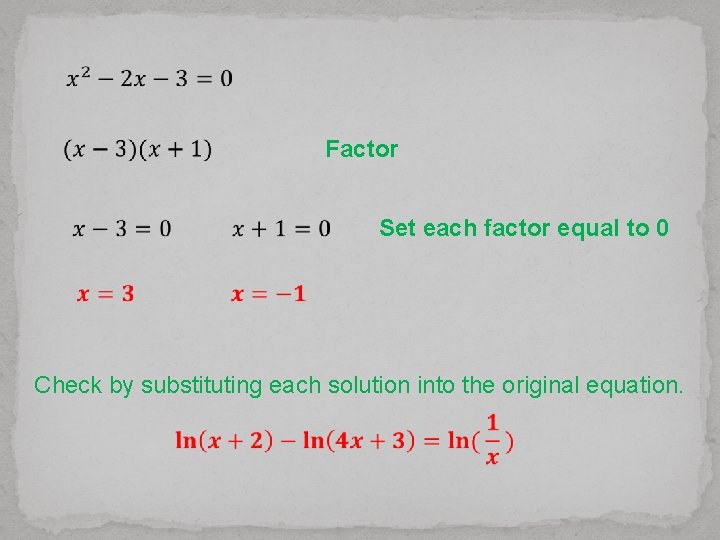
Factor Set each factor equal to 0 Check by substituting each solution into the original equation.

- Slides: 25