
Explosive Cyclogenesis Over Western Pacific Predictability and Downstream
Explosive Cyclogenesis Over Western Pacific: Predictability and Downstream Impacts Edmund K. M. Chang School of Marine and Atmospheric Sciences Stony Brook University NCEP THORPEX TPARC Workshop October 2008

Explosive cyclogenesis: deepening rate of > 24 h. Pa/24 hours normalized to 60° latitude (Sanders and Gyakum, 1980) Preferred explosive cyclogenesis locations Gyakum et al. (1989)
• Several studies have suggested that explosive cyclogenesis may be less predictable than other less intense storms (e. g. Mullen and Baumhefner 1988, 1989; Kuo and Low-Nam 1990) • Chang (2005): – Wave packets over Asia frequently precedes cyclogenesis over western Pacific – Explosive cyclogenesis much more frequent following existence of wave packets over Asia
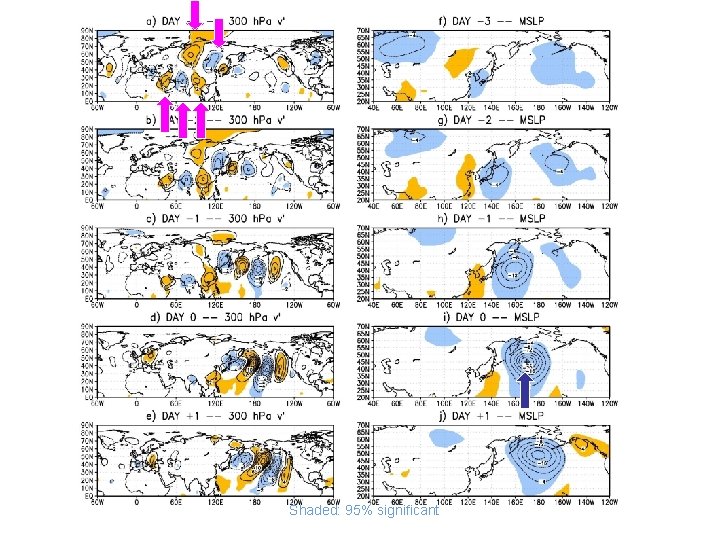
Shaded: 95% significant
Case Selection • ERA 40 MSLP and 300 h. Pa v’ data: – A) Day of occurrence of < 975 h. Pa cyclone between 160 -180 E with explosive growth during previous 24 hours [> 1 Bergeron] (Day 0) – B) Day of occurrence of significant wave packet over N (S) branch – All cases in which A (Day 0) occurs 3 days after B (Day -3) are selected

An example of explosive cyclogenesis 3 days after N packet ERA 40 MSLP (contour interval 5 h. Pa)
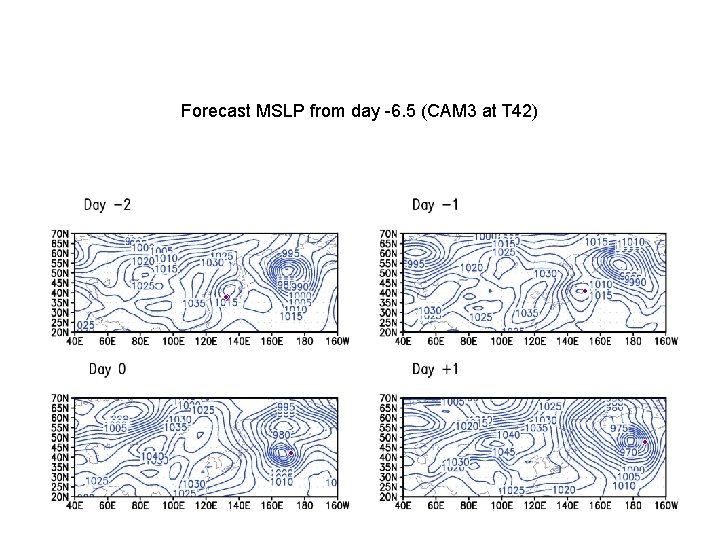
Forecast MSLP from day -6. 5 (CAM 3 at T 42)
Central pressure of cyclone Forecast from Day -8 Black: Analysis Red: Ideal Model Day Forecast from Day -6. 5 Green: NCEPR Blue: CAM 3 Day
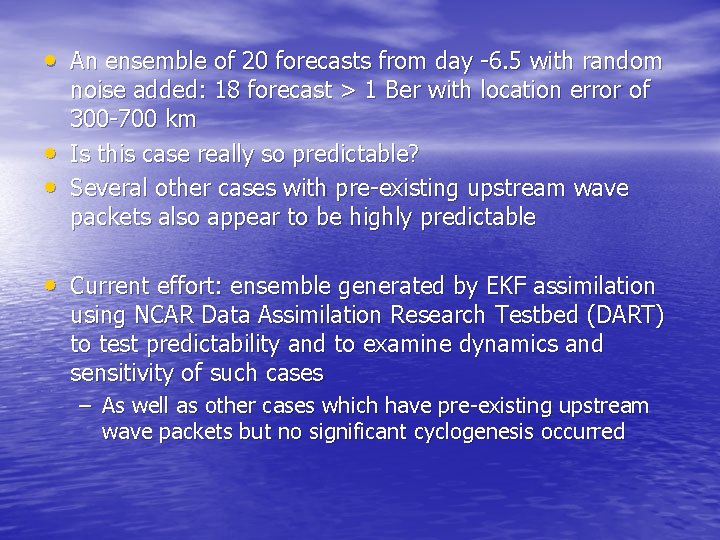
• An ensemble of 20 forecasts from day -6. 5 with random • • noise added: 18 forecast > 1 Ber with location error of 300 -700 km Is this case really so predictable? Several other cases with pre-existing upstream wave packets also appear to be highly predictable • Current effort: ensemble generated by EKF assimilation using NCAR Data Assimilation Research Testbed (DART) to test predictability and to examine dynamics and sensitivity of such cases – As well as other cases which have pre-existing upstream wave packets but no significant cyclogenesis occurred
• Linkage to TPARC? – Analyses and forecasts monitored for upstream wave packets and W. Pacific explosive cyclogenesis – DART ensemble assimilation too expensive to run real time, but interesting cases can be selected for posterior analyses – TIGGE data (if available real time) can be used for real time sensitivity analyses to provide dynamical insight and guidance
Downstream Impacts? Taken from THORPEX International Science Plan (Shapiro and Thorpe, 2004)
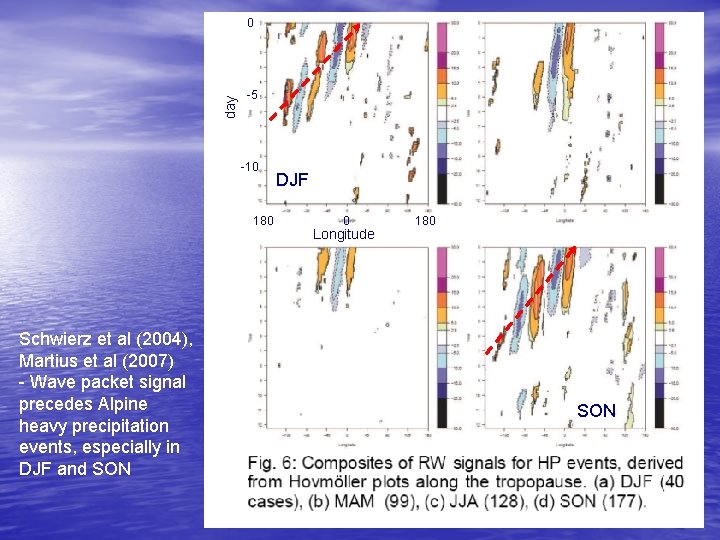
day 0 -5 -10 180 Schwierz et al (2004), Martius et al (2007) - Wave packet signal precedes Alpine heavy precipitation events, especially in DJF and SON DJF 0 Longitude 180 SON
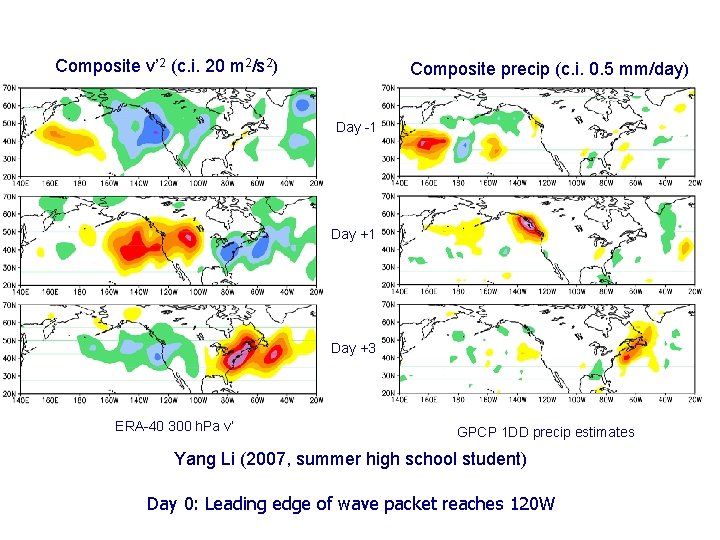
Composite v’ 2 (c. i. 20 m 2/s 2) Composite precip (c. i. 0. 5 mm/day) Day -1 Day +3 ERA-40 300 h. Pa v’ GPCP 1 DD precip estimates Yang Li (2007, summer high school student) Day 0: Leading edge of wave packet reaches 120 W
• Park (2008, summer REU student) found clear upstream wave signal associated with precip anomalies over NW and NE • Chang (2005): wave packets appear to become more coherent after significant cyclone events over western Pacific • Follow up research: – Are downstream impacts of those wave packets that involved explosive cyclogenesis more/less significant? – Link to financial losses and casualties?
- Slides: 14