
Exploring the Weather Exploring the Weather Important terms

- Slides: 15
Exploring the Weather
Exploring the Weather • Important terms: – Latitude – Snow – Condensation – Precipitation – Climate – Precipitation – Air Masses – Fog – Ocean Currents – Proximity to Water Effect – Climate Change – Weather Radar Stations – Meteorology
Latitude • Lines of Latitude run from West to East on Earth. (Page 31) • As latitude increases, the intensity of solar radiation (sunshine) decreases. • The ____ is the line of latitude that receives the greatest number of daylight hours per year. Areas closer to the ____ are often warmer than polar regions.
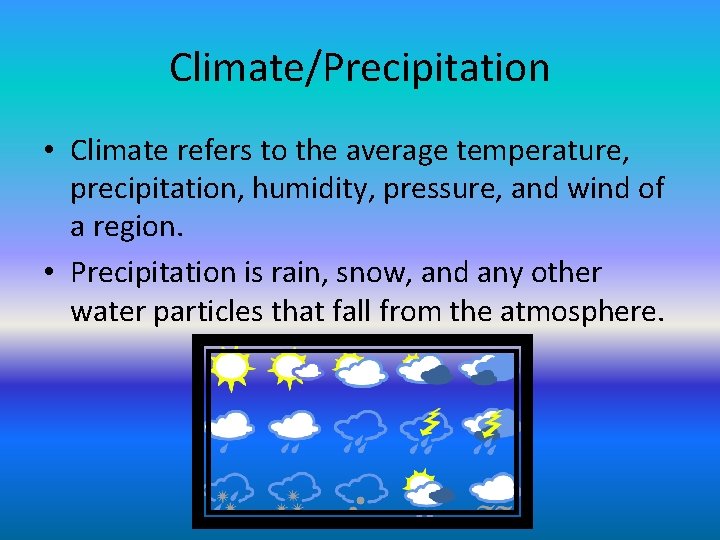
Climate/Precipitation • Climate refers to the average temperature, precipitation, humidity, pressure, and wind of a region. • Precipitation is rain, snow, and any other water particles that fall from the atmosphere.
Three Types of Precipitation • Frontal Precipitation: may be caused when one air mass displaces another (Page 34; Figure 2. 18). • Convectional Precipitation: may occur as a result of vertical movement within a mass of air (Page 34; Figure 2. 19) • Relief/Orographic Precipitation: occurs when moist air moves over a mountain barrier (Page 35, Figure 2. 20)
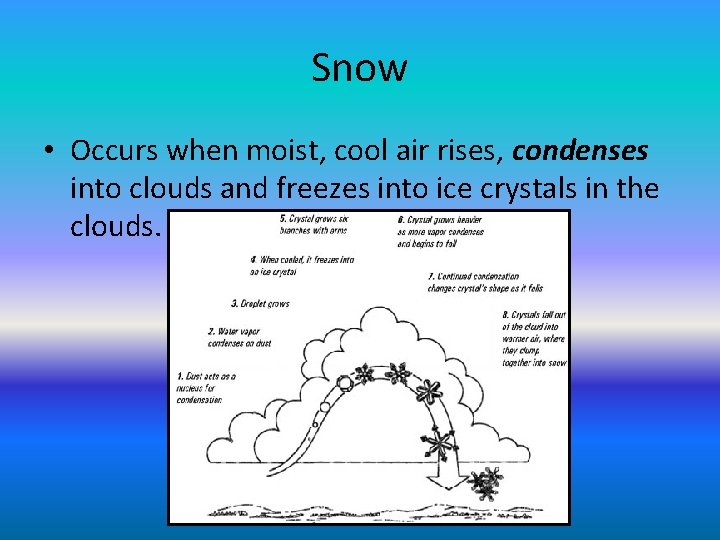
Snow • Occurs when moist, cool air rises, condenses into clouds and freezes into ice crystals in the clouds.
Climate Change • Climate Change – the result of increased levels of carbon dioxide, nitrous oxide, and methane. – what we experience is an increase in average temperatures around the world. – increased temperatures mean that polar ice caps will shrink resulting in higher sea levels and greater risk to the world’s population.
Air Masses • Air masses are large amounts of air with similar temperature and moisture conditions. • Air masses we may encounter: – Continental Arctic: cold and dry air from Northern Canada – Maritime Tropical: warm and moist air from the Caribbean – Maritime Polar: cool and moist air from the Atlantic (east of Newfoundland)
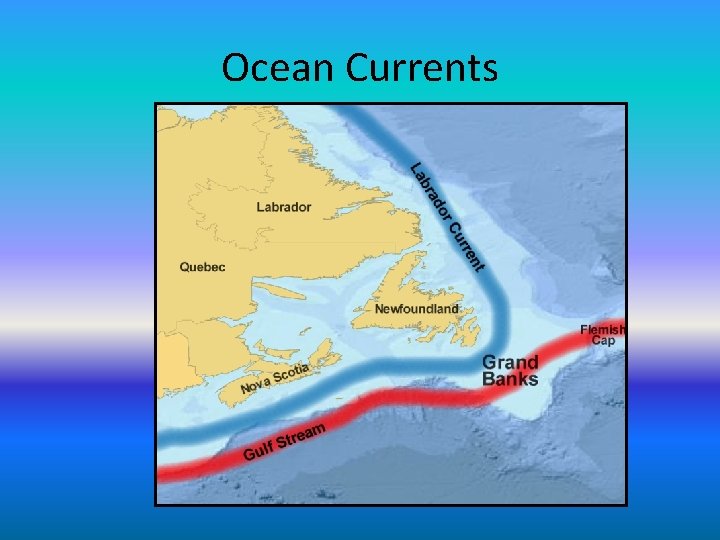
Ocean Currents • Ocean currents occur when water moves great distances from one part of the globe to another. • Major ocean currents: – Gulf Stream: warm water from the south that is brought to southeastern Nova Scotian shores and warms and moistens air masses above it. – Labrador Current: cold water from the north that affects us and cools and moistens air masses above it.
Ocean Currents
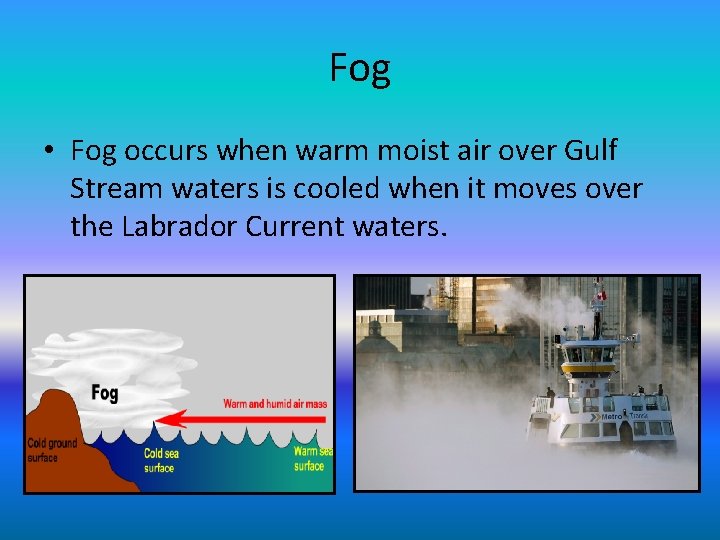
Fog • Fog occurs when warm moist air over Gulf Stream waters is cooled when it moves over the Labrador Current waters.
Proximity to Water Effect • The proximity of a place to water (close or far) affects how quickly or slowly the sun can heat an area. • For example the sun warms land faster than it warms water. • Therefore areas that are coastal will be cooler in the summer and warmer in winter than inland areas.
Meteorologists • Weather experts who use satellite imagery to forecast the weather. • For example, Cindy Day on CTV and Peter Coade on CBC • This news is useful to help people properly prepare themselves during storms, hurricanes, tornadoes, etc.
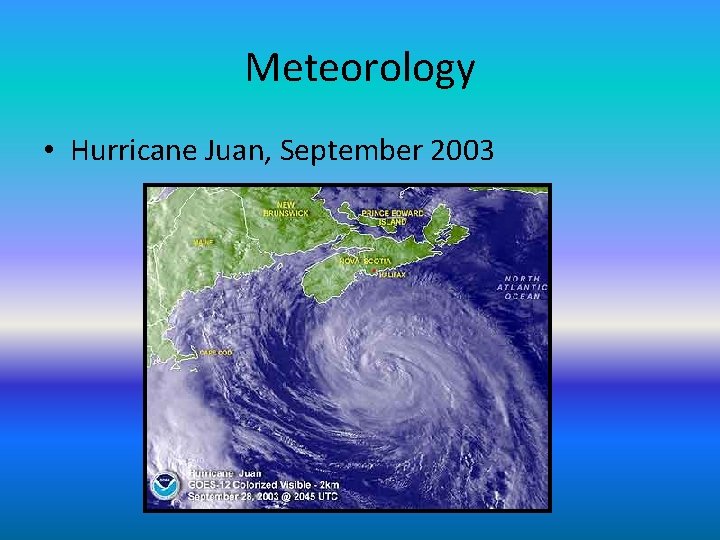
Meteorology • Hurricane Juan, September 2003
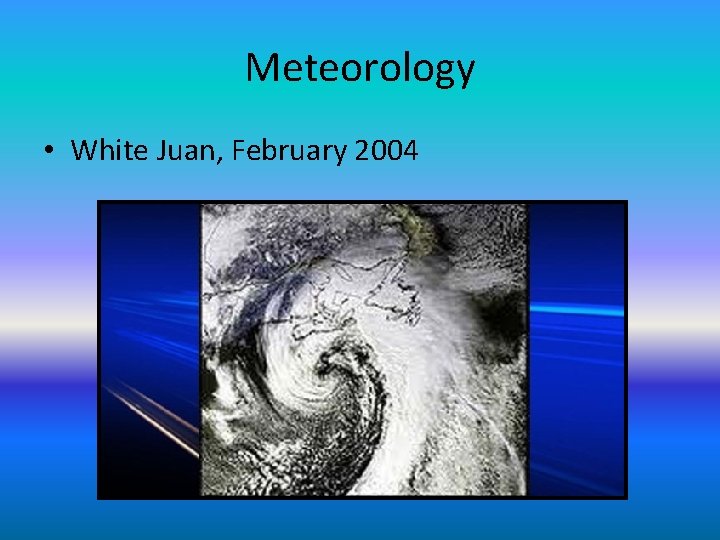
Meteorology • White Juan, February 2004