
Exploring the Structure and Function of Cytochrome bo
Exploring the Structure and Function of Cytochrome bo 3 Ubiquinol Oxidase from Escherichia coli Lai Yap Department of Biochemistry
Heme-Copper Oxidase Superfamily • catalyze reduction of oxygen to water, and utilizes free energy produced to pump protons across membrane • transmembrane proton and voltage gradient thus generated is converted to useful energy forms (eg. ATP by ATP synthase)
Heme-Copper Oxidase Superfamily • 2 main groups (based on electron-donating substrate) : cytochrome c oxidase (eg. mitochondrial cytochrome c oxidase) and ubiquinol oxidase (eg. cytochrome bo 3 ubiquinol oxidase) • membership based on presence of subunit homologous to subunit I of mammalian cytochrome c oxidase • subunit I: – largest subunit – binuclear center (where O 2 binds and is reduced to water) consisting of a heme and copper (Cu. B) – a second heme (which facilitates transfer of electrons to binuclear center)
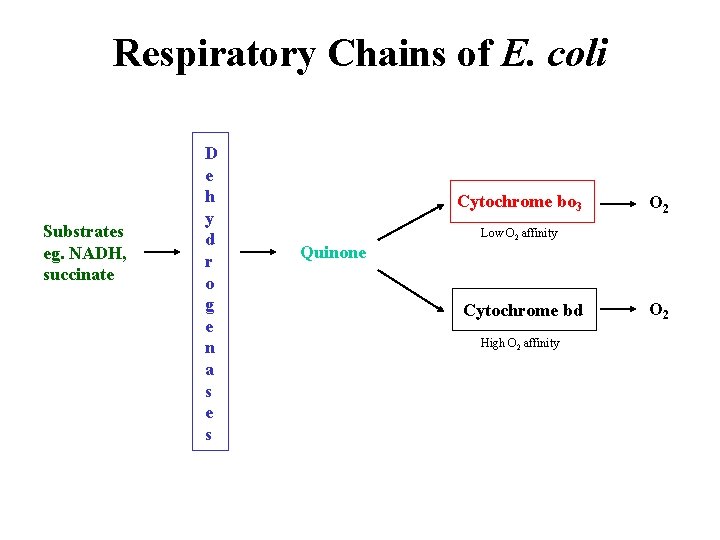
Respiratory Chains of E. coli Substrates eg. NADH, succinate D e h y d r o g e n a s e s Cytochrome bo 3 O 2 Low O 2 affinity Quinone Cytochrome bd High O 2 affinity O 2
Cytochrome bo 3 ubiquinol oxidase • • a terminal oxidase in the aerobic respiratory chain of Escherichia coli member of the heme-copper oxidase superfamily consists of four subunits catalyzes two-electron oxidation of ubiquinol-8 (Q 8 H 2) at periplasmic side of cytoplasmic membrane and four-electron reduction of oxygen to water at cytoplasmic side • also functions as a proton pump by translocating protons across the cytoplasmic membrane to establish an electrochemical proton gradient • possible mechanism: ubiquinone bound at the high affinity site (QH) acts as cofactor and mediates electron transfer from ubiquinol substrate (at the low-affinity QL site) to heme b • reduced heme b then provides electrons to the binuclear center for the reduction of oxygen to water
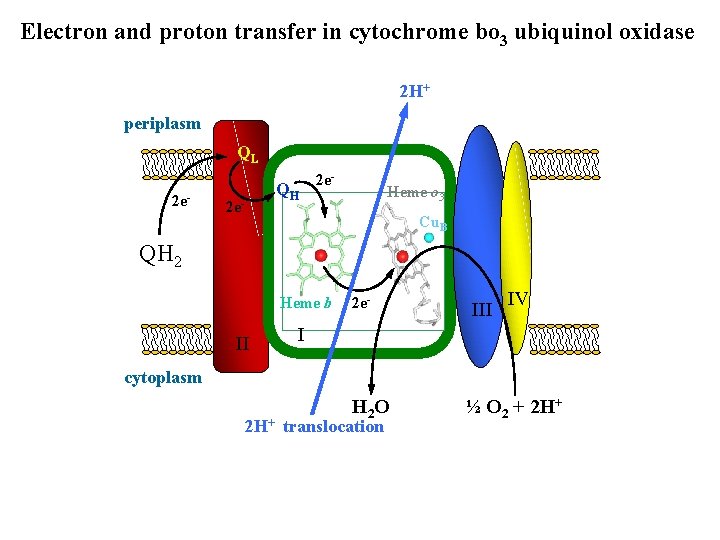
Electron and proton transfer in cytochrome bo 3 ubiquinol oxidase 2 H+ periplasm QL 2 e- QH 2 e- Heme o 3 Cu. B QH 2 Heme b II 2 e- III IV I cytoplasm H 2 O 2 H+ translocation ½ O 2 + 2 H+

Spherical rendering structure of ubiquinol oxidase ubiquinol binding site Subunit III Subunit IV P C

Structure of ubiquinol oxidase ubiquinol binding site Subunit III Subunit IV P C
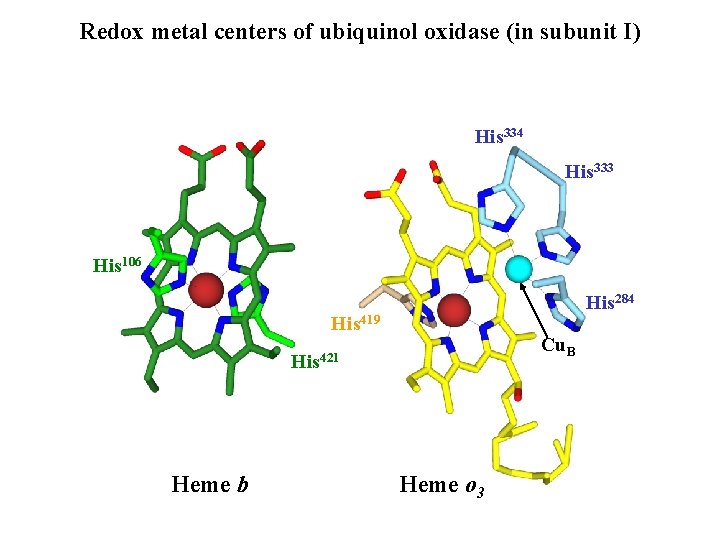
Redox metal centers of ubiquinol oxidase (in subunit I) His 334 His 333 His 106 His 284 His 419 Cu. B His 421 Heme b Heme o 3
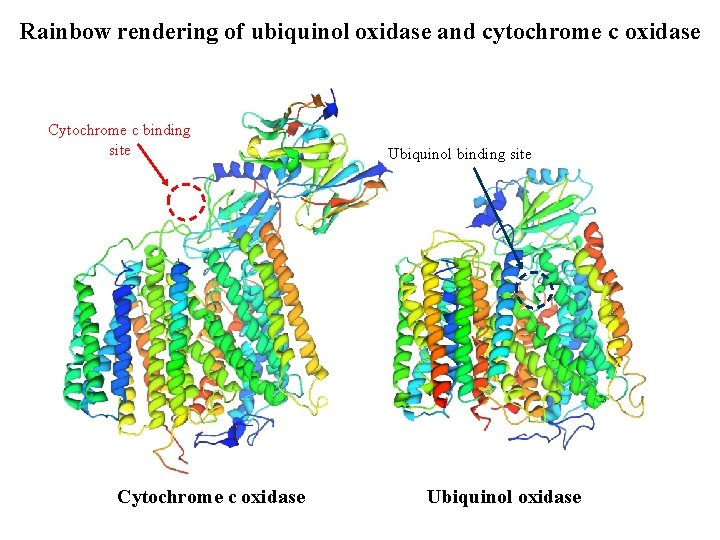
Rainbow rendering of ubiquinol oxidase and cytochrome c oxidase Cytochrome c binding site Cytochrome c oxidase Ubiquinol binding site Ubiquinol oxidase
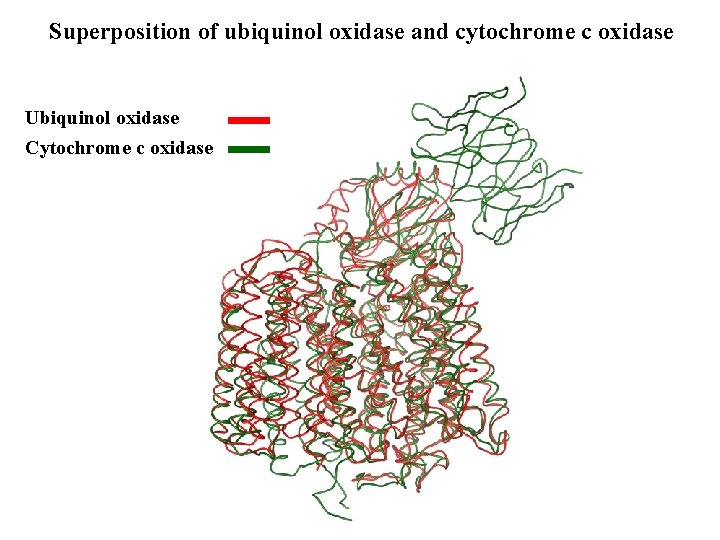
Superposition of ubiquinol oxidase and cytochrome c oxidase Ubiquinol oxidase Cytochrome c oxidase
Proton transfer pathways • D- and K-channels in subunit I • channels form polar cavities that originate on the cytoplasmic side, leading to the binuclear center for proton pumping and water formation • D-channel : uptake of both chemical and pumped protons • K-channel : load enzyme with protons at some earlier catalytic steps
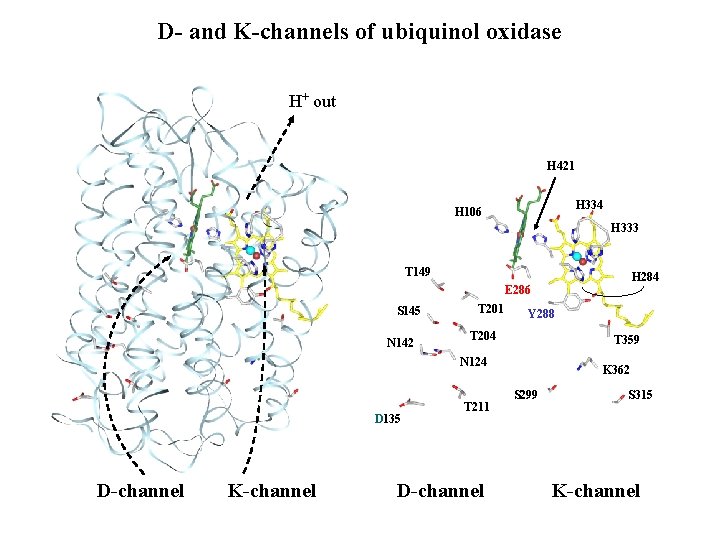
D- and K-channels of ubiquinol oxidase H+ out H 421 H 334 H 106 H 333 T 149 H 284 E 286 S 145 N 142 T 201 Y 288 T 204 T 359 N 124 D 135 D-channel K-channel T 211 D-channel K 362 S 299 S 315 K-channel
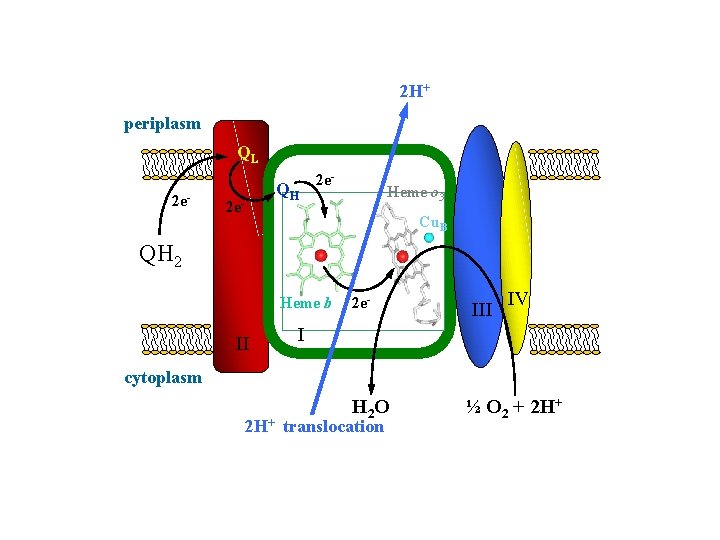
2 H+ periplasm QL 2 e- QH 2 e- Heme o 3 Cu. B QH 2 Heme b II 2 e- III IV I cytoplasm H 2 O 2 H+ translocation ½ O 2 + 2 H+
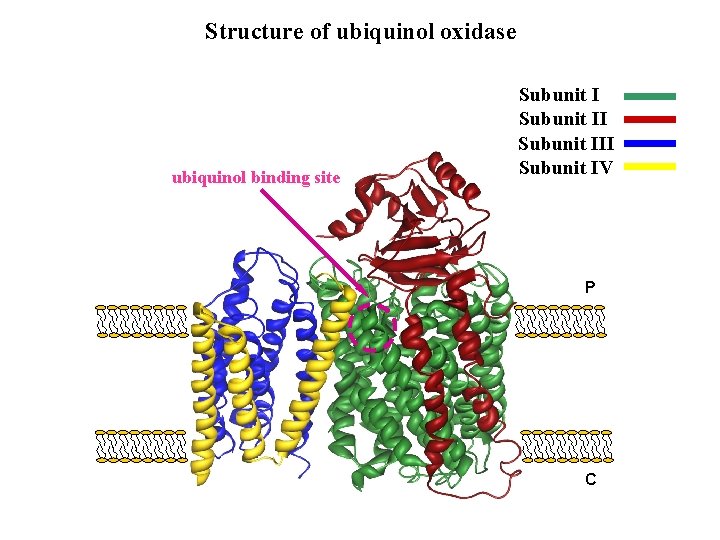
Structure of ubiquinol oxidase ubiquinol binding site Subunit III Subunit IV P C
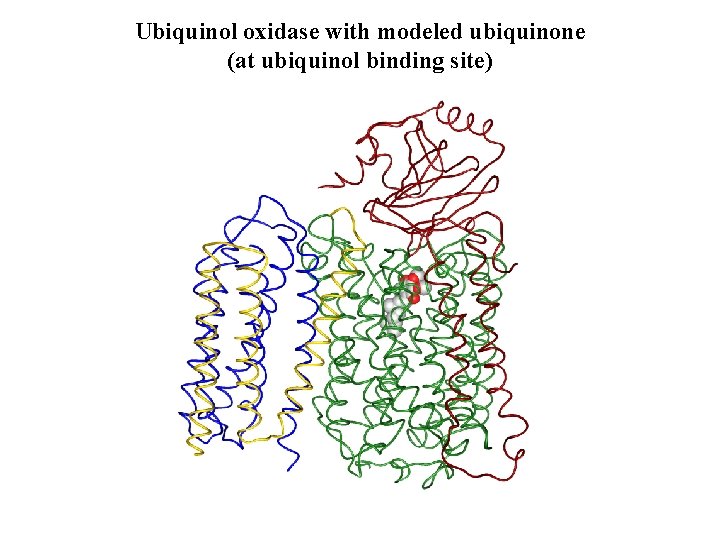
Ubiquinol oxidase with modeled ubiquinone (at ubiquinol binding site)
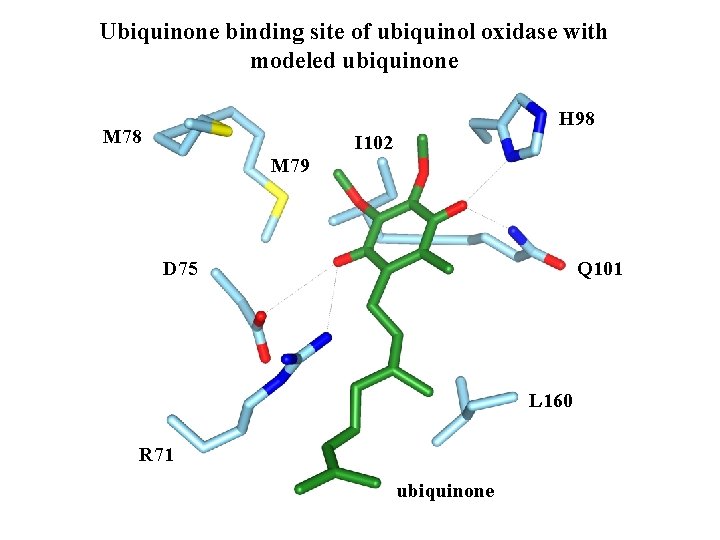
Ubiquinone binding site of ubiquinol oxidase with modeled ubiquinone H 98 M 78 I 102 M 79 D 75 Q 101 L 160 R 71 ubiquinone
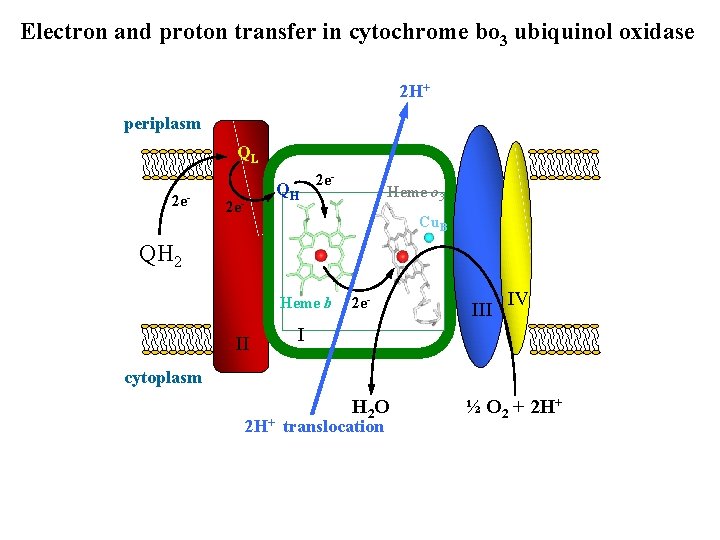
Electron and proton transfer in cytochrome bo 3 ubiquinol oxidase 2 H+ periplasm QL 2 e- QH 2 e- Heme o 3 Cu. B QH 2 Heme b II 2 e- III IV I cytoplasm H 2 O 2 H+ translocation ½ O 2 + 2 H+
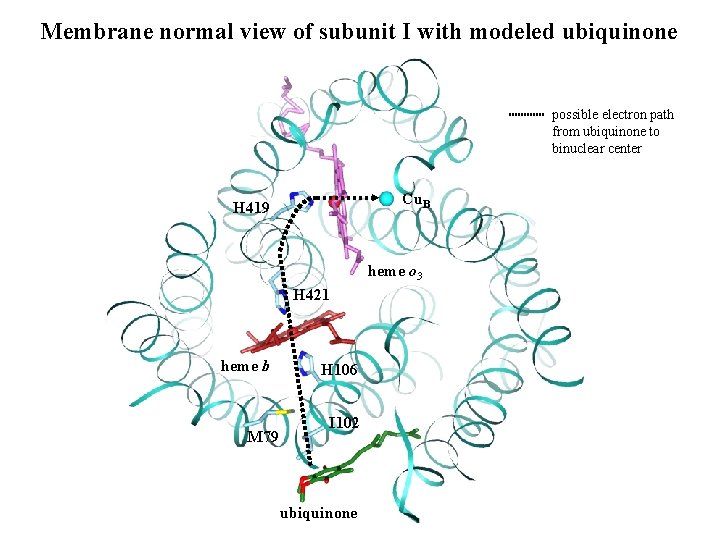
Membrane normal view of subunit I with modeled ubiquinone possible electron path from ubiquinone to binuclear center Cu. B H 419 heme o 3 H 421 heme b M 79 H 106 I 102 ubiquinone
- Slides: 19