
Exploring the Roles of Variation and Expectation in
- Slides: 20
Exploring the Roles of Variation and Expectation in Children's Learning of Probability h mit S r e Tayl stin d n rtz a han Au u K han Dr. Jat t a n Jo tor: n e M
Introduction ● ● ● Learning probability poses many challenges, such as developing sound intuitions about random behavior (Degner, 2015). Playing probability games can help build knowledge of probability and random behavior. Students can systematically conduct trials, record the outcomes, and reflect on the results (Nisbet & Williams, 2009). Teachers should design activities that help students understand the relationship between variation and expectation, which is at the heart of learning probability (Watson & English, 2016).
Purpose ● Investigate students’ thinking about variation and expectation in probability ● Design a game-based instructional sequence to help their thinking develop. Research Question How do students think about variation and expectation before, during, and after a game-based instructional sequence designed to help them build probabilistic knowledge?
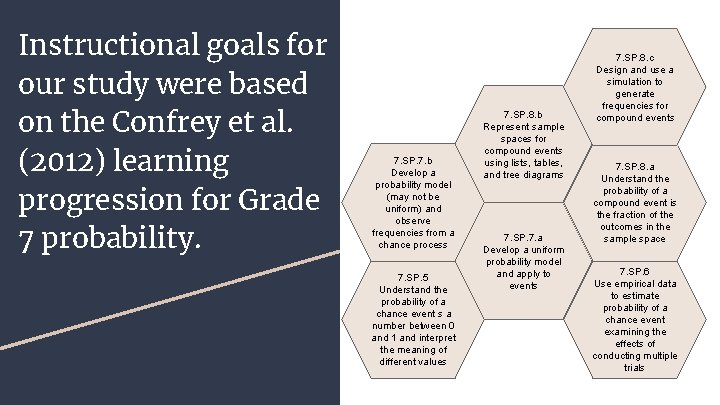
Instructional goals for Curricular Framework our study were based on the Confrey et al. (2012) learning progression for Grade 7 probability. 7. SP. 7. b Develop a probability model (may not be uniform) and observe frequencies from a chance process 7. SP. 5 Understand the probability of a chance event s a number between 0 and 1 and interpret the meaning of different values 7. SP. 8. b Represent sample spaces for compound events using lists, tables, and tree diagrams 7. SP. 7. a Develop a uniform probability model and apply to events 7. SP. 8. c Design and use a simulation to generate frequencies for compound events 7. SP. 8. a Understand the probability of a compound event is the fraction of the outcomes in the sample space 7. SP. 6 Use empirical data to estimate probability of a chance event examining the effects of conducting multiple trials
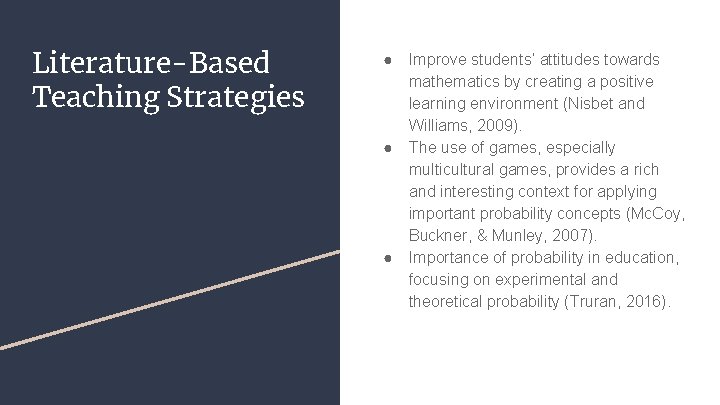
Literature-Based Teaching Strategies ● ● ● Improve students’ attitudes towards mathematics by creating a positive learning environment (Nisbet and Williams, 2009). The use of games, especially multicultural games, provides a rich and interesting context for applying important probability concepts (Mc. Coy, Buckner, & Munley, 2007). Importance of probability in education, focusing on experimental and theoretical probability (Truran, 2016).
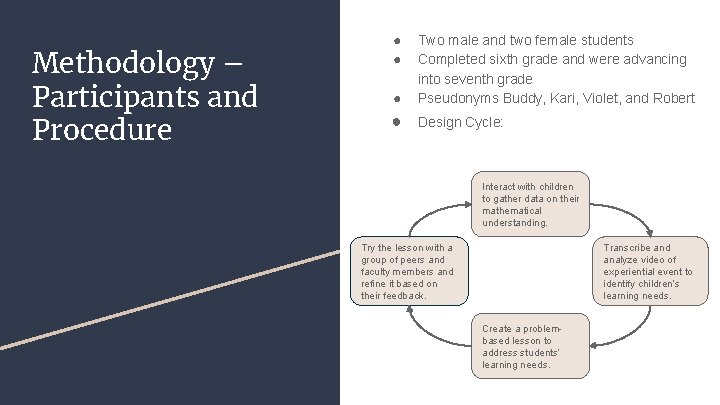
Methodology – Participants and Procedure ● ● ● Two male and two female students Completed sixth grade and were advancing into seventh grade Pseudonyms Buddy, Kari, Violet, and Robert ● Design Cycle: Interact with children to gather data on their mathematical understanding. Transcribe and analyze video of experiential event to identify children’s learning needs. Try the lesson with a group of peers and faculty members and refine it based on their feedback. Create a problembased lesson to address students’ learning needs.
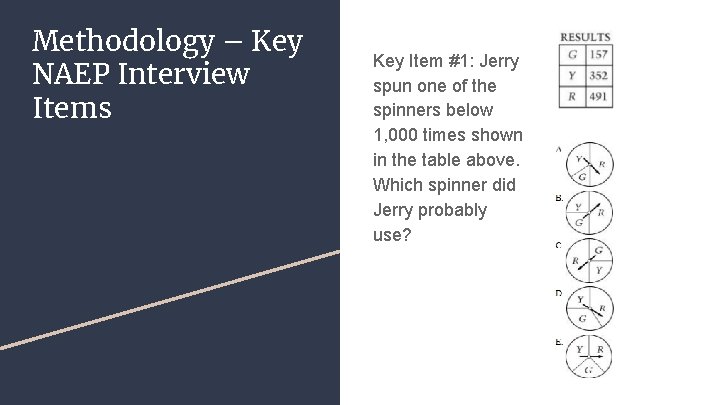
Methodology – Key NAEP Interview Items Key Item #1: Jerry spun one of the spinners below 1, 000 times shown in the table above. Which spinner did Jerry probably use?
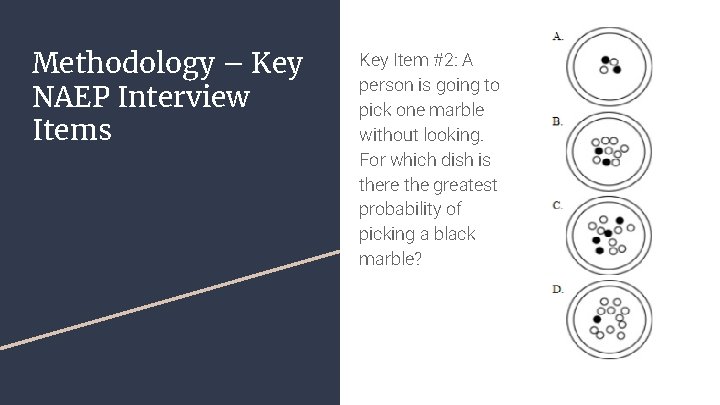
Methodology – Key NAEP Interview Items Key Item #2: A person is going to pick one marble without looking. For which dish is there the greatest probability of picking a black marble?
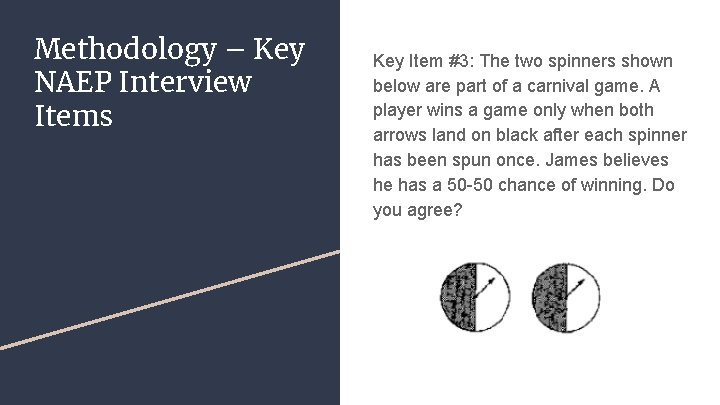
Methodology – Key NAEP Interview Items Key Item #3: The two spinners shown below are part of a carnival game. A player wins a game only when both arrows land on black after each spinner has been spun once. James believes he has a 50 -50 chance of winning. Do you agree?
Initial Assessment Results ● ● ● Key Item #1: ○ Violet thought yellow and green would occupy the same amount of space on a spinner, even though yellow appeared in the results far more often. Key Item #2: ○ Buddy used odds ratio-like expressions for each problem, as when quantifying probabilities ( e. g. , 1: 1, 1: 4, 1: 8). Key Item #3: ○ Three of the four students had trouble with compound events. They believed there was a 50 -50 chance of winning the carnival game when there was actually only a 25% chance. Robert's interview response is illustrative: “There’s an equal amount on each side and when he spins he could have the same amount of getting it [white or black]. ”
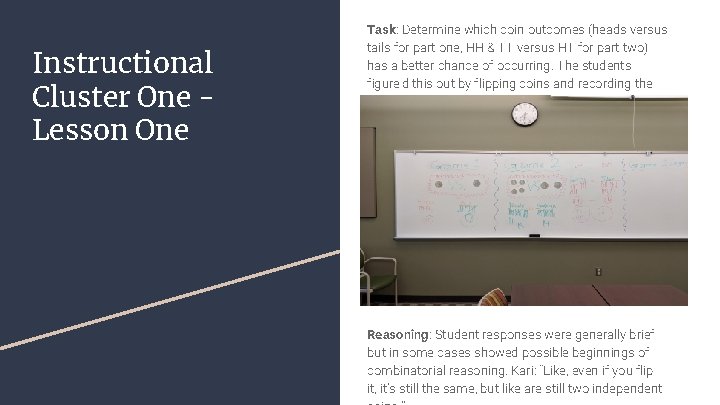
Instructional Cluster One Lesson One Task: Determine which coin outcomes (heads versus tails for part one, HH & TT versus HT for part two) has a better chance of occurring. The students figure d this out by flipping coins and recording the results. Reasoning: Student responses were generally brief but in some cases showed possible beginnings of combinatorial reasoning. Kari: “Like, even if you flip it, it’s still the same, but like are still two independent
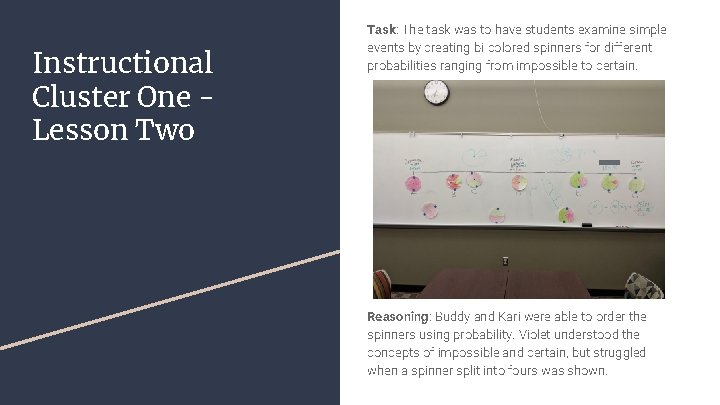
Instructional Cluster One Lesson Two Task: The task was to have students examine simple events by creating bi-colored spinners for different probabilities ranging from impossible to certain. Reasoning: Buddy and Kari were able to order the spinners using probability. Violet understood the concepts of impossible and certain, but struggled when a spinner split into fours was shown.
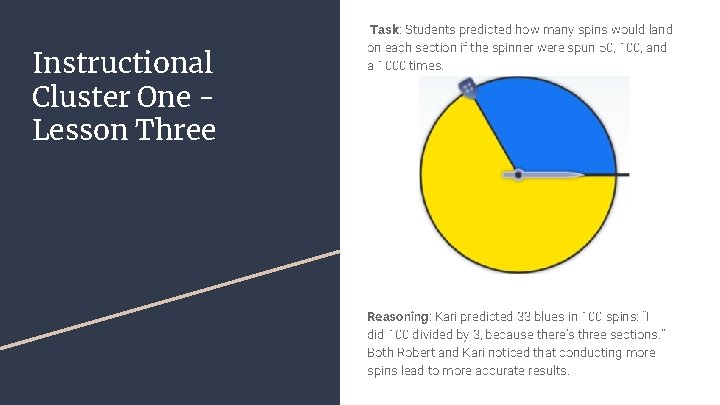
Instructional Cluster One Lesson Three Task: Students predicted how many spins would land on each section if the spinner were spun 50, 100, and a 1000 times. Reasoning: Kari predicted 33 blues in 100 spins: “I did 100 divided by 3, because there’s three sections. ” Both Robert and Kari noticed that conducting more spins lead to more accurate results.
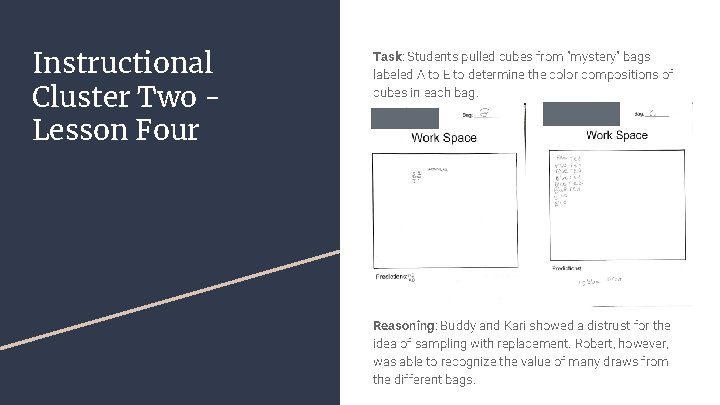
Instructional Cluster Two Lesson Four Task: Students pulled cubes from "mystery" bags labeled A to E to determine the color compositions of cubes in each bag. Reasoning: Buddy and Kari showed a distrust for the idea of sampling with replacement. Robert, however, was able to recognize the value of many draws from the different bags.
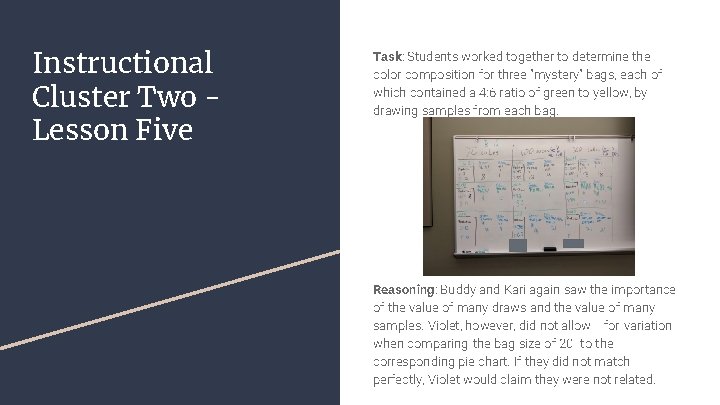
Instructional Cluster Two Lesson Five Task: Students worked together to determine the color composition for three "mystery" bags, each of which contained a 4: 6 ratio of green to yellow, by drawing samples from each bag. Reasoning: Buddy and Kari again saw the importance of the value of many draws and the value of many samples. Violet, however, did not allow for variation when comparing the bag size of 20 to the corresponding pie chart. If they did not match perfectly, Violet would claim they were not related.
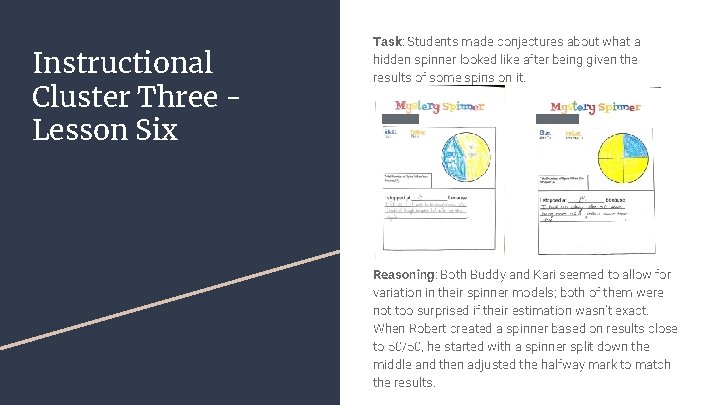
Instructional Cluster Three Lesson Six Task: Students made conjectures about what a hidden spinner looked like after being given the results of some spins on it. Reasoning: Both Buddy and Kari seemed to allow for variation in their spinner models; both of them were not too surprised if their estimation wasn’t exact. When Robert created a spinner based on results close to 50/50, he started with a spinner split down the middle and then adjusted the halfway mark to match the results.
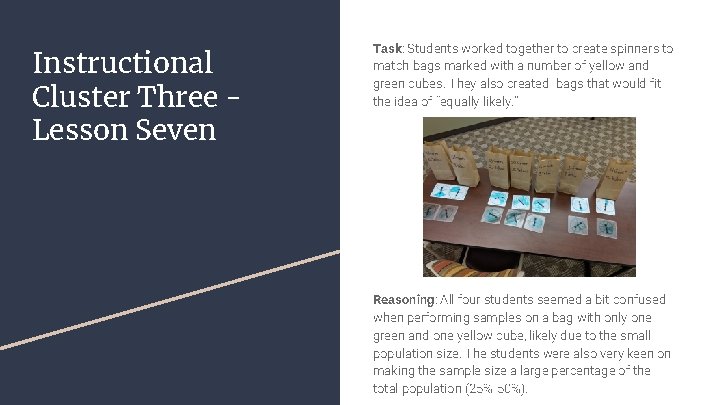
Instructional Cluster Three Lesson Seven Task: Students worked together to create spinners to match bags marked with a number of yellow and green cubes. They also created bags that would fit the idea of “equally likely. ” Reasoning: All four students seemed a bit confused when performing samples on a bag with only one green and one yellow cube, likely due to the small population size. The students were also very keen on making the sample size a large percentage of the total population (25%-50%).
Post-Assessment Results ● Compared to the first interview, Violet did show some slight improvements. However, contextual details still confused her in many of the questions. Both Kari and Buddy showed much more improvement, using strong proportional reasoning in many of their answers. ● In many of the problems, Kari used fractions to relate areas of spinners to expected values. For example, one problem had a spinner split up into three parts, with a 2: 1: 1 ratio. She recognized that the smaller portions were quarters and was able to correctly estimate how many would land in a quarter portion out of 300. ● Compound events still posed trouble for the students, something we did not have much time to cover. Only Buddy was successfully able to state there was a 25% chance of winning the carnival game (key item #3). Unfortunately, Robert did not show up for the final postassessment due to responsibilities elsewhere.
Reflection and Discussion ● ● Students had difficulty understanding sampling with replacement; they tended to not trust this sampling method. Students also generally wanted the sample size to be a large percentage of population and would be worried about pulling the same cube twice in a single sample. The seventh grade learning progressions guiding our study involved compound events. Our experience suggests that several more lessons would be needed to prepare students to study this topic; moving from a basic understanding of probability to understanding compound events is not a trivial matter. Although probability is not addressed until Grade 7 in the Common Core, it would be helpful for teachers in earlier grade levels to develop children’s understanding of beginning probability concepts so that the seventh grade curriculum is not overwhelming. Our study provides examples of how such understanding can be developed through games and other concrete activities.
References Confrey, J. , Nguyen, K. H. , Lee, K. , Panorkou, N. , Corley, A. K. , & Maloney, A. P. (2012). Turn. On. CCMath. net: Learning trajectories for the K-8 Common Core Math Standards. Retrieved from http: //www. turnonccmath. net Degner, K. (2015). Flipping out: Calculating probability with a coin game. Mathematics Teaching In The Middle School, 21 (4), 244 -245. Jones, G. A. , Langrall, C. W. , & Mooney, E. S. (2007). Research in probability: Responding to classroom realities. In F. K. Lester (Ed. ), Second handbook of research on mathematics teaching and learning (pp. 909 -955). Charlotte, NC: National Council of Teachers of Mathematics and Information Age Publishing. Mc. Coy, L. , Buckner, S. , & Munley, J. (2007). Probability games from diverse cultures. Mathematics Teaching in the Middle School, 12(7), 394 -402. Nisbet, S. , & Williams, A. (2009). Improving students' attitudes to chance with games and activities. Australian Mathematics Teacher, 65 (3), 25 -37. Truran, J. (2016). What is the probability of. . . ? . Australian Mathematics Teacher, 72 (3), 59 -60. Ricks, T. E. (2011). Process reflection during Japanese lesson study experiences by prospective secondary mathematics teachers. Journal of Mathematics Teacher Education, 14 (4), 251 -267. Watson, J. M. , & English, L. D. (2016). Development of probabilistic understanding in fourth grade. Journal for Research in Mathematics Education, 47 (1), 28 -62.