
Exploring the role of Tactical Decision Games TDGs
- Slides: 18
Exploring the role of Tactical Decision Games (TDGs) as a novel method of teaching Non-Technical Skills (NTS) ID Drummond, J Skinner, SM Wood AMEE, Milan, September 1 st 2014
Non-technical skills (NTS) “The cognitive, social and personal resource skills that complement technical skills, and contribute to safe and efficient task performance”. Ø Ref: Flin et al. Safety at the sharp end: A guide to non-technical skills. Ashgate, Surrey 2008
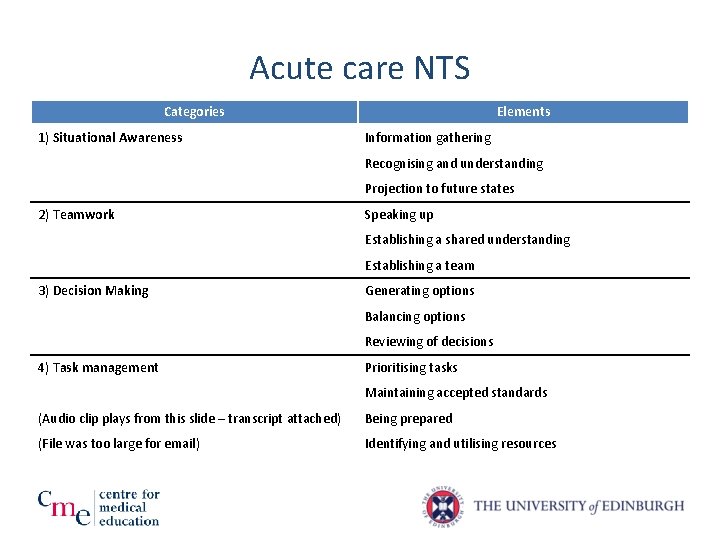
Acute care NTS Categories 1) Situational Awareness Elements Information gathering Recognising and understanding Projection to future states 2) Teamwork Speaking up Establishing a shared understanding Establishing a team 3) Decision Making Generating options Balancing options Reviewing of decisions 4) Task management Prioritising tasks Maintaining accepted standards (Audio clip plays from this slide – transcript attached) Being prepared (File was too large for email) Identifying and utilising resources
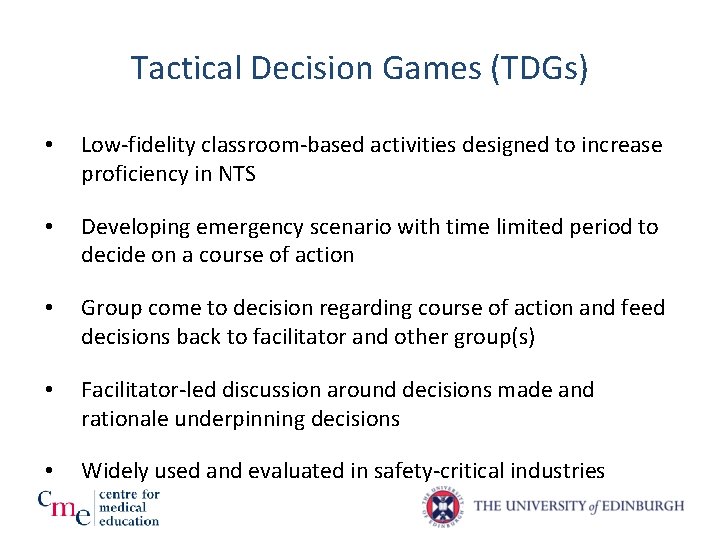
Tactical Decision Games (TDGs) • Low-fidelity classroom-based activities designed to increase proficiency in NTS • Developing emergency scenario with time limited period to decide on a course of action • Group come to decision regarding course of action and feed decisions back to facilitator and other group(s) • Facilitator-led discussion around decisions made and rationale underpinning decisions • Widely used and evaluated in safety-critical industries
Example TDG • Your plane has crash landed • You can access either the front or rear cargo hold • Each hold contains multiple items that may be used to aid survival Task: select 10 items from your chosen hold
Objectives 1) To explore the feasibility of using TDGs as a novel teaching method with final year medical students 2) To explore how to use TDGs most effectively to teach NTS to final year medical students
Methodology • 2 generic TDGs, acute care simulation and focus group • Short presentation and discussion around NTS between TDGs • TDGs/simulations video recorded and focus groups audio recorded and transcribed • Findings of 1 cycle inform the next
Results Emergent Themes
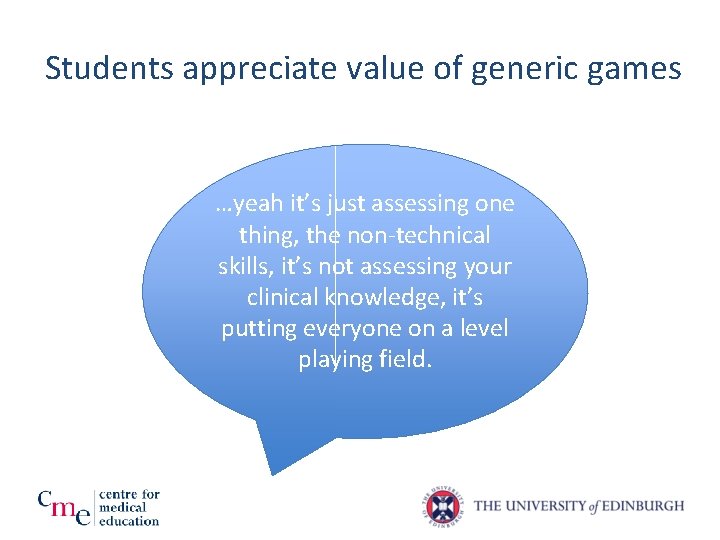
Students appreciate value of generic games …yeah it’s just assessing one thing, the non-technical skills, it’s not assessing your clinical knowledge, it’s putting everyone on a level playing field.
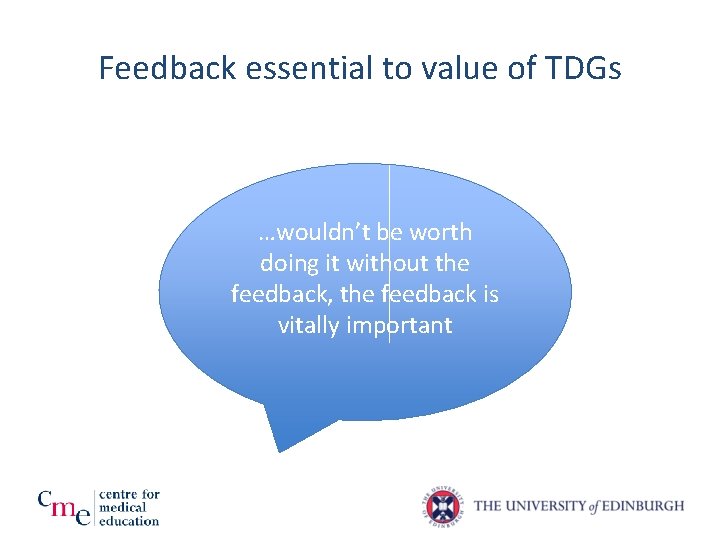
Feedback essential to value of TDGs …wouldn’t be worth doing it without the feedback, the feedback is vitally important
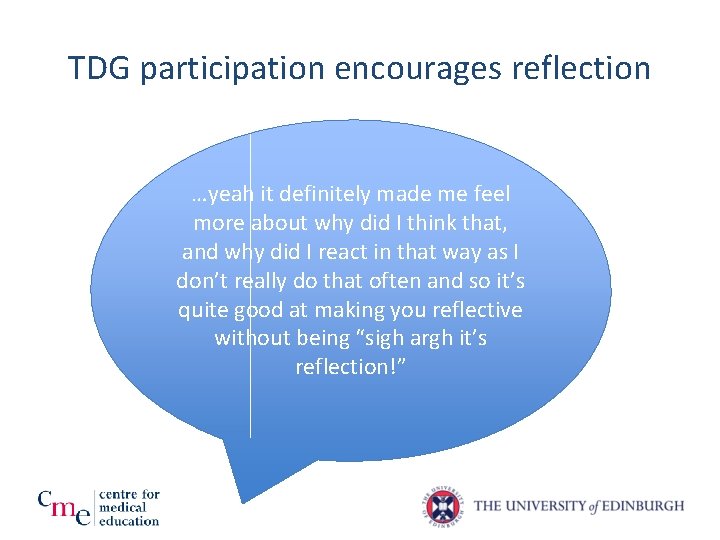
TDG participation encourages reflection …yeah it definitely made me feel more about why did I think that, and why did I react in that way as I don’t really do that often and so it’s quite good at making you reflective without being “sigh argh it’s reflection!”
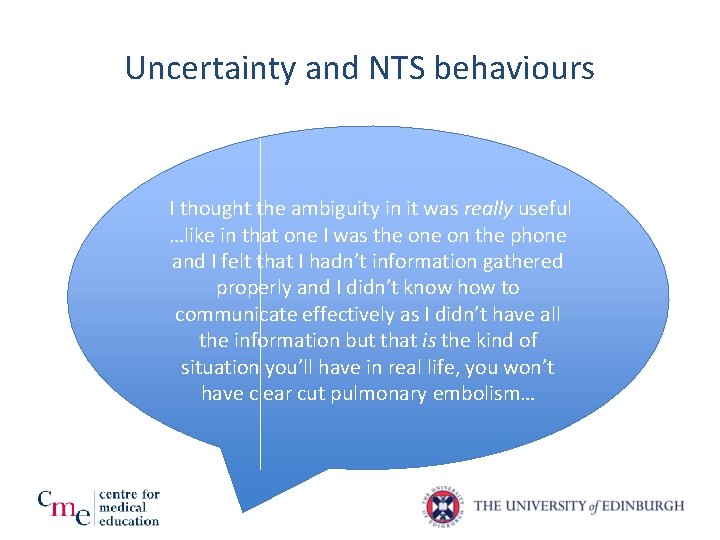
Uncertainty and NTS behaviours I thought the ambiguity in it was really useful …like in that one I was the on the phone and I felt that I hadn’t information gathered properly and I didn’t know how to communicate effectively as I didn’t have all the information but that is the kind of situation you’ll have in real life, you won’t have clear cut pulmonary embolism…
Students as co-creators of research S 3 – so how about an initial learning process, and then seeing whether that influences the second attempt? S 2 – But surely you would have a control group who wouldn’t do that initial challenge and then…. (all talk over each other) S 1 – You are all trying to design a research project now!
Integrating TDGs into the curriculum And it should be something that is started from Year 1 or Year 2 when you do not have so much medical knowledge so you actually stop medicalising things and develop…. non-technical skills yeah I agree earlier is better…maybe they should teach this in primary school because it’s applicable to lots of different areas and so I don’t think there is ever a wrong time to start doing it
Recognising and applying NTS But I think making you aware of these skills would actually help you develop them, …once you are aware you can think I don’t usually act in this way…. . then you can apply it to yourself.
Summary • • • Improving NTS is essential for safe clinical practice Students value TDG participation as a positive learning experience TDGs appear to be an innovative low-fidelity, affordable and sustainable method of teaching NTS
Next steps 1. Explore influence of TDG participation on recognition and understanding of NTS 2. Evaluate impact of TDG participation on subsequent NTS behaviour 3. Assess transferability to other groups
Acknowledgments • Clinical Skills Managed Educational Network (CSMEN) • The University of Edinburgh Principal’s Teaching Award Scheme (PTAS)