
Exploring the relationship between linguistic knowledge speech processing
Exploring the relationship between linguistic knowledge, speech processing and oral fluency Dr Zöe Handley, University of York Dr Sible Andringa, Universität van Amsterdam BAAL Annual Meeting 2015, Aston University
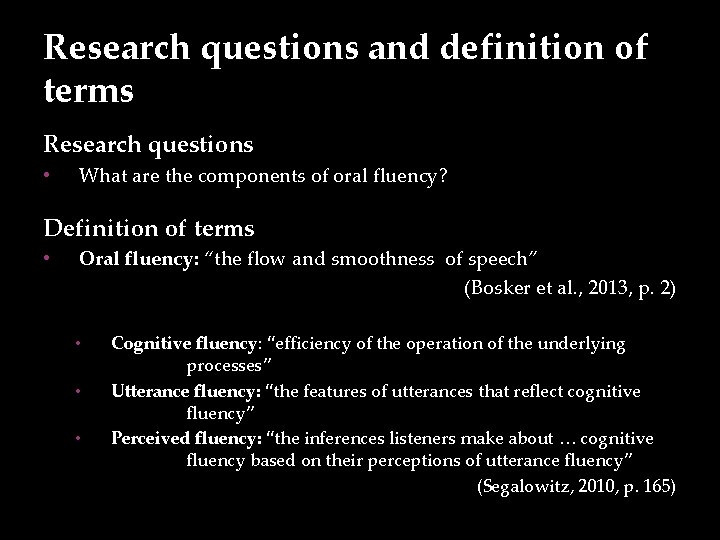
Research questions and definition of terms Research questions • What are the components of oral fluency? Definition of terms • Oral fluency: “the flow and smoothness of speech” (Bosker et al. , 2013, p. 2) • • • Cognitive fluency: “efficiency of the operation of the underlying processes” Utterance fluency: “the features of utterances that reflect cognitive fluency” Perceived fluency: “the inferences listeners make about … cognitive fluency based on their perceptions of utterance fluency” (Segalowitz, 2010, p. 165)

Utterance fluency Components of fluency: – Speed fluency: – Breakdown fluency: – Repair fluency: Rate of delivery Extent of interruptions Number of corrections and repetitions (Segalowitz, 2010) < two boats &-er were sinking yesterday > [//] two boats sank ye(sterday) +/. < they play piano er everyday > [//] < play the piano > [//] they play the piano everyday
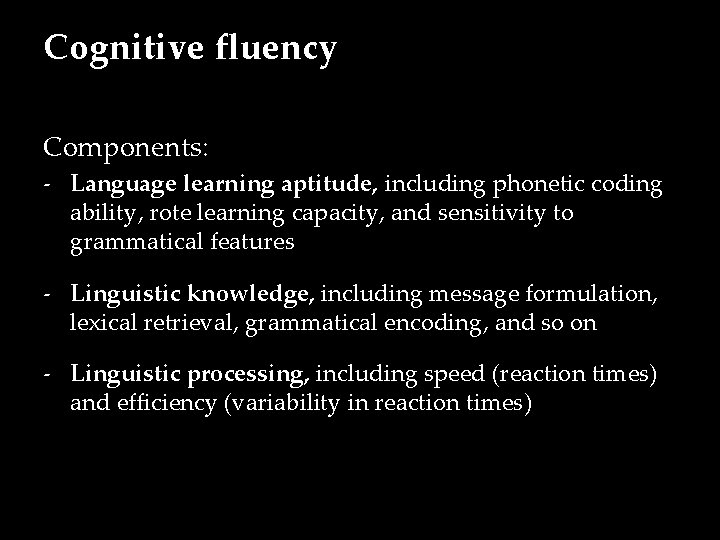
Cognitive fluency Components: - Language learning aptitude, including phonetic coding ability, rote learning capacity, and sensitivity to grammatical features - Linguistic knowledge, including message formulation, lexical retrieval, grammatical encoding, and so on - Linguistic processing, including speed (reaction times) and efficiency (variability in reaction times)
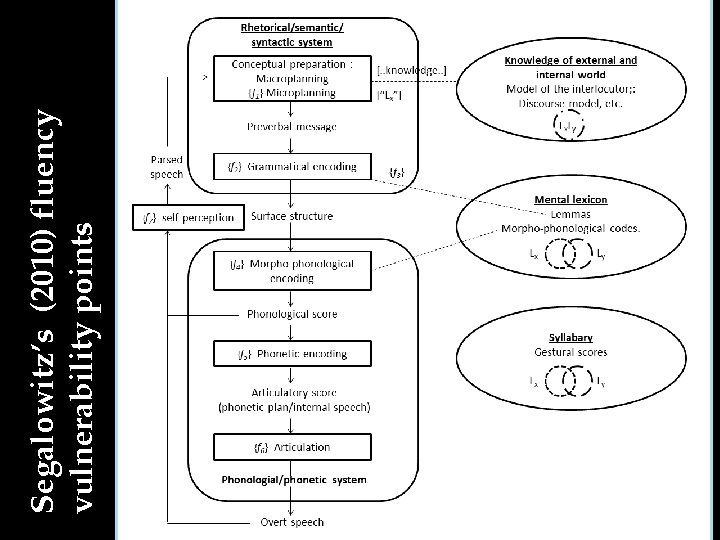
Segalowitz’s (2010) fluency vulnerability points
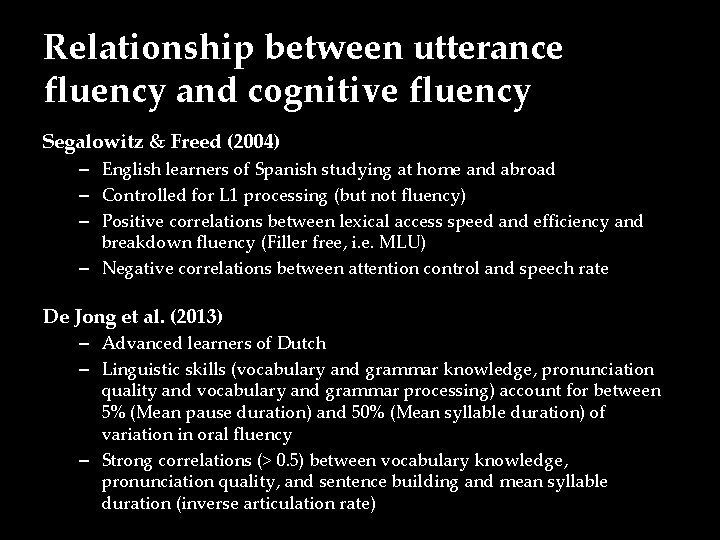
Relationship between utterance fluency and cognitive fluency Segalowitz & Freed (2004) – English learners of Spanish studying at home and abroad – Controlled for L 1 processing (but not fluency) – Positive correlations between lexical access speed and efficiency and breakdown fluency (Filler free, i. e. MLU) – Negative correlations between attention control and speech rate De Jong et al. (2013) – Advanced learners of Dutch – Linguistic skills (vocabulary and grammar knowledge, pronunciation quality and vocabulary and grammar processing) account for between 5% (Mean pause duration) and 50% (Mean syllable duration) of variation in oral fluency – Strong correlations (> 0. 5) between vocabulary knowledge, pronunciation quality, and sentence building and mean syllable duration (inverse articulation rate)
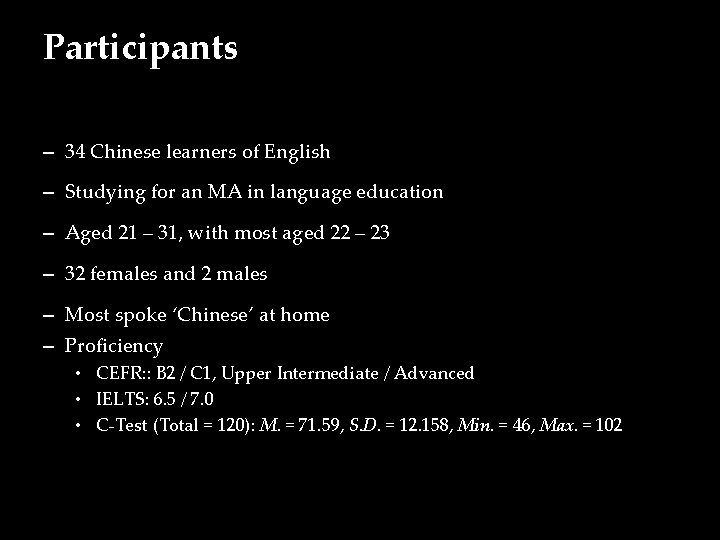
Participants – 34 Chinese learners of English – Studying for an MA in language education – Aged 21 – 31, with most aged 22 – 23 – 32 females and 2 males – Most spoke ‘Chinese’ at home – Proficiency • CEFR: : B 2 / C 1, Upper Intermediate / Advanced • IELTS: 6. 5 / 7. 0 • C-Test (Total = 120): M. = 71. 59, S. D. = 12. 158, Min. = 46, Max. = 102
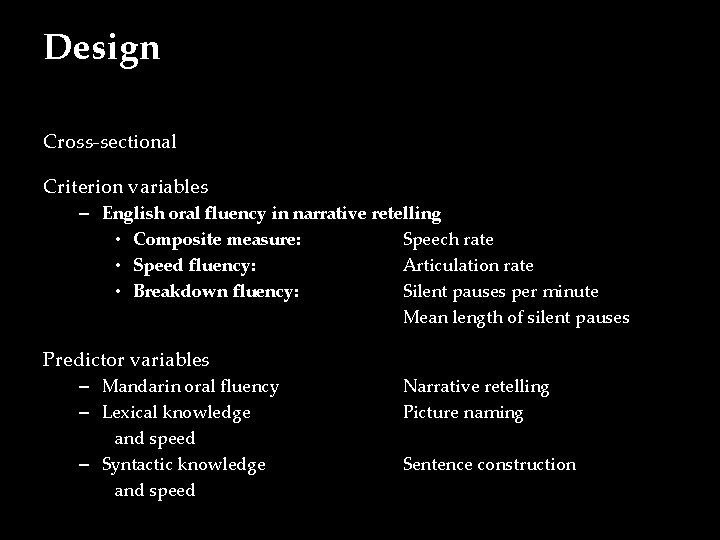
Design Cross-sectional Criterion variables – English oral fluency in narrative retelling • Composite measure: Speech rate • Speed fluency: Articulation rate • Breakdown fluency: Silent pauses per minute Mean length of silent pauses Predictor variables – Mandarin oral fluency – Lexical knowledge and speed – Syntactic knowledge and speed Narrative retelling Picture naming Sentence construction
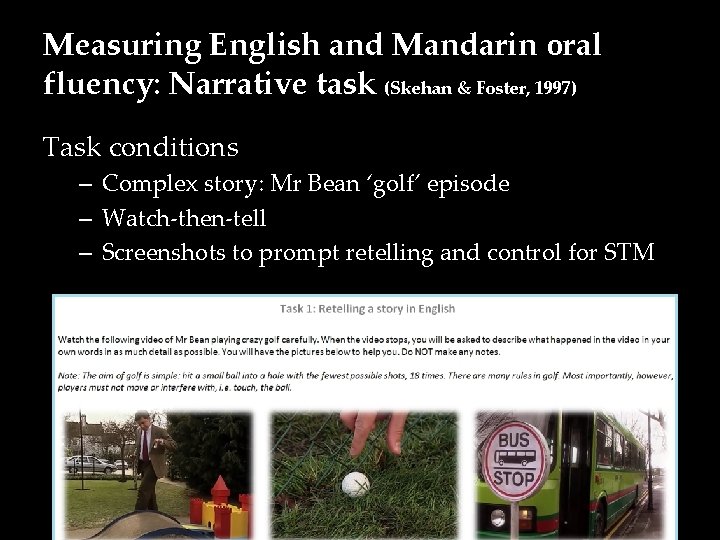
Measuring English and Mandarin oral fluency: Narrative task (Skehan & Foster, 1997) Task conditions – Complex story: Mr Bean ‘golf’ episode – Watch-then-tell – Screenshots to prompt retelling and control for STM
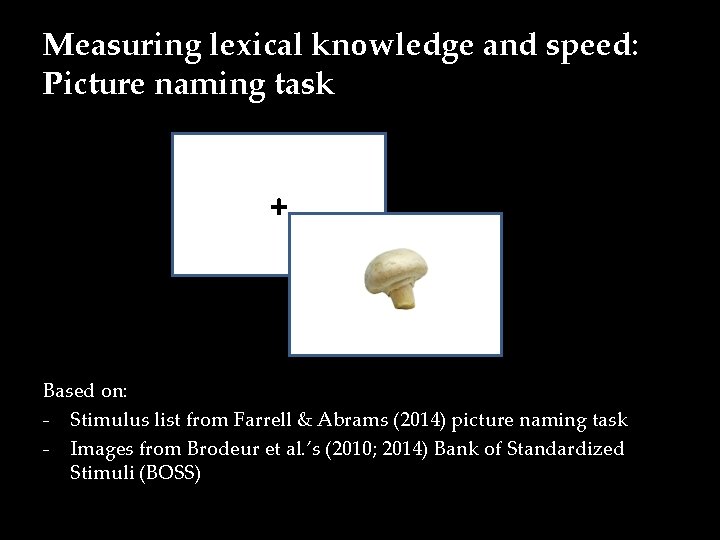
Measuring lexical knowledge and speed: Picture naming task + Based on: - Stimulus list from Farrell & Abrams (2014) picture naming task - Images from Brodeur et al. ’s (2010; 2014) Bank of Standardized Stimuli (BOSS)
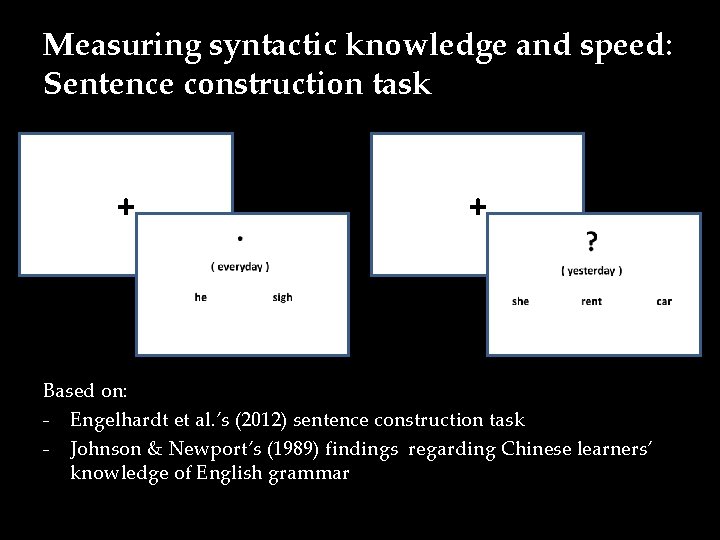
Measuring syntactic knowledge and speed: Sentence construction task + + Based on: - Engelhardt et al. ’s (2012) sentence construction task - Johnson & Newport’s (1989) findings regarding Chinese learners’ knowledge of English grammar
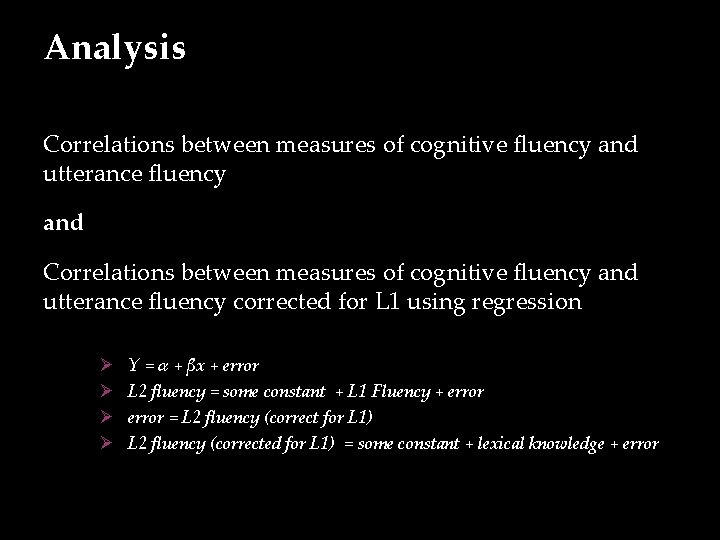
Analysis Correlations between measures of cognitive fluency and utterance fluency and Correlations between measures of cognitive fluency and utterance fluency corrected for L 1 using regression Ø Ø Y = α + βx + error L 2 fluency = some constant + L 1 Fluency + error = L 2 fluency (correct for L 1) L 2 fluency (corrected for L 1) = some constant + lexical knowledge + error
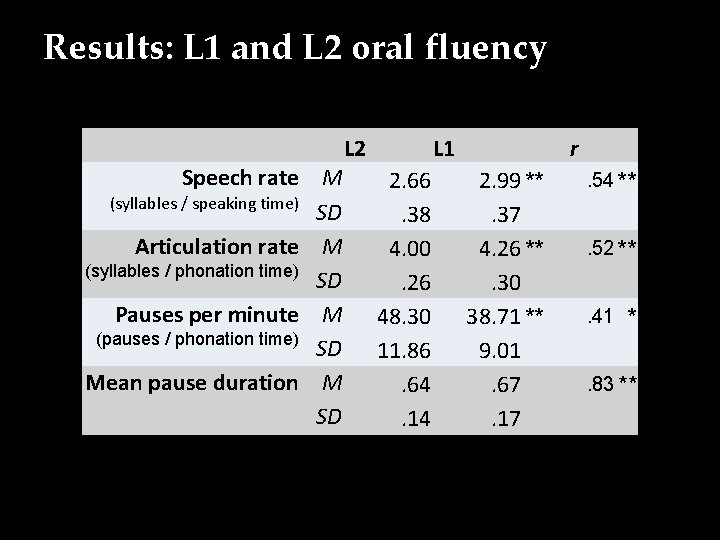
Results: L 1 and L 2 oral fluency L 2 Speech rate M (syllables / speaking time) SD Articulation rate M (syllables / phonation time) SD Pauses per minute M (pauses / phonation time) SD Mean pause duration M SD L 1 2. 66. 38 4. 00. 26 48. 30 11. 86. 64. 14 r 2. 99 **. 37 4. 26 **. 30 38. 71 ** 9. 01. 67. 17 . 54 **. 52 **. 41 * . 83 **
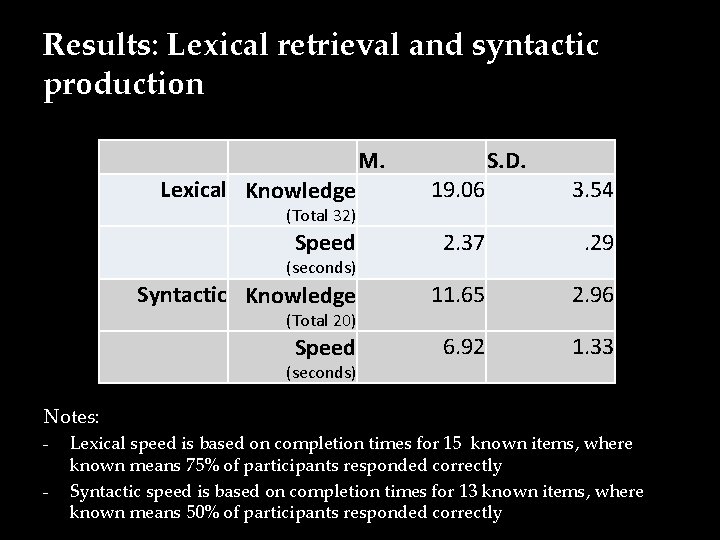
Results: Lexical retrieval and syntactic production M. S. D. Lexical Knowledge 19. 06 3. 54 Speed 2. 37 . 29 Syntactic Knowledge 11. 65 2. 96 Speed 6. 92 1. 33 (Total 32) (seconds) (Total 20) (seconds) Notes: - Lexical speed is based on completion times for 15 known items, where known means 75% of participants responded correctly Syntactic speed is based on completion times for 13 known items, where known means 50% of participants responded correctly
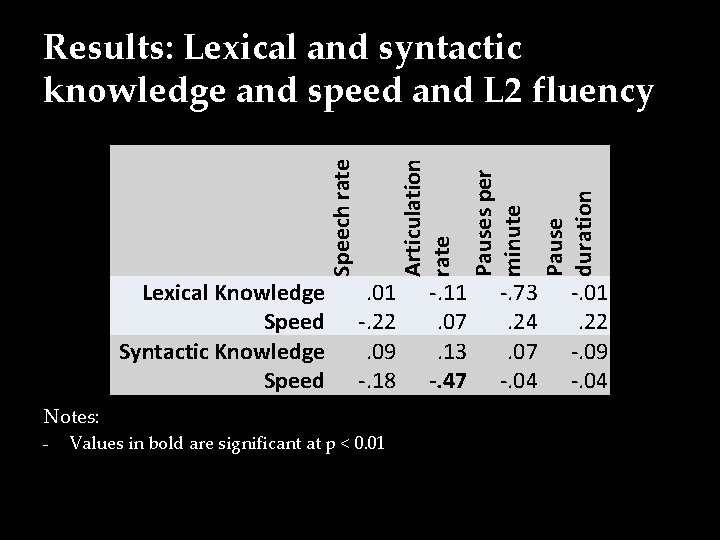
Lexical Knowledge Speed Syntactic Knowledge Speed . 01 -. 22. 09 -. 18 Notes: - Values in bold are significant at p < 0. 01 -. 11. 07. 13 -. 47 -. 73. 24. 07 -. 04 Pause duration Pauses per minute Speech rate Articulation rate Results: Lexical and syntactic knowledge and speed and L 2 fluency -. 01. 22 -. 09 -. 04
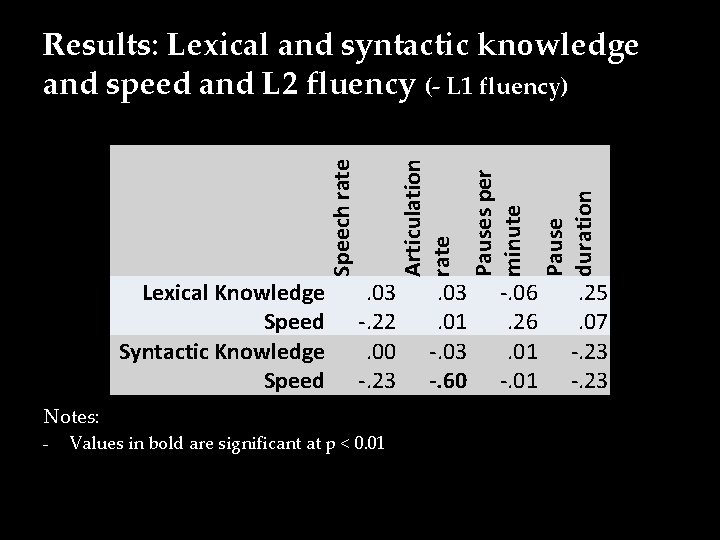
Lexical Knowledge Speed Syntactic Knowledge Speed . 03 -. 22. 00 -. 23 Notes: - Values in bold are significant at p < 0. 01 . 03. 01 -. 03 -. 60 -. 06. 26. 01 -. 01 Pause duration Pauses per minute Speech rate Articulation rate Results: Lexical and syntactic knowledge and speed and L 2 fluency (- L 1 fluency) . 25. 07 -. 23
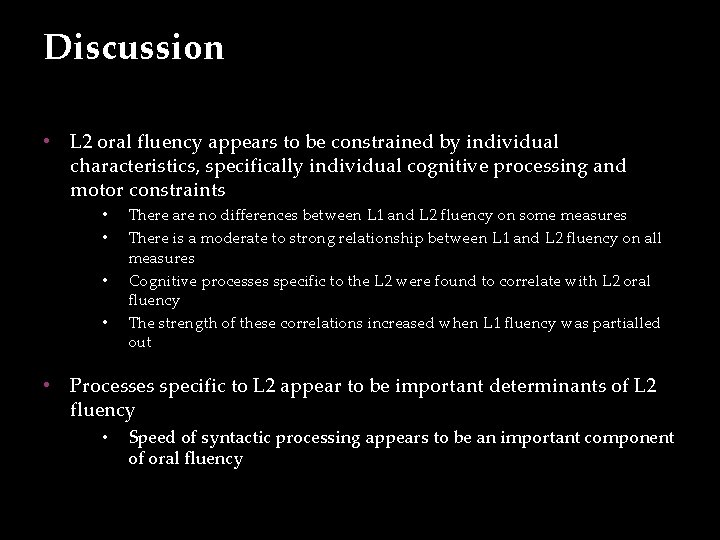
Discussion • L 2 oral fluency appears to be constrained by individual characteristics, specifically individual cognitive processing and motor constraints • • There are no differences between L 1 and L 2 fluency on some measures There is a moderate to strong relationship between L 1 and L 2 fluency on all measures Cognitive processes specific to the L 2 were found to correlate with L 2 oral fluency The strength of these correlations increased when L 1 fluency was partialled out • Processes specific to L 2 appear to be important determinants of L 2 fluency • Speed of syntactic processing appears to be an important component of oral fluency
Limitations • L 1 cognitive processing, i. e. lexical speed and syntactic speed, were not controlled for • Our measure of syntactic speed potentially captures a wide range of processes involved in speech processing • Our measures confound knowledge and speed • Small effects may have not been detected due to the small (N = 34) sample size
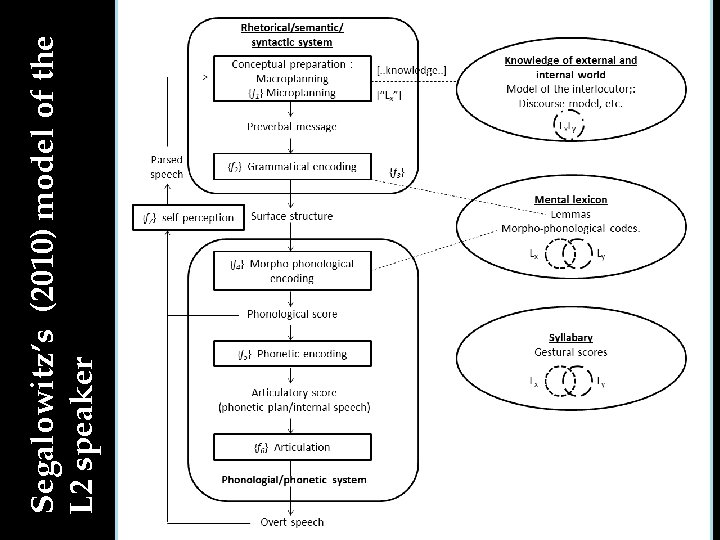
Segalowitz’s (2010) model of the L 2 speaker
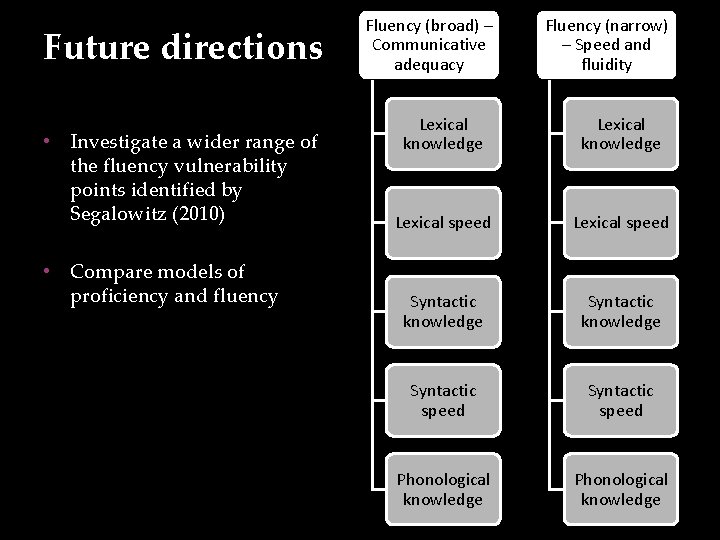
Future directions • Investigate a wider range of the fluency vulnerability points identified by Segalowitz (2010) • Compare models of proficiency and fluency Fluency (broad) – Communicative adequacy Fluency (narrow) – Speed and fluidity Lexical knowledge Lexical speed Syntactic knowledge Syntactic speed Phonological knowledge
Thank you • British Academy Skills Acquisition Award • Department of Education, University of York, Pump Priming Fund • Ruby (Jiaying) Yu and Abby (Ping) Wang for support with data collection • Members of Centre for Research in Language Learning and Use, University of York and Members of the Cognitive Approaches to Second Language Acquisition Research Group, Universität van Amsterdam for insightful comments on the work in progress Questions? Contact: zoe. handley@york. ac. uk

References Bosker et al. (2013). What makes speech sound fluent? The contributions of pauses, speed and repairs. Language Testing, 30, 159 -175 Brodeur et al. (2010). The Bank of Standardized Stimuli (BOSS), a new set of 480 normative photos of objects to be used as visual stimuli in cognitive research. PLo. S ONE, 5, e 10773. Brodeur, et al. (2014). Bank of Standardized Stimuli (BOSS) phase II: 930 new normative photos. PLo. S ONE, 9, e 106953. De Jong et al. (2013). Linguistic skills and speaking fluency in a second language. Applied Psycholinguistics, 34, 893 -916 Engelhardt et al. (2012). Are language production problems apparent in adults who no longer meet diagnostic criteria for attention-deficit/hyperactivity disorder? Cognitive Neuropsychology, 29(3), 275 -299 Farrell & Abrams (2014). Picture-word interference reveals inhibitory effects of syllable frequency on lexical selection. The Quarterly Journal of Experimental Psychology, 67(3), 525 -541

References Johson & Newport (1989). Critical period effect s in second language learning: The influence of maturational state on the acquisition of English as a second language. Cognitive Psychology, 21, 60 -99 Segalowitz (2010). Cognitive bases of second language fluency. London: Routledge. Segalowitz & Freed (2004). Context, contact, and cognition in oral fluency acquisition. Studies in Second Language Acquisitioncy in advanced learners of French. Applied Linguistics, 17(1), 84 -119 Title image: http: //pixabay. com/en/photos/gears/
- Slides: 23