
Exploring the Relationship among Culture Interaction and Language
- Slides: 6
Exploring the Relationship among Culture, Interaction and Language: Crosslinguistic Perspectives -- what motivates this panel + its general merits -- brief global summary -- a couple of questions -- a brief/small suggestion IPra 2005 Riva del Garda, Italy
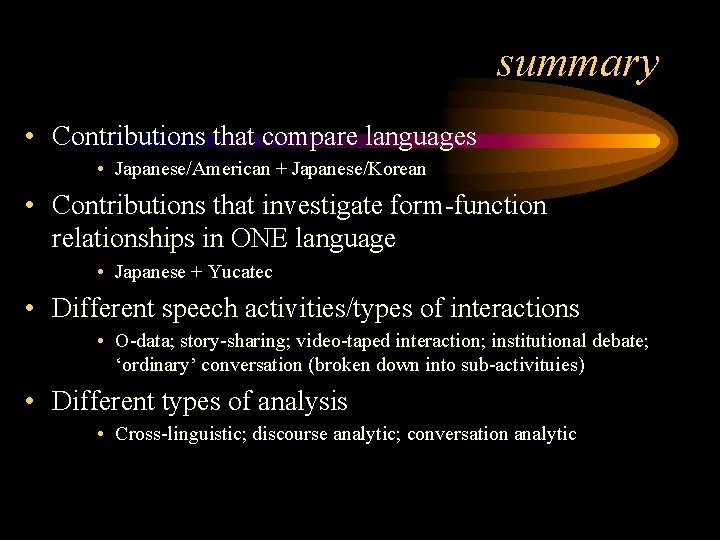
summary • Contributions that compare languages • Japanese/American + Japanese/Korean • Contributions that investigate form-function relationships in ONE language • Japanese + Yucatec • Different speech activities/types of interactions • O-data; story-sharing; video-taped interaction; institutional debate; ‘ordinary’ conversation (broken down into sub-activituies) • Different types of analysis • Cross-linguistic; discourse analytic; conversation analytic
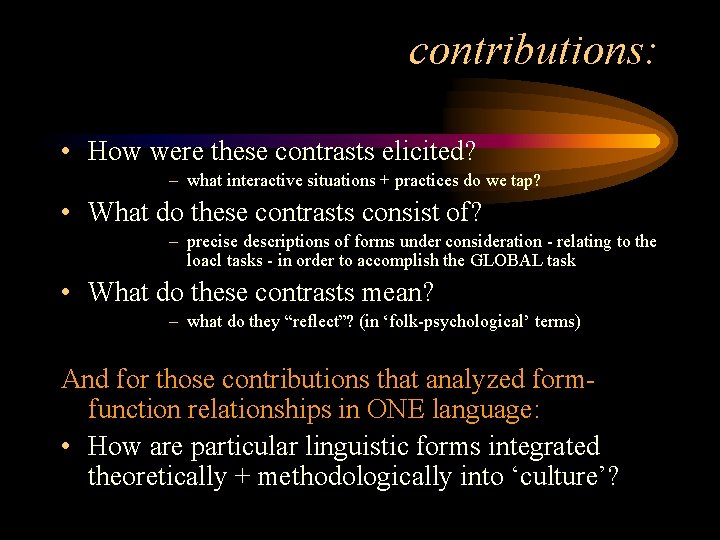
contributions: • How were these contrasts elicited? – what interactive situations + practices do we tap? • What do these contrasts consist of? – precise descriptions of forms under consideration - relating to the loacl tasks - in order to accomplish the GLOBAL task • What do these contrasts mean? – what do they “reflect”? (in ‘folk-psychological’ terms) And for those contributions that analyzed formfunction relationships in ONE language: • How are particular linguistic forms integrated theoretically + methodologically into ‘culture’?
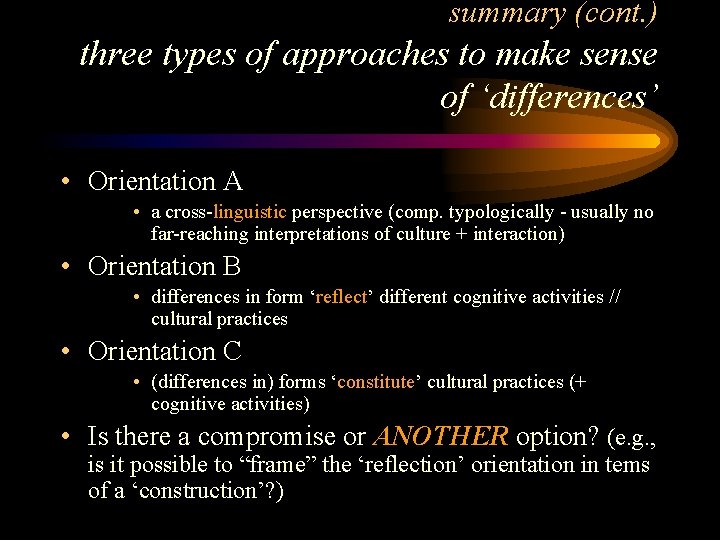
summary (cont. ) three types of approaches to make sense of ‘differences’ • Orientation A • a cross-linguistic perspective (comp. typologically - usually no far-reaching interpretations of culture + interaction) • Orientation B • differences in form ‘reflect’ different cognitive activities // cultural practices • Orientation C • (differences in) forms ‘constitute’ cultural practices (+ cognitive activities) • Is there a compromise or ANOTHER option? (e. g. , is it possible to “frame” the ‘reflection’ orientation in tems of a ‘construction’? )
interpretations • congenial talk vs. exchange talk • In synch with cross-cultural psychology (but also gender comparative works) - moving toward ‘cultural psychology’ or ‘ethnogaphic gender research’ • Is there an alternative? -- moving to more fine-grained observational, ethnographic work, in different settings, with different populations …
brief suggestion • Without moving back to “universializings” – Processes of INTEGRATION & DIFFERENTIATION (occurring simultaneously in all interactive phenomena as the “underlying” ‘developmental principle’ of ‘differences’