
Exploring the Mysteries of Long and Skewed Path

- Slides: 18
Exploring the Mysteries of Long and Skewed Path DXing Panel Discussion By W 6 YA – K 6 NA – W 6 YI
Propagation programs for predicting long path openings are generally worthless
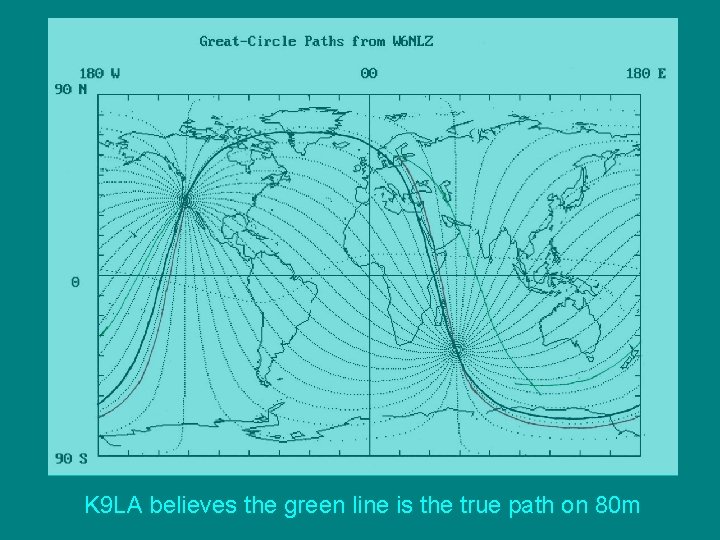
• Long Path = opposite the shortest path • Gray Line = propagation along the terminator • Long path has traditionally referred to opposite ends of the terminator • This is disputed by K 9 LA and others with regard to 80 and 160 meters. See his excellent 2014 webinar
K 9 LA webinar A Long Overdue Review of Gray Line Propagation on the Low Bands wwrof. org/webinar-archive (older posts) search for K 9 LA
In General • Point your antenna southwest in AM • Most common long path is on 20 m after sunrise to Europe, Middle East • Most long path is probably skewed • For Africa & South Atlantic, point the antenna opposite the usual short path bearing • LP to South Africa is active all year
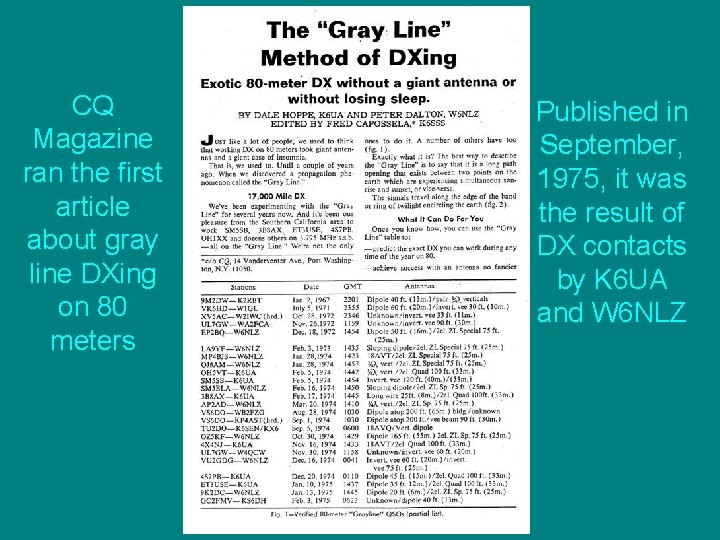
CQ Magazine ran the first article about gray line DXing on 80 meters Published in September, 1975, it was the result of DX contacts by K 6 UA and W 6 NLZ
K 9 LA believes the green line is the true path on 80 m
Let’s explore our experiences band by band Beginning with 20 meters • Usual morning path after sunrise • Often a very skewed path (VU, A 5) • VK 6 afternoon path at his sunrise • Evening south path around sunset • Equinox variations 4 S 7 RO
40 Meters • Winter morning LP to Europe, Middle East, Indian Ocean, SEA, etc. • LP often occurs before sunrise but peaks well afterward as on 20 m. • Fall equinox brings surprise paths • Some Africa/Indian Ocean in summer • Evening LP near sunset to Eastern Asia (VU, etc. ) in fall and early winter HA 8 RM
75/80 Meters • Apparently a skewed path • Few have directional gain antennas • Morning LP much like 40 m but rarer • Shorter time peaking before sunrise • Skewed sunset path over the top of South America 9 K 2 HN
160 Meters • Very few Have directional antennas • Several CA stations worked A 61 AJ years ago one morning on what was assumed to be long path • No other known LP from CA • N 7 UA worked A 61 AJ and 5 B 4 AGN LP from his QTH near Seattle
30 Meters • Propagation similar to 40 m long path • Directional antennas becoming more common with Stepp. IR popularity • SP and LP often open simultaneously • This creates a problem with multipath echo using omnidirectional antennas • Evening LP similar to 40 m in winter 9 N 7 BCC
15 Meters • • Morning long path is similar to 20 m Less common than on 20 m Occurs most often during cycle peaks Rarer LP can occur in mid-late evening after mid winter • Rarest LP can occur from Middle East to Eastern Asia in mornings after mid winter, well after sunrise time A 45 XR
17 Meters • Similar to 20 m and 15 m morning long path but less common • More experience is needed by most of us
12 and 10 Meters • • More experience is needed for 12 m Evening LP is similar to 15 meters Morning LP is similar to 15 meters Incidence is greatest during highest cycle peaks • Morning LP may be open at the same time as SP to Europe A 45 XR 10 m
Please tell us about your unusual experiences with long path on all bands, other than what was described in this discussion. We all have much to learn about these unusual paths. Predictions with software, such as VOACAP, ICECAP, HAMCAP, W 6 EL PROP all are unreliable for predicting long path conditions, suggesting these paths may be more complex than was previously believed. This is one of the reasons that DXing is more fun than internet communication!