
Exploring the Intrinsic Dynamics of Proteins from Metabolic
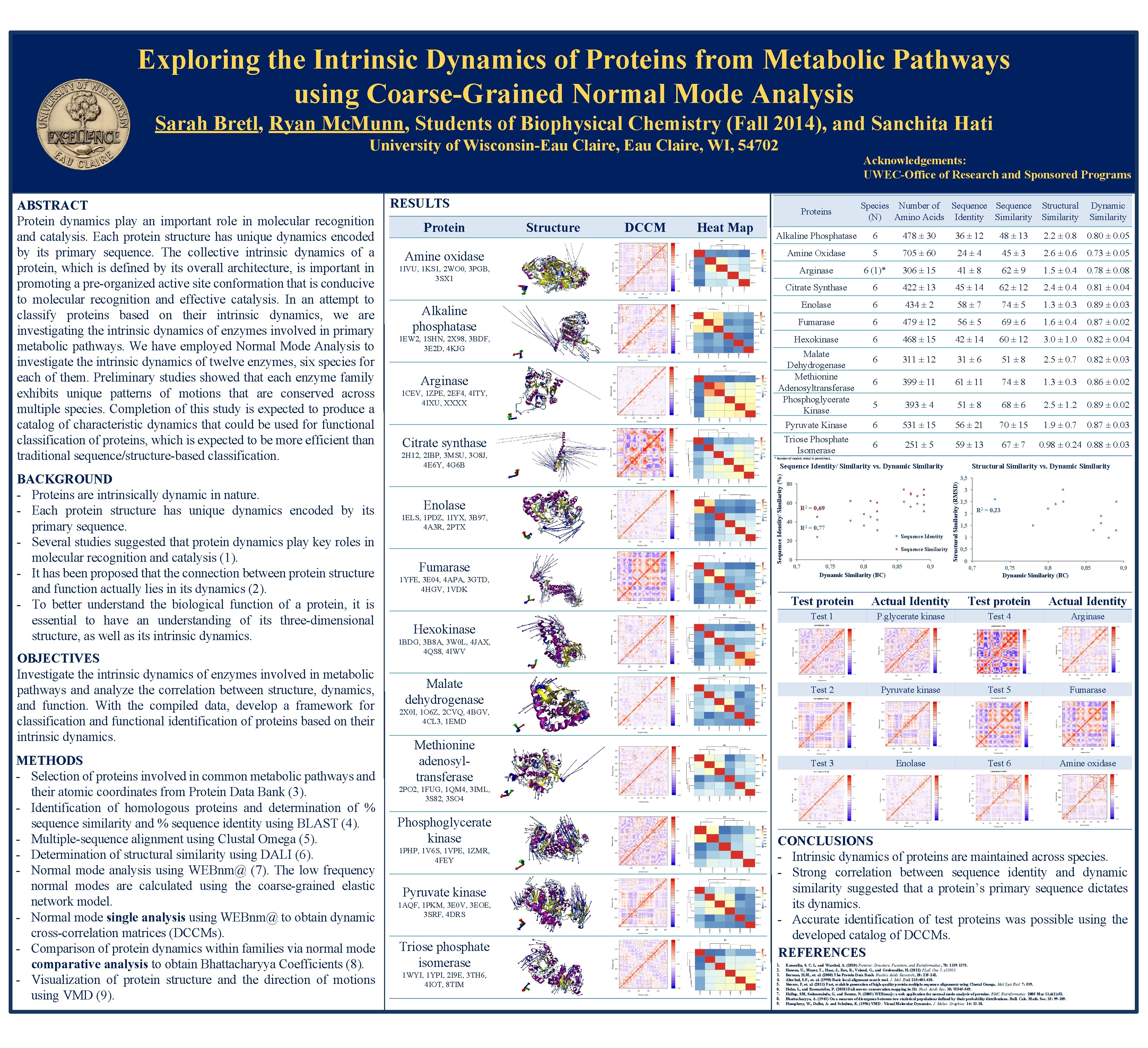
Exploring the Intrinsic Dynamics of Proteins from Metabolic Pathways using Coarse-Grained Normal Mode Analysis Sarah Bretl, Ryan Mc. Munn, Students of Biophysical Chemistry (Fall 2014), and Sanchita Hati University of Wisconsin-Eau Claire, WI, 54702 OBJECTIVES Investigate the intrinsic dynamics of enzymes involved in metabolic pathways and analyze the correlation between structure, dynamics, and function. With the compiled data, develop a framework for classification and functional identification of proteins based on their intrinsic dynamics. METHODS - Selection of proteins involved in common metabolic pathways and their atomic coordinates from Protein Data Bank (3). - Identification of homologous proteins and determination of % sequence similarity and % sequence identity using BLAST (4). - Multiple-sequence alignment using Clustal Omega (5). - Determination of structural similarity using DALI (6). - Normal mode analysis using WEBnm@ (7). The low frequency normal modes are calculated using the coarse-grained elastic network model. - Normal mode single analysis using WEBnm@ to obtain dynamic cross-correlation matrices (DCCMs). - Comparison of protein dynamics within families via normal mode comparative analysis to obtain Bhattacharyya Coefficients (8). - Visualization of protein structure and the direction of motions using VMD (9). Protein Amine oxidase 1 IVU, 1 KS 1, 2 WO 0, 3 PGB, 3 SX 1 Alkaline phosphatase 1 EW 2, 1 SHN, 2 X 98, 3 BDF, 3 E 2 D, 4 KJG Arginase 1 CEV, 1 ZPE, 2 EF 4, 4 ITY, 4 IXU, XXXX Citrate synthase 2 H 12, 2 IBP, 3 MSU, 3 O 8 J, 4 E 6 Y, 4 G 6 B Enolase 1 ELS, 1 PDZ, 1 IYX, 3 B 97, 4 A 3 R, 2 PTX Fumarase 1 YFE, 3 E 04, 4 APA, 3 GTD, 4 HGV, 1 VDK Hexokinase 1 BDG, 3 B 8 A, 3 W 0 L, 4 JAX, 4 QS 8, 4 IWV Malate dehydrogenase 2 X 0 I, 1 O 6 Z, 2 CVQ, 4 BGV, 4 CL 3, 1 EMD Methionine adenosyltransferase Proteins Structure DCCM Heat Map 6 478 ± 30 36 ± 12 48 ± 13 2. 2 ± 0. 80 ± 0. 05 Amine Oxidase 5 705 ± 60 24 ± 4 45 ± 3 2. 6 ± 0. 6 0. 73 ± 0. 05 Arginase 6 (1)* 306 ± 15 41 ± 8 62 ± 9 1. 5 ± 0. 4 0. 78 ± 0. 08 Citrate Synthase 6 422 ± 13 45 ± 14 62 ± 12 2. 4 ± 0. 4 0. 81 ± 0. 04 Enolase 6 434 ± 2 58 ± 7 74 ± 5 1. 3 ± 0. 3 0. 89 ± 0. 03 Fumarase 6 479 ± 12 56 ± 5 69 ± 6 1. 6 ± 0. 4 0. 87 ± 0. 02 Hexokinase 6 468 ± 15 42 ± 14 60 ± 12 3. 0 ± 1. 0 0. 82 ± 0. 04 6 311 ± 12 31 ± 6 51 ± 8 2. 5 ± 0. 7 0. 82 ± 0. 03 6 399 ± 11 61 ± 11 74 ± 8 1. 3 ± 0. 3 0. 86 ± 0. 02 5 393 ± 4 51 ± 8 68 ± 6 2. 5 ± 1. 2 0. 89 ± 0. 02 Pyruvate Kinase 6 531 ± 15 56 ± 21 70 ± 15 1. 9 ± 0. 7 0. 87 ± 0. 03 Triose Phosphate Isomerase 6 251 ± 5 59 ± 13 67 ± 7 2. 16 Malate Dehydrogenase Methionine Adenosyltransferase Phosphoglycerate Kinase 0. 98 ± 0. 24 0. 88 ± 0. 03 * Number of models noted in parenthesis. Sequence Identity/ Similarity vs. Dynamic Similarity 2. 4 Dynamic Similarity Alkaline Phosphatase 2. 16 Species Number of Sequence Structural (N) Amino Acids Identity Similarity 3, 5 80 60 R 2 40 = 0, 69 R 2 = 0, 77 Sequence Identity 20 Sequence Similarity 0 0, 75 0, 85 0, 9 Dynamic Similarity (BC) 2. 4 Structural Similarity vs. Dynamic Similarity Structural Similarity (RMSD) BACKGROUND - Proteins are intrinsically dynamic in nature. - Each protein structure has unique dynamics encoded by its primary sequence. - Several studies suggested that protein dynamics play key roles in molecular recognition and catalysis (1). - It has been proposed that the connection between protein structure and function actually lies in its dynamics (2). - To better understand the biological function of a protein, it is essential to have an understanding of its three-dimensional structure, as well as its intrinsic dynamics. RESULTS Sequence Identity/ Similarity (%) ABSTRACT Protein dynamics play an important role in molecular recognition and catalysis. Each protein structure has unique dynamics encoded by its primary sequence. The collective intrinsic dynamics of a protein, which is defined by its overall architecture, is important in promoting a pre-organized active site conformation that is conducive to molecular recognition and effective catalysis. In an attempt to classify proteins based on their intrinsic dynamics, we are investigating the intrinsic dynamics of enzymes involved in primary metabolic pathways. We have employed Normal Mode Analysis to investigate the intrinsic dynamics of twelve enzymes, six species for each of them. Preliminary studies showed that each enzyme family exhibits unique patterns of motions that are conserved across multiple species. Completion of this study is expected to produce a catalog of characteristic dynamics that could be used for functional classification of proteins, which is expected to be more efficient than traditional sequence/structure-based classification. Acknowledgements: UWEC-Office of Research and Sponsored Programs 3 2, 5 R 2 = 0, 23 2 1, 5 1 0, 5 0 0, 75 0, 85 0, 9 Dynamic Similarity (BC) Test protein Actual Identity Test 1 P. glycerate kinase Test 4 Arginase Test 2 Pyruvate kinase Test 5 Fumarase Test 3 Enolase Test 6 Amine oxidase 2. 4 2. 96 3. 77 2 PO 2, 1 FUG, 1 QM 4, 3 IML, 3 S 82, 3 SO 4 Phosphoglycerate kinase 1 PHP, 1 V 6 S, 1 VPE, 1 ZMR, 4 FEY Pyruvate kinase 1 AQF, 1 PKM, 3 E 0 V, 3 EOE, 3 SRF, 4 DRS Triose phosphate isomerase 1 WYI, 1 YPI, 2 I 9 E, 3 TH 6, 4 IOT, 8 TIM 2. 96 2. 43 CONCLUSIONS - Intrinsic dynamics of proteins are maintained across species. - Strong correlation between sequence identity and dynamic similarity suggested that a protein’s primary sequence dictates its dynamics. - Accurate identification of test proteins was possible using the developed catalog of DCCMs. REFERENCES 1. 2. 3. 4. 5. 6. 7. 8. 9. Kamerlin, S. C. L. and Warshel, A. (2010) Proteins: Structure, Function, and Bioinformatics, 78: 1339 -1375. Hensen, U. , Meyer, T. , Haas, J. , Rex, R. , Vriend, G. , and Grubmuller, H. (2012) PLo. S One 7, e 33931. Berman, H. M. , et. al. (2000) The Protein Data Bank. Nucleic Acids Research, 28: 235 -242. Altschul, S. F. , et. al. (1990) Basic local alignment search tool. J. Mol. Biol. 215: 403 -410. Sievers, F, et. al. (2011) Fast, scalable generation of high-quality protein multiple sequence alignments using Clustal Omega. Mol Syst Biol. 7: 539. Holm, L, and Rosenström, P. (2010) Dali server: conservation mapping in 3 D. Nucl. Acids Res. 38: W 545 -549. Hollup, SM, Sælensminde, G, and Reuter, N. (2005) WEBnm@: a web application for normal mode analysis of proteins. BMC Bioinformatics. 2005 Mar 11; 6(1): 52. Bhattacharyya, A. (1943) On a measure of divergence between two statistical populations defined by their probability distributions. Bull. Calc. Math. Soc. 35: 99 -109. Humphrey, W. , Dalke, A. and Schulten, K. (1996) VMD - Visual Molecular Dynamics. J. Molec. Graphics. 14: 33 -38.
- Slides: 1