
Exploring the Impact of RoutinesBased Interviews and Functional
Exploring the Impact of Routines-Based Interviews and Functional Outcomes on Early Intervention Service Delivery Stakeholder Meeting October 26, 2017 Miriam Kuhn, Ph. D.
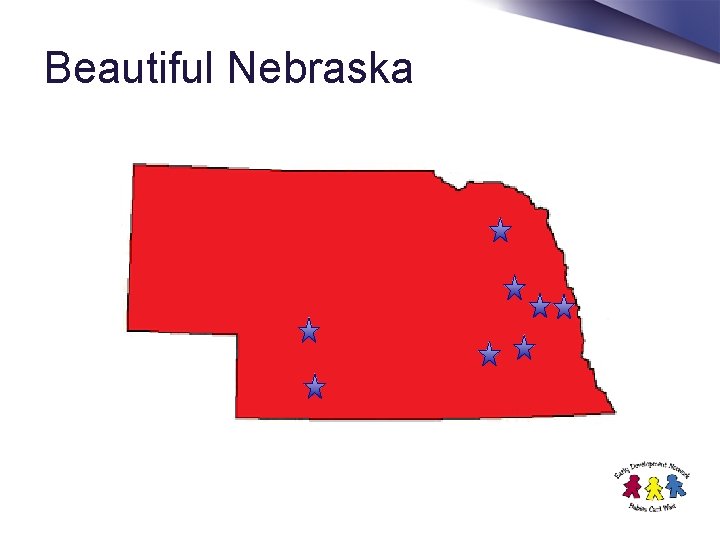
Beautiful Nebraska
Purpose of the Study • Impact of the professional development and technical assistance efforts in the pilot sites for the first two phases of training/support • Distinctions from the “business as usual” operations in the non-pilot sites
Research Question #1 How has the implementation of effective RBI practices in the Nebraska PRT pilot sites informed IFSP development and application in terms of q“Dosage” of early intervention services q. Types of goals q. Functionality and quality of goals
Research Question #2 How has the implementation of effective RBI practices in the Nebraska PRT pilot sites informed early intervention service delivery in terms of q. Percentages of children referred to children subsequently found eligible q. EI team service delivery decision-making q. Infrastructure and cohesion of EI teams q. EI service providers’ job satisfaction q. Family satisfaction with EI services
Research Question #3 What differences are seen between the approaches used in the Nebraska PRT pilot sites and the Nebraska PRT non-pilot sites of child/family assessment, IFSP development, and early intervention (EI) service delivery?
Three Sources of Data • Interviews– family members and EI professionals (n = 80) • IFSPs (n = 30) • Statewide CONNECT data
• Interviews – 58 out of 80 participants completed – Transcripts independently coded by two researchers – Thematic analysis for the pilot site interview data is completed • IFSPs – 30 out of 30 de-identified IFSPs received – Dosage and outcome quality data has been collected and descriptive analysis is in progress
• Statewide CONNECT Data – Awaiting analysis
Preliminary Findings Pilot Site Interview Participants v 22 parents from 19 families v. These parents had 21 children v 31 professionals v. Services coordinators v. Early intervention service providers v. Supervisors of early intervention service providers Pilot Site and Non-pilot Site IFSPs v 19 pilot site IFSPs v 11 non-pilot site IFSPs
Preliminary Findings v. Impact of the use of RBI: 5 themes v. IFSP outcome development: 6 themes v. Early Intervention service delivery: 4 themes v. Job satisfaction in the world of EI: 2 themes
Routines-Based Interviews Theme 1: What is gained from the use of RBI v Adherence to family-centered practices v. Deeper look at family life, priorities, & challenges “They're really just telling their story and I feel like we're basically just documenting it…We might sort of guide the interview through their day, but really once we get them started on…what their day looks like, most of them will just sit and tell you their story, what their day looks like, and what they do with their children, and how that involves… their interaction. ” (Services Coordinator)
Routines-Based Interviews Theme 1: What is gained from the use of RBI v. Foundation for relationship with families v. Support needed by families v. Information to complete standardized tool for verification purposes
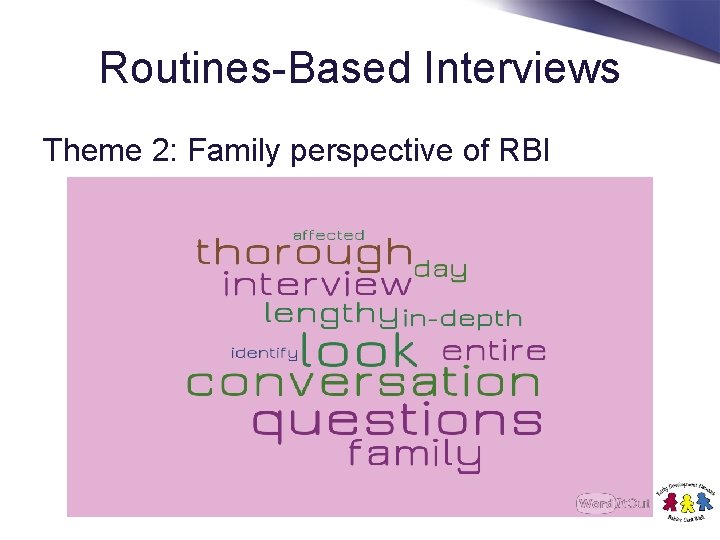
Routines-Based Interviews Theme 2: Family perspective of RBI
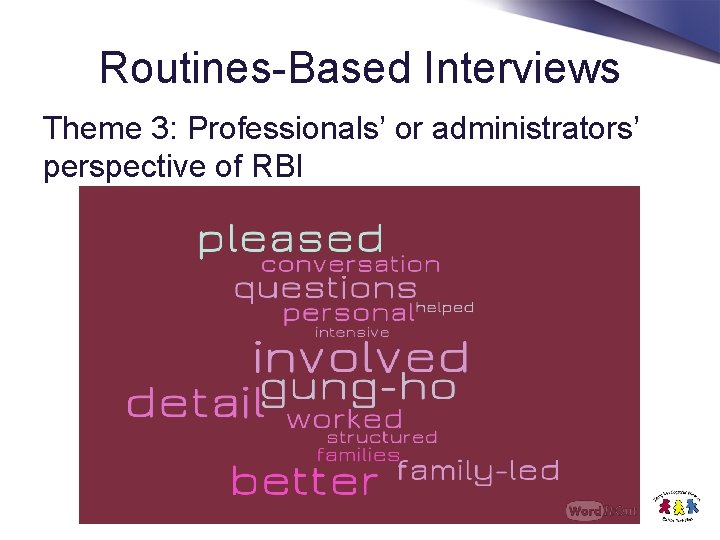
Routines-Based Interviews Theme 3: Professionals’ or administrators’ perspective of RBI
Routines-Based Interviews Theme 3: Professionals’ or administrators’ perspective of RBI v. Benefitted from “boot camp” training model v. Would like the primary service provider involved in the RBI v. Widespread use in some districts– 100% “The number one thing that is going on in that interview is to really get to know the families. I feel like it's really beneficial. I feel like I've really gotten to know families and their routines so much better than the way we used to do it. ” (Service Provider)
Routines-Based Interviews Theme 4: Challenges of using RBI v. Scheduling among professionals and with families v. Time intensive v. Emotional energy v. Cultural and/or language barriers v. Letting go of profession-specific assessment procedures v. Keeping up with changes in assessment procedures
Routines-Based Interviews Theme 5: Suggestions for improvement v. Some families desire more guidance through the process v. Extension of this sort of assessment process v. Need to update local intake forms
Reflecting on Routines-Based Interviews
IFSP Outcome Development Theme 1: Functionality has increased Theme 2: Service providers understand that family culture influences priorities
IFSP Outcome Development Theme 3: Family perspective of IFSP outcome development v“We told them what we wanted to work on. ” (Parent) v“[His] main focus of struggle led to a goal. ” (Parent) v. Collaborative effort
IFSP Outcome Development Theme 3: Family perspective of IFSP outcome development v. Many parents readily and accurately described setting the measurement criteria for their child’s outcome(s) v. Distance walked v. Number of steps walked v. Number of feedings taken from feeding tube reduced v. Number of times he crawls with his head up off the floor throughout a week v. Percentage of time a child sat by himself without falling over v. Saying 50 words v. Having under three (toileting) accidents a day
IFSP Outcome Development Theme 4: Professionals’ or administrators’ perspectives of IFSP outcome development v. Professionals say they provide guidance to families
IFSP Outcome Development Theme 4: Professionals’ or administrators’ perspectives of IFSP outcome development v. Some administrators say service providers devise goals ahead of IFSP meetings and then take the goals to families for review or input “We really work as a team to determine how the goals are written, because my service providers are the ones to be carrying out those goals in most cases. And so, we get the expertise from my speech language pathologist for example. You know, occupational therapist, depending upon the needs of the family. ” (Administrator)
IFSP Outcome Development Theme 5: Challenges of IFSP outcome development v. School-age mindset of some service providers or administrators Theme 6: Suggestions for improvement of IFSP outcome development v No suggestions from the participants, but themes 4 and 5 may suggest some areas to target for improvement
Reflection on IFSP Outcome Development
EI Service Delivery Theme 1: Traditions often dictate “dosage” of EI provided v Professionals talk about “front loading” services but it’s not often reported that they use the strategy. v Professionals and families state that families are welcome to contact service providers between visits, but it’s not often reported that they do so.
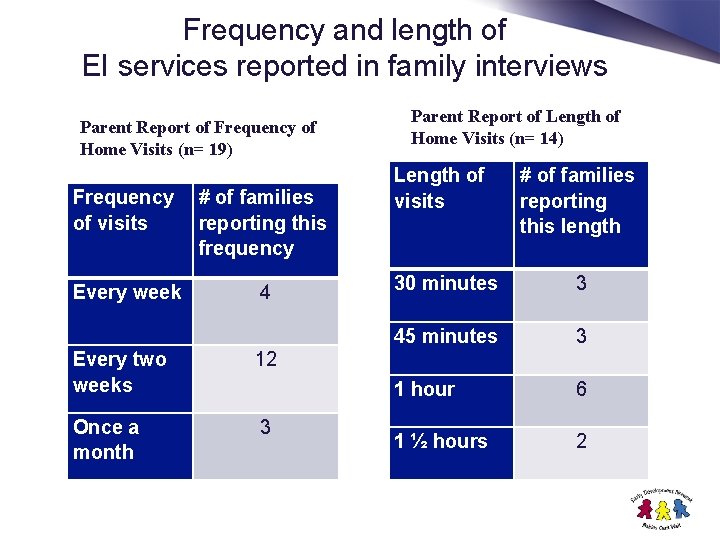
Frequency and length of EI services reported in family interviews Parent Report of Frequency of Home Visits (n= 19) Frequency of visits # of families reporting this frequency Every week 4 Every two weeks 12 Once a month 3 Parent Report of Length of Home Visits (n= 14) Length of visits # of families reporting this length 30 minutes 3 45 minutes 3 1 hour 6 1 ½ hours 2
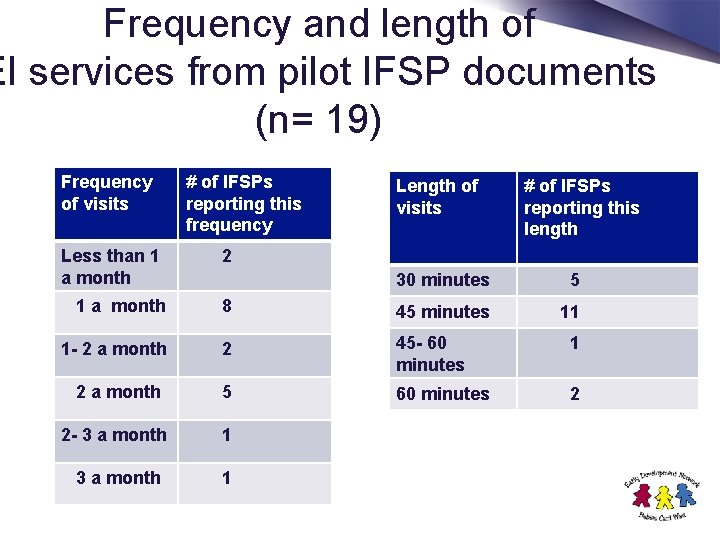
Frequency and length of EI services from pilot IFSP documents (n= 19) Frequency of visits Less than 1 a month # of IFSPs reporting this frequency Length of visits # of IFSPs reporting this length 2 30 minutes 5 11 1 a month 8 45 minutes 1 - 2 a month 2 45 - 60 minutes 1 2 a month 5 60 minutes 2 2 - 3 a month 1
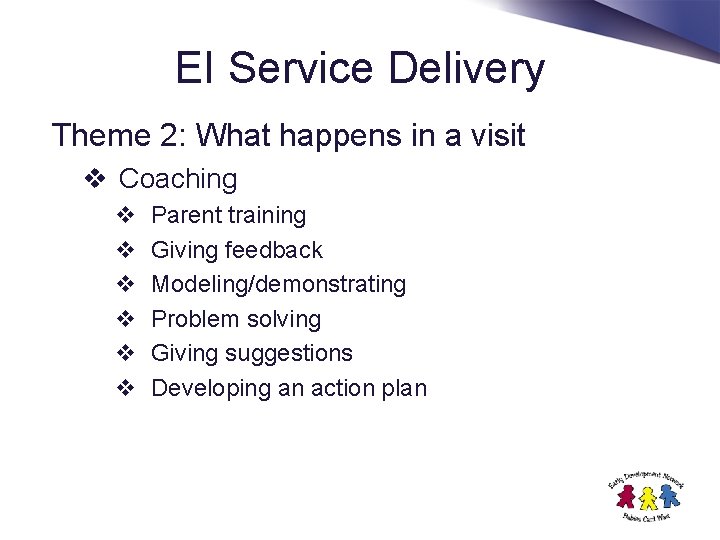
EI Service Delivery Theme 2: What happens in a visit v Coaching v v v Parent training Giving feedback Modeling/demonstrating Problem solving Giving suggestions Developing an action plan
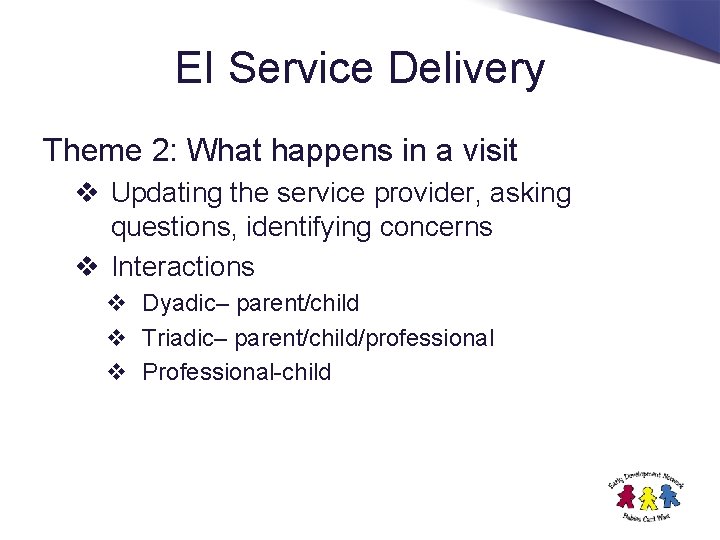
EI Service Delivery Theme 2: What happens in a visit v Updating the service provider, asking questions, identifying concerns v Interactions v Dyadic– parent/child v Triadic– parent/child/professional v Professional-child
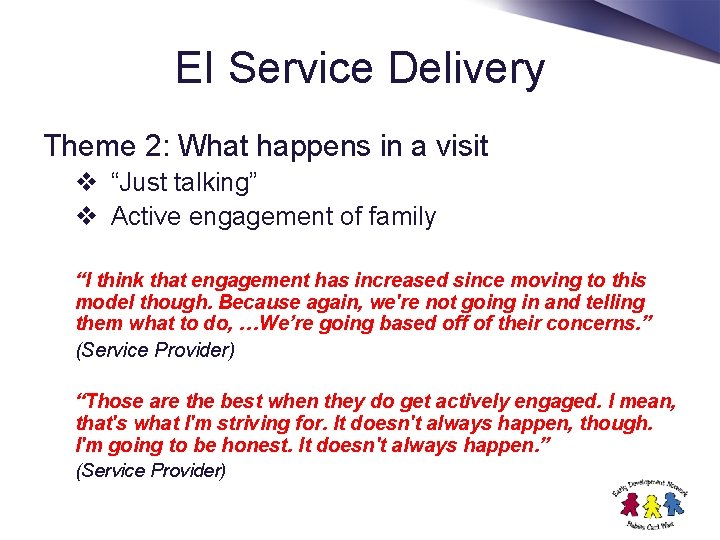
EI Service Delivery Theme 2: What happens in a visit v “Just talking” v Active engagement of family “I think that engagement has increased since moving to this model though. Because again, we're not going in and telling them what to do, …We’re going based off of their concerns. ” (Service Provider) “Those are the best when they do get actively engaged. I mean, that's what I'm striving for. It doesn't always happen, though. I'm going to be honest. It doesn't always happen. ” (Service Provider)
EI Service Delivery Theme 3: The role of routines within the structure of a home visit v Routines most often mentioned by parents as targeted in a home visit: meals and play skills v. Routines mentioned by parents as topics of “discussion”: bed time, walking in the park, cuddling and watching TV, toilet training, making choices at meal time
EI Service Delivery Theme 3: The role of routines within the structure of a home visit v. Mixed parent perspective on whether or not the service provider helps them or the child participate in any family activities or routines v. Most replied “yes” and gave at least one example v. A few said: “I wouldn’t say they do that. ” “No they just kind of let me do that. ” “No, We haven’t had that. ” “They usually just like to help him and we watch. ” “It hasn’t worked out scheduling wise to do that yet, no. ” (Parents)
EI Service Delivery Theme 4: Challenges with EI service delivery v Several families wished for “more”– more frequent visits or more time during the visit v Desire to be more flexible with services (ex. front loading) conflicts with schedules v Caseload creep
EI Service Delivery Theme 5: Suggestions for improvement of EI service delivery v Further use of RBI information v Activity-based interventions– “bursts” of service to address a particular outcome “in the moment” “That's a struggle to do especially with, you know, a lot of distance to drive and so forth. But that…has already improved, it's just I think that's an area (where) we really need to grow. ” (Administrator)
Reflection on EI Service Delivery
Job Satisfaction in the World of EI Theme 1: Advantages of this job v Flexibility v Team relationships v Intrinsic rewards of this work with families and their children
Job Satisfaction in the World of EI Theme 2: What would make it better
Job Satisfaction in the World of EI Theme 2: What would make it better v For administrators– v more assistance with office tasks v For service providers– v more staff or dedicated staff v more time to collaborate and plan home visits v less time spent on evaluation and report-writing v state timelines when scheduling or “cases” are difficult v managing full calendars as caseloads get full v on-going professional development—planning who will deliver services

Reflection on Job Satisfaction in the World of EI
Next steps… Exploring the IFSPs Procedures: v 30 de-identified randomly chosen IFSPs were provided by the 8 PRTs v. The child and family outcomes were scored using the IFSP Outcome Quality Checklist (Bainter & Hankey, 2015). v. Information about designated service providers, frequency, and length of services will be gathered analyzed from the documents.
Next steps… v. Written report of this first phase of the study for the co-lead agencies v. Complete interviews of the non-pilot site participants v. Analyze non-pilot interview data v. Written report of the second phase of the study for the co-lead agencies

Contact Information Miriam Kuhn University of Nebraska at Omaha miriamkuhn@unomaha. edu (402) 554 -3360
- Slides: 44