
EXPLORING THE EINSTEIN PROBLEM Zoe Allwood RECAP OF
EXPLORING THE EINSTEIN PROBLEM Zoe Allwood
RECAP OF LAST PRESENTATION The Einstein Problem is an attempt to find an aperiodic prototile set consisting of a single tile. Find a single tile that can only create non-periodic tilings Socolar and Taylor tile creates aperiodic, hierarchical structures Mirror image fundamentally different and needed Not fully defined by shape

THE TAYLOR AND SOCOLAR TILE Lines and Flags The hexagons tessellate periodically The local matching rules force the aperiodicity R 1 – The black lines must be continuous R 2 – The flags at either end of an edge must face the same way
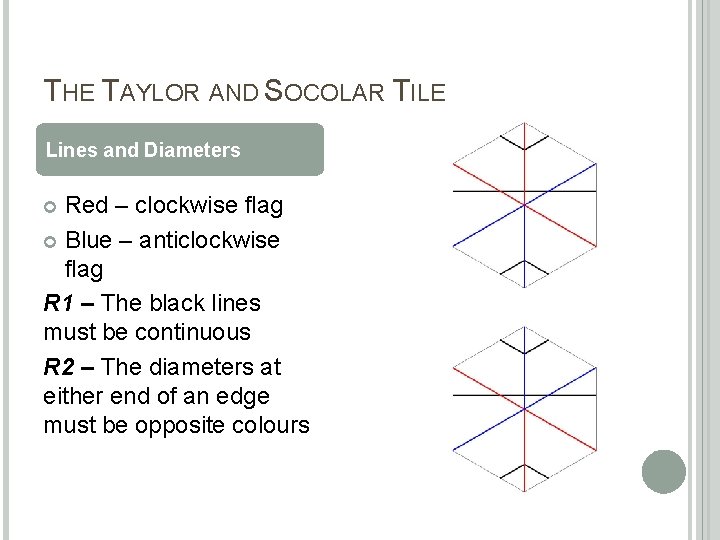
THE TAYLOR AND SOCOLAR TILE Lines and Diameters Red – clockwise flag Blue – anticlockwise flag R 1 – The black lines must be continuous R 2 – The diameters at either end of an edge must be opposite colours


IMPROVING THE TILE By making the tile and its mirror image opposite sides of a 3 D tile it can be made one tile. Want it to also just to be defined by shape Unconnected tile defined completely by shape. Can create a 3 D tile from this that is connected.
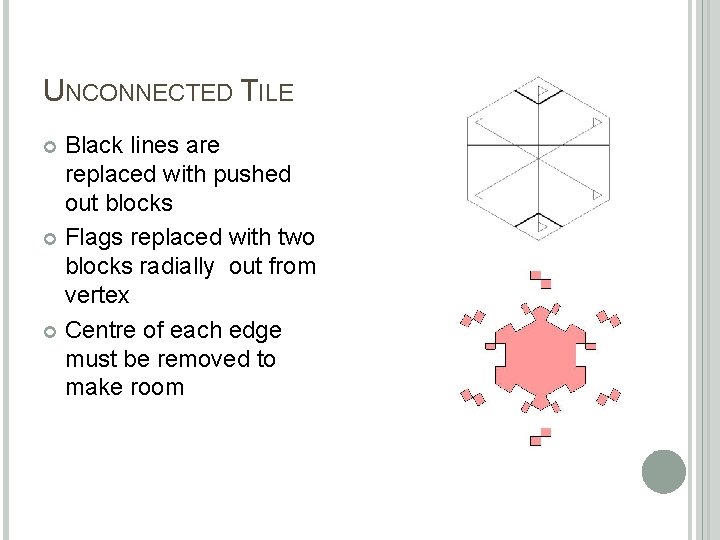
UNCONNECTED TILE Black lines are replaced with pushed out blocks Flags replaced with two blocks radially out from vertex Centre of each edge must be removed to make room
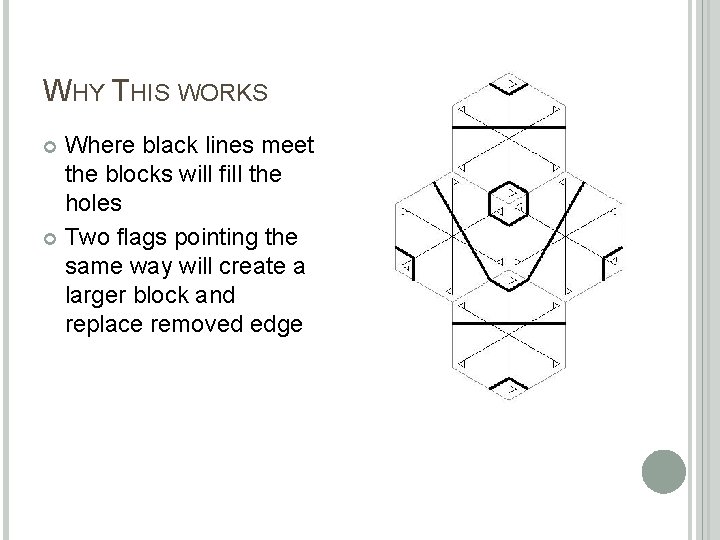
WHY THIS WORKS Where black lines meet the blocks will fill the holes Two flags pointing the same way will create a larger block and replace removed edge
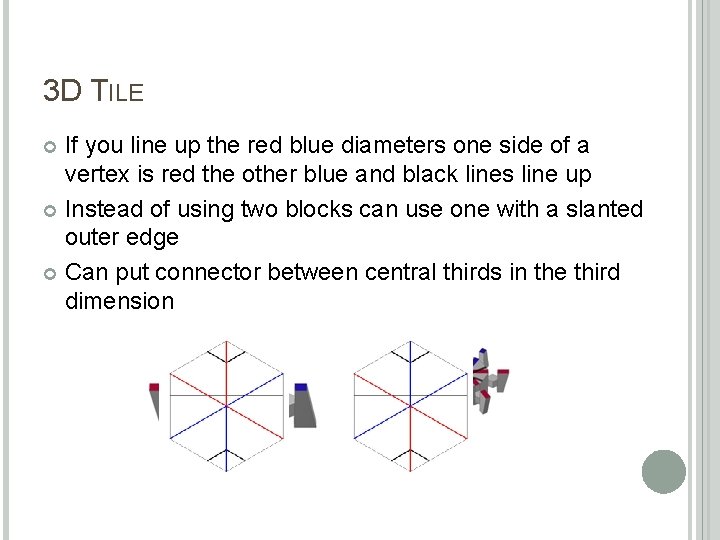
3 D TILE If you line up the red blue diameters one side of a vertex is red the other blue and black lines line up Instead of using two blocks can use one with a slanted outer edge Can put connector between central thirds in the third dimension
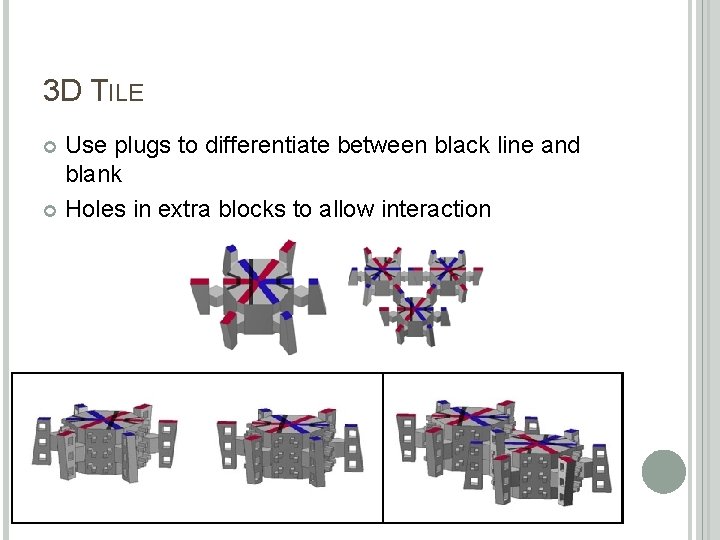
3 D TILE Use plugs to differentiate between black line and blank Holes in extra blocks to allow interaction
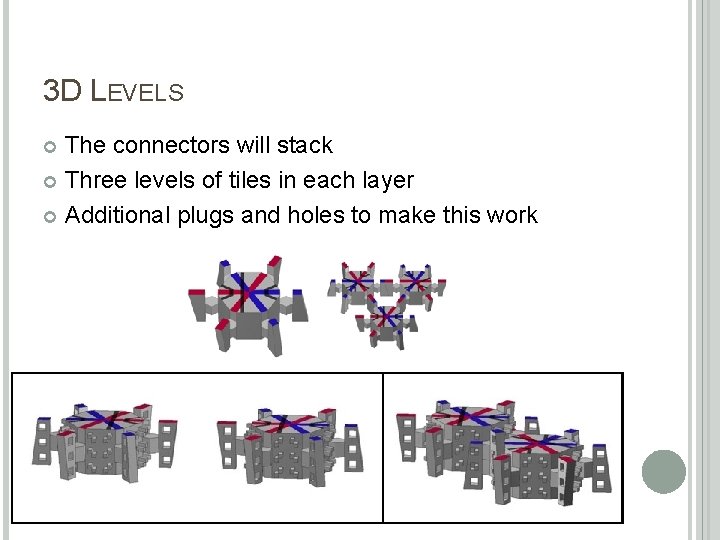
3 D LEVELS The connectors will stack Three levels of tiles in each layer Additional plugs and holes to make this work
APERIODICITY Tile is still aperiodic in each layer The layers can be periodically stacked Want to enforce aperiodicity in third dimension There are two possible ways to do this � Force a non-periodic stack such that each layer can still tile correctly � Rotate each layer an irrational amount
APERIODIC STACK No one-dimensional tilings are defined by shape Can only enforce aperiodicity between tiles that are in contact Not all tiles in the stack can be in contact Could define it by substitution
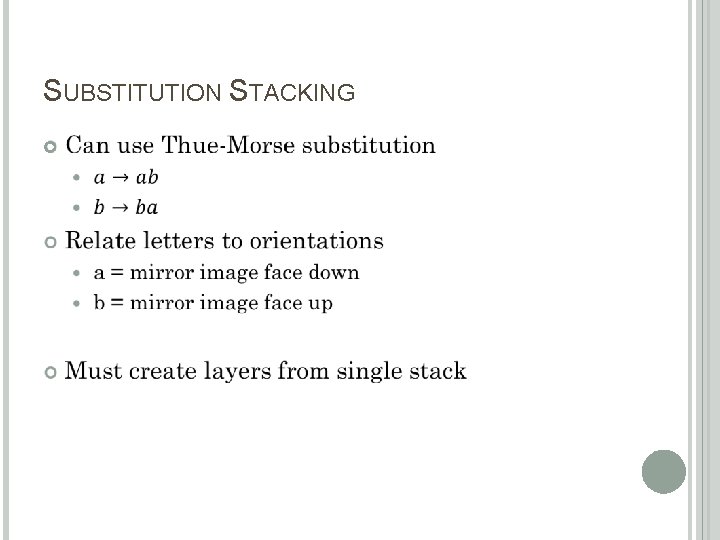
SUBSTITUTION STACKING
2 D APERIODIC TILINGS Could try to find two dimensional tiling defined by shape to incorporate into third dimension Would need to change the non-hexagonal faces Every two non-hexagonal faces meet Must be indistinguishable Regular repetition of hexagons Negates the aperiodicity
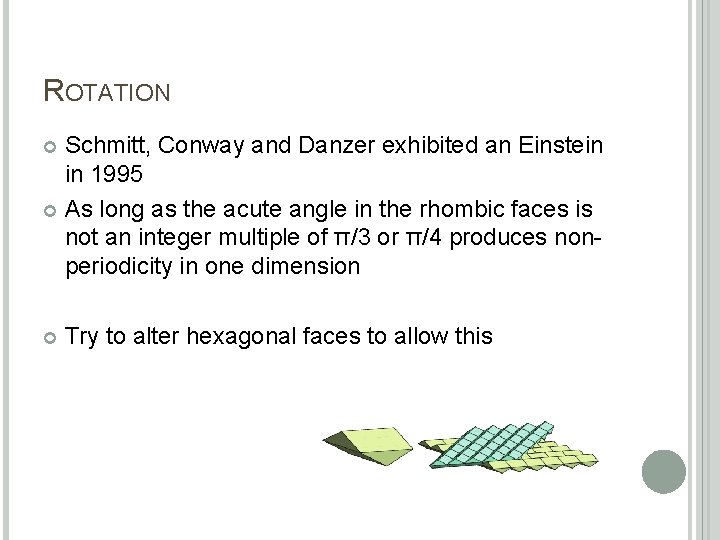
ROTATION Schmitt, Conway and Danzer exhibited an Einstein in 1995 As long as the acute angle in the rhombic faces is not an integer multiple of π/3 or π/4 produces nonperiodicity in one dimension Try to alter hexagonal faces to allow this
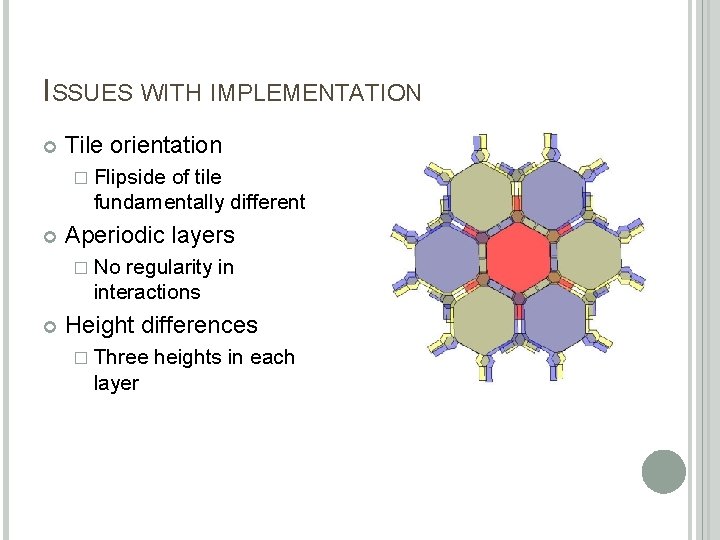
ISSUES WITH IMPLEMENTATION Tile orientation � Flipside of tile fundamentally different Aperiodic layers � No regularity in interactions Height differences � Three heights in each layer
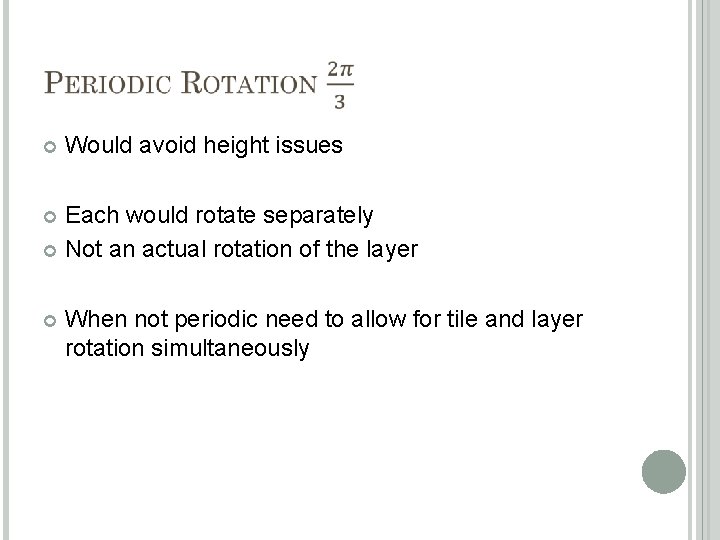
Would avoid height issues Each would rotate separately Not an actual rotation of the layer When not periodic need to allow for tile and layer rotation simultaneously
CONCLUSION Cannot improve on Socolar and Taylor’s tile Will always have issues, different depending on choice of representation May be impossible to create true 2 D or 3 D Einstein � Not enough variation in 2 D � Odd number of dimensions in 3 D May be possible in four dimensions

ARE THERE ANY QUESTIONS?
- Slides: 20